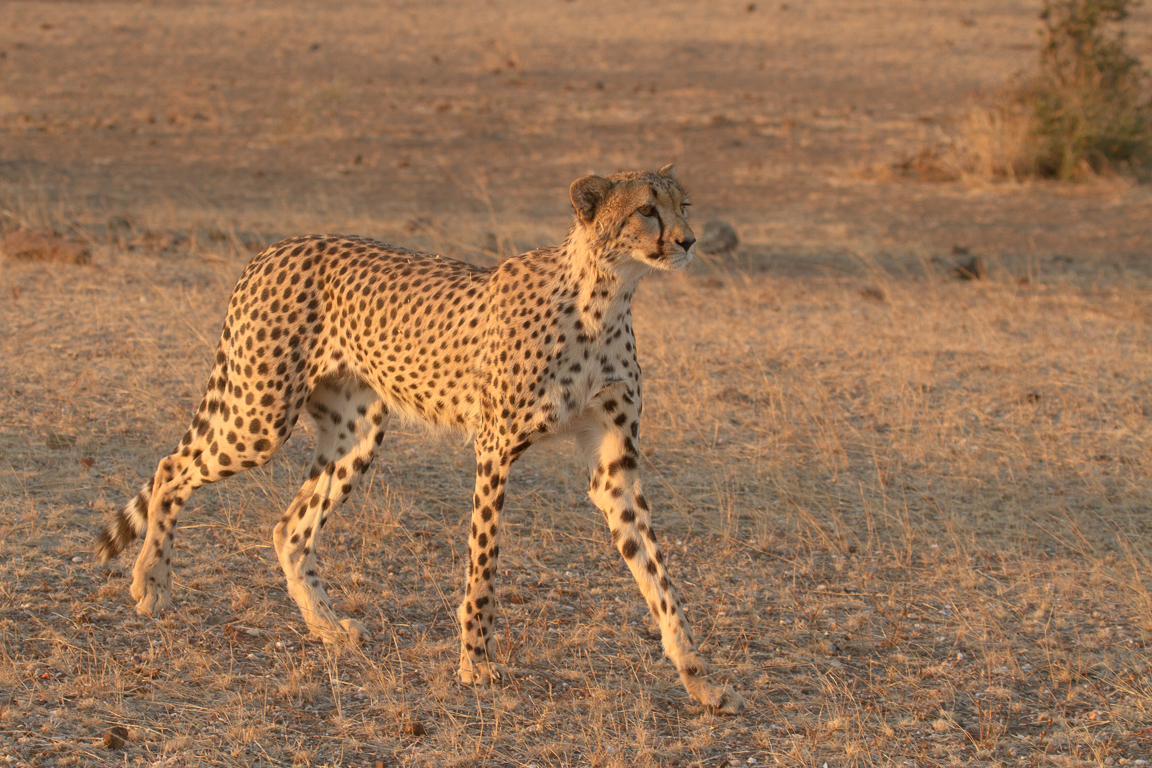
Acinonyx jubatus (Schreber, 1775)

Cheetah


Species recognized by The Integrated Taxonomic Information System external link, T Orrell (custodian) in 
IUCN Red List Status: Vulnerable (VU) external link Showing: scientific names

Media Center Navigation


Acinonyx jubatus (Schreber, 1775)

Images


Choose images

Acinonyx jubatus
Acinonyx jubatus
Acinonyx jubatus
Acinonyx jubatus
Acinonyx jubatus (Schreber, 1775)
Acinonyx jubatus
Acinonyx jubatus
Acinonyx jubatus (Schreber, 1775)
Acinonyx jubatus

Page navigation

Page 1 Next


Overview

Biology

Source and Additional Information
Supplier
Location
Citation

With the exception of the lion (Panthera leo), the cheetah is more gregarious than the other big cats; siblings stay together for around 6 months after leaving their mother (3), and brothers will often remain together for life (2). In the Serengeti, where the majority of research has been undertaken, male coalitions are common and around a third of the time these include unrelated males (2). It is thought that males benefit from living in groups by being able to obtain and keep territories, which in turn allows them greater access to females (2). Apart from when they have young, females are solitary and non-territorial, occupying vast home ranges as large as 800km2 (2). Females are sexually mature at around 24 months and can give birth throughout the year. At 3-4 cubs, the litter size is larger than that of the other big cats (3). The cubs are nursed in a lair amongst a rocky outcrop or within tall grasses, and until they are around 8 weeks old, the female must leave them alone whist she hunts (2). The death rate of young cheetahs is high and they are at risk from predation by lions, hyenas and even baboons (3). Cheetahs are the fastest land mammal and use their speed to run-down their prey. Observing from a vantage point, an individual will pick off an antelope at the edge of the herd, stalk and then give chase (6). Cheetahs are able to maintain a speed of up to 87 kilometres an hour for 200-300 metres, before bringing the prey to the ground and then lunging for the throat (3). The carcass is devoured quickly as cheetahs are often displaced from their kills by the more aggressive carnivores of the plains; medium sized antelope such as Thomson's gazelle (Gazella thomsoni) make up the majority of the diet (6).
Katja Schulz. Curator. "Acinonyx jubatus (Schreber, 1775)". Encyclopedia of Life, available from "http://www.eol.org/pages/328680". Accessed 19 Mar 2010.