Overview

Distribution

Sphagnum lindbergii Schimp.:
Brazil (South America)
Greenland (North America)
Canada (North America)
United States (North America)
Creative Commons Attribution Non Commercial Share Alike 3.0 (CC BY-NC-SA 3.0)

© Missouri Botanical Garden, 4344 Shaw Boulevard, St. Louis, MO 63110 USA

Source: Missouri Botanical Garden

Trusted

Article rating from 0 people

Average rating: 2.5 of 5

National Distribution

Canada

Origin: Unknown/Undetermined

Regularity: Regularly occurring

Currently: Unknown/Undetermined

Confidence: Confident

United States

Origin: Unknown/Undetermined

Regularity: Regularly occurring

Currently: Unknown/Undetermined

Confidence: Confident

Creative Commons Attribution Non Commercial 3.0 (CC BY-NC 3.0)

© NatureServe

Source: NatureServe

Trusted

Article rating from 0 people

Average rating: 2.5 of 5

Physical Description

Morphology

Comments

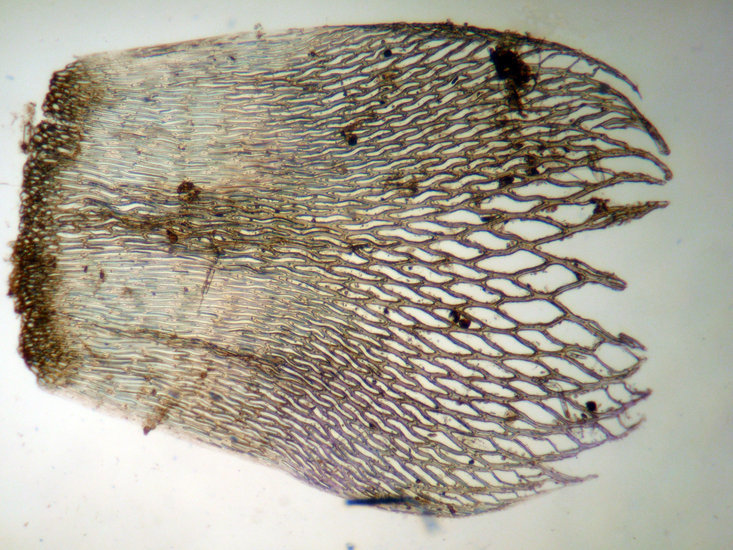
Sporophytes are uncommon. Sphagnum lindbergii is normally easily distinguished from other carpet-forming species of sect. Cuspidata by its large, strongly lacerate stem leaf and dark brown to black stem. Sexual condition is taken from from L. I. Savicz-Lubitzkaya and Z. N. Smirnova (1968).
Creative Commons Attribution Non Commercial Share Alike 3.0 (CC BY-NC-SA 3.0)

© Missouri Botanical Garden, 4344 Shaw Boulevard, St. Louis, MO, 63110 USA

Source: Missouri Botanical Garden

Trusted

Article rating from 0 people

Average rating: 2.5 of 5

Description

Plants moderate-sized to large, moderately densely branched; green to brown, often bluish tinged and/or shiny when dry; capitulum flattopped with a conspicuous terminal bud. Stems dark brown; superficial cortex of 2-4 layers of enlarged, thin-walled cells. Stem leaves lingulate-spatulate, large, 1.3-1.6 mm; appressed to stem; apex very broad and lacerate; hyaline cells efibrillose and aporose, often septate. Branches strongly 5-ranked and straight. Branch fascicles with 2 spreading and 2 pendent branches, leaves not much elongated at distal end. Branch stems green, with cortex enlarged with retort cells. Branch leaves ovate-lanceolate, 1.5-3 mm; straight to slightly subsecund; imbricate to somewhat reflexed and not undulate; margins entire; hyaline cells long and narrow, length to width ca. 10:1 on convex surface with 1 or more small pores in the cell ends and angles and often with numerous pseudopores along the margins, on concave surface with large round wall thinnings on the cell ends and angles; chlorophyllous cells triangular to trapezoidal in transverse section, apex often exposed on concave surface. Sexual condition monoicous or dioicous. Spores 22-34 µm; both surfaces smooth, apparent ridged border on proximal surface; proximal laesura more than 0.5 spore radius.
  • Flora of North America @ eFloras.org
Creative Commons Attribution Non Commercial Share Alike 3.0 (CC BY-NC-SA 3.0)

© Missouri Botanical Garden, 4344 Shaw Boulevard, St. Louis, MO, 63110 USA

Source: Missouri Botanical Garden

Trusted

Article rating from 0 people

Average rating: 2.5 of 5

Conservation

Conservation Status

NatureServe Conservation Status

Rounded Global Status Rank: G5 - Secure

Creative Commons Attribution Non Commercial 3.0 (CC BY-NC 3.0)

© NatureServe

Source: NatureServe

Trusted

Article rating from 0 people

Average rating: 2.5 of 5

National NatureServe Conservation Status

Canada

Rounded National Status Rank: NNR - Unranked

United States

Rounded National Status Rank: NNR - Unranked

Creative Commons Attribution Non Commercial 3.0 (CC BY-NC 3.0)

© NatureServe

Source: NatureServe

Trusted

Article rating from 0 people

Average rating: 2.5 of 5

Disclaimer

EOL content is automatically assembled from many different content providers. As a result, from time to time you may find pages on EOL that are confusing.

To request an improvement, please leave a comment on the page. Thank you!