Overview

Comprehensive Description

Syrphidae (Hover Flies, Flower Flies, Syrphid Flies, Drone Flies)
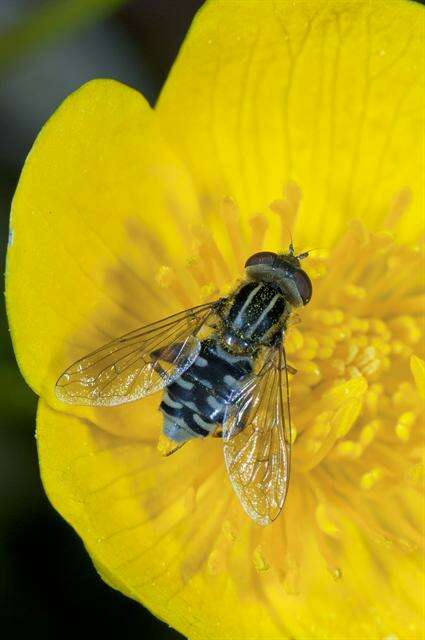
These are small to medium-sized flies that can hover motionless in the air. They usually mimic bees or wasps, often with black and yellow stripes along the abdomen. The proboscis is short, therefore Syrphid flies tend to visit smaller flowers with short nectar tubes in sunny places. At larger flowers, some Syrphid flies feed on stray pollen, while other species are attracted to salty perspiration. These latter species are sometimes called "Sweat Bees," which is a misnomer. Depending on the species, the larvae feed on aphids and other insects, or they may scavenge for dead animal material in moist soil, or they may feed in water that is rich in organic decomposition. There are numerous species in this family. As a group, Syrphid flies are probably the most common and important pollinators of prairie wildflowers among the various families of flies.

Trusted

Article rating from 0 people

Average rating: 2.5 of 5

Distribution

Geographic Range

This family of flies is found all over the world, and there are thousands of species. Nobody knows exactly how many species there are in Michigan or in the whole Great Lakes region, but it is probably more than 150.

Biogeographic Regions: nearctic (Native ); palearctic (Native ); oriental (Native ); ethiopian (Native ); neotropical (Native ); australian (Native ); oceanic islands (Introduced )

Creative Commons Attribution Non Commercial Share Alike 3.0 (CC BY-NC-SA 3.0)

© The Regents of the University of Michigan and its licensors

Source: Animal Diversity Web

Trusted

Article rating from 0 people

Average rating: 2.5 of 5

Physical Description

Morphology

Physical Description

Adult flies of many species in this family are mimics of bees or wasps. They are mostly black with yellow or orange stripes. A few others are brown, or metallic green or blue (these may also be mimics of bees). They have large eyes and short mouthparts formed into a tube with a sponge at the end. Their bodies may be slim or stout and are sometimes flattened top-to-bottom. Some species wag they abdomens up and down when they land. Like all flies they only have two wings, their hind wings are reduced (see More Information about True Flies for more).

Larvae are more variable. They are all legless and headless, but some aquatic species have long breathing tubes on their hind ends, some have tough skins, some look like little slugs. Color varies from white to brown to green.

Range length: 4.0 to 25.0 mm.

Other Physical Features: ectothermic ; bilateral symmetry

Sexual Dimorphism: sexes alike; female larger

Creative Commons Attribution Non Commercial Share Alike 3.0 (CC BY-NC-SA 3.0)

© The Regents of the University of Michigan and its licensors

Source: Animal Diversity Web

Trusted

Article rating from 0 people

Average rating: 2.5 of 5

Ecology

Habitat

Adult Flower Flies are found (surprise!) around flowers. They are also found near places where their larvae might live and feed and this is variable (see below).

Flower Fly larvae live in many different types of habitats. Some live in still or slow-moving freshwater, some live in decaying wood, some live in dung, some on plants, and some in the nests of other insects.

Habitat Regions: temperate ; tropical ; polar ; terrestrial ; freshwater

Terrestrial Biomes: tundra ; taiga ; desert or dune ; chaparral ; forest ; rainforest ; scrub forest ; mountains

Aquatic Biomes: lakes and ponds; rivers and streams

Wetlands: marsh ; swamp ; bog

Creative Commons Attribution Non Commercial Share Alike 3.0 (CC BY-NC-SA 3.0)

© The Regents of the University of Michigan and its licensors

Source: Animal Diversity Web

Trusted

Article rating from 0 people

Average rating: 2.5 of 5

Trophic Strategy

Food Habits

Adult flower flies feed on nectar from flowers and from aphid "honeydew" (see Aphididae).

The larvae of different species feed on different kinds of food. Some feed on decaying, damp plant material, on fungi or on green plants, some on the bulbs of plants in the lily family, some in dung. Many are aquatic and live in shallow freshwater (sometimes in water that seems foul and polluted), some in water-filled treeholes. Some species are scavengers in the nests of ants or wasps. Some of the most amazing are predators on slow-moving, soft-skinned insects like Aphididae. These predators have no eyes and no legs, but they still hunt and eat these little insects.

Creative Commons Attribution Non Commercial Share Alike 3.0 (CC BY-NC-SA 3.0)

© The Regents of the University of Michigan and its licensors

Source: Animal Diversity Web

Trusted

Article rating from 0 people

Average rating: 2.5 of 5

Associations

Animal / parasitoid
larva of Campocraspedon caudatus is parasitoid of aphidivorous larva of Syrphidae
Remarks: Other: uncertain

Animal / parasitoid
larva of Diplazontinae is parasitoid of (mostly aphidivorous) larva of Syrphidae
Other: major host/prey

In Great Britain and/or Ireland:
Animal / parasitoid
larva of Phthorima compressa is parasitoid of aphidivorous larva of Syrphidae
Remarks: Other: uncertain

Animal / predator
pitcher of Sarracenia flava is predator of adult of Syrphidae
Remarks: captive: in captivity, culture, or experimentally induced
Other: major host/prey

Animal / predator
larva of Syrphidae is predator of larva of Gastrophysa viridula

Plant / pollenated
adult of Syrphidae pollenates or fertilises flower of Orchis militaris

Animal / predator
nymph of Troilus luridus is predator of larva of Syrphidae

Animal / parasitoid
larva of Tymmophorus rufiventris is parasitoid of aphidivorous larva of Syrphidae
Remarks: Other: uncertain

Animal / parasitoid
larva of Woldstedtius biguttatus is parasitoid of aphidivorous larva of Syrphidae

Trusted

Article rating from 0 people

Average rating: 2.5 of 5

Ecosystem Roles

Flower Flies are imporant pollinators of many flowers. Their larvae help clean up and break down dead plants, and feed on micro-organisms.

Ecosystem Impact: pollinates

Creative Commons Attribution Non Commercial Share Alike 3.0 (CC BY-NC-SA 3.0)

© The Regents of the University of Michigan and its licensors

Source: Animal Diversity Web

Trusted

Article rating from 0 people

Average rating: 2.5 of 5

Predation

Adult flower flies rely on their high-speed flight and their similarity to stinging insects to avoid or discourage many predators. Larvae hide in muck and mud, and some live only in small treeholes where there are not very many predators. The species that live in nests of ants and wasps have adjusted their scent so they don't smell like food, and they stay out of the way of the other insects as much as they can.

Known Predators:

  • Anura (eat adults)
  • Testudines (eat aquatic larvae)
  • Cyprinus carpio and Pimephales notatus (eat aquatic larvae)
  • Araneae, especially flower spiders (eat adults)
  • mantids (eat adults)
  • water boatmen (eat aquatic larvae)
  • Hymenoptera (eat larvae)
  • Coccinellidae (eat eggs)
  • Chrysopidae (eat eggs)
  • Hirudinea (eat aquatic larvae)
  • Malacostraca

Creative Commons Attribution Non Commercial Share Alike 3.0 (CC BY-NC-SA 3.0)

© The Regents of the University of Michigan and its licensors

Source: Animal Diversity Web

Trusted

Article rating from 0 people

Average rating: 2.5 of 5

Known prey organisms

Syrphidae (syrphid larvae) preys on:
Sericothrips variabilis

Based on studies in:
USA: Illinois (Agricultural)

This list may not be complete but is based on published studies.
  • M. A. Mayse and P. W. Price, 1978. Seasonal development of soybean arthropod communities in east central Illinois. Agro-Ecosys. 4:387-405, from p. 402.
Creative Commons Attribution 3.0 (CC BY 3.0)

© SPIRE project

Source: SPIRE

Trusted

Article rating from 0 people

Average rating: 2.5 of 5

Life History and Behavior

Behavior

Communication and Perception

These flies find each other by sight, sound, and maybe scent. They have good wide-angle vision to find each other and watch out for predators. They can continue to make vibration noise by moving structures in their thorax even when they are not moving or flapping their wings.

Creative Commons Attribution Non Commercial Share Alike 3.0 (CC BY-NC-SA 3.0)

© The Regents of the University of Michigan and its licensors

Source: Animal Diversity Web

Trusted

Article rating from 0 people

Average rating: 2.5 of 5

Life Cycle

Development

Flower Flies have complete metamorphosis, see More Information under True Flies for the basic fly life cycle. In cold climates they spend the winter as larvae or pupae.

Development - Life Cycle: metamorphosis

Creative Commons Attribution Non Commercial Share Alike 3.0 (CC BY-NC-SA 3.0)

© The Regents of the University of Michigan and its licensors

Source: Animal Diversity Web

Trusted

Article rating from 0 people

Average rating: 2.5 of 5

Life Expectancy

Lifespan/Longevity

Most Flower Flies live a year or less, but some aquatic species that live in cold climates may survive as larvae for several years before metamorphosing into adults.

Creative Commons Attribution Non Commercial Share Alike 3.0 (CC BY-NC-SA 3.0)

© The Regents of the University of Michigan and its licensors

Source: Animal Diversity Web

Trusted

Article rating from 0 people

Average rating: 2.5 of 5

Reproduction

After mating, female flies lay their eggs in habitat suitable to their offspring's needs.

Breeding season: Spring to Fall

Key Reproductive Features: iteroparous ; seasonal breeding ; sexual ; fertilization (Internal ); oviparous

There is no parental care in this family.

Parental Investment: no parental involvement

Creative Commons Attribution Non Commercial Share Alike 3.0 (CC BY-NC-SA 3.0)

© The Regents of the University of Michigan and its licensors

Source: Animal Diversity Web

Trusted

Article rating from 0 people

Average rating: 2.5 of 5

Molecular Biology and Genetics

Molecular Biology

Statistics of barcoding coverage

Barcode of Life Data Systems (BOLD) Stats
                                        
Specimen Records:15,691Public Records:872
Specimens with Sequences:13,066Public Species:442
Specimens with Barcodes:10,696Public BINs:200
Species:2,096         
Species With Barcodes:1,660         
          
Creative Commons Attribution 3.0 (CC BY 3.0)

© Barcode of Life Data Systems

Source: Barcode of Life Data Systems (BOLD)

Trusted

Article rating from 0 people

Average rating: 2.5 of 5

Barcode data

Creative Commons Attribution 3.0 (CC BY 3.0)

© Barcode of Life Data Systems

Source: Barcode of Life Data Systems (BOLD)

Trusted

Article rating from 0 people

Average rating: 2.5 of 5

Locations of barcode samples

Collection Sites: world map showing specimen collection locations for Syrphidae

Creative Commons Attribution 3.0 (CC BY 3.0)

© Barcode of Life Data Systems

Source: Barcode of Life Data Systems (BOLD)

Trusted

Article rating from 0 people

Average rating: 2.5 of 5

Conservation

Conservation Status

No Flower Fly species are currently known to be endangered.

Creative Commons Attribution Non Commercial Share Alike 3.0 (CC BY-NC-SA 3.0)

© The Regents of the University of Michigan and its licensors

Source: Animal Diversity Web

Trusted

Article rating from 0 people

Average rating: 2.5 of 5

Relevance to Humans and Ecosystems

Benefits

Economic Importance for Humans: Negative

A few species of Flower Flies have larvae that damage bulbs or green plants that are valuable to humans. They are not a major agricultural pest, but they do sometimes cause damage.

Negative Impacts: crop pest

Creative Commons Attribution Non Commercial Share Alike 3.0 (CC BY-NC-SA 3.0)

© The Regents of the University of Michigan and its licensors

Source: Animal Diversity Web

Trusted

Article rating from 0 people

Average rating: 2.5 of 5

Economic Importance for Humans: Positive

These flies can be important pollinators, and some species feed on aphids that are pests.

Positive Impacts: pollinates crops; controls pest population

Creative Commons Attribution Non Commercial Share Alike 3.0 (CC BY-NC-SA 3.0)

© The Regents of the University of Michigan and its licensors

Source: Animal Diversity Web

Trusted

Article rating from 0 people

Average rating: 2.5 of 5

Wikipedia

Hoverfly

Hoverflies, sometimes called flower flies or syrphid flies, make up the insect family Syrphidae. As their common name suggests, they are often seen hovering or nectaring at flowers; the adults of many species feed mainly on nectar and pollen, while the larvae (maggots) eat a wide range of foods. In some species, the larvae are saprotrophs, eating decaying plant and animal matter in the soil or in ponds and streams. In other species, the larvae are insectivores and prey on aphids, thrips, and other plant-sucking insects.

Aphids alone cause tens of millions of dollars of damage to crops worldwide every year; because of this, aphidophagous hoverflies are being recognized as important natural enemies of pests, and potential agents for use in biological control. Some adult syrphid flies are important pollinators.

About 6,000 species in 200 genera have been described. Hoverflies are common throughout the world and can be found on all continents except Antarctica. Hoverflies are harmless to most other animals despite their mimicry of more dangerous wasps and bees, which serves to ward off predators.

Contents

Description

Characteristic wing venation of the Syrphidae

The size of hoverflies varies, depending on the species.[1] Some, like members of the genus Baccha, are small, elongate and slender, while others, like members of Criorhina are large, hairy, and yellow and black. As members of Diptera, all hoverflies have a single functional pair of wings (the hindwings are reduced to balancing organs).[2] They are brightly colored, with spots, stripes, and bands of yellow or brown covering their bodies.[2] Due to this coloring, they are often mistaken for wasps or bees; they exhibit Batesian mimicry. Despite this, hoverflies are harmless.[1]

With a few exceptions (e.g.[3]), hoverflies are distinguished from other flies by a spurious vein, located parallel to the fourth longitudinal wing vein.[1] Adults feed mainly on nectar and pollen.[2] They also hover around flowers, lending to their common name.[1]

Reproduction and life cycle

Two Simosyrphus grandicornis mating in midair

Unlike adults, the maggots of hoverflies feed on a variety of foods; some are saprotrophs, eating decaying plant or animal matter, while others are insectivores, eating aphids, thrips, and other plant-sucking insects.[1] This is beneficial to gardens, as aphids destroy crops, and hoverfly maggots are often used in biological control. Certain species, such as Lampetia equestris or Eumerus tuberculatus, are responsible for pollination.

An example of a well-known hoverfly maggot is the rat-tailed maggot, of the drone fly, Eristalis tenax. It has a breathing siphon at its rear end, giving it its name.[1] The species lives in stagnant water, such as sewage and lagoons.[4] The maggots also have a commercial use, and are sometimes sold for ice fishing.[5]

On occasion, Hoverfly larvae have been known to cause accidental myiasis in humans. This occurs when the larva are accidentally ingested on food or from other sources. Myiasis causes discomfort, pain, or itching,[4][6] however, Hoverflies do not normally prey upon humans and cases of myiasis from Hoverflies is very rare.

Distribution and habitat

Hoverflies are a cosmopolitan family found in most biomes, except deserts, tundra at extremely high latitudes, and Antarctica.[7][8] Certain species are more common in certain areas than others; for example, the American hoverfly, Eupeodes americanus, is common in the Nearctic ecozone, and the common hoverfly, Melangyna viridiceps, is common in the Australasia ecozone. About 6,000 species and 200 genera are in the family.[9]

Larvae of hoverflies are often found in stagnant water. Adults are often found near plants, their principal food source being nectar and pollen.[2] Some species are found in more unusual locations; for example, members of the genus Volucella can be found in bumblebee nests, while members of Microdon are myrmecophiles, found in ant or termite nests.[1] Others can be found in decomposing vegetation.

Systematics

See Genera of Syrphidae.

Relationship with people

Many species of hoverfly larvae prey upon pest insects, including aphids and the leafhoppers, which spread some diseases such as curly top. Therefore, they are seen in biocontrol as a natural means of reducing the levels of pests.

Gardeners, therefore, will sometimes use companion plants to attract hoverflies. Those reputed to do so include alyssum, Iberis umbellata, statice, buckwheat, chamomile, parsley, and yarrow.

Identification guides

  • Stubbs, A.E. and Falk, S.J. (2002) British Hoverflies An Illustrated Identification Guide. Pub. 1983 with 469 pages, 12 col plates, b/w illus.British Entomological and Natural History Society [ISBN 1-899935-05-3]. 276 species are described with extensive keys to aid identification. 190 species are displayed on the colour plates. 2nd edition, pub. 2002, includes new British species and name changes. Also includes European species which are likely to be found in Britain. There are additional black & white plates illustrating the male genitalia of the difficult genera Cheilosia and Sphaerophoria.
  • Vockeroth, J.R. A revision of the genera of the Syrphini (Diptera: Syrphidae) Memoirs of the Entomological Society of Canada, no. 62:1-176. Keys subfamilies, tribes and genera on a world basis and under regions.
  • van Veen, M.P. |(2004) "Hoverflies of Northwest Europe, Identification Keys to the Syrphidae". KNNV Publishing, Utrecht. [ISBN 9050111998]

Regional Lists

See also

References

  1. ^ a b c d e f g "Hover fly". Encyclopædia Britannica Online. 2009. Retrieved December 5, 2009. 
  2. ^ a b c d "Hoverfly". Hutchinson Encyclopedia. Helicon Publishing. 2009. Retrieved December 6, 2009. 
  3. ^ Reemer, Menno (2008). "Surimyia, a new genus of Microdontinae, with notes on Paragodon Thompson, 1969 (Diptera, Syrphidae)" (PDF). Zoologische Mededelingen 82: 177–188. 
  4. ^ a b Aguilera A, Cid A, Regueiro BJ, Prieto JM, Noya M (September 1999). "Intestinal myiasis caused by Eristalis tenax". Journal of Clinical Microbiology 37 (9): 3082. PMC 85471. PMID 10475752. 
  5. ^ Dictionary of Ichthyology; Brian W. Coad and Don E. McAllister at ww.briancoad.com
  6. ^ Whish-Wilson PB (2000). "A possible case of intestinal myiasis due to Eristalis tenax". The Medical Journal of Australia 173 (11–12): 652. PMID 11379520. 
  7. ^ Barkemeyer, Werner. "Syrphidae (hoverflies)". Biodiversity Explorer. South Africa: Iziko Museum. Retrieved December 11, 2009. 
  8. ^ Thompson, F. Christian (August 19, 1999). "Flower Flies". The Diptera Site. United States Department of Agriculture. Retrieved December 11, 2009. 
  9. ^ Philip J. Scholl, E. Paul Catts & Gary R. Mullen (2009). "Myiasis (Muscoidea, Oestroidea)". In Gary Mullen, Gary Richard Mullen & Lance Durden. Medical and Veterinary Entomology (2nd ed.). Academic Press. pp. 309–338. ISBN 978-0-12-372500-4. 
Creative Commons Attribution Share Alike 3.0 (CC BY-SA 3.0)


Source: Wikipedia

Unreviewed

Article rating from 0 people

Average rating: 2.5 of 5

List of the flower flies of North America

There are more than 870 species[1] of flower fly (Syrphidae) in North America .[2] The following is an attempt at a comprehensive North American list of this family of insects.

Contents

Family Syrphidae

Subfamily Syrphinae

Tribe Bacchini

Genus Baccha Fabricius
Genus Melanostoma Schiner
Genus Platycheirus Lepeletier & Serville

70 species [1]

Tribe Paragini

Genus Paragus Latreille

Tribe Pipizini

Genus Pipiza Fallén
Genus Heringia Róndani
Genus Trichopsomyia Williston

Tribe Syrphini

Genus Allograpta Osten Sacken

5 species [1]

Genus Chrysotoxum Meigen

10 species [2]

Genus Dasysyrphus Enderlein

7 species [2]

Genus Didea Macquart

2 species [2]

Genus Doros Meigen
Genus Epistrophe Walker
Genus Epistrophella
Genus Eriozona Schiner
Genus Eupeodes Osten Sacken
Genus Lapposyrphus
Genus Leucozona Schiner
Genus Melangyna Verrall
Genus Meligramma Frey
Genus Meliscaeva Frey
Genus Ocyptamus Macquart

14 species [2]

Genus Parasyrphus Matsumura
Genus Pseudodoros Matsumura
Genus Salpingogaster Schiner
Genus Scaeva
Genus Sphaerophoria

13 species [1]

Genus Syrphus

11 species [1]

Genus Xanthogramma

Tribe Toxomerini

Genus Toxomerus

17 species [1]

Subfamily Microdontinae

Genus Microdon

29 species [1]

Subfamily Eristalinae

Tribe Brachyopini

Genus Brachyopa

14 species

Genus Chrysogaster
Genus Chrysosyrphus
Genus Myolepta

7 species

Genus Neoascia
Genus Orthonevra
Genus Sphegina

[3]

Tribe Callicerini

Genus Callicera

Tribe Cerioidini

Genus Ceriana

Includes Monoceromyia, Polybiomyia and Sphiximorpha

Tribe Eristalini

Genus Eristalinus
Genus Eristalis
Genus Helophilus

10 species [1]

Genus Lejops
Genus Mallota

11 species [1]

Genus Meromacrus
Genus Myathropa
Genus Palpada
Genus Parhelophilus

Tribe Sericomyini

Genus Sericomyia

11 species [1]

Genus Pyritis

Tribe Merodontini

Genus Eumerus
Genus Merodon
Genus Nausigaster

Tribe Milesini

Genus Blera
Genus Brachypalpus
Genus Chalcosyrphus
Genus Criorhina

14 species [1]

Genus Cynorhinella
Genus Hadromyia
Genus Merapoides
Genus Milesia

3 species [1]

Genus Palumbia
Genus Pocota
Genus Pterallastes
Genus Somula
Genus Sphecomyia

8 species [1]

Genus Spilomyia

11 species [1]

Genus Syritta
Genus Temnostoma

10 species [1]

Genus Teuchocnemis
Genus Tropidia

8 species [1]

Genus Xylota

29 species [1]

Tribe Rhingiini

Genus Chamaesyrphus
Genus Cheilosia
Genus Ferdinandea
Genus Rhingia
Genus Hiatomyia

Tribe Volucellini

Genus Copestylum

39 species [1]

Genus Ornidia
Genus Volucella

References

  1. ^ a b c d e f g h i j k l m n o p q r s t u Kaufman Field Guide to Insects of North America (Kaufman Field Guides) – Eric R. Eaton; Kenn Kaufman
  2. ^ a b c d e Vockeroth, J. R. (1992). The Flower Flies of the Subfamily Syrphinae of Canada, Alaska, and Greenland (Diptera: Syrphidae). Part 18. The Insects and Arachnids of Canada. Canadian Government Pub Centre. pp. 1–456. ISBN 0-660-13830-1.
  3. ^ Coovert, G. C.; Thompson F. C. (1977). "The Sphegina species of Eastern North America (Diptera: Syrphidae)" (PDF). Proceedings of the Biological Society of Washington 90: 536–552. http://si-pddr.si.edu/jspui/bitstream/10088/17073/1/ent_FCT_30.pdf.
  4. ^ a b Thompson, F. Christian (1997). "Revision of the Eristalis flower flies (Diptera: Syrphidae) of the Americas south of the United States." (PDF). Proceedings of the Entomological Society of Washington (Washington D.C.: Entomological Society of Washington) 99: 209–237. ISSN 0013-8797. http://entomology.si.edu/StaffPages/ThompsonFC/1997_Eristalis.pdf. Retrieved 2009-06-19.
Creative Commons Attribution Share Alike 3.0 (CC BY-SA 3.0)


Source: Wikipedia

Unreviewed

Article rating from 0 people

Average rating: 2.5 of 5

Disclaimer

EOL content is automatically assembled from many different content providers. As a result, from time to time you may find pages on EOL that are confusing.

To request an improvement, please leave a comment on the page. Thank you!