IUCN threat status:

Not evaluated

Comprehensive Description

Read full entry


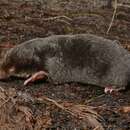
The family Talpidae consists of moles and desmans; currently, its approximately 42 species are grouped into 17 genera. Talpids can be found throughout most of North America and Eurasia. Around 2/3 of the members of this family are at least partially fossorial, digging underground tunnels in which they live and forage on subterranean invertebrates (some also eat plant parts). Others are aquatic (desmans) or forage on the surface (Asian shrew-moles, Uropsilus). Fossorial moles have evolved notable specializations for their underground lifestyle. Their bodies are fusiform, the eyes are tiny (and sometimes covered by skin), the legs are short, and external ears are lacking. The forelimbs are rotated such that the elbows point dorsally and the palms of the front feet face posteriorly. This orientation lends power to their digging strokes. In addition, the forelimbs are short and strong and terminate in formidable claws. The fur of moles is velvety and can lie equally well in any direction, which allows easy movement in the burrows backward as well as forwards.


Most talpids have a flattened skull with a long and narrow rostrum. Sutures between cranial bones fuse early. The zygomatic arches are complete, and auditory bullae are present. The modifications of the pectoral girdle and forearm to achieve the orientation and power described above are extreme in some species of moles; the humerus, for example, is broader than long and almost unrecognizable due to the elaboration of surfaces for the attachment of muscles. A short and broad clavicle is present.


The dental formula of talpids is 2-3/1-3, 1/0--1, 3-4/3-4, 3/3 = 33-44. The molars are dilambdodont.


Desmans and some moles are aquatic; that is, they are skilled swimmers that live near the water and eat aquatic invertebrates and small fish that they catch underwater. Desmans have webbed feet and a very unusual flexible snout that is used to probe for food at the bottoms of lakes, streams, or ponds. There are only two species of desmans, one lives in Asia and the other in Europe, and both are endangered.


Like shrews, moles have relatively high metabolic rates and insatiable appetites. They are active at all times of the day and night. While they can be found in a wide variety of habitats, they seem to prefer moist soils that are easy to burrow in.


Fossil talpids are known from as early as the Eocene.


    Technical characters 


  References and literature cited: 


Nowak, R.M., and J.L. Paradiso. 1983. Walker's Mammals of the World, 4th ed., Vol. I. Baltimore, Johns Hopkins University Press.


Gorman, M.L., and R.D. Stone. 1990. The Natural History of Moles. Ithaca, New York, Comstock Publishing Associates.


Vaughan, T.A. 1972. Mammalogy. Philadelphia, W.B. Saunders Co.


Yates, T. L. 1984. Insectivores, elephant shrews, tree shrews, and dermopterans. Pp. 117-144 in Anderson, S. and J. K. Jones, Jr. (eds). Orders and Families of Recent Mammals of the World. John Wiley and Sons, N.Y. xii+686 pp.


Trusted

Creative Commons Attribution Non Commercial Share Alike 3.0 (CC BY-NC-SA 3.0)

© The Regents of the University of Michigan and its licensors

Supplier: Animal Diversity Web

Belongs to 0 communities

This taxon hasn't been featured in any communities yet.

Learn more about Communities

Disclaimer

EOL content is automatically assembled from many different content providers. As a result, from time to time you may find pages on EOL that are confusing.

To request an improvement, please leave a comment on the page. Thank you!