Ecology

Associations

Known predators

Geomyidae (gopher) is prey of:
Bubo virginianus
Mustelinae
Canis latrans
Mephitinae
Taxidea taxus
Gulo gulo
Ursus arctos
Strigiformes
Accipitridae
Lynx rufus
Vulpes vulpes
Asio otus
Tyto alba
Buteo regalis
Buteo swainsoni

Based on studies in:
Canada: Manitoba (Forest)
USA: California, Cabrillo Point (Grassland)
USA: Montana (Tundra)

This list may not be complete but is based on published studies.
  • R. D. Bird, Biotic communities of the Aspen Parkland of central Canada, Ecology, 11:356-442, from p. 410 (1930).
  • L. D. Harris and L. Paur, A quantitative food web analysis of a shortgrass community, Technical Report No. 154, Grassland Biome. U.S. International Biological Program (1972), from p. 17.
  • D. L. Pattie and N. A. M. Verbeek, Alpine birds of the Beartooth Mountains, Condor 68:167-176 (1966); Alpine mammals of the Beartooth Mountains, Northwest Sci. 41(3):110-117 (1967).
Creative Commons Attribution 3.0 (CC BY 3.0)

© SPIRE project

Source: SPIRE

Trusted

Article rating from 0 people

Average rating: 2.5 of 5

Known prey organisms

Geomyidae (gopher) preys on:
Microtus ochrogaster
Helianthus
Agropyron
Agrostis
Stipa
alpine vegetation
Bouteloua gracilis
Kochia
Sphaeralcea coccinea
Psoralidium tenuiflorum
Hesperostipa comata
Aristida purpurea
Sporobolus cryptandrus
Pascopyrum smithii

Atriplex canescens
Opuntia macrorhiza

Based on studies in:
Canada: Manitoba (Forest)
USA: California, Cabrillo Point (Grassland)
USA: Montana (Tundra)

This list may not be complete but is based on published studies.
  • R. D. Bird, Biotic communities of the Aspen Parkland of central Canada, Ecology, 11:356-442, from p. 410 (1930).
  • L. D. Harris and L. Paur, A quantitative food web analysis of a shortgrass community, Technical Report No. 154, Grassland Biome. U.S. International Biological Program (1972), from p. 17.
  • D. L. Pattie and N. A. M. Verbeek, Alpine birds of the Beartooth Mountains, Condor 68:167-176 (1966); Alpine mammals of the Beartooth Mountains, Northwest Sci. 41(3):110-117 (1967).
Creative Commons Attribution 3.0 (CC BY 3.0)

© SPIRE project

Source: SPIRE

Trusted

Article rating from 0 people

Average rating: 2.5 of 5

Evolution and Systematics

Functional Adaptations

Functional adaptation

Paws excavate burrows: pocket gopher
 

The front paws of pocket gophers are used to excavate burrows because they are large and powerful, with curved claws.

   
  "A pocket gopher tunnels through the soil in search of roots and bulbs to eat. Note the huge front paws and powerful fingers ending in strong curved claws for digging. A small animal, it can excavate burrows hundreds of metres long." (Foy and Oxford Scientific Films 1982:178)
  Learn more about this functional adaptation.
  • Foy, Sally; Oxford Scientific Films. 1982. The Grand Design: Form and Colour in Animals. Lingfield, Surrey, U.K.: BLA Publishing Limited for J.M.Dent & Sons Ltd, Aldine House, London. 238 p.
Creative Commons Attribution Non Commercial 3.0 (CC BY-NC 3.0)

© The Biomimicry Institute

Source: AskNature

Trusted

Article rating from 0 people

Average rating: 2.5 of 5

Molecular Biology and Genetics

Barcode

Locations of barcode samples

Collection Sites: world map showing specimen collection locations for Geomyidae
Creative Commons Attribution 3.0 (CC BY 3.0)

© Barcode of Life Data Systems

Source: Barcode of Life Data Systems (BOLD)

Trusted

Article rating from 0 people

Average rating: 2.5 of 5

Statistics of barcoding coverage

Barcode of Life Data Systems (BOLD) Stats
                                                             
Specimen Records:394
Specimens with Sequences:301
Specimens with Barcodes:299
Public Records:101
Species:26
Species With Barcodes:26
  
Creative Commons Attribution 3.0 (CC BY 3.0)

© Barcode of Life Data Systems

Source: Barcode of Life Data Systems (BOLD)

Trusted

Article rating from 0 people

Average rating: 2.5 of 5

Barcode data

Creative Commons Attribution 3.0 (CC BY 3.0)

© Barcode of Life Data Systems

Source: Barcode of Life Data Systems (BOLD)

Trusted

Article rating from 0 people

Average rating: 2.5 of 5

Wikipedia

Pocket gopher

The pocket gophers are burrowing rodents of the family Geomyidae. These are the "true" gophers, though several ground squirrels of the family Sciuridae are often called gophers as well. The name "pocket gopher" on its own may be used to refer to any of a number of subspecies of the family.

Contents

Distribution

Pocket gophers are widely distributed in North America, extending into Central America.

Appearance

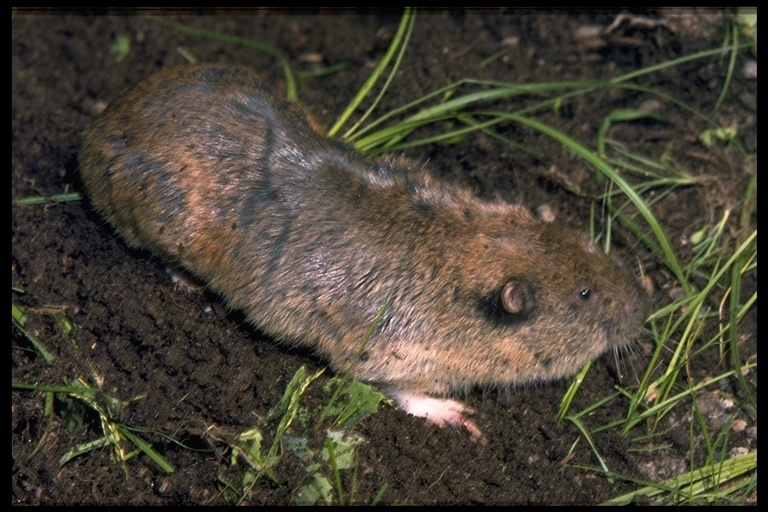
Gophers are heavily built, and most are 12 to 30 cm (4.7 to 12 in) long, weighing a few hundred grams. A few species reach weights approaching 1 kg (2.2 lb). Within any species, the males are larger than the females and can be nearly double their weight.[1] Most gophers have brown fur that often closely matches the color of the soil in which they live. Their most characteristic features are their large cheek pouches, from which the word "pocket" in their name derives. These pouches are fur-lined, and can be turned inside out. They extend from the side of the mouth well back onto the shoulders. They have small eyes and a short, hairy tail, which they use to feel around tunnels when they walk backwards.

Behavior

All pocket gophers are burrowers. They are larder hoarders, and their cheek pouches are used for transporting food back to their burrows. Gophers can collect large hoards. Their presence is unambiguously announced by the appearance of mounds of fresh dirt about 20 cm (7.9 in) in diameter. These mounds will often appear in vegetable gardens, lawns, or farms, as gophers like moist soil (see Soil biomantle). They also enjoy feeding on vegetables. For this reason, some species are considered agricultural pests. They may also damage trees in forests. Although they will attempt to flee when threatened, they may attack other animals, including cats and humans, and can inflict serious bites with their long, sharp teeth.

Pocket gophers are solitary outside of the breeding season, aggressively maintaining territories that vary in size depending on the resources available. Males and females may share some burrows and nesting chambers if their territories border each other, but in general, each pocket gopher inhabits its own individual tunnel system.

Depending on the species and local conditions, pocket gophers may have a specific annual breeding season, or may breed repeatedly through the year. Each litter typically consists of two to five young, although this may be much higher in some species. The young are born blind and helpless, and are weaned at around forty days.[2]

Classification

There has been much debate among taxonomists about which races of pocket gopher should be recognised as full species, and the following list cannot be regarded as definitive.

Some sources also list a genus Hypogeomys, with one species, but this genus name is normally used for the Malagasy Giant Rat, which belongs to the family Nesomyidae.

Control

Geomys spp and Thomomys spp are classed as "prohibited new organisms" under New Zealand's Hazardous Substances and New Organisms Act 1996 preventing it from being imported into the country.[3]

References

  1. ^ Macdonald (Ed), Professor David W. (2006). The Encyclopedia of Mammals. Oxford University Press. ISBN 0-19-920608-2. 
  2. ^ Patton, James (1984). Macdonald, D.. ed. The Encyclopedia of Mammals. New York: Facts on File. pp. 628–631. ISBN 0-87196-871-1. 
  3. ^ Hazardous Substances and New Organisms Act 2003 - Schedule 2 Prohibited new organisms, New Zealand Government, http://legislation.govt.nz/act/public/1996/0030/latest/DLM386556.html#DLM386556, retrieved 26 January 2012 
Creative Commons Attribution Share Alike 3.0 (CC BY-SA 3.0)


Source: Wikipedia

Unreviewed

Article rating from 0 people

Average rating: 2.5 of 5

Disclaimer

EOL content is automatically assembled from many different content providers. As a result, from time to time you may find pages on EOL that are confusing.

To request an improvement, please leave a comment on the page. Thank you!