Brief Summary
Read full entryFluorescent lures may serve to attract aerial prey
These carnivorous plants have been shown to exhibit UV to blue fluorescence. Fluorescence involves the absorption of light at one wavelength, followed by the release of the light energy at a different wavelength. In this case, light in the ultraviolet range (shorter than 400nm) is absorbed and re-emitted as blue light (430-480nm). (Kurup et al, 2013)
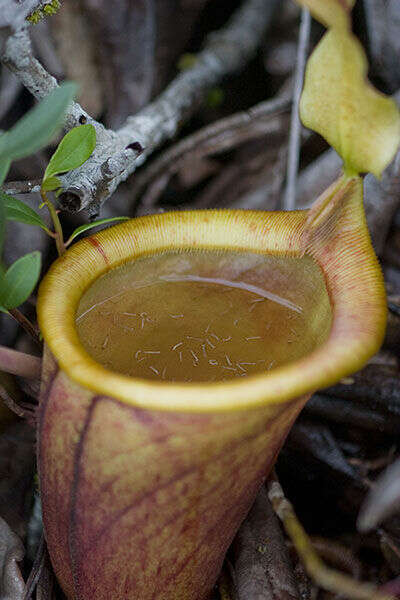
These plants probably make use of the blue light as an attractant to lure insect prey in flight overhead. Pitfall trap predators like Nepenthes and Sarracenia fluoresce from the peristome and lid, the portions near the entrance to the pitfall. Their pitcher fluid is also fluorescent. Dionaea muscipula, a snap-trap, captures prey by rapid closure of the leaves, and in this species the inner surface of the leaf traps show blue fluorescence. (Kurup et al, 2013)
Not all carnivorous plants appear to share this tactic. Drosera and Pinguicula, both flypaper-style traps, as well as Utricularia, a bladder trap, were tested in the same study and no blue fluorescence was found.
Trusted