Articles on this page are available in 1 other language: Dutch (2) (learn more)
Overview
Comprehensive Description
General Description
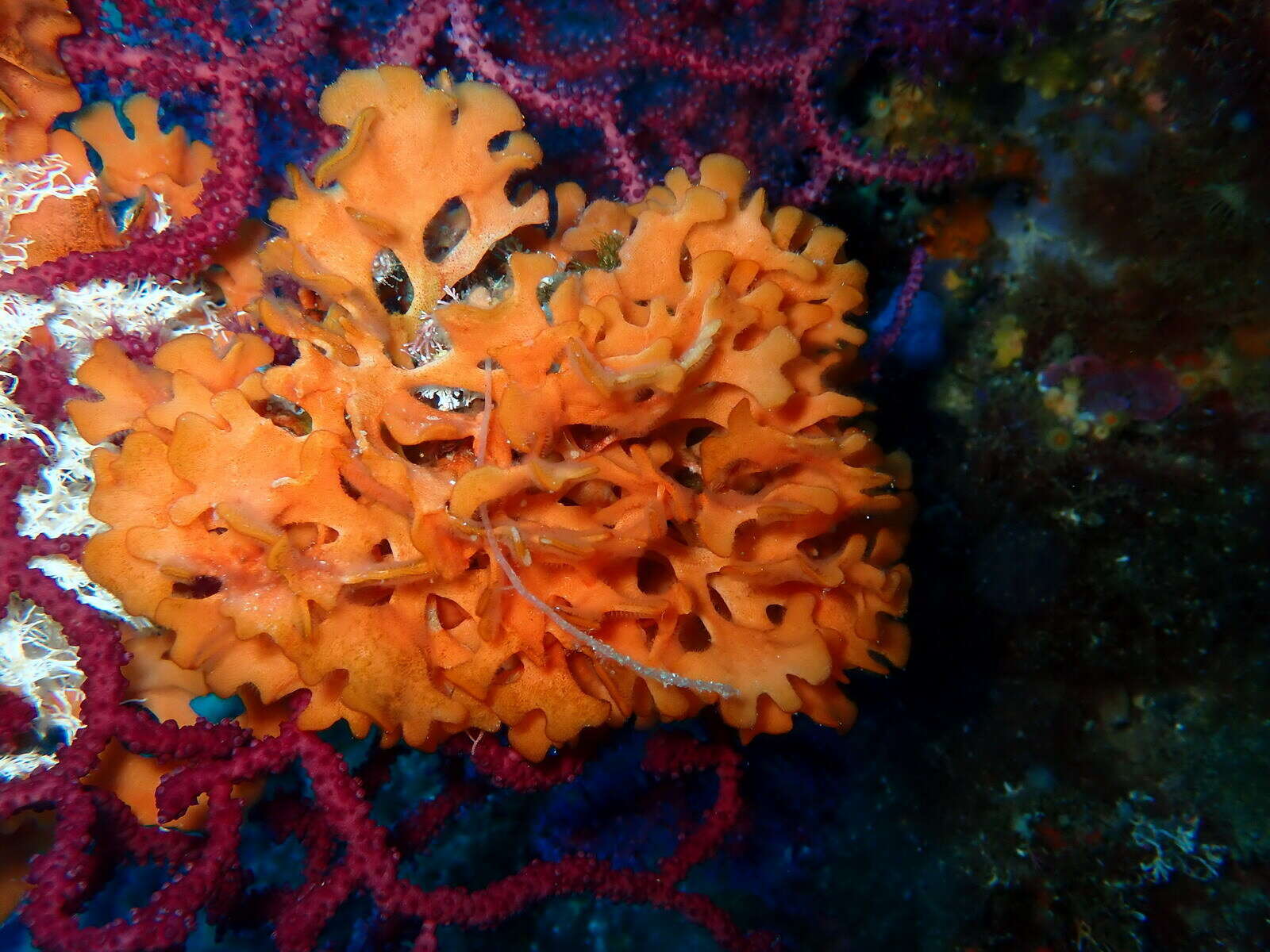
Pentapora fascialis is a large erect bryozoan, known from the Mediterranean. Colonies attach to the substrate via an extensive encrusting base and develop narrow strap-like branches. Colonies are deep orange in colour when alive, fading to a pale buff after death.
Trusted
General Description
Pentapora foliacea, commonly known as “Potato Crisp Bryozoan” or “Ross Coral” is the largest bryozoan inhabiting British waters. Colonies attach to the substrate via an extensive encrusting base and develop folded three-dimensional branching plates. Plates are composed of two layers of autozooids arranged back-to-back. Colonies are deep orange in colour when alive, fading to a pale buff after death. The species is found in the north-eastern Atlantic.
There is continuing disagreement about whether Pentapora foliacea and Pentapora fascialis are separate species, with the majority of the more recent work, up until Lombardi et al (2010), tending to regard P. foliacea as a junior synonym of P. fascialis. Lombardi et al (2010) again split the two species pending the results of molecular analysis, which is currently being undertaken
Trusted
Description
Trusted
Description
Trusted
Distribution
-
De Blauwe, Hans
http://www.marinespecies.org/aphia.php?p=sourcedetails&id=1071
-
Hayward, P.J. (2001). Bryozoa, in: Costello, M.J. et al. (Ed.) (2001). European register of marine species: a check-list of the marine species in Europe and a bibliography of guides to their identification. Collection Patrimoines Naturels, 50: pp. 325-333
http://www.marinespecies.org/aphia.php?p=sourcedetails&id=1369
-
De Blauwe, H. (2009). Mosdiertjes van de Zuidelijke Bocht van de Noordzee. Determinatiewerk voor België en Nederland. Uitgave Vlaams Instituut voor de Zee, Oostende: 464pp.
http://www.marinespecies.org/aphia.php?p=sourcedetails&id=130048
-
MEDIN (2011). UK checklist of marine species derived from the applications Marine Recorder and UNICORN, version 1.0.
http://www.marinespecies.org/asteroidea/aphia.php?p=sourcedetails&id=149081
-
Ramos, M. (ed.). 2010. IBERFAUNA. The Iberian Fauna Databank
http://www.marinespecies.org/aphia.php?p=sourcedetails&id=149024
Trusted
Pentapora fascialis is distributed throughout the Mediterranean, from the Strait of Gibraltar in the west to the Aegean in the east.
Trusted
Pentapora foliacea is distributed in the north-eastern Atlantic from St. Kilda south to the coast of Morocco. It is found in the English Channel as far east as Hastings. Mediterranean records require reassessment owing to the similarities of P. foliacea to Pentapora fascialis.
Trusted
Trusted
Physical Description
Size
Colonies are commonly 40 cm in diameter. Autozooids range in size from 0.67-0.93 by 0.28-0.44 mm.
Trusted
Diagnostic Description
Colonies developing erect, narrow, strap-like, bifurcating branches from an encrusting base. Early astogeny unknown.
Autozooids longer than wide, 0.68-1.28 mm long (mean 0.88 ± 0.13mm; N=20) by 0.32-0.54 wide (mean 0.42 ± 0.05 mm; N=20) in recent samples, 0.73-0.79 mm long (mean 0.75 ± 0.03 mm; N= 20) in Pliocene fossils, roughly rectangular in shapes, arranged quincuncially with distinct boundaries becoming obscured during later ontogeny. Frontal shield lepralioid, granular, with areolar pores and pseudopores, developing knobs as thickening increases during ontogeny. Primary orifice 0.17-0.25 mm long (mean 0.21 ± 0.02 mm; N=20) by 0.14- 0.21 mm wide (mean 0.18 ± 0.01 mm; N = 20) in recent material, 0.13-0.19 long (mean 0.17 ± 0.02 mm; N=20) by 0.11-0.17 mm wide (mean 0.15 ± 0.02; N=20) in Pliocene fossils, a pair of down turned condyles between anter and poster; secondary orifice slightly oval to trifoliate, following the development of lappets. Operculum brown, lustrous. Oral spines lacking in recent material, but very occasionally observed lateral to the orifice in Pliocene fossils. Basal walls with short median septum extending distally from transverse vertical walls. Ovicells globular or elliptical, wider than long, 0.19-0.25 mm long (mean 0.32 ± 0.03 mm; N=20) by 0.24-0.35 mm wide (mean 0.32 ± 0.03; N=20) wide, pores few scattered, becoming occluded by secondary calcification.
Avicularia dimorphic, adventitious, suboral proximally directed. Normal avicularia small, inclined at a high angle to frontal surface, longer than wide, 0.08-0.12 mm long (mean 0.09 ± 0.01 mm; N=10) by 0.07-0.09 mm wide (mean 0.08-0.003 mm; N=10) in recent material, 0.08-0.11 long (mean 0.09 ± 0.01 mm; N=10) by 0.07-0.09 mm wide (mean 0.08 ± 0.01; N=10) in Pliocene fossils; rostrum short, semielliptical; orifice 0.050 ± 0.005 mm long (N = 10) by 0.030 ± 0.007 mm wide (N = 10); crossbar averaging 0.050 ± 0.004 mm long (N = 10). Giant avicularia occasionally replacing normal avicularia; longer than wide, 0.29–0.42 mm long (mean 0.34 ± 0.07 mm; N = 5) by 0.17–0.20 mm wide (mean 0.11 ± 0.01 mm; N = 5) in recent material, 0.26–0.41 mm long (mean 0.32 ± 0.05 mm; N = 5) by 0.13–0.23 mm wide (mean 0.18 ± 0.05 mm; N = 5) in Pliocene fossils; rostrum spatulate, palate deep; orifice 0.13 ± 0.04 mm long by 0.070 ± 0.001 mm wide (N = 5); crossbar averaging 0.110 ± 0.001 mm long (N = 5).
Lombardi et al (2010)
Trusted
Colonies developing three-dimensional box-like growth comprising folded and anatomosing bilamellar plates from an extensive encrusting base. Early astogeny unknown.
Autozooids longer than wide, 0.67-0.93 mm long (mean 0.81 ± 0.09 mm; N= 20) by 0.28-0.44 mm wide (mean 0.36 ± 0.04 mm; N=20), roughly rectangular in shape, initially elongate, but becoming more equidimensional during ontogeny; arranged quincuncially; zooidal boundary walls salient. Frontal shield lepraliod, granular, with areolar pores and pseudopores, both becoming less distinct through wall thickening during ontogeny, which also obscures zooidal boundaries. Primary orifice 0.11-.020 mm long (mean 0.18 ± 0.2 mm; N=15) by 0.16-0.19 mm wide (mean 0.18 ± 0.01 mm; N=15), a pair of downturned condyles between anter and poster; secondary orifice slightly oval to trifoliate because of the development of lappets. Operculum brown, lustrous. No oral spines. Basal walls with short median septum extending distally from transverse wall. Multiporous septula in lateral and transverse vertical walls near their bases; circular to ovoidal, shallow muscle impressions may be visible close to septula. Ovicell elliptical, wider than long, 0.21-0.25 mm long (mean 0.23 ± 0.01 mm; N=20) by 0.27-0.35 mm wide (mean 0.31 ± 0.02; N=20), a few scattered pores arranged in a band proximally above orifice, becoming overgrown by secondary calcification.
Avicularia monomorphic, adventitious, suboral, usually placed on an umbo, inconspicuous, small, longer than wide, 0.09-0.11 mm long (mean 0.100 ± 0.005 mm; N=10) by 0.08-0.10 mm wide (0.090 ± 0.007 mm; N=10); rostrum semielliptical; orifice 0.050 ± 0.005 mm long by 0.030 ± 0.004 mm wide; crossbar averaging 0.060 ± 0.008 mm long. Giant avicularia not observed, presumed lacking.
(Lombardi et al., 2010)
Trusted
Ecology
Habitat
Water temperature and chemistry ranges based on 73 samples.
Environmental ranges
Depth range (m): 8.85 - 96
Temperature range (°C): 9.899 - 17.140
Nitrate (umol/L): 0.211 - 8.618
Salinity (PPS): 34.692 - 38.444
Oxygen (ml/l): 5.513 - 6.346
Phosphate (umol/l): 0.095 - 0.682
Silicate (umol/l): 1.247 - 5.963
Graphical representation
Depth range (m): 8.85 - 96
Temperature range (°C): 9.899 - 17.140
Nitrate (umol/L): 0.211 - 8.618
Salinity (PPS): 34.692 - 38.444
Oxygen (ml/l): 5.513 - 6.346
Phosphate (umol/l): 0.095 - 0.682
Silicate (umol/l): 1.247 - 5.963
Note: this information has not been validated. Check this *note*. Your feedback is most welcome.
Trusted
The species usually colonises boulders or bedrock, with small colonies occasionally found on kelp holdfasts. Pentapora fascialis is found in subtidal waters and is most common below 18 m and often abundant between 25-35 m.
Trusted
The species usually colonises boulders or bedrock, with small colonies occasionally found on kelp holdfasts. Pentapora foliacea is found in subtidal waters and is most common below 18 m and often abundant between 25-35 m.
Trusted
Trusted
Trusted
Disclaimer
EOL content is automatically assembled from many different content providers. As a result, from time to time you may find pages on EOL that are confusing.
To request an improvement, please leave a comment on the page. Thank you!