Overview
Distribution
-
Cherbonnier, G. (1988). Echinodermes: Holothurides. Faune de Madagascar 70.
http://www.marinespecies.org/aphia.php?p=sourcedetails&id=5997
-
Massin, C. (1999). Reef-dwelling Holothuroidea (Echinodermata) of the Spermonde Archipelago (South-West Sulawesi, Indonesia). Zoologische Verhandelingen 329, Leiden. 144 pp.
http://www.marinespecies.org/aphia.php?p=sourcedetails&id=6337
-
Clark, A.M. and J.D. Taylor. (1971). Echinoderms from Diego Garcia. Atoll Research Bulletin. 149: 89-92.
http://www.marinespecies.org/aphia.php?p=sourcedetails&id=6270
-
Conand, C. (1998). Holothurians. In F.A.O. species identification guide. The marine living resources of the Western Central Pacific. Vol 2 Cephalopods, crustaceans, holothurians and sharks, K. Carpenter & V. Niem eds.: 1157-1190.
http://www.marinespecies.org/aphia.php?p=sourcedetails&id=6370
-
Clark, A.M. and F.W.E. Rowe. (1971). Monograph of Shallow-water Indo-West Pacific Echinoderms. Trustees of the British Museum (Natural History): London. x + 238 p. + 30 pls.
http://www.marinespecies.org/ophiuroidea/aphia.php?p=sourcedetails&id=5916
Trusted
Physical Description
Diagnostic Description
Description
-
Cherbonnier, G. (1988). Echinodermes: Holothurides. Faune de Madagascar 70.
http://www.marinespecies.org/aphia.php?p=sourcedetails&id=5997
Trusted
Ecology
Habitat
Water temperature and chemistry ranges based on 127 samples.
Environmental ranges
Depth range (m): 2 - 15
Temperature range (°C): 25.567 - 28.552
Nitrate (umol/L): 0.033 - 0.206
Salinity (PPS): 34.133 - 35.083
Oxygen (ml/l): 4.497 - 4.643
Phosphate (umol/l): 0.067 - 0.214
Silicate (umol/l): 1.089 - 3.887
Graphical representation
Depth range (m): 2 - 15
Temperature range (°C): 25.567 - 28.552
Nitrate (umol/L): 0.033 - 0.206
Salinity (PPS): 34.133 - 35.083
Oxygen (ml/l): 4.497 - 4.643
Phosphate (umol/l): 0.067 - 0.214
Silicate (umol/l): 1.089 - 3.887
Note: this information has not been validated. Check this *note*. Your feedback is most welcome.
Trusted
Molecular Biology and Genetics
Molecular Biology
Barcode data: Bohadschia argus
There are 7 barcode sequences available from BOLD and GenBank. Below is a sequence of the barcode region Cytochrome oxidase subunit 1 (COI or COX1) from a member of the species. See the BOLD taxonomy browser for more complete information about this specimen and other sequences.
-- end --
Download FASTA File
Trusted
Statistics of barcoding coverage: Bohadschia argus
Public Records: 7
Specimens with Barcodes: 23
Species With Barcodes: 1
Trusted
Trusted
Wikipedia
Bohadschia argus
Bohadschia argus, the leopard sea cucumber, is a species of marine invertebrate in the family Holothuriidae. It is the type species of the genus Bohadschia; Jaeger, 1833.
Contents |
Description
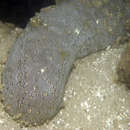
Bohadschia argus is sausage-shaped with a smooth, tough, leathery skin and can grow to 2 feet (0.61 m) in length. It is a greyish-brown colour, paler below, with distinctive dark eye-spots surrounded by white haloes. There are several rows of tube feet on the underside. Surrounding the mouth at the anterior end is a ring of paddle-shaped, black tentacles fringed with white. The anus, at the posterior end, has cuvierian tubules situated at its base which are readily ejected as sticky threads if the animal is disturbed or handled. These contain toxins which deter predators and are irritating to human skin.[2][3]
Distribution and habitat
Bohadschia argus is found in the Western Indian Ocean and the Pacific Ocean. Its range extends from Madagascar, the Seychelles and Sri Lanka to Malaysia and the South Pacific Islands.[4] It is found on coral reefs and on exposed, sandy areas of the seabed [2] at depths of between 10 feet (3.0 m) and 120 feet (37 m).[5]
Biology
Bohadschia argus is an omnivore. As it moves across the seabed, it sweeps sand grains and detritus into its mouth using its sticky tentacles. It obtains some nourishment from the biofilm that coats the grains.[3]
Ecology
Fish of the species Carapus mourlani are sometimes found living in the coelomic cavity of Bohadschia argus; the fish enter through the anus, either going in head first or more frequently tail first. In a study in the Banda Islands in the South Moluccan Sea, 15 individual fish were found to be inhabiting the body of one sea cucumber 40 centimetres (16 in) in length.[6]
The small emperor shrimp (Periclimenes imperator) is often associated with Bohadschia argus and may help keep it clear of ectoparasites.
Uses
A new triterpene glycoside, Arguside A, has been extracted from the tissues of Bohadschia argus. This compound appears to exhibit cytotoxicity against several different types of human tumour cells.[7]
References
- ^ Paulay, Gustav (2010). "Bohadschia argus Jaeger, 1833". World Register of Marine Species. http://www.marinespecies.org/aphia.php?p=taxdetails&id=210768. Retrieved 2012-01-19.
- ^ a b Bohadschia argus North Australian Sea Cucumbers. Retrieved 2012-01-18.
- ^ a b Bohadschia argus DiveGallery. Retrieved 2012-01-18.
- ^ Bohadschia genus WetWebMedia. Retrieved 2012-01-18.
- ^ Leopard sea cucumber Florent’s guide to the tropical reefs. Retrieved 2012-01-18.
- ^ Meyer-Rochow, VB (1977). "Comparison between 15 Caropus mourlani in a single Holothurian and 19 C. mourlani from starfish". Copeia 1977 (3): 582. JSTOR 1443286.
- ^ Liu, Bao-Shu et al. (2007). "Arguside A: A New Cytotoxic Triterpene Glycoside from the Sea Cucumber Bohadschia argus". Chemistry & Biodiversity 4 (12): 2845–2851. doi:10.1002/cbdv.200790234.
Unreviewed
Disclaimer
EOL content is automatically assembled from many different content providers. As a result, from time to time you may find pages on EOL that are confusing.
To request an improvement, please leave a comment on the page. Thank you!