Articles on this page are available in 1 other language: Spanish (1) (learn more)
Overview
Comprehensive Description
Comments
Trusted
Description
Trusted
Comments
Trusted
Description
Trusted
Distribution
-
Flora of China Editorial Committee. 2003. Fl. China 5: 1–506. Science Press & Missouri Botanical Garden Press, Beijing & St. Louis.
http://www.tropicos.org/Reference/1024907
Trusted
National Distribution
Canada
Origin: Exotic
Regularity: Regularly occurring
Currently: Unknown/Undetermined
Confidence: Confident
Trusted
National Distribution
Canada
Origin: Exotic
Regularity: Regularly occurring
Currently: Unknown/Undetermined
Confidence: Confident
United States
Origin: Unknown/Undetermined
Regularity: Regularly occurring
Currently: Unknown/Undetermined
Confidence: Confident
Trusted
Range and Habitat in Illinois
Trusted
Range and Habitat in Illinois
Trusted
Argentina (South America)
Belize (Mesoamerica)
Bolivia (South America)
Brazil (South America)
Bhutan (Asia)
Canada (North America)
Mexico (Mesoamerica)
Honduras (Mesoamerica)
Peru (South America)
Panama (Mesoamerica)
Chile (South America)
Gabon (Africa & Madagascar)
Costa Rica (Mesoamerica)
Guatemala (Mesoamerica)
Ecuador (South America)
Laos (Asia)
Nepal (Asia)
Japan (Asia)
French Guiana (South America)
United States (North America)
China (Asia)
Vietnam (Asia)
Suriname (South America)
Venezuela (South America)
-
Forzza, R. C. & et al. 2010. 2010 Lista de espécies Flora do Brasil. http://floradobrasil.jbrj.gov.br/2010/.
http://www.tropicos.org/Reference/100002289
-
Jørgensen, P. M. & C. Ulloa Ulloa. 1994. Seed plants of the high Andes of Ecuador---A checklist. AAU Rep. 34: 1–443.
http://www.tropicos.org/Reference/47124
-
Cowan, C. P. 1983. Flora de Tabasco. Listados Floríst. México 1: 1–123.
http://www.tropicos.org/Reference/511
-
Anonymous. 1986. List-Based Rec., Soil Conserv. Serv., U.S.D.A. Database of the U.S.D.A., Beltsville.
http://www.tropicos.org/Reference/1103
-
Voss, E. G. 1985. Michigan Flora. Part II Dicots (Saururaceae-Cornaceae). Bull. Cranbrook Inst. Sci. 59. xix + 724.
http://www.tropicos.org/Reference/1700
-
Renner, S. S., H. Balslev & L. B. Holm-Nielsen. 1990. Flowering plants of Amazonian Ecuador---A checklist. AAU Rep. 24: 1–241.
http://www.tropicos.org/Reference/43828
-
Molina Rosito, A. 1975. Enumeración de las plantas de Honduras. Ceiba 19(1): 1–118.
http://www.tropicos.org/Reference/866
-
Standley, P. C. & J. A. Steyermark. 1946. Amaranthaceae. In Standley, P.C. & Steyermark, J.A. (Eds), Flora of Guatemala - Part IV. Fieldiana, Bot. 24(4): 143–174.
http://www.tropicos.org/Reference/6387
-
Funk, V. A., P. E. Berry, S. Alexander, T. H. Hollowell & C. L. Kelloff. 2007. Checklist of the Plants of the Guiana Shield (Venezuela: Amazonas, Bolivar, Delta Amacuro; Guyana, Surinam, French Guiana). Contr. U.S. Natl. Herb. 55: 1–584.
http://www.tropicos.org/Reference/1033072
-
ORSTOM. 1988. List Vasc. Pl. Gabon Herbier National du Gabon, Yaounde.
http://www.tropicos.org/Reference/1671
-
Gleason, H. A. 1968. The Choripetalous Dicotyledoneae. vol. 2. 655 pp. In H. A. Gleason Ill. Fl. N. U.S. (ed. 3). New York Botanical Garden, New York.
http://www.tropicos.org/Reference/1704
-
Marticorena, C. & M. Quezada. 1985. Catálogo de la Flora Vascular de Chile. Gayana, Bot. 42: 1–157.
http://www.tropicos.org/Reference/1592
-
Serrano, M. & J. Teran. 2000. Identific. Esp. Veg. Chuquisaca 1–129. PLAFOR, Intercooperación, Fundación Ceibo, Sucre.
http://www.tropicos.org/Reference/1014273
-
Adolfo M., H. 1966. Nóm. Pl. Recol. Valle Cochabamba 2: 17–86. Colegio La Salle, Cochabamba.
http://www.tropicos.org/Reference/1018799
-
Eliasson, U. H. 1987. 44. Amaranthaceae. 28: 1–138. In G. W. Harling & B. B. Sparre (eds.) Fl. Ecuador. University of Göteborg and Swedish Museum of Natural history, Göteborg and Stockholm.
http://www.tropicos.org/Reference/26160
-
Nee, M. 2004. Magnoliidae, Hamamelidae y Caryophyllidae. 2: 1–209. In M. Nee Fl. Reg. Parque Nac. Amboró Bolivia. Editorial FAN, Santa Cruz.
http://www.tropicos.org/Reference/1029643
-
Ragonese, A. E. 1941. La vegetacion de la Provincia de Santa Fe (R. A.). Darwiniana 5: 369–416.
http://www.tropicos.org/Reference/282
-
Macbride, J. F. 1937. Amaranthaceae, Flora of Peru. Publ. Field Mus. Nat. Hist., Bot. Ser. 13(2/2): 478–518.
http://www.tropicos.org/Reference/1255
-
D'Arcy, W. G. 1987. Flora of Panama. Checklist and Index. Monogr. Syst. Bot. Missouri Bot. Gard. 17(1): i–xxx,.
http://www.tropicos.org/Reference/1289
-
Long, R. W. & O. K. Lakela. 1971. Fl. Trop. Florida i–xvii, 1–962. University of Miami Press, Coral Cables.
http://www.tropicos.org/Reference/1506
-
Correa A., M. D., C. Galdames & M. N. S. Stapf. 2004. Cat. Pl. Vasc. Panamá 1–599. Smithsonian Tropical Research Institute, Panama.
http://www.tropicos.org/Reference/1031911
-
Hokche, O., P. E. Berry & O. Huber. 2008. Nuev. Cat. Fl. Vas. Venezuela 1–860. Fundación Instituto Botánico de Venezuela, Caracas, Venezuela.
http://www.tropicos.org/Reference/1033110
-
Jørgensen, P. M. & S. León-Yánez. (eds.) 1999. Catalogue of the vascular plants of Ecuador. Monogr. Syst. Bot. Missouri Bot. Gard. 75: i–viii, 1–1181.
http://www.tropicos.org/Reference/42250
-
Breedlove, D. E. 1986. Flora de Chiapas. Listados Floríst. México 4: i–v, 1–246.
http://www.tropicos.org/Reference/513
-
Radford, A. E., H. E. Ahles & C. R. Bell. 1968. Man. Vasc. Fl. Carolinas i–lxi, 1–1183. University of North Carolina Press, Chapel Hill.
http://www.tropicos.org/Reference/636
-
Correll, D. S. & M. C. Johnston. 1970. Man. Vasc. Pl. Texas i–xv, 1–1881. The University of Texas at Dallas, Richardson.
http://www.tropicos.org/Reference/1493
-
Sousa Sánchez, M. & E. F. Cabrera Cano. 1983. Flora de Quintana Roo. Listados Floríst. México 2: 1–100.
http://www.tropicos.org/Reference/512
-
Small, J. K. 1933. Man. S.E. Fl. i–xxii, 1–1554. Published by the Author, New York.
http://www.tropicos.org/Reference/1515
-
Great Plains Flora Association. 1986. Fl. Great Plains i–vii, 1–1392. University Press of Kansas, Lawrence.
http://www.tropicos.org/Reference/637
-
Martínez Salas, E. M., M. Sousa Sánchez & C. H. Ramos Álvarez. 2001. Región de Calakmul, Campeche. Listados Floríst. México 22: 1–55.
http://www.tropicos.org/Reference/1018508
-
Hickman, J. C. 1993. Jepson Man.: Higher Pl. Calif. i–xvii, 1–1400. University of California Press, Berkeley.
http://www.tropicos.org/Reference/40453
-
López, R. P. 2000. La prepuna boliviana. Ecol. Bolivia 34: 45–70.
http://www.tropicos.org/Reference/1018607
-
Munz, P. A. & D. D. Keck. 1959. Cal. Fl. 1–1681. University of California Press, Berkeley.
http://www.tropicos.org/Reference/1717
-
Munz, P. A. 1974. Fl. S. Calif. 1–1086. University of California Press, Berkeley.
http://www.tropicos.org/Reference/1719
-
Burger, W. C. 1983. Family 64. Amaranthaceae. In: W. C. Burger (ed.), Flora Costaricensis. Fieldiana, Bot., n.s. 13: 142–180.
http://www.tropicos.org/Reference/2728
-
Pedersen, T. M. 1987. Amaranthaceae, Caryophyllaceae. In A. Burkart. 3: 160–203,. In A. Burkart Fl. Il. Entre Ríos. Instituto Nacional de Tecnología Agropecuaria, Buenos Aires.
http://www.tropicos.org/Reference/43373
-
Flora of China Editorial Committee. 2003. Fl. China 5: 1–506. Science Press & Missouri Botanical Garden Press, Beijing & St. Louis.
http://www.tropicos.org/Reference/1024907
-
Pérez, A., M. Sousa Sánchez, A. M. Hanan-Alipi, F. Chiang Cabrera & P. Tenorio L. 2005. Vegetación terrestre. 65–110. In Biodivers. Tabasco. CONABIO-UNAM, México.
http://www.tropicos.org/Reference/1030034
-
Novelo, A. & L. Ramos. 2005. Vegetación acuática. Cap. 5: 111–144. In Biodivers. Tabasco. CONABIO-UNAM, México.
http://www.tropicos.org/Reference/1030036
-
Balick, M. J., M. Nee & D. E. Atha. 2000. Checklist of the vascular plants of Belize. Mem. New York Bot. Gard. 85: i–ix, 1–246.
http://www.tropicos.org/Reference/1014725
Trusted
-
Ragonese. 1951. Revista Invest. Agríc. 5(1–2): 108.
http://www.tropicos.org/Reference/43751
-
Vervoorst. 1967. Inst. Bot. Agric. serie Fitogeogr. 7: 235.
http://www.tropicos.org/Reference/43992
-
Covas, G. 1941. Las Amarantáceas bonarienses. Darwiniana 5: 329–368.
http://www.tropicos.org/Reference/44033
Trusted
Gabon (Africa & Madagascar)
South Africa (Africa & Madagascar)
-
ORSTOM. 1988. List Vasc. Pl. Gabon Herbier National du Gabon, Yaounde.
http://www.tropicos.org/Reference/1671
-
Gibbs Russell, G. E., W. G. Welman, E. Reitief, K. L. Immelman, G. Germishuizen, B. J. Pienaar, M. v. Wyk & A. Nicholas. 1987. List of species of southern African plants. Mem. Bot. Surv. S. Africa 2(1–2): 1–152(pt. 1), 1–270(pt. 2).
http://www.tropicos.org/Reference/1371
Trusted
-
Foster, R. C. 1958. A catalogue of the ferns and flowering plants of Bolivia. Contr. Gray Herb. 184: 1–223.
http://www.tropicos.org/Reference/1313
-
Grisebach, A. 1879. Symbolae ad Floram argentinam. Abh. Königl. Ges. Wiss. Göttingen 24(1): 1–345.
http://www.tropicos.org/Reference/43319
-
Ball. 1884. J. Linn. Soc., Bot. 21: 235.
http://www.tropicos.org/Reference/43531
-
Bettfreund. 1901. Flora Argentina 3: 210.
http://www.tropicos.org/Reference/44026
Trusted
Physical Description
Morphology
Comments
Distribution of Amaranthus hybridus in North America needs clarification because the name was misapplied to other species, notably A. powellii, and specimens of A. retroflexus, A. powellii, and A. hybridus are frequently interchangeably misidentified. Forms of A. hybridus and A. powellii with reddish inflorescences are often misidentified as escaped and hence presumably naturalized, cultivated species A. caudatus Linnaeus, A. hypochondriacus Linnaeus, and A. cruentus Linnaeus.
Amaranthus hybridus is extremely variable. In particular, there are numerous North American specimens with subobtuse tepals and thick inflorescences, suggesting hybridization with A. retroflexus. In Europe such presumably hybrid forms are known as A. ×ozanonii Thellung (A. Thellung 1914-1919).
A new, presumably hybridogenous taxon, Amaranthus ×tucsonensis Henrickson, was recently described from Arizona (J. Henrickson 1999). It was suggested that one of its parents is A. hybridus; the other parental species (probably a species with obtuse or spatulate tepals) remains unknown. The problem of proper taxonomic position and origin of A. ×tucsonensis needs further study.
Trusted
Description
- Flora of China @ eFloras.org
Trusted
Description
- Flora of Pakistan @ eFloras.org
Trusted
Description
- Flora of China @ eFloras.org
Trusted
Description
- Flora of North America @ eFloras.org
Trusted
Ecology
Habitat
Habitat & Distribution
- Flora of China @ eFloras.org
Trusted
Habitat & Distribution
- Flora of China @ eFloras.org
Trusted
Habitat & Distribution
- Flora of North America @ eFloras.org
Trusted
Range and Habitat in Illinois
Trusted
Range and Habitat in Illinois
Trusted
Associations
Faunal Associations
Trusted
Faunal Associations
Trusted
Molecular Biology and Genetics
Molecular Biology
Statistics of barcoding coverage: Amaranthus hybridus L.
Public Records: 0
Species: 2
Species With Barcodes: 1
Trusted
Statistics of barcoding coverage: Amaranthus hybridus
Public Records: 7
Species: 16
Species With Barcodes: 1
Trusted
Conservation
Conservation Status
National NatureServe Conservation Status
Canada
Rounded National Status Rank: NNA - Not Applicable
Trusted
Relevance to Humans and Ecosystems
Benefits
Economic Uses
Comments: A black-seeded African diploid species, the probable wild form of A. hypochondriacus.
Trusted
Cultivation
Trusted
Cultivation
Trusted
Wikipedia
Amaranthus hybridus
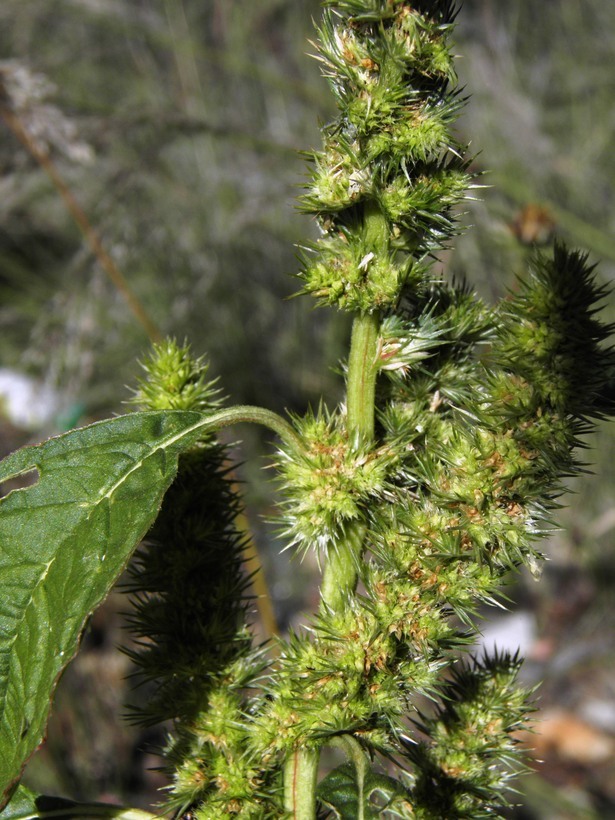
Amaranthus hybridus, commonly called smooth amaranth, smooth pigweed, red amaranth, or slim amaranth, is a species of annual flowering plant. It is a weedy species found now over much of North America and introduced into Europe and Eurasia.
Contents |
Description
A. hybridus grows from a short taproot and can be up to 2.5 m in height. It is a glabrous or glabrescent plant.
Distribution
A. hybridus was originally a pioneer plant in eastern North America. It has been reported to have been found in every state except Wyoming, Utah, and Alaska. It is also found in many provinces of Canada, and in parts of Mexico, the West Indies, Central America, and South America. It has been naturalized in many places of warmer climate. It grows in many different places, including disturbed habitats.
Taxonomy
It is extremely variable, and many other Amaranthus species are believed to be natural hybridizations or derive from A. hybridus.
As a weed
Although easily controlled and not particularly competitive, it is recognized as a harmful weed of North American crops. The plant was used for food and medicine by several Native American groups and in traditional African medicine.
References
- Jepson Manual Treatment
- Various images of green amaranth
- Scientific and taxonomic information
- Distribution and pictures
- Ethnobotany
- A. Davis, K. Renner, C. Sprague, L. Dyer, D. Mutch (2005). Integrated Weed Management. MSU.
| This Amaranthaceae article is a stub. You can help Wikipedia by expanding it. |
Unreviewed
Amaranthus chlorostachys
Amaranthus chlorostachys is a species of flowering plant. It has been suggested that it is a subspecies of Amaranthus hybridus. It is present in Pakistan.
References
| This Amaranthaceae article is a stub. You can help Wikipedia by expanding it. |
Unreviewed
Disclaimer
EOL content is automatically assembled from many different content providers. As a result, from time to time you may find pages on EOL that are confusing.
To request an improvement, please leave a comment on the page. Thank you!