Articles on this page are available in 1 other language: Spanish (1) (learn more)
Overview
Comprehensive Description
Description
-
Hilty, J. Editor. 2013. Illinois Wildflowers. World Wide Web electronic publication. flowervisitors.info, version 04/2013.
See: Botanical Terminology and Line Drawings, Ecological Terminology, Website Description, Links to Other Websites, Reference Materials
Trusted
Distribution
Range and Habitat in Illinois
-
Hilty, J. Editor. 2013. Illinois Wildflowers. World Wide Web electronic publication. flowervisitors.info, version 04/2013.
See: Botanical Terminology and Line Drawings, Ecological Terminology, Website Description, Links to Other Websites, Reference Materials
Trusted
Distribution in Egypt
Mountainous southern Sinai specially at St.Katherine.
Trusted
Global Distribution
East Mediterranean region, Sinai; widely cultivated in temperate and warm regions.
Trusted
Localities documented in Tropicos sources
Canada (North America)
Guatemala (Mesoamerica)
Honduras (Mesoamerica)
Panama (Mesoamerica)
United States (North America)
Note: This information is based on publications available through Tropicos and may not represent the entire distribution. Tropicos does not categorize distributions as native or non-native.
-
Standley, P. C. & J. A. Steyermark. 1949. Malvaceae. In Standley, P.C. & Steyermark, J.A. (Eds), Flora of Guatemala - P art VI. Fieldiana, Bot. 24(6): 324–386.
http://www.tropicos.org/Reference/6462
-
Voss, E. G. 1985. Michigan Flora. Part II Dicots (Saururaceae-Cornaceae). Bull. Cranbrook Inst. Sci. 59. xix + 724.
http://www.tropicos.org/Reference/1700
-
Molina Rosito, A. 1975. Enumeración de las plantas de Honduras. Ceiba 19(1): 1–118.
http://www.tropicos.org/Reference/866
-
Gleason, H. A. 1968. The Choripetalous Dicotyledoneae. vol. 2. 655 pp. In H. A. Gleason Ill. Fl. N. U.S. (ed. 3). New York Botanical Garden, New York.
http://www.tropicos.org/Reference/1704
-
Correa A., M. D., C. Galdames & M. N. S. Stapf. 2004. Cat. Pl. Vasc. Panamá 1–599. Smithsonian Tropical Research Institute, Panama.
http://www.tropicos.org/Reference/1031911
-
Radford, A. E., H. E. Ahles & C. R. Bell. 1968. Man. Vasc. Fl. Carolinas i–lxi, 1–1183. University of North Carolina Press, Chapel Hill.
http://www.tropicos.org/Reference/636
-
Correll, D. S. & M. C. Johnston. 1970. Man. Vasc. Pl. Texas i–xv, 1–1881. The University of Texas at Dallas, Richardson.
http://www.tropicos.org/Reference/1493
-
Great Plains Flora Association. 1986. Fl. Great Plains i–vii, 1–1392. University Press of Kansas, Lawrence.
http://www.tropicos.org/Reference/637
-
Munz, P. A. & D. D. Keck. 1959. Cal. Fl. 1–1681. University of California Press, Berkeley.
http://www.tropicos.org/Reference/1717
-
Munz, P. A. 1974. Fl. S. Calif. 1–1086. University of California Press, Berkeley.
http://www.tropicos.org/Reference/1719
-
D'Arcy, W. G. 1987. Flora of Panama. Checklist and Index. Part 1: The introduction and checklist. Monogr. Syst. Bot. Missouri Bot. Gard. 17: v–xxx, 1–328.
http://www.tropicos.org/Reference/1289
Trusted
Localities documented in Tropicos sources
Belize (Mesoamerica)
China (Asia)
Ecuador (South America)
Mexico (Mesoamerica)
United States (North America)
Colombia (South America)
Greece (Europe)
Note: This information is based on publications available through Tropicos and may not represent the entire distribution. Tropicos does not categorize distributions as native or non-native.
-
Jørgensen, P. M. & C. Ulloa Ulloa. 1994. Seed plants of the high Andes of Ecuador---A checklist. AAU Rep. 34: 1–443.
http://www.tropicos.org/Reference/47124
-
Anonymous. 1986. List-Based Rec., Soil Conserv. Serv., U.S.D.A. Database of the U.S.D.A., Beltsville.
http://www.tropicos.org/Reference/1103
-
Fryxell, P. A. 1988. Malvaceae of Mexico. Syst. Bot. Monogr. 25: 1–522.
http://www.tropicos.org/Reference/31284
-
Fryxell, P. A. 1992. 118. Malvaceae. 44: 1–141. In G. W. Harling & B. B. Sparre (eds.) Fl. Ecuador. University of Göteborg and Swedish Museum of Natural history, Göteborg and Stockholm.
http://www.tropicos.org/Reference/37532
-
McVaugh, R. 2001. Ochnaceae to Loasaceae. 3: 9–751. In R. McVaugh Fl. Novo-Galiciana. The University of Michigan, Ann Arbor.
http://www.tropicos.org/Reference/1019947
-
Fryxell, P. A. 1990. Malvaceae. 3: 1–90. In D. E. Breedlove Fl. Chiapas. California Academy of Sciences, San Francisco.
http://www.tropicos.org/Reference/47182
-
Jørgensen, P. M. & S. León-Yánez. (eds.) 1999. Catalogue of the vascular plants of Ecuador. Monogr. Syst. Bot. Missouri Bot. Gard. 75: i–viii, 1–1181.
http://www.tropicos.org/Reference/42250
-
Breedlove, D. E. 1986. Flora de Chiapas. Listados Floríst. México 4: i–v, 1–246.
http://www.tropicos.org/Reference/513
-
Balick, M. J., M. Nee & D. E. Atha. 2000. Checklist of the vascular plants of Belize. Mem. New York Bot. Gard. 85: i–ix, 1–246.
http://www.tropicos.org/Reference/1014725
-
Idárraga-Piedrahita, A., R. D. C. Ortiz, R. Callejas Posada & M. Merello. 2011. Flora de Antioquia. Catálogo de las Plantas Vasculares, vol. 2. Listado de las Plantas Vasculares del Departamento de Antioquia. Pp. 1-939.
http://www.tropicos.org/Reference/100008595
Trusted
Trusted
National Distribution
Canada
Origin: Exotic
Regularity: Regularly occurring
Currently: Unknown/Undetermined
Confidence: Confident
United States
Origin: Exotic
Regularity: Regularly occurring
Currently: Unknown/Undetermined
Confidence: Confident
Trusted
Physical Description
Morphology
Description
Trusted
Description
Trusted
Diagnostic Description
Synonym
Trusted
Ecology
Habitat
Range and Habitat in Illinois
-
Hilty, J. Editor. 2013. Illinois Wildflowers. World Wide Web electronic publication. flowervisitors.info, version 04/2013.
See: Botanical Terminology and Line Drawings, Ecological Terminology, Website Description, Links to Other Websites, Reference Materials
Trusted
Habitat & Distribution
Trusted
Associations
Faunal Associations
-
Hilty, J. Editor. 2013. Illinois Wildflowers. World Wide Web electronic publication. flowervisitors.info, version 04/2013.
See: Botanical Terminology and Line Drawings, Ecological Terminology, Website Description, Links to Other Websites, Reference Materials
Trusted
Agrobacterium tumefaciens causes gall of stem (esp. base) of Alcea rosea
Foodplant / internal feeder
larva of Apion radiolus feeds within stem of Alcea rosea
Foodplant / sap sucker
nymph of Campylomma verbasci sucks sap of Alcea rosea
In Great Britain and/or Ireland:
Foodplant / parasite
Golovinomyces orontii parasitises live Alcea rosea
Foodplant / parasite
Leveillula taurica parasitises Alcea rosea
Foodplant / sap sucker
Macrosiphum euphorbiae sucks sap of live shoot (young) of Alcea rosea
Foodplant / saprobe
immersed, gregarious, often in lines pycnidium of Phoma coelomycetous anamorph of Phoma nebulosa is saprobic on dead stem of Alcea rosea
Foodplant / gall
pulvinate, hypophyllous telium of Puccinia malvacearum causes gall of live bract of Alcea rosea
Remarks: season: 4-11
Other: major host/prey
Trusted
Life History and Behavior
Life Expectancy
Conservation
Conservation Status
National NatureServe Conservation Status
Canada
Rounded National Status Rank: NNA - Not Applicable
United States
Rounded National Status Rank: NNA - Not Applicable
Trusted
Management
-
Aeschimann, D. & C. Heitz. 2005. Synonymie-Index der Schweizer Flora und der angrenzenden Gebiete (SISF). 2te Auflage. Documenta Floristicae Helvetiae N° 2. Genève.
http://www.crsf.ch/
Trusted
Relevance to Humans and Ecosystems
Benefits
Cultivation
-
Hilty, J. Editor. 2013. Illinois Wildflowers. World Wide Web electronic publication. flowervisitors.info, version 04/2013.
See: Botanical Terminology and Line Drawings, Ecological Terminology, Website Description, Links to Other Websites, Reference Materials
Trusted
Wikipedia
Alcea rosea
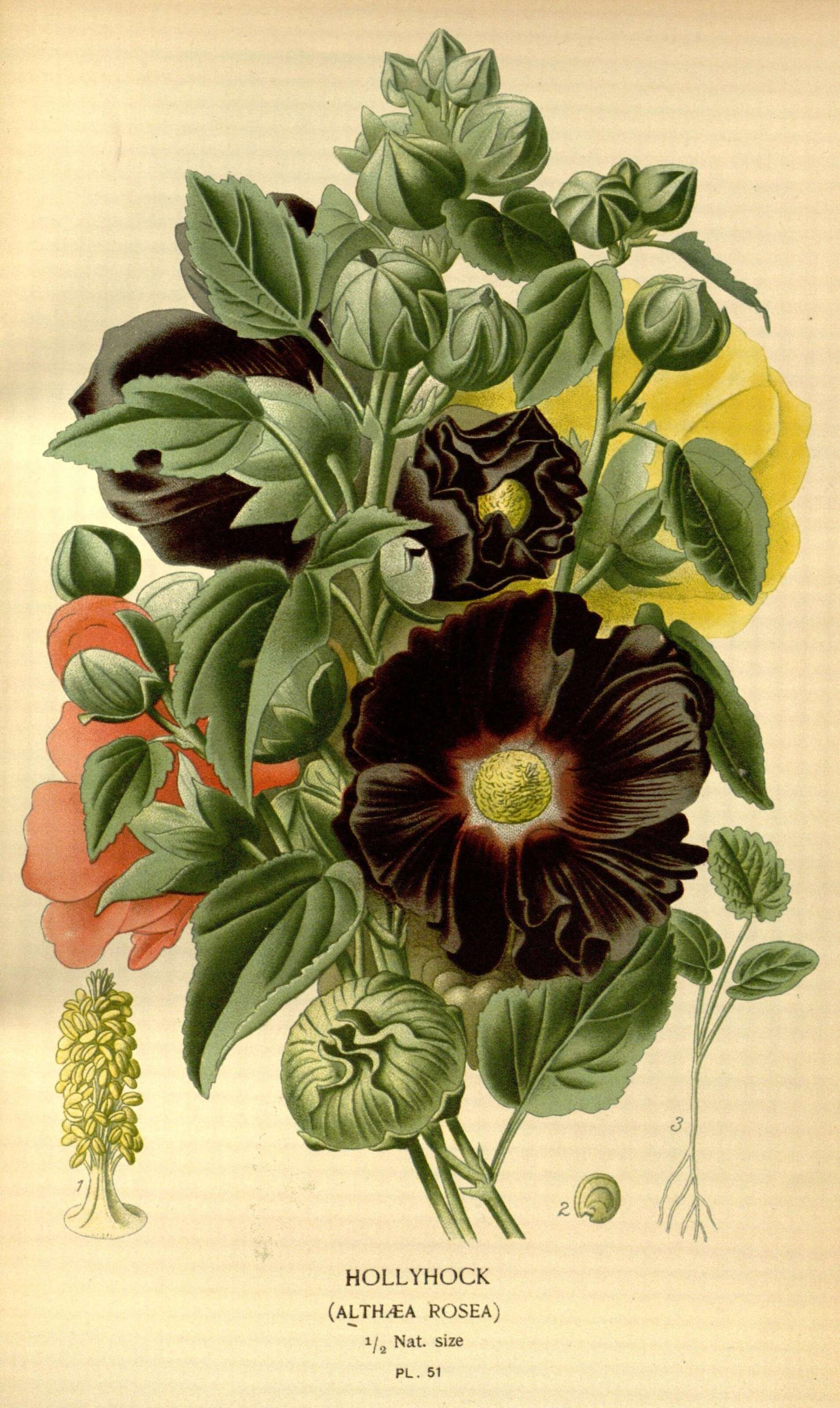
Alcea rosea (Common Hollyhock; syn. Althaea chinensis Wall., Althaea ficifolia Cav., Althaea rosea Cav.) is an ornamental plant in the Malvaceae family.
It was imported into Europe from southwestern China during, or possibly before, the 15th century.[1] William Turner, an herbalist of the time, gave it the name "holyoke" from which the English name derives.
Contents |
Cultivation
Alcea rosea is variously described as a biennial (having a two-year life cycle), as an annual, or as a short-lived perennial.[2][3][4] It frequently self-sows, which may create a perception that the plants are perennial.[2] The plant may flower during its first year when sown early.[3] It will grow in a wide range of soils, and can easily reach a height of about 8 feet (2.4 m). The flowers are a range of colours from white to dark red, including pink, yellow and orange. Different colours prefer different soils.[citation needed] The darker red variety seems to favour sandy soils, while the lighter colour seems to favour clay soils.[citation needed] The plants are easily grown from seed, and readily self-seed. However, tender plants, whether young from seed or from old stock, may be wiped out by slugs and snails. The foliage is subject to attack from rust (Puccinia malvacearum), which may be treated with fungicides.[5] Commercial growers have reported that some closely related species (Alcea rugosa and Alcea ficifolia) are resistant to this fungus.[6]
Herbalism
In herbal medicine, Hollyhock is believed to be an emollient and laxative. It is used to control inflammation, to stop bedwetting and as a mouthwash in cases of bleeding gums.[7]
Footnotes
- ^ "Flora of China 12: 267–268. 2007". Harvard University. Retrieved 2011-07-21.
- ^ a b "Hollyhock". Cornell University. Retrieved 2011-07-21.
- ^ a b "Annual - Hollyhock - Alcea rosea". University of Illinois. Retrieved 2011=-7-21.
- ^ "Plant of the Month - Hollyhocks". New Mexico State University Master Gardener Newsletter. Retrieved 2011-07-21.
- ^ "Hollyhock rust". Cornell University. Archived from the original on 22 June 2009. Retrieved 2009-07-15.
- ^ "Yard & Garden Line News". University of Minnesota Extension Service. 2005-06-15. Retrieved 2010-02-05.
- ^ Howard, Michael. Traditional Folk Remedies (Century, 1987) p.155
References
Unreviewed
Notes
Comments
Trusted
Names and Taxonomy
Taxonomy
Comments: Origin of this widely cultivated ornamental is unclear, but assumed Eurasian. Sometimes classified in the genus Althaea as Althaea rosea.
Trusted
Disclaimer
EOL content is automatically assembled from many different content providers. As a result, from time to time you may find pages on EOL that are confusing.
To request an improvement, please leave a comment on the page. Thank you!