Articles on this page are available in 1 other language: Dutch (1) (learn more)
Overview
Brief Summary
Trusted
Distribution
Distribution in Egypt
Nile Valley North of Nubia (Delta), Mareotic Sector, North Sinai, Isthmic Desert, Galala Desert.
Trusted
Localities documented in Tropicos sources
United States (North America)
Note: This information is based on publications available through Tropicos and may not represent the entire distribution. Tropicos does not categorize distributions as native or non-native.
-
Small, J. K. 1933. Man. S.E. Fl. i–xxii, 1–1554. Published by the Author, New York.
http://www.tropicos.org/Reference/1515
Trusted
Localities documented in Tropicos sources
Canada (North America)
Greenland (North America)
United States (North America)
Note: This information is based on publications available through Tropicos and may not represent the entire distribution. Tropicos does not categorize distributions as native or non-native.
-
Anonymous. 1986. List-Based Rec., Soil Conserv. Serv., U.S.D.A. Database of the U.S.D.A., Beltsville.
http://www.tropicos.org/Reference/1103
-
Gleason, H. A. 1968. The Choripetalous Dicotyledoneae. vol. 2. 655 pp. In H. A. Gleason Ill. Fl. N. U.S. (ed. 3). New York Botanical Garden, New York.
http://www.tropicos.org/Reference/1704
-
Böcher, T. W., K. Holmen & K. Jacobsen. 1968. Fl. Greenland (ed. 2) 312 pp.
http://www.tropicos.org/Reference/1507
-
Munz, P. A. & D. D. Keck. 1959. Cal. Fl. 1–1681. University of California Press, Berkeley.
http://www.tropicos.org/Reference/1717
-
Munz, P. A. 1974. Fl. S. Calif. 1–1086. University of California Press, Berkeley.
http://www.tropicos.org/Reference/1719
Trusted
-
Rappé, G. (1984). The distribution of some lesser known thalassochorous plant species along the Belgian coast, compared with their distribution in western Europe. Biol. Jb. Dodonaea 52: 35-56
http://www.marinespecies.org/aphia.php?p=sourcedetails&id=133477
-
Poma, L. (1936). Botanisch verslag van de excursies naar het Zwin op 15 mei en 13 september 1936. Biol. Jb. Dodonaea 3: 65-69
http://www.marinespecies.org/aphia.php?p=sourcedetails&id=138557
-
Provoost, S.; Bonte, D. (Ed.) (2004). Animated dunes: a view of biodiversity at the Flemish coast [Levende duinen: een overzicht van de biodiversiteit aan de Vlaamse kust]. Mededelingen van het Instituut voor Natuurbehoud, 22. Instituut voor Natuurbehoud: Brussel, Belgium. ISBN 90-403-0205-7. 416, ill., appendices pp.
http://www.marinespecies.org/aphia.php?p=sourcedetails&id=133005
-
Goetghebeur, P. (1976). The vegetation of mud flats and salt marshes along the IJzer estuary at Nieuwpoort (West Flanders, Belgium) from 1900 to present [De vegetatie van de slikken en de schorren langs de IJzermonding te Nieuwpoort (Prov. West-Vlaanderen, België) van 1900 tot heden]. Biol. Jb. Dodonaea 44: 163-177, 1 folded table
http://www.marinespecies.org/aphia.php?p=sourcedetails&id=133465
Trusted
National Distribution
Canada
Origin: Exotic
Regularity: Regularly occurring
Currently: Unknown/Undetermined
Confidence: Confident
United States
Origin: Exotic
Regularity: Regularly occurring
Currently: Unknown/Undetermined
Confidence: Confident
Trusted
Ecology
Associations
larva of Ceutorhynchus cakilis feeds on Cakile maritima
Foodplant / miner
larva of Psylliodes marcida mines stem of Cakile maritima
Other: sole host/prey
Trusted
Life History and Behavior
Life Expectancy
Molecular Biology and Genetics
Molecular Biology
Barcode data: Cakile maritima
No available public DNA sequences.
Download FASTA File
Trusted
Statistics of barcoding coverage: Cakile maritima
Public Records: 3
Specimens with Barcodes: 7
Species With Barcodes: 1
Trusted
Conservation
Conservation Status
National NatureServe Conservation Status
Canada
Rounded National Status Rank: NNA - Not Applicable
United States
Rounded National Status Rank: NNA - Not Applicable
Trusted
Wikipedia
Cakile maritima
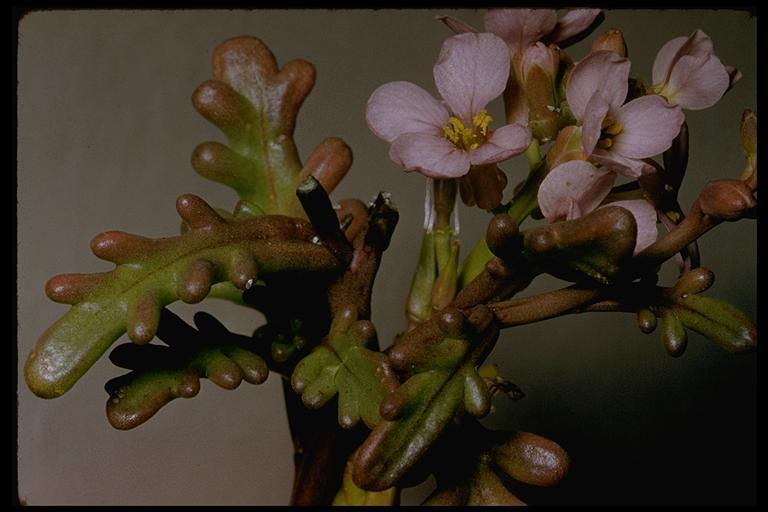
Cakile maritima, the European searocket, is a common plant in the mustard family. It is widespread in Europe, especially on coastlines, and it can now be found in other areas of the world where it has been introduced. It is an inhabitant of the west and east coasts of North America, where it has the potential to become a noxious weed. This is an annual plant which grows in clumps or mounds in the sand on beaches and bluffs. The shiny leaves are fleshy, green and tinted with purple or magenta, and long-lobed. It has white to light purple flowers and sculpted, segmented, corky brown fruits one to three centimeters long. The fruits float and are water-dispersed.
Veterinary significance
The seed oil contains a high level of erucic acid, which can have pathological effects on the cardiac muscle of several animal species. However, Orange-bellied Parrots feed on its seed during their northward migrating journey from Tasmania.
Unreviewed
Disclaimer
EOL content is automatically assembled from many different content providers. As a result, from time to time you may find pages on EOL that are confusing.
To request an improvement, please leave a comment on the page. Thank you!