Articles on this page are available in 2 other languages: Arabic (12), Spanish (1) (learn more)

Overview

Distribution

Localities documented in Tropicos sources

Atriplex stocksii Boiss.:
Pakistan (Asia)

Note: This information is based on publications available through Tropicos and may not represent the entire distribution. Tropicos does not categorize distributions as native or non-native.
Creative Commons Attribution Non Commercial Share Alike 3.0 (CC BY-NC-SA 3.0)

© Missouri Botanical Garden, 4344 Shaw Boulevard, St. Louis, MO 63110 USA

Source: Missouri Botanical Garden

Trusted

Article rating from 0 people

Average rating: 2.5 of 5

Localities documented in Tropicos sources

Spinacia glabra Mill.:
Equatorial Guinea (Africa & Madagascar)

Note: This information is based on publications available through Tropicos and may not represent the entire distribution. Tropicos does not categorize distributions as native or non-native.
Creative Commons Attribution Non Commercial Share Alike 3.0 (CC BY-NC-SA 3.0)

© Missouri Botanical Garden, 4344 Shaw Boulevard, St. Louis, MO 63110 USA

Source: Missouri Botanical Garden

Trusted

Article rating from 0 people

Average rating: 2.5 of 5

Localities documented in Tropicos sources

Spinacea oleracea L.:
Costa Rica (Mesoamerica)

Note: This information is based on publications available through Tropicos and may not represent the entire distribution. Tropicos does not categorize distributions as native or non-native.
Creative Commons Attribution Non Commercial Share Alike 3.0 (CC BY-NC-SA 3.0)

© Missouri Botanical Garden, 4344 Shaw Boulevard, St. Louis, MO 63110 USA

Source: Missouri Botanical Garden

Trusted

Article rating from 0 people

Average rating: 2.5 of 5

Localities documented in Tropicos sources

Spinacia oleracea L.:
Belize (Mesoamerica)
China (Asia)
Ecuador (South America)
Honduras (Mesoamerica)
United States (North America)
Colombia (South America)

Note: This information is based on publications available through Tropicos and may not represent the entire distribution. Tropicos does not categorize distributions as native or non-native.
Creative Commons Attribution Non Commercial Share Alike 3.0 (CC BY-NC-SA 3.0)

© Missouri Botanical Garden, 4344 Shaw Boulevard, St. Louis, MO 63110 USA

Source: Missouri Botanical Garden

Trusted

Article rating from 0 people

Average rating: 2.5 of 5

introduced; Calif., Conn., Maine, Mass., N.H., N.Y., N.C., Ohio, Oreg., Pa., R.I., S.C., Va., Wash.; Eurasia; n Africa.
Creative Commons Attribution Non Commercial Share Alike 3.0 (CC BY-NC-SA 3.0)

© Missouri Botanical Garden, 4344 Shaw Boulevard, St. Louis, MO, 63110 USA

Source: Missouri Botanical Garden

Trusted

Article rating from 0 people

Average rating: 2.5 of 5

Distribution: Probably originated from S. tetrandra Stev. in W. Asia.
Creative Commons Attribution Non Commercial Share Alike 3.0 (CC BY-NC-SA 3.0)

© Missouri Botanical Garden, 4344 Shaw Boulevard, St. Louis, MO, 63110 USA

Source: Missouri Botanical Garden

Trusted

Article rating from 0 people

Average rating: 2.5 of 5

National Distribution

Canada

Origin: Exotic

Regularity: Regularly occurring

Currently: Unknown/Undetermined

Confidence: Confident

United States

Origin: Exotic

Regularity: Regularly occurring

Currently: Unknown/Undetermined

Confidence: Confident

Creative Commons Attribution Non Commercial 3.0 (CC BY-NC 3.0)

© NatureServe

Source: NatureServe

Trusted

Article rating from 0 people

Average rating: 2.5 of 5

Distribution: Pakistan (endemic).
Creative Commons Attribution Non Commercial Share Alike 3.0 (CC BY-NC-SA 3.0)

© Missouri Botanical Garden, 4344 Shaw Boulevard, St. Louis, MO, 63110 USA

Source: Missouri Botanical Garden

Trusted

Article rating from 0 people

Average rating: 2.5 of 5

Physical Description

Morphology

Description

Shrubby, shining white, erect, much branched, robust, 20-60 cm high. Leaves alternate, oblong, orbicular or rhombic-ovate to oblong-spathulate, shortly cuneate at base, subsessile to shortly petiolate, obtuse 10-25 x 5-20 mm. Male flowers in axillary clusters or short spikes; females in few-flowered clusters. Fruiting bracteoles 10-12 mm in diameter, orbicular or broadly ovate, subcordate at base, and abruptly contracted in to a short pedicel, free, entire, coriaceous, ± reticulate.
Creative Commons Attribution Non Commercial Share Alike 3.0 (CC BY-NC-SA 3.0)

© Missouri Botanical Garden, 4344 Shaw Boulevard, St. Louis, MO, 63110 USA

Source: Missouri Botanical Garden

Trusted

Article rating from 0 people

Average rating: 2.5 of 5

Description

Annual or biennial, dioecious herb, 20-60 cm tall, erect, light green, glabrous. Leaves ovate to triangular-hastate, entire or dentate, lower long-petiolate, usually entire, Staminate flowers in interrupted spiciform panicles, with 4 (-5) perianth segments and stamens; pistillate flowers in dense axillary sessile clusters, each separated and falling so in fruit; bracteoles in fruit orbicular-obovate, usually broader than long, free, with (f. spinosa) or without (f. glabra) divergent spines at the apex.
Creative Commons Attribution Non Commercial Share Alike 3.0 (CC BY-NC-SA 3.0)

© Missouri Botanical Garden, 4344 Shaw Boulevard, St. Louis, MO, 63110 USA

Source: Missouri Botanical Garden

Trusted

Article rating from 0 people

Average rating: 2.5 of 5

Description

Plants to 1 m tall. Root reddish, rarely white, conic. Stem simple or few branched, hollow. Leaf blade light green, hastate to ovate, slightly succulent, margin entire or with a few lobelike teeth. Male flowers: perianth segments usually 4; filaments filiform, flattened; anthers without an appendage. Fruiting bracts slightly compressed, with a thornlike appendage on each side, apex with 2 teeth; stigmas exserted. Utricle ovoid or subglobose, compressed, ca. 2.5 mm in diam.; pericarp brown.
Creative Commons Attribution Non Commercial Share Alike 3.0 (CC BY-NC-SA 3.0)

© Missouri Botanical Garden, 4344 Shaw Boulevard, St. Louis, MO, 63110 USA

Source: Missouri Botanical Garden

Trusted

Article rating from 0 people

Average rating: 2.5 of 5

Description

Stems leafy, 1-5(-10) dm. Leaves gradually becoming smaller distally; blade oblong, base cuneate. Bracteoles orbicular-obovate, usually wider than long, apex with divergent spine or smooth. 2n = 12.
Creative Commons Attribution Non Commercial Share Alike 3.0 (CC BY-NC-SA 3.0)

© Missouri Botanical Garden, 4344 Shaw Boulevard, St. Louis, MO, 63110 USA

Source: Missouri Botanical Garden

Trusted

Article rating from 0 people

Average rating: 2.5 of 5

Diagnostic Description

Synonym

Obione stocksii Wight, Icon. P1. Ind. Or.5, Expl. plates 5 & tab. 1789. 1852; Atriplex griffithii Moq. var. stocksii (Boiss.) Boiss., F1.Or. 5: 916. 1879; Stewart, l.c. 218; A. griffithii Moq. subsp. stocksii (Boiss.) Boulos in Nord. J.Bot. 11. 310. 1991.
Creative Commons Attribution Non Commercial Share Alike 3.0 (CC BY-NC-SA 3.0)

© Missouri Botanical Garden, 4344 Shaw Boulevard, St. Louis, MO, 63110 USA

Source: Missouri Botanical Garden

Trusted

Article rating from 0 people

Average rating: 2.5 of 5

Synonym

S.spinosa Moench., Meth. 318. 1794; S. glabra Mill.., Gard. Dict. ed. 8 (2): 1768; S. tetrandra auct. non Stev. (1809); Roxb., F1. Ind. 3: 711. 1824.
Creative Commons Attribution Non Commercial Share Alike 3.0 (CC BY-NC-SA 3.0)

© Missouri Botanical Garden, 4344 Shaw Boulevard, St. Louis, MO, 63110 USA

Source: Missouri Botanical Garden

Trusted

Article rating from 0 people

Average rating: 2.5 of 5

Ecology

Habitat

Waste areas; 0-1500m.
Creative Commons Attribution Non Commercial Share Alike 3.0 (CC BY-NC-SA 3.0)

© Missouri Botanical Garden, 4344 Shaw Boulevard, St. Louis, MO, 63110 USA

Source: Missouri Botanical Garden

Trusted

Article rating from 0 people

Average rating: 2.5 of 5

Habitat & Distribution

Commonly cultivated as a vegetable. in China [unknown in the wild; widely cultivated in temperate and subtropical regions of the world].
Creative Commons Attribution Non Commercial Share Alike 3.0 (CC BY-NC-SA 3.0)

© Missouri Botanical Garden, 4344 Shaw Boulevard, St. Louis, MO, 63110 USA

Source: Missouri Botanical Garden

Trusted

Article rating from 0 people

Average rating: 2.5 of 5

Associations

Foodplant / miner
larva of Amauromyza flavifrons mines leaf of Spinacia oleracea

Foodplant / sap sucker
densely clustered Aphis fabae sucks sap of often stunted, curled shoot of Spinacia oleracea
Remarks: season: summer

In Great Britain and/or Ireland:
Foodplant / spot causer
effuse colony of Cladosporium dematiaceous anamorph of Cladosporium variabile causes spots on live leaf (esp. towards apex) of Spinacia oleracea

Foodplant / spot causer
acervulus of Colletotrichum coelomycetous anamorph of Colletotrichum dematium f. spinaceae causes spots on leaf of Spinacia oleracea
Remarks: Other: uncertain

Foodplant / pathogen
Cucumber Mosaic virus infects and damages yellowed, limp leaf (mature) of Spinacia oleracea

Foodplant / pathogen
Ditylenchus dipsaci infects and damages live, swollen, stunted or malformed leaf of Spinacia oleracea

Plant / resting place / within
oospore of Peronospora farinosa f.sp. spinaciae may be found in live, pale yellowish spotted leaf of Spinacia oleracea

Foodplant / sap sucker
adult of Piesma maculatum sucks sap of Spinacia oleracea
Other: minor host/prey

Trusted

Article rating from 0 people

Average rating: 2.5 of 5

Life History and Behavior

Cyclicity

Flowering/Fruiting

Flowering spring-fall.
Creative Commons Attribution Non Commercial Share Alike 3.0 (CC BY-NC-SA 3.0)

© Missouri Botanical Garden, 4344 Shaw Boulevard, St. Louis, MO, 63110 USA

Source: Missouri Botanical Garden

Trusted

Article rating from 0 people

Average rating: 2.5 of 5

Flower/Fruit

Fl. Per.: December-January
Creative Commons Attribution Non Commercial Share Alike 3.0 (CC BY-NC-SA 3.0)

© Missouri Botanical Garden, 4344 Shaw Boulevard, St. Louis, MO, 63110 USA

Source: Missouri Botanical Garden

Trusted

Article rating from 0 people

Average rating: 2.5 of 5

Flower/Fruit

Fl. Per.: Feb.-May.
Creative Commons Attribution Non Commercial Share Alike 3.0 (CC BY-NC-SA 3.0)

© Missouri Botanical Garden, 4344 Shaw Boulevard, St. Louis, MO, 63110 USA

Source: Missouri Botanical Garden

Trusted

Article rating from 0 people

Average rating: 2.5 of 5

Evolution and Systematics

Functional Adaptations

Functional adaptation

Leaves convert photons to energy: spinach
 

Leaves of spinach convert photons from sun into electrical energy through an ordered arrangement of proteins that acts as a diode.

   
  "Spinach protein has the ability to convert photons from the sun into electrical energy; an ordered arrangement of spinach proteins on a flat surface can therefore act as a diode. These diodes could be combined with other components to make switches such as the ones that store and manipulate information in a computer. Spinach proteins are much more environmentally-friendly than the often toxic materials that go into the making of computer chips." (Courtesy of the Biomimicry Guild)
  Learn more about this functional adaptation.
Creative Commons Attribution Non Commercial 3.0 (CC BY-NC 3.0)

© The Biomimicry Institute

Source: AskNature

Trusted

Article rating from 0 people

Average rating: 2.5 of 5

Molecular Biology and Genetics

Molecular Biology

Barcode data: Spinacia oleracea

The following is a representative barcode sequence, the centroid of all available sequences for this species.


No available public DNA sequences.

Download FASTA File
Creative Commons Attribution 3.0 (CC BY 3.0)

© Barcode of Life Data Systems

Source: Barcode of Life Data Systems (BOLD)

Trusted

Article rating from 0 people

Average rating: 2.5 of 5

Statistics of barcoding coverage: Spinacia oleracea

Barcode of Life Data Systems (BOLDS) Stats
Public Records: 4
Specimens with Barcodes: 4
Species With Barcodes: 1
Creative Commons Attribution 3.0 (CC BY 3.0)

© Barcode of Life Data Systems

Source: Barcode of Life Data Systems (BOLD)

Trusted

Article rating from 0 people

Average rating: 2.5 of 5

Conservation

Conservation Status

National NatureServe Conservation Status

Canada

Rounded National Status Rank: NNA - Not Applicable

United States

Rounded National Status Rank: NNA - Not Applicable

Creative Commons Attribution Non Commercial 3.0 (CC BY-NC 3.0)

© NatureServe

Source: NatureServe

Trusted

Article rating from 0 people

Average rating: 2.5 of 5

NatureServe Conservation Status

Rounded Global Status Rank: GNR - Not Yet Ranked

Creative Commons Attribution Non Commercial 3.0 (CC BY-NC 3.0)

© NatureServe

Source: NatureServe

Trusted

Article rating from 0 people

Average rating: 2.5 of 5

Management

These species are introduced in Switzerland.
  • Aeschimann, D. & C. Heitz. 2005. Synonymie-Index der Schweizer Flora und der angrenzenden Gebiete (SISF). 2te Auflage. Documenta Floristicae Helvetiae N° 2. Genève.   http://www.crsf.ch/ External link.
Creative Commons Attribution 3.0 (CC BY 3.0)

© Info Flora (CRSF/ZDSF) & Autoren 2005

Supplier: Name It's Source (profile not public)

Trusted

Article rating from 0 people

Average rating: 2.5 of 5

Wikipedia

Spinach

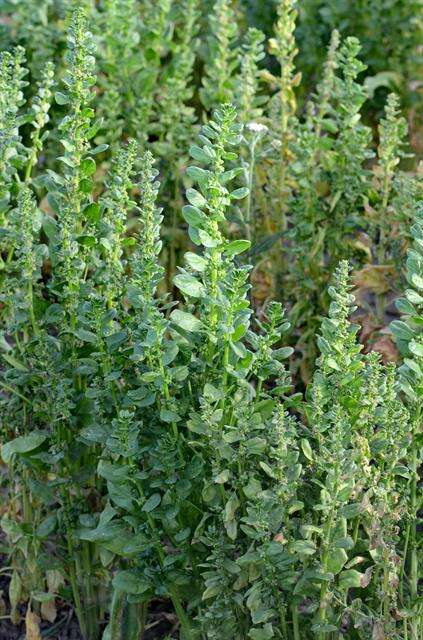
Spinach (Spinacia oleracea) is an edible flowering plant in the family of Amaranthaceae. It is native to central and southwestern Asia. It is an annual plant (rarely biennial), which grows to a height of up to 30 cm. Spinach may survive over winter in temperate regions. The leaves are alternate, simple, ovate to triangular-based, very variable in size from about 2–30 cm long and 1–15 cm broad, with larger leaves at the base of the plant and small leaves higher on the flowering stem. The flowers are inconspicuous, yellow-green, 3–4 mm diameter, maturing into a small, hard, dry, lumpy fruit cluster 5–10 mm across containing several seeds.

Common spinach, Spinacia oleracea, was long considered to be in the Chenopodiaceae family, but in 2003, the Chenopodiaceae family was combined with the Amaranthaceae family under the family name 'Amaranthaceae' in the order Caryophyllales. Within the Amaranthaceae family, Amaranthoideae and Chenopodioideae are now subfamilies, for the amaranths and the chenopods, respectively.

Contents

Etymology

Spinach plant in November, Castelltallat

The English word "spinach" dates to the late 14th century, and is from espinache (Fr. épinard), of uncertain origin. The traditional view derives it from O.Prov. espinarc, which perhaps is via Catalan espinac, from Andalusian Arabic asbinakh (اسبيناخ), from Arabic es-sabaanikh (السبانخ), from Persian اسپاناخ aspanakh, meaning roughly "green hand",[1] but the multiplicity of forms makes the theory doubtful.[2]

History

Spinach is thought to have originated in ancient Persia (modern Iran and neighboring countries). Arab traders carried spinach into India, and then the plant was introduced into ancient China, where it was known as "Persian vegetable" (bōsī cài; 波斯菜; present:菠菜). The earliest available record of the spinach plant was recorded in Chinese, stating it was introduced into China via Nepal (probably in 647 AD).[3]

In AD 827, the Saracens introduced spinach to Sicily.[citation needed] The first written evidence of spinach in the Mediterranean was recorded in three 10th-century works: the medical work by al-Razi (known as Rhazes in the West) and in two agricultural treatises, one by Ibn Wahshiya and the other by Qustus al-Rumi. Spinach became a popular vegetable in the Arab Mediterranean and arrived in Spain by the latter part of the 12th century, where the great Arab agronomist Ibn al-'Awwam called it the "captain of leafy greens". Spinach was also the subject of a special treatise in the 11th century by Ibn Hajjaj.[4]

The prickly-seeded form of spinach was known in Germany by no later than the 13th century, though the smooth-seeded form was not described until 1552. (The smooth-seeded form is used in modern commercial production.)[3]

Spinach first appeared in England and France in the 14th century, probably via Spain, and it gained quick popularity because it appeared in early spring, when other vegetables were scarce and when Lenten dietary restrictions discouraged consumption of other foods. Spinach is mentioned in the first known English cookbook, The Forme of Cury (1390), where it is referred to as spinnedge and/or spynoches.[5] Smooth-seeded spinach was described in 1552.[3]

In 1533, Catherine de' Medici became queen of France; she so fancied spinach, she insisted it be served at every meal. To this day, dishes made with spinach are known as "Florentine", reflecting Catherine's birth in Florence.[6]

During World War I, wine fortified with spinach juice was given to French soldiers weakened by hemorrhage.[7]

Culinary information

Nutrition

Spinach, raw
Nutritional value per 100 g (3.5 oz)
Energy97 kJ (23 kcal)
Carbohydrates3.6 g
- Sugars0.4 g
- Dietary fiber2.2 g
Fat0.4 g
Protein2.9 g
Water91.4 g
Vitamin A equiv.469 μg (59%)
Vitamin A9377 IU
- beta-carotene5626 μg (52%)
- lutein and zeaxanthin12198 μg
Thiamine (vit. B1)0.078 mg (7%)
Riboflavin (vit. B2)0.189 mg (16%)
Niacin (vit. B3)0.724 mg (5%)
Vitamin B60.195 mg (15%)
Folate (vit. B9)194 μg (49%)
Vitamin C28 mg (34%)
Vitamin E2 mg (13%)
Vitamin K483 μg (460%)
Calcium99 mg (10%)
Iron2.7 mg (21%)
Magnesium79 mg (22%)
Manganese0.897 mg (43%)
Phosphorus49 mg (7%)
Potassium558 mg (12%)
Sodium79 mg (5%)
Zinc0.53 mg (6%)
Link to USDA Database entry
Percentages are relative to
US recommendations for adults.
Source: USDA Nutrient Database

Spinach has a high nutritional value and is extremely rich in antioxidants, especially when fresh, steamed, or quickly boiled. It is a rich source of vitamin A (and especially high in lutein), vitamin C, vitamin E, vitamin K, magnesium, manganese, folate, betaine, iron, vitamin B2, calcium, potassium, vitamin B6, folic acid, copper, protein, phosphorus, zinc, niacin, selenium and omega-3 fatty acids. Recently, opioid peptides called rubiscolins have also been found in spinach.

Polyglutamyl folate (vitamin B9 or folic acid) is a vital constituent of cells, and spinach is a good source of folic acid. Boiling spinach can more than halve the level of folate left in the spinach, but microwaving does not affect folate content.[8] Vitamin B9 was first isolated from spinach in 1941.[9]

Iron

Spinach, along with other green leafy vegetables,[10] is considered to be rich in iron. For example, the United States Department of Agriculture states that a 180-g serving of boiled spinach contains 6.43 mg of iron, whereas a 170-g ground hamburger patty contains at most 4.42 mg.[11] However, spinach contains iron absorption-inhibiting substances, including high levels of oxalate, which can bind to the iron to form ferrous oxalate and render much of the iron in spinach unusable by the body.[12] In addition to preventing absorption and use, high levels of oxalates remove iron from the body.[13] But some studies have found that the addition of oxalic acid to the diet may improve iron absorption in rats over a diet with spinach without additional oxalic acid.[14]

Calcium

Spinach also has a high calcium content. However, the oxalate content in spinach also binds with calcium, decreasing its absorption. Calcium and zinc also limit iron absorption.[15] The calcium in spinach is the least bioavailable of calcium sources.[16] By way of comparison, the body can absorb about half of the calcium present in broccoli, yet only around 5% of the calcium in spinach.

Pureed spinach and homemade cheese with spiced flatbread (makki di roti) from India

Types of spinach

A distinction can be made between older varieties of spinach and more modern ones. Older varieties tend to bolt too early in warm conditions. Newer varieties tend to grow more rapidly, but have less of an inclination to run up to seed. The older varieties have narrower leaves and tend to have a stronger and more bitter taste. Most newer varieties have broader leaves and round seeds.

The three basic types of spinach are:

  • Savoy has dark green, crinkly and curly leaves. It is the type sold in fresh bunches in most supermarkets in the United States. One heirloom variety of savoy is 'Bloomsdale', which is somewhat resistant to bolting. Other common heirloom varieties are 'Merlo Nero' (a mild variety from Italy) and 'Viroflay' (a very large spinach with great yields).
  • Flat- or smooth-leaf spinach has broad, smooth leaves that are easier to clean than Savoy. This type is often grown for canned and frozen spinach, as well as soups, baby foods, and processed foods.
  • Semi-savoy is a hybrid variety with slightly crinkled leaves. It has the same texture as Savoy, but it is not as difficult to clean. It is grown for both fresh market and processing. 'Five Star', a widely grown variety, has good resistance to running up to seed.

Production, marketing and storage

Spinach output in 2005

Spinach is sold loose, bunched, packaged fresh in bags, canned, or frozen. Fresh spinach loses much of its nutritional value with storage of more than a few days.[17] While refrigeration slows this effect to about eight days, spinach will lose most of its folate and carotenoid content, so for longer storage, it is blanched and frozen, cooked and frozen, or canned. Storage in the freezer can be for up to eight months.

The Environmental Working Group reported spinach is one of the dozen most heavily pesticide-contaminated produce products.[18] The most common pesticides found on spinach are permethrin, dimethoate, and DDT.[citation needed] Spinach is high in cadmium contamination. An FDA study found more in boiled spinach in the early 90's (0.125 mg/kg) than in the 320 other foods studied.[19]

Spinach is packaged in air, or in nitrogen gas to extend shelf life. Some packaged spinach is exposed to radiation to kill any harmful bacteria that may be on the leaves. The Food and Drug Administration approves of irradiation of spinach leaves up to 4.0 kilograys; however, using radiation to sanitize spinach is of concern because it may deplete the leaves of their nutritional value. Researchers at the Agricultural Research Service experimentally tested the concentrations of vitamins C, E, K, B9, and four other carotenoids in packaged spinach following irradiation. They found with increasing level of irradiation, four nutrients showed little or no change. Those nutrients include vitamins B9, E, K, and the carotenoid neoxanthin. This study showed the irradiation of packaged spinach to have little or no change to the nutritional value of the crop, and the health benefits of irradiating packed spinach to reduce harmful bacteria seem to outweigh the loss of nutrients.[20]

In popular culture

The cartoon character Popeye the Sailor Man is portrayed as having a strong affinity for spinach, becoming physically stronger after consuming it. The commonly accepted version of events states this portrayal was based on faulty calculations of the iron content.[21] In the version, German scientist Emil von Wolff misplaced a decimal point in an 1870 measurement of spinach's iron content, leading to an iron value ten times higher than it should have been, and this faulty measurement was not noticed until the 1930s. This caused the popular misconception that spinach is high in iron that makes the body stronger.[22]

Criminologist Mike Sutton wrote an article in the Internet Journal of Criminology, claiming the Popeye and iron link is just another long-standing myth, and spinach was chosen and promoted in Popeye for its vitamin A content alone.[23] In the cited article, he also disputes the above — what he calls the Spinach Popeye Iron Decimal Error Story (SPIDES) — due to lack of verifiable sources, although he found a different reference of ten times the actual iron content from the twenties. Further research by Sutton presents more evidence for the SPIDES being a myth which is cited as veracious evidence in the official errata pages for Samuel Arbesman's book, The Half-life of Facts.[24]

Spinach, along with Brussels sprouts and other green vegetables, is often portrayed in the media, including children's shows, as being undesirable. For example, early Popeye movies played on the gag that Popeye's nephews never liked spinach but ate it anyway to grow up big and strong.[25] The same theme is depicted in an even earlier classic cartoon from the New Yorker magazine.[26]

See also

References

  1. ^ Douglas Harper, Online Etymological Dictionary s.v. spinach. (WWW: Accessed 03/07/2010). [1]
  2. ^ "spinach". Oxford English Dictionary (3rd ed.). Oxford University Press. September 2005. 
  3. ^ a b c Victor R. Boswell, "Garden Peas and Spinach from the Middle East". Reprint of "Our Vegetable Travelers" National Geographic Magazine, Vol 96:2 (Aug 1949). (WWW: Aggie Horticulture. Accessed 03/07/2010). [2]
  4. ^ Clifford A. Wright. Mediterranean Vegetables: A Cook's ABC of Vegetables and their Preparation in Spain, France, Italy, Greece, Turkey, the Middle East, and North Africa, with More than 200 Authentic Recipes for the Home Cook. (Boston: Harvard Common Press, 2001). pp. 300-301.
  5. ^ Jacques Rolland and Carol Sherman, "Spinach". The Food Encyclopedia: Over 8,000 Ingredients, Tools, Techniques and People . Toronto: Robert Rose. 2006. (WWW: Canadian Living. Accessed 03/07/2010). [3]
  6. ^ "Spinach," (WWW: The George Mateljan Foundation, 2001-2010)
  7. ^ Margaret Grieve; Maud Grieve (1 June 1971). A modern herbal: the medicinal, culinary, cosmetic and economic properties, cultivation and folk-lore of herbs, grasses, fungi, shrubs, & trees with all their modern scientific uses. Courier Dover Publications. pp. 761–. ISBN 978-0-486-22799-3. Retrieved 13 August 2010. 
  8. ^ G. F. M. Ball (2006). Vitamins in foods: analysis, bioavailability, and stability. CRC Press. pp. 236–. ISBN 978-1-57444-804-7. Retrieved 13 August 2010. 
  9. ^ Gideon Koren (2007). Medication safety in pregnancy and breastfeeding. McGraw-Hill Professional. pp. 279–. ISBN 978-0-07-144828-4. Retrieved 13 August 2010. 
  10. ^ Wt_Rank
  11. ^ U.S. Department of Agriculture, Agricultural Research Service. 2005. USDA National Nutrient Database for Standard Reference, Release 18. Nutrient Data Laboratory Home Page, http://www.nal.usda.gov/fnic/foodcomp
  12. ^ http://helios.hampshire.edu/~nlNS/mompdfs/oxalicacid.pdf
  13. ^ Williams, Sue Rodwell; Long, Sara (1997). Nutrition and diet therapy. p. 229. ISBN 978-0-8151-9273-2. 
  14. ^ http://jn.nutrition.org/cgi/reprint/114/3/526.pdf
  15. ^ Insel, By Paul M.; Elaine Turner, R.; Ross, Don (2003). Nutrition. p. 474. ISBN [[Special:BookSources/978076370765|978076370765[[Category:Articles with invalid ISBNs]]]] Check |isbn= value (help). Retrieved 2009-04-15. 
  16. ^ Heaney, Robert Proulx (2006). Calcium in human health. p. 135. ISBN 978-1-59259-961-5. Retrieved 2009-04-15. 
  17. ^ "Storage Time And Temperature Effects Nutrients In Spinach". Retrieved 2008-07-05. 
  18. ^ EWG's Shopper's Guide to Pesticides hello
  19. ^ http://www.yogurtforever.org/download/tds1byel.pdf (Previously at http://www.cfsan.fda.gov/~acrobat/ tds1byel.pdf  ?)
  20. ^ Nutrient Retention of Safer Salads Explored | Environmental Working Group
  21. ^ Gabbatt, Adam (8 December 2009). "E.C. Segar, Popeye's creator, celebrated with a Google doodle". guardian.co.uk. Retrieved 5 May 2010. 
  22. ^ Fullerton-Smith, Jill (2007). The Truth about Food. Bloomsbury Publishing. p. 224. Retrieved February 18, 2012. 
  23. ^ "SPINACH, IRON and POPEYE: Ironic lessons from biochemistry and history on the importance of healthy eating, healthy scepticism and adequate citation". Internet Journal of Criminology. 
  24. ^ errata page of Samuel Arbesman's book The Half-life of Facts
  25. ^ http://www.youtube.com/watch?v=zO8g9OQuESc
  26. ^ http://www.condenaststore.com/-sp/It-s-broccoli-dear-I-say-it-s-spinach-and-I-say-the-hell-with-it-New-Yorker-Cartoon-Prints_i8562908_.htm

Further reading

  • D. Maue, S. Walia, S. Sahore, M. Parkash, S. K. Walia, S. K. Walia (2005). "Prevalence of Multiple Antibiotic Resistant Bacteria in Ready-to-Eat Bagged Salads". American Society for Microbiology meeting. June 5–9. pp. Atlanta. Abstract
  • Rogers, Jo. What Food is That?: and how healthy is it?. The Rocks, Sydney, NSW: Lansdowne Publishing Pty Ltd, 1990. ISBN 1-86302-823-4.
  • Cardwell, Glenn. Spinach is a Good Source of What?. The Skeptic. Volume 25, No 2, Winter 2005. Pp 31–33. ISSN 0726-9897
  • Blazey, Clive. The Australian Vegetable Garden: What's new is old. Sydney, NSW: New Holland Publishers, 1999. ISBN 1-86436-538-2
  • Stanton, Rosemary. Complete Book of Food and Nutrition. Australia, Simon & Schuster, Revised Edition, 1995. ISBN 0-7318-0538-
  • Sutton, M. (2010) The Spinach Popeye Iron Decimal Error Myth is Finally Busted. Best Thinking.Com: http://www.bestthinking.com/articles/science/chemistry/biochemistry/the-spinach-popeye-iron-decimal-error-myth-is-finally-busted
Creative Commons Attribution Share Alike 3.0 (CC BY-SA 3.0)


Source: Wikipedia

Unreviewed

Article rating from 0 people

Average rating: 2.5 of 5

Notes

Comments

Reports of populations in Canada and inland areas of the United States appear to be from gardens where the plants do not persist without benefit of cultivation. 

 Spinach is an important and widely cultivated crop of unknown origin, though known from the Mediterranean region since ancient times. The plant is prized as a rich source of vitamins, calcium, iron, and antioxidant carotenoids, but, if ingested in excessive amounts, the high concentration of oxalates in the leaves can be toxic by inhibiting the absorption of calcium. The cultivated form named var. oleracea has spiny seeds and tends to be more cold hardy than var. inermis, the smooth-seeded variety that is more tolerant of warm weather.

Creative Commons Attribution Non Commercial Share Alike 3.0 (CC BY-NC-SA 3.0)

© Missouri Botanical Garden, 4344 Shaw Boulevard, St. Louis, MO, 63110 USA

Source: Missouri Botanical Garden

Trusted

Article rating from 1 person

Average rating: 3.0 of 5

Comments

A fairly variable species. Boulos (1991) treated it as a subspecies of Atriplex griffithii Boiss. However, A. stocksii is an endemic species in the coastal belt of the Arabian sea. It has thin leaves, short stems, leafier and oblong-obovate leaves, with entire or lobulate margins.  

 There seems to be a controversy in the true authority of Atriplex stocksii. The taxon was first described by Wight (1852) as Obione stocksii Wight, based upon the specimen of J.E.Stocks (542) collected from Scinde (Sindh). Later, Boissier (1859) described the same taxon as Atriplex stocksii Boiss. based on two specimens:1. Scinde, Stocks (un-numbered by Boissier); 2. Persia australis, Aucher 5268; without any reference to Wight (1852). It seems that a combination was never proposed for the above taxon. However, as Boissier (1859) has already described the taxon under the appropriate genus , it seems most logical to attribute the species to Boissier (1859).

Creative Commons Attribution Non Commercial Share Alike 3.0 (CC BY-NC-SA 3.0)

© Missouri Botanical Garden, 4344 Shaw Boulevard, St. Louis, MO, 63110 USA

Source: Missouri Botanical Garden

Trusted

Article rating from 0 people

Average rating: 2.5 of 5

Comments

Spinach is widely cultivated and sometimes naturalized or found as an escape from cultivation; leaves are commonly used as vegetable. It contains a considerable amount of vitamins A, B and C, iron and phosphorus and sufficient protein inferior only to meat; and thus an important food for weak and anaemic persons; it is said to increase secretions of stomach and function of pancreas.
Creative Commons Attribution Non Commercial Share Alike 3.0 (CC BY-NC-SA 3.0)

© Missouri Botanical Garden, 4344 Shaw Boulevard, St. Louis, MO, 63110 USA

Source: Missouri Botanical Garden

Trusted

Article rating from 0 people

Average rating: 2.5 of 5

Disclaimer

EOL content is automatically assembled from many different content providers. As a result, from time to time you may find pages on EOL that are confusing.

To request an improvement, please leave a comment on the page. Thank you!