Overview
Brief Summary
Biology
Trusted
Comprehensive Description
Description
Trusted
Distribution
Range Description
Trusted
National Distribution
United States
Origin: Native
Regularity: Regularly occurring
Currently: Present
Confidence: Confident
Type of Residency: Year-round
Trusted
Global Range: Range includes Na Pali and Hapuu areas of Kauai, current reports on Niihau but no specimens collected.
Trusted
Range
Trusted
Physical Description
Type Information
Collection: Smithsonian Institution, National Museum of Natural History, Department of Botany
Preparation: Pressed specimen
Collector(s): C. N. Forbes
Year Collected: 1916
Locality: Haupu Range near Nawiliwili Bay., Kaua`i, Hawaii, United States, Hawaiian Archipelago, Pacific Islands
- Isotype: Forbes, C. N. & Lydgate, -. 1917. Occas. Pap. Bernice Pauahi Bishop Mus. 6 (4): 11.
Trusted
Ecology
Habitat
Habitat and Ecology
Systems
- Terrestrial
Trusted
Comments: Moist, or rarely dry habitats. Usually on steep cliffs, sparsely vegetated with native shrubs and grasses.
Trusted
Habitat
Trusted
Population Biology
Number of Occurrences
Note: For many non-migratory species, occurrences are roughly equivalent to populations.
Estimated Number of Occurrences: 1 - 5
Comments: 4 current occurrences (between 1982 and 1997) and current status of Niihau occurrence is unknown (possibly destroyed).
Trusted
Molecular Biology and Genetics
Molecular Biology
Statistics of barcoding coverage: Brighamia insignis
Public Records: 1
Species: 1
Species With Barcodes: 1
Trusted
Conservation
Conservation Status
IUCN Red List Assessment
Red List Category
Red List Criteria
Version
Year Assessed
Assessor/s
Reviewer/s
Justification
Trusted
National NatureServe Conservation Status
United States
Rounded National Status Rank: N1 - Critically Imperiled
Trusted
NatureServe Conservation Status
Rounded Global Status Rank: G1 - Critically Imperiled
Reasons: Endemic to two areas on the island of Kauai (Napali and the Haupu Range), and Niihau. It is currently known only from Kauai, with approximately 60-70 plants remaining. Major threats to surviving individuals include predation and habitat degradation by feral goats and competition with alien plants species. This species is also vulnerable to disturbance by hikers, fire, and spider mite infestations.
Trusted
Status: Endangered
Date Listed: 02/25/1994
Lead Region: Pacific Region (Region 1)
Where Listed:
Population detail:
Listing status: E
For most current information and documents related to the conservation status and management of Brighamia insignis, see its USFWS Species Profile
Trusted
Status
Trusted
Threats
Threats
Trusted
Threats
Trusted
Management
Biological Research Needs: Reproductive biology and population ecology.
Trusted
Conservation
Trusted
Wikipedia
Brighamia insignis
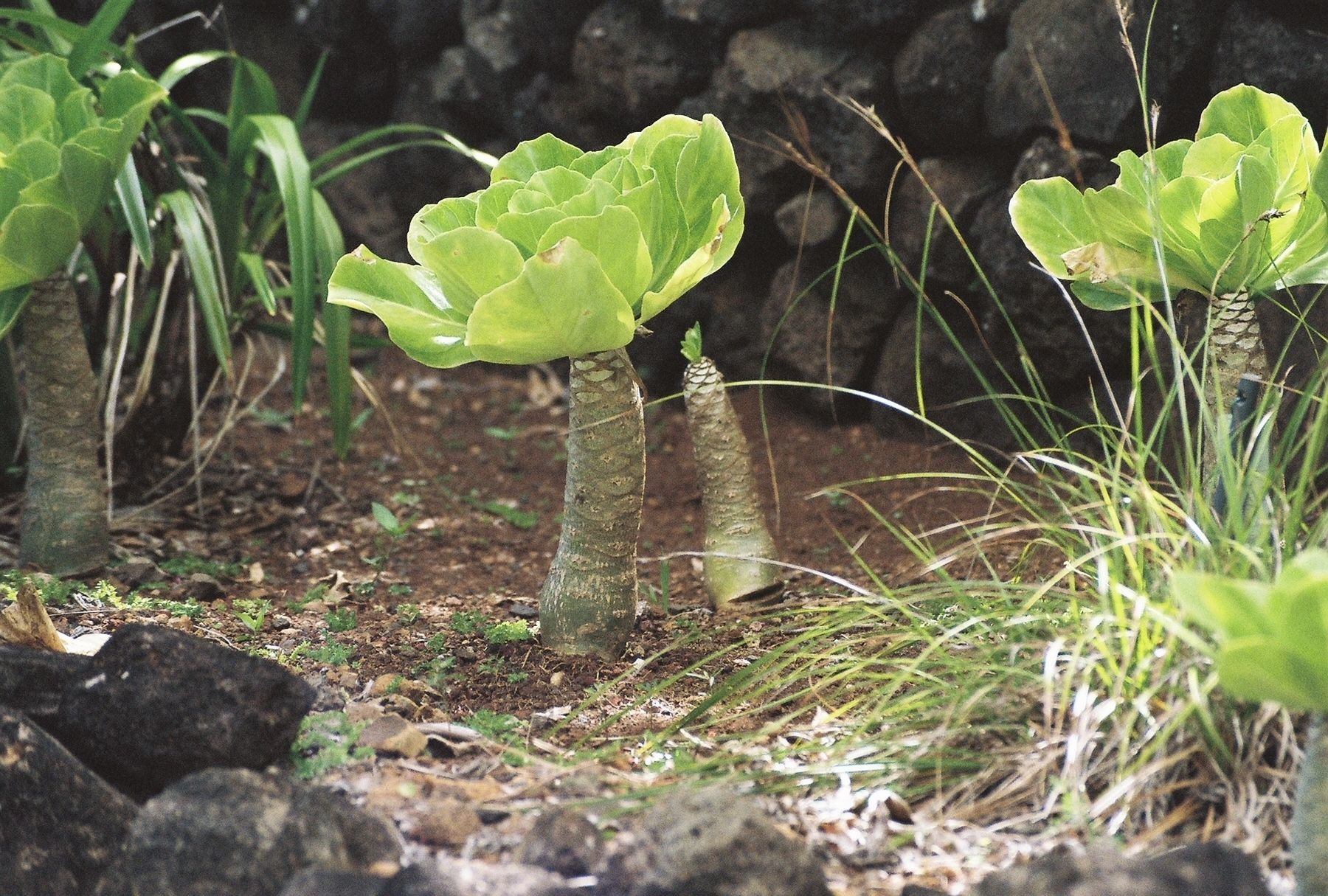
Brighamia insignis, commonly known as ʻŌlulu or Alula in Hawaiian,[1] or colloquially as cabbage on a stick,[2] is a critically endangered species of Hawaiian lobelioid in the bellflower family, Campanulaceae. It is native to the islands of Kauaʻi and Niʻihau. This short-lived perennial species is a member of a unique endemic Hawaiian genus with only one other species. It is now extremely rare. In 1994 the United States Fish and Wildlife Service reported five populations totaling 45 to 65 individuals, and listed the plant as an endangered species.
B. insignis is a potentially branched plant with a succulent stem that is bulbous at the bottom and tapers toward the top, ending in a compact rosette of fleshy leaves. The stem is usually 1–2 m (3.3–6.6 ft) in height, but can reach 5 m (16 ft).[3] The plant blooms in September through November.[4] It has clusters of fragrant yellow flowers in groups of three to eight in the leaf axils. The scent has been compared to honeysuckle.[4] Petals are fused into a tube 7 to 14 cm (2.8 to 5.5 in) long. The fruit is a capsule 13 to 19 mm (0.51 to 0.75 in) long containing numerous seeds.[5]
B. insignis is found at elevations from sea level to 480 m (1,570 ft) in mesic shrublands and dry forests that receive less than 170 cm (67 in) of annual rainfall. It grows on rocky ledges with little soil and steep sea cliffs.[3] Associated plants include ʻāhinahina (Artemisia spp.) ʻakoko (Euphorbia celastroides), alaheʻe (Psydrax odorata), kāwelu (Eragrostis variabilis), pili (Heteropogon contortus), kokiʻo ʻula (Hibiscus kokio), ʻānaunau (Lepidium serra), nehe (Lipochaeta succulenta), pokulakalaka (Munroidendron racemosum), and ʻilima (Sida fallax).[5]
According to the U.S. Botanical Gardens, its only pollinator was a certain type of now-extinct hawk moth. This has made it all but impossible for B. insignis to reproduce on its own.[6] Therefore, individuals only produce seed when artificially pollinated by humans.
Other threats to the species have included exotic plant species, feral goats and pigs, slugs, rats, fire, and infestations of carmine spider mites (Tetranychus cinnabarinus).[7][8] There is also a hiking trail near one of the populations.[7] The plant grows on steep, exposed cliffs and has been damaged by hurricanes and landslides.[8]
Despite its rarity in the wild it is not hard to cultivate in a nursery,[8] and it has come into use as a novel ornamental plant.[9]
Gallery
Flowers of the Brighamia insignis
An alula plant at Limahuli Garden and Preserve, Kauaʻi.
References
- ^ McDonald, Marie A.; Paul R. Weissich; Jean Cote (2003). Nā Lei Makamae: the Treasured Lei. University of Hawaii Press. p. 124. ISBN 978-0-8248-2649-9. http://books.google.com/books?id=WA246oBPf7UC&source=gbs_navlinks_s.
- ^ USDA Plants Profile
- ^ a b "Brighamia insignis". Meet the Plants. National Tropical Botanical Garden. http://ntbg.org/plants/plant_details.php?plantid=1923. Retrieved 2009-11-15.
- ^ a b Hawaiian Native Plant Cultivation Database. University of Hawaii, Manoa.
- ^ a b "Brighamia insignis". CPC National Collection Plant Profiles. Center for Plant Conservation. 2008-07-22. http://www.centerforplantconservation.org/Collection/CPC_ViewProfile.asp?CPCNum=630. Retrieved 2009-11-15.
- ^ "Alula, Olulu" (PDF). Hawaii's Species of Greatest Conservation Need: Process and SGCN Fact Sheets. Hawaii Department of Fish and Wildlife. http://www.state.hi.us/dlnr/dofaw/cwcs/files/Flora%20fact%20sheets/Bri_ins%20plant%20NTBG_OK.pdf. Retrieved 2008-12-10.
- ^ a b The Nature Conservancy
- ^ a b c USFWS. Brighamia insignis Five Year Review. January 18, 2008.
- ^ Dave's Garden
Unreviewed
Names and Taxonomy
Taxonomy
Comments: GENUS ENDEMIC TO HAWAIIAN ISLANDS, SPECIES RESTRICTED TO KAUAI.
Trusted
Disclaimer
EOL content is automatically assembled from many different content providers. As a result, from time to time you may find pages on EOL that are confusing.
To request an improvement, please leave a comment on the page. Thank you!