Overview
Brief Summary
The gobies, family Gobiidae, are among the most speciose fish families, with more than 2000 species in 200 genera worldwide and a long taxonomic history (Van Tassell 1998). They are generally small- to mid-size fish that dwell mostly in shallow warm marine waters, although some inhabit brackish waters and estuaries and a few hundred species live in fresh water environments. Gobies have fused pelvic fins that they can use as a suction device to hold rocks and other objects in their environment. This sucker is functionally analogous (of separate evolutionary origin so not homologous) to suction-forming organs in in other fish, for example remoras and lump suckers. Most goby species eat small invertebrates and plankton, some eat other fish. Gobies are important prey for many larger fish. Few goby species are fished commercially as a human food source; some examples are: round goby, monkey goby, toad goby, and grass goby. Some species of salt-water gobies are popular in the aquarium trade.
(Van Tassell 1998; Wikipedia 2012)
- Van Tassell, 1998. History of Gobioid Classification. Gobioid Research institute. Retrieved March 15, 2012 from http://gobiidae.com/histgoby.htm .
- Wikipedia, The Free Encyclopedia. 13 March, 2012. “Goby”. Retrieved March 15, 2012 from http://en.wikipedia.org/w/index.php?title=Goby&oldid=481715307
Trusted
Comprehensive Description
Diversity
Currently 212 genera and 1,875 species are recognized, making gobies the largest marine fish family and the most species-rich family of vertebrates. Gobies and blennies combined make up a dominant portion of the small fish inhabiting benthic tropical reefs around the world. Additionally, gobies are usually the most abundant freshwater fish on oceanic islands. This group is so poorly known due to their cryptic and secretive nature that 10 to 20 new species are described each year, making them the marine family with the greatest number of newly described species. The range of morphology, behavior, habitat and reproductive strategies within this family is undeniably impressive.
- Thresher, R. 1984. Reproduction in Reef Fishes. Neptune City, NJ: T.F.H. Publications.
- Nelson, J. 1994. Fishes of the World – third edition. New York, NY: John Wiley and Sons.
- Hoese, D. 1998. Gobies. Pp. 218 in W Eschmeyer, J Paxton, eds. Encyclopedia of fishes – second edition. San Diego, CA: Academic Press.
Trusted
Distribution
Geographic Range
Gobies are found worldwide in fresh, brackish and saltwater. They are concentrated in the tropics and subtropics, mainly of the Indo-Pacific, but some marine species can be found in the subarctic streams of southern Siberia. Gobies have been transported beyond their natural range via the intake pipes or ballast water of large ships. One species, Neogobius melanostomus, a native of the Black and Caspian Seas, was introduced into one of the Great Lakes in North America around 1990 and has since spread into all five. Between 1960 and 1963 two marine gobies native to Japan, Korea, and China had established populations along the California coastline and by 1980 they were established in several parts of Australia.
Biogeographic Regions: nearctic (Introduced , Native ); palearctic (Native ); oriental (Native ); ethiopian (Native ); neotropical (Native ); australian (Introduced , Native ); oceanic islands (Native ); indian ocean (Native ); atlantic ocean (Native ); pacific ocean (Native ); mediterranean sea (Native )
Other Geographic Terms: island endemic
- Berra, T. 2001. Freshwater Fish Distribution. San Diego, CA: Academic Press.
Trusted
Physical Description
Morphology
Physical Description
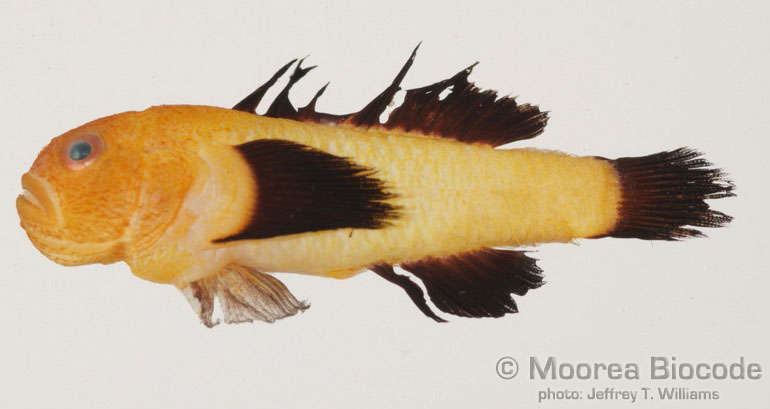
Most gobies are extremely small; in fact, the smallest known vertebrate is a goby from Japan, no longer than 10 mm at sexual maturity. The largest, Gobioides broussenetii from the Caribbean, may reach 50 cm TL. Gobies are usually recognized by their small size, the existence of two dorsal fins (the first with eight flexible spines and the second soft), and a blunt round head with large eyes. Some gobies have prominent head barbells as well. Most gobies, and all freshwater species, have pelvic fins united to form an adhesive or sucking disc. However, some reef species have separated pelvic fins although the degree of separation is highly variable. The
scales may be cycloid, ctenoid, or absent and the lateral line is absent. (Click here to see a
fish diagram).
Coloration in gobies ranges from vivid, especially in reef species like the brilliantly marked neon gobies, to drab, as in many estuarine species (Bathygobius). Still others may be pallid or translucent (Coryphopterus). Although most reef gobies are sexually monomorphic in terms of permanent coloration and gross morphology, temporary sexual dichromatism (color differences between the sexes) has been observed during courtship and spawning on reefs and other habitats. When permanent
sexual dimorphism does occur, it may vary even within a genus. For instance, males in some genera, Lythrypnus and Coryphopterus, have longer dorsal and/or anal spines than females, but other species within these genera lack any morphological differences. Permanent sexual dichromatism also exists in some species but investigators have been unable to explain why there is such variation within genera.
Many gobies have evolved unique physical adaptations for life in tidal or estuarine environments. For instance, mudskippers, which span the genera Boleophthalmus, Periophthalmus, Periophthalmadon, and Scartelaos, are essentially amphibious. The skin contains numerous blood vessels enabling them to take up atmospheric oxygen and a muscular tail helps them to skip over the mud. Additionally, their eyes are perched high on the head to allow them to forage effectively and avoid predation. Another goby, Gillichthys mirabilis, has evolved a highly vascularized buccopharynx, which allows it to gulp air from the surface when the waters it inhabits become depleted of oxygen.
Other Physical Features: ectothermic ; bilateral symmetry
Sexual Dimorphism: sexes alike; male larger; sexes colored or patterned differently; male more colorful; sexes shaped differently; ornamentation
- Hoese, D., R. Moore. 1998. Fishes of the Gulf of Mexico, Texas, Louisiana, and Adjacent Waters – second edition. College Station, TX: Texas A&M University Press.
Trusted
Ecology
Habitat
Gobies are extremely successful in their ability to exploit microhabitats inaccessible to most other fishes; they are found from subarctic streams in Siberia to mountain streams at altitudes of 2,000 m on islands to ocean depths of 800 m. On coral reefs, they can be found in the numerous cracks and crevices or out in the open among corals (Gobiosoma). Others build burrows (Signigobius) or use the burrows of invertebrates, ranging from polychaete worms to clams. Members of the genera Boleophthalmus, Periophthalmus, Periophthalmadon, Scartelaos, and Bathygobius have uniquely adapted to tidepools, mudflats and mangrove swamps, where some even climb out of the water for extended periods to forage (discussed further in Food Habits). Still others build numerous holes along sandy beaches (Coryphopterus) or compose a large part of the fishes in estuaries, inland seas and continental shelf environments as deep as 800 m.
The approximately 200 species found in freshwater form a separate category of gobies. Gobies are extremely successful in freshwater habitats where few other fish are found, such as oceanic islands. Half of the freshwater species are part of the subfamily Sicydiinae. Members of this group exhibit a high degree of island endemism and some even reach the headwaters of high-elevation rivers (2,000 m) in mountains. Some species have a short marine life-stage while others have evolved to live completely within freshwater environments.
Habitat Regions: temperate ; tropical ; saltwater or marine ; freshwater
Aquatic Biomes: pelagic ; benthic ; reef ; lakes and ponds; rivers and streams; temporary pools; coastal ; abyssal ; brackish water
Other Habitat Features: estuarine ; intertidal or littoral
- Moyle, P., J. Cech. 2000. Fishes: An introduction to ichthyology – fourth edition. Upper Saddle River, NJ: Prentice-Hall.
- Böhlke, J., C. Chaplin. 1994. Fishes of the Bahamas and Adjacent Tropical Waters. Wynnewood, PA: Published for the Academy of Natural Sciences of Philadelphia by Livingston.
Trusted
Trophic Strategy
Food Habits
Gobies are classified as zooplanktivores, omnivores, and carnivores, as they feed on a wide variety of small organisms like crabs, shrimps, smaller crustaceans (such as copepods, amphipods, and ostracods), mollusks, annelids, polychaetes, formaninferans, sponges, small fishes, and eggs of various invertebrates and fishes. Many gobies are quite selective in their feeding habits, favoring an individual prey item, such as a minute algae or small invertebrate. Others have evolved unusual adaptations to allowing feeding in habitats formerly off-limits to fish. For instance, mudskippers (Boleophthalmus, Periophthalmus, Periophthalmadon, and Scartelaos) take on an amphibious character, actively foraging over mudflats and up mangrove roots for crustaceans and insects (see Physical Description for more information on this). Members of the genus Gobiosoma are well known for their brilliant colors used to distinguish them as cleaner fishes. These gobies feed on the parasites and dead skin of larger fish. Some freshwater species of the subfamily Sicydiinae are amphidromous: the larvae are carried downstream to the ocean where they feed and grow (they travel for feeding, not reproduction, unlike many other fishes) before migrating back to freshwater island habitats.
Primary Diet: carnivore (Piscivore , Eats eggs, Eats non-insect arthropods, Molluscivore ); herbivore ; omnivore ; planktivore
- Allen, G., D. Robertson. 1994. Fishes of the Tropical Eastern Pacific. Honolulu, HI: University of Hawaii Press.
- Harmelin-Vivien, M. 2002. Energetics and Fish Diversity on Coral Reefs. Pp. 269 in P Sale, ed. Coral Reef Fishes: Dynamics and Diversity in a Complex Ecosystem. San Diego, CA: Academic Press.
Trusted
Associations
Ecosystem Roles
Gobies are extremely important in almost any ecosystem they occupy because their relative abundance makes them an essential part of the food chain. Gobies have the greatest impact on the benthic environment since most reside there. Gobies may be the keystone species (dominant in the food chain) in the freshwaters of small oceanic islands because they are often one of the few species of fish that exist in these areas.
Ecosystem Impact: keystone species ; parasite
Species Used as Host:
- Branched Corals
- Sponges
- Sea Urchins
Mutualist Species:
- Shrimps
Trusted
Predation
Due to their small size, gobies must be wary of many different predators, such as sea snakes, shore birds and larger fishes. It’s no surprise that they have developed a wide range of behaviors to defend themselves. Perhaps the most characteristic feature of gobies is their secretive nature. They rarely leave their burrows and display a wide range of coloration for camouflage. Some gobies are translucent and have only a few colored spots to match their surroundings while others have formed symbiotic relationships with shrimp. In the latter case Crytocentrus steinitzni sits outside the burrow watching guard while the shrimp clears out the burrow they share. Cleaner fishes of the genus Gobiosoma enjoy relative freedom from predation due to their color pattern and cleaning behavior. Others live within sponges, sea urchins, the branches of corals, or the roofs of caves for protection. Some gobies even rely on chemical protection, producing a poison called tetrodotoxin, which also occurs in pufferfishes and species of salamander. Some morphological adaptations can be found in mudskippers (Boleophthalmus, Periophthalmus, Periophthalmadon, and Scartelaos). The eyes of mudskippers are located on the tops of their heads to detect and avoid shore birds as well as to locate prey, and their powerful tail allows them to move quickly along the mud.
Known Predators:
- larger fish (Actinopterygii)
- sea snakes (Hydrophiidae)
- shore birds (Charadriiformes)
Anti-predator Adaptations: aposematic ; cryptic
- Helfman, G., B. Collete, D. Facey. 1997. The Diversity of Fishes. Malden, MA: Blackwell.
Trusted
Known predators
Actinopterygii
organic stuff
Hydrophiidae
Charadriiformes
Based on studies in:
Puerto Rico, Puerto Rico-Virgin Islands shelf (Reef)
This list may not be complete but is based on published studies.
- Opitz S (1996) Trophic interactions in Caribbean coral reefs. ICLARM Tech Rep 43, Manila, Philippines
- Myers, P., R. Espinosa, C. S. Parr, T. Jones, G. S. Hammond, and T. A. Dewey. 2006. The Animal Diversity Web (online). Accessed February 16, 2011 at http://animaldiversity.org. http://www.animaldiversity.org
Trusted
Known prey organisms
Isopoda
Amphipoda
Pycnogonidae
Tanaidae
non-insect arthropods
Based on studies in:
Puerto Rico, Puerto Rico-Virgin Islands shelf (Reef)
This list may not be complete but is based on published studies.
- Opitz S (1996) Trophic interactions in Caribbean coral reefs. ICLARM Tech Rep 43, Manila, Philippines
- Myers, P., R. Espinosa, C. S. Parr, T. Jones, G. S. Hammond, and T. A. Dewey. 2006. The Animal Diversity Web (online). Accessed February 16, 2011 at http://animaldiversity.org. http://www.animaldiversity.org
Trusted
Life History and Behavior
Behavior
Communication and Perception
There is considerable evidence that gobies use visual, tactile, chemical, auditory, or olfactory cues in reproduction and territorial behavior (see Reproduction and Behavior). It is quite likely that investigators will find more evidence of different types of communication as research progresses.
Communication Channels: visual ; tactile ; chemical
Other Communication Modes: pheromones
Perception Channels: visual
Trusted
Life Cycle
Development
In most gobies, eggs hatch in one to five days and grow rapidly within a few days. At hatching the larvae are quite advanced with pigmented eyes, well-developed jaws, digestive tracts, and vertical fin folds. The small transparent larvae (between 2 and 10 mm long) are usually dispersed in the water column where they swim for three to 20 days. Finally, the larvae settle into a suitable habitat and develop colors that allow them to blend in with the surroundings. They reach sexual maturity within a few months. However, in temperate climates development may take much longer, with sexual maturity occurring after one to two years.
A notable exception to this developmental pattern (and there are likely many others) can be found in burrowing gobies. In this species, the male remains in a burrow, which is sealed shut by the female, for up to five days. During this time, the burrow is periodically reopened and the eggs cleaned by both male and female before the male is again sealed in the burrow. The eggs develop entirely within the burrow and only one juvenile apparently exits the burrow, suggesting that juveniles receive nourishment through cannibalism, as well as food reserves and their surroundings. Upon exiting, the juvenile immediately begins a benthic existence.
Trusted
Life Expectancy
Lifespan/Longevity
Tropical gobies develop very quickly and probably live no longer than one year but in cooler areas some species may live between two and ten years.
Trusted
Reproduction
Gobies exhibit a wide variety of mating systems but most seem to be promiscuous, either organized into a hierarchical social system, such as Coryphopterus personatus, or small territories maintained by individuals, such as Coryphopterus glaucofrenum and Lythrypnus dalli. A typical mating sequence begins with nest preparation by the male, which involves clearing and cleaning the area where eggs will be deposited. In response, the ventral area of the female swells and the male proceeds to swim back and forth between the female and nest site and in some cases the male will nudge the female with its snout. The male may also make exaggerated swimming motions in place by anchoring himself with the sucking disc.
There is evidence of monogamy in some gobies (Ioglossus spp., Gobiodon spp., Valencienna spp., Gobiosoma spp., and Paragobiodon spp., among others) but some of these pairings are the result of fierce territorialism toward other members of the same sex, which confines mating to that individual. However, there is evidence that some gobies recognize mates as individuals (Elacatinus lobeli), possibly through olfactory cues. In fact, extensive research on frillfin gobies has revealed a complex suite of visual, chemical, auditory, and olfactory cues used in courting behavior. For instance, an ovarian pheromone produce by female frillfin gobies has been shown to elicit courtship in males, even if the female is not present. Male frillfin gobies have also been observed making a knocking sound to initiate courtship. An example of visual cues is well illustrated by the alamo’o, which is found in the Hawaiian Islands. In this species, the male attracts females by perching on a rock and waving its rear end, which is bright yellow, back and forth in the current. Although there are very few studies as extensive as these for all gobies it is likely that a mixture of visual, tactile, chemical, auditory, or olfactory cues will be found in other gobies as well.
Mating System: monogamous ; polygynous ; polygynandrous (promiscuous)
Most gobies have extended spawning seasons with peak spawning depending on the species, but in colder regions breeding may only occur once or twice a year. Females may deposit from five to several hundred eggs, which the male then fertilizes. Some gobies exhibit protogynous hermaphroditism, such as members of the genus Paragobiodon. Individuals may be found in pairs, trios, or male-dominated harems depending on the species. In Paragobiodon harems the largest individual is always the dominant male and the second largest the functional female, and sex change is socially controlled. Most likely, similar hermaphroditism will be found in other territorial and pair-forming gobies. In estuarine species the lunar cycle is thought to play a role in spawning behavior as well as larval recruitment.
Key Reproductive Features: iteroparous ; seasonal breeding ; year-round breeding ; gonochoric/gonochoristic/dioecious (sexes separate); sequential hermaphrodite (Protogynous ); sexual ; fertilization (External ); oviparous
In most cases, male gobies guard the eggs after they are fertilized. The young probably stay close to adults for a period of time after hatching. Even if females are permanently paired, they rarely take part in parental care. In some freshwater island species parental care is not practiced at all. For instance, in the subfamily Sicydiinae the larvae are carried downstream to the ocean where they feed and grow before ascending the freshwater streams.
Parental Investment: male parental care
- Thresher, R. 1984. Reproduction in Reef Fishes. Neptune City, NJ: T.F.H. Publications.
- Berra, T. 2001. Freshwater Fish Distribution. San Diego, CA: Academic Press.
- Moyle, P., J. Cech. 2000. Fishes: An introduction to ichthyology – fourth edition. Upper Saddle River, NJ: Prentice-Hall.
- Böhlke, J., C. Chaplin. 1994. Fishes of the Bahamas and Adjacent Tropical Waters. Wynnewood, PA: Published for the Academy of Natural Sciences of Philadelphia by Livingston.
- Hoese, D. 1998. Gobies. Pp. 218 in W Eschmeyer, J Paxton, eds. Encyclopedia of fishes – second edition. San Diego, CA: Academic Press.
Trusted
Molecular Biology and Genetics
Molecular Biology
Statistics of barcoding coverage
| Specimen Records: | 5,804 | Public Records: | 1,916 |
| Specimens with Sequences: | 4,824 | Public Species: | 255 |
| Specimens with Barcodes: | 4,665 | Public BINs: | 317 |
| Species: | 629 | ||
| Species With Barcodes: | 562 | ||
Trusted
Barcode data
Trusted
Locations of barcode samples
Trusted
Trusted
Conservation
Conservation Status
There are five critically endangered gobies, 18 listed as vulnerable, and 12 listed as low risk. Agricultural practices and the introduction of non-native species are some important causes for their decline. This is not surprising considering the diversity of this family and the fact that many are confined to a single lake or river system, or one or few islands. Some may go extinct before humans become aware of their existence.
- The World Conservation Union, 2002. "IUCN 2002" (On-line). 2002 IUCN Red List of Threatened Species. Accessed July 20, 2003 at http://www.iucnredlist.org/.
Trusted
Relevance to Humans and Ecosystems
Benefits
Economic Importance for Humans: Negative
No specific information was found concerning any negative impacts to humans.
Trusted
Economic Importance for Humans: Positive
In the Caribbean and Philippines amphidromous gobies (see Food Habits) form a large portion of the catch as they migrate upstream in freshwater creeks. A number of gobies have been successfully bred in captivity, and some are also popular in the aquarium trade.
Positive Impacts: pet trade ; food
Trusted
Wikipedia
Goby
The gobies form the family Gobiidae, which is one of the largest families of fish, with more than 2,000 species in more than 200 genera.[1] Most are relatively small, typically less than 10 cm (4 in) in length. Gobies include some of the smallest vertebrates in the world, such as species of the genera Trimmatom nanus and Pandaka pygmaea, which are under 1 cm (3/8 in) long when fully grown. Some large gobies, such as some species of the genera Gobioides or Periophthalmodon, can reach over 30 cm (1 ft) in length, but that is exceptional. Although few are important as food for humans, they are of great significance as prey species for commercially important fish such as cod, haddock, sea bass, and flatfish. Several gobies are also of interest as aquarium fish, such as the bumblebee gobies of the genus Brachygobius.
Contents |
Description [edit]
The most distinctive aspects of goby morphology are the fused pelvic fins that form a disc-shaped sucker. This sucker is functionally analogous to the dorsal fin sucker possessed by the remoras or the pelvic fin sucker of the lumpsuckers, but is anatomically distinct; these similarities are the product of convergent evolution. Gobies can often be seen using the sucker to adhere to rocks and corals, and in aquariums they will stick to glass walls of the tank, as well.
Subfamilies [edit]
Gobiidae contains six subfamilies:
Amblyopinae [edit]
Members of the subfamily Amblyopinae are elongated mud-dwelling gobies commonly known as the eel gobies or worm gobies. Their two dorsal fins are connected by a membranous structure and their eyes are highly reduced. They are usually pink, red, or purple in coloration. Amblyopinae contain 12 genera and about 23 species.[2][3]
Benthophilinae [edit]
Members of Benthophilinae are endemic to the Ponto-Caspian region (including the Marmara, Black, Azov, Caspian, and Aral Seas).[4] The representatives of the subfamily have fused pelvic fins and elongated dorsal and anal fins.[5] They are distinguished from the closely related subfamily Gobiinae by the absence of a swimbladder in adults and location of the uppermost rays of the pectoral fins within the fin membrane.[6] Its members include tadpole gobies, monkey gobies, and bighead gobies.
Gobiinae [edit]
Members of Gobiinae are known as true gobies. It is the most widespread and most diverse of the subfamilies under Gobiidae, containing around 2000 species and 150 genera.
Gobionellinae [edit]
Members of Gobionellinae mostly inhabit estuarine habitats, though some are freshwater. They are found in tropical and temperate regions around the world with the exception of the northeastern Atlantic Ocean, the Mediterranean Sea, and the Ponto-Caspian region. It includes around 370 species and 55 genera.[7]
Oxudercinae [edit]
Members of Oxudercinae are commonly known as mudskippers. They are highly specialized members of the family. They are able to survive for extended periods on land through a combination of behavioral and physiological adaptations, including pectoral fins that act as simple legs; the ability to breathe through their skins (like frogs); and the digging of damp burrows to avoid drying out. Mudskippers live in tidal areas, particularly on mudflats and in mangrove forests, and are only found in tropical and subtropical regions.
Sicydiinae [edit]
Sicydiinae are a small subfamily of freshwater gobies, including only nine genera.[8] They are usually found in fast-moving mountain streams in tropical islands.[9][10]
Ecology and biology [edit]
Gobies are primarily fish of shallow marine habitats, including tide pools, coral reefs, and seagrass meadows; they are also very numerous in brackish water and estuarine habitats, including the lower reaches of rivers, mangrove swamps, and salt marshes. A small number of gobies (unknown exactly, but in the low hundreds) are also fully adapted to freshwater environments. These include the Asian river gobies (Rhinogobius spp.), the Australian desert goby (Chlamydogobius eremius), and the European freshwater goby Padogobius bonelli. Most gobies feed on small invertebrates, although some of the larger species eat other fish, and a few eat planktic algae.
Reproduction [edit]
Gobies attach their eggs to a substrate, such as vegetation, coral, or a rock surface. They can lay from five to a few hundred eggs, depending on species. After fertilizing the eggs, the male remains to guard them from predators and keep them free from detritus. The eggs hatch after a few days. The larvae are born transparent, developing their coloration after dispersing to find a suitable habitat. The larvae of many freshwater species are carried downstream to the brackish waters of estuaries, or even to the sea, and only return to fresh water weeks or months later.[11]
Gobies in warmer waters reach adulthood in a matter of months, while those in cooler environments may take up to two years. The total lifespans of gobies vary from one to ten years, again with the temperate species generally living longer.[11]
A few species of goby, such as the blackeye goby, are known to be able to change sex from female to male. In such species, most individuals are born female, and the male must expend considerable effort in guarding the eggs of the multiple females with which he breeds.[11]
Symbiosis [edit]
Gobies sometimes form symbiotic relationships with other species,[12] such as with burrowing shrimps. The shrimp maintains a burrow in the sand in which both the shrimp and the goby live. The shrimp has poor eyesight compared to the goby, but if it sees or feels the goby suddenly swim into the burrow, it will follow. The goby and shrimp keep in contact with each other, the shrimp using its antennae, and the goby flicking the shrimp with its tail when alarmed. These gobies are thus sometimes known as watchmen or prawn gobies. Each party gains from this relationship: the shrimp gets a warning of approaching danger, and the goby gets a safe home and a place to lay its eggs. Only the alpha male and female reproduce, other fish in the colony eat sparingly to resist being eaten by the alpha male or female. This way, only the largest and fittest are able to reproduce.[citation needed]
Another example of symbiosis is demonstrated by the neon gobies (Elacatinus spp.). These gobies, known as "cleaner gobies", remove parasites from the skin, fins, mouth, and gills of a wide variety of large fish. The most remarkable aspect of this symbiosis is many of the fish that visit the gobies' cleaning stations would otherwise treat such small fish as food (for example, groupers and snapper. Again, this is a relationship where both parties gain: the gobies get a continual supply of food as bigger fish visit their cleaning stations, and the bigger fish leave the cleaning stations healthier than they were when they arrived.
Another form of symbiosis exists between gobies and the mushroom coral Heliofungia actiniformis (Fungiidae), in which representatives of the genus Eviota roam among the tentacles possibly hiding from predators.[13]
Commercial importance [edit]
Gobies have commercial importance in Ukraine. They are fished in the Sea of Azov, northwestern Black Sea. Most important species are round goby, monkey goby, toad goby, and grass goby. The grass goby is also a commercial fish in Italy.
In aquariums [edit]
Several species of gobies are kept in aquaria.[14] Most captive gobies are species from saltwater, and make excellent additions to healthy reef or fish-only aquariums. Perhaps the most popular is the small but colorful neon goby. Most gobies stay toward the lower portion of the aquarium, hiding in the rockwork, but some species (most notably the shrimp gobies) prefer to dig themselves little burrows. Potential keepers of these striking fish should provide them with a fine-grained substrate to prevent damage to their delicate undersides.
Commonly kept saltwater species include the Randall's shrimp goby, and watchman goby. The bumblebee gobies from the genus Brachygobius are perhaps the most widely traded freshwater species, being small, colorful, and easy to care for. They need tropical, hard and alkaline freshwater or slightly brackish conditions to do well.
Gobies are generally peaceful towards their tankmates, though territorial among themselves. Since most are small and few are predatory toward other fishes, they usually make good community fishes. Typically, the main problem with gobies is feeding them; with a few exceptions, the small species kept in aquariums prefer live or frozen foods rather than flake, and they are not very good at competing with active species such as cichlids. Another problem is they commonly jump out of the tank, so having a tight-fitting lid is a must. They are recommended to be kept on their own or with peaceful surface dwelling species, such as halfbeaks and guppies.
See also [edit]
- Sleeper gobies are a closely related family (Eleotridae) that lack the fused pelvic fin sucker typical of most gobies, but are otherwise very similar in size, shape, and ecology.
- Blennies are a group of shallow-water marine fish often confused with gobies.
- Dragonets are superficially similar to gobies and sometimes confused with them.
- Pholidichthys leucotaenia is commonly called the engineer goby or convict goby, but is not a goby.
References [edit]
- ^ Froese, Rainer, and Daniel Pauly, eds. (2006). "Gobiidae" in FishBase. January 2006 version.
- ^ Edward Murdy (2011). "Systematics of Amblyopinae". In B.G. Kapoor. The Biology of Gobies. Science Publishers. pp. 107–118. doi:10.1201/b11397-10. ISBN 978-1-4398-6233-9.
- ^ WoRMS (2012). "Amblyopinae". In Nicolas Bailly. FishBase. World Register of Marine Species. Retrieved February 27, 2012.
- ^ Simonović P.D., Nikolić V.P., Skóra K.E. (1996) Vertebral number in Ponto-Caspian gobies: phylogenetic relevance. J. Fish Biol., 49: 1027–1029.
- ^ Miller P.J. (1986) Gobiidae. In: Whitehead P.J.P., Bauchot M.-L., Hureau J.-C., Nielsen J., Tortonese E. (eds.) Fishes of the North-eastern Atlantic and the Mediterranean, Vol. 3. UNESCO, Paris.
- ^ Pinchuk V.I. (1991) K voprosu o grupirovkakh vidov v predelakh roda Neogobius (Perciformes). Voprosy Ikhtiologii, 31: 380–393.
- ^ Frank Pezold (2011). "Systematics of the Family Gobionellidae". In Robert Patzner, James L. Van Tassell, Marcelo Kovacic, and B. G. Kapoor. The Biology of Gobies. Science Publishers, Inc. ISBN 978-1-57808-436-4.
- ^ Keith, P.; Marquet, G.; Taillebois, L. (2011). "Discovery of the freshwater genus Sicyopus (Teleostei: Gobioidei: Sicydiinae) in Madagascar, with a description of a new species and comments on regional dispersal". Journal of Natural History 45 (43–44): 2725. doi:10.1080/00222933.2011.602479.
- ^ Ronald E. Watson & Maurice Kottelat (2006). "Two new freshwater gobies from Halmahera, Maluku, Indonesia (Teleostei: Gobioidei: Sicydiinae)". Ichthyological Exploration of Freshwaters 17 (2): 121–128.
- ^ Ronald E. Watson, Philippe Keith, & Gérard Marquet (2007). "Akihito vanuatu, a new genus and new species of freshwater goby (Sicydiinae) from the South Pacific". Cybium 31 (3): 341&–349.
- ^ a b c Hoese, Douglas F. (1998). In Paxton, J.R. & Eschmeyer, W.N. Encyclopedia of Fishes. San Diego: Academic Press. pp. 218–222. ISBN 0-12-547665-5.
- ^ G. S. Helfman, B. B. Colette & D. E. Facey (1997). "Chapter 21: Fishes as social animals". The Diversity of Fishes. Blackwell. ISBN 0-86542-256-7.
- ^ Bos, Arthur R (2012). "Fishes (Gobiidae and Labridae) associated with the mushroom coral Heliofungia actiniformis (Scleractinia: Fungiidae) in the Philippines". Coral Reefs 31: 133. doi:10.1007/s00338-011-0834-3.
- ^ Frank Schäfer (2005). Brackish-Water Fishes. Aqualog. ISBN 3-936027-82-X (English), ISBN 3-936027-81-1 (German) Check
|isbn=value (help).
Unreviewed
Disclaimer
EOL content is automatically assembled from many different content providers. As a result, from time to time you may find pages on EOL that are confusing.
To request an improvement, please leave a comment on the page. Thank you!