Overview
Comprehensive Description
Diversity
Tripterygiids (triplefin blennies) are one of the least-studied blennies, but they are known to be cryptic, territorial reef dwellers identifiable by their three distinct dorsal fins and
ctenoid (rough-edged) scales. There are some undescribed forms among the Tripterygiidae, but there are thought to be at least 20 genera and 150 species in the family.
- Thresher, R. 1984. Reproduction in Reef Fishes. Neptune City, NJ: T.F.H. Publications.
- Helfman, G., B. Collete, D. Facey. 1997. The Diversity of Fishes. Malden, MA: Blackwell.
- Allen, G., D. Robertson. 1994. Fishes of the Tropical Eastern Pacific. Honolulu, HI: University of Hawaii Press.
- Böhlke, J., C. Chaplin. 1994. Fishes of the Bahamas and Adjacent Tropical Waters. Wynnewood, PA: Published for the Academy of Natural Sciences of Philadelphia by Livingston.
- Wheeler, A. 1985. The World Encyclopedia of Fishes - second edition. London: Macdonald.
- Nelson, J. 1994. Fishes of the World – third edition. Upper Saddle River, NJ: Prentice-Hall.
- Springer, V. 1998. Blennies. Pp. 217 in W Eschmeyer, J Paxton, eds. Encyclopedia of Fishes – second edition. San Diego, CA: Academic Press.
Trusted
Distribution
Geographic Range
Triplefin blennies are found in the Atlantic, Pacific, and Indian Oceans, and one species has been identified in the Antarctic Peninsula. There are five species known to be from the Bahamas, all of which are located in the Bahamas. Blennies are generally not found on most of the Atlantic coasts of Africa and South America. New Zealand is thought to be the area with greatest diversity of triplefin blennies.
Biogeographic Regions: indian ocean (Native ); atlantic ocean (Native ); pacific ocean (Native )
Trusted
Physical Description
Morphology
Physical Description
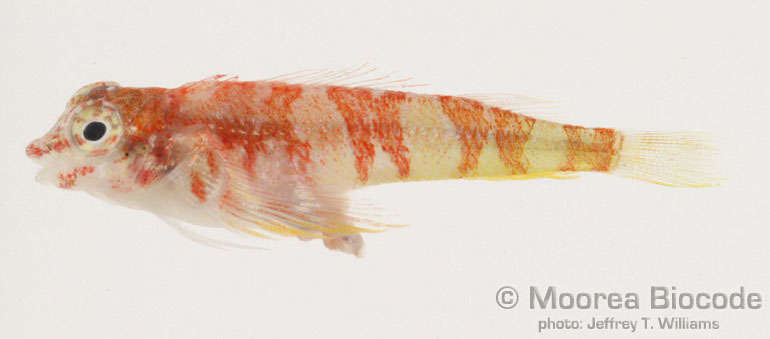
Triplefin blennies are cryptically colored or transparent, heavily scaled, and small. Most are only 3-4 cm, the largest reaching 25 cm. In triplefin blennies the dorsal fin is divided into three distinct parts. The first two segments are composed of numerous slender spines, and the third segment is made up of at least seven soft rays. There are between zero and two anal fin spines. Scales are usually, but not universally,
ctenoid (rough-edged or toothed). The nape lacks cirri, and the first gill arch attaches to the operculum, the latter characteristic distinguishing Tripterygiidae from Clinidae.
Sexual dimorphism is common, with males assuming black or red coloration on the head, body, or caudal fin during spawning. Urogenital (involving both the urinary and genital structures) morphology may also differ between males and females. Gray and brown are typical colors on females and nonspawning males. (Click here to see a
fish diagram).
Other Physical Features: ectothermic ; bilateral symmetry
Sexual Dimorphism: male more colorful; sexes shaped differently
Trusted
Ecology
Habitat
Primarily benthic reef-dwellers in tropical and warm temperate seas, triplefin blennies commonly live near reef surfaces, rocky slopes, rubble, or algae-covered rocks. Depth and habitat can vary according to specific local adaptations. One species can sometimes be found in estuaries.
Habitat Regions: tropical ; saltwater or marine
Aquatic Biomes: benthic ; reef ; brackish water
Other Habitat Features: estuarine ; intertidal or littoral
- Graham, J. 1997. Air-Breathing Fishes: Evolution, Diversity, and Adaptation.. San Diego, CA: Academic Press.
Trusted
Trophic Strategy
Food Habits
Triplefin blennies feed on algae and tiny invertebrates.
Primary Diet: carnivore (Eats non-insect arthropods); herbivore ; omnivore ; planktivore
Trusted
Associations
Ecosystem Roles
Triplefin blennies have in many cases adapted to specialized local conditions, so they may occupy otherwise unfilled roles in certain areas. They feed on and thereby impact populations of small invertebrates, and likewise may affect algal growth.
Trusted
Predation
Triplefin blennies avoid predators by attempting to remain unnoticed. They are small, occupy hiding places in the reef, and are cryptically colored or partially transparent.
Anti-predator Adaptations: cryptic
Trusted
Known prey organisms
non-insect arthropods
This list may not be complete but is based on published studies.
- Myers, P., R. Espinosa, C. S. Parr, T. Jones, G. S. Hammond, and T. A. Dewey. 2006. The Animal Diversity Web (online). Accessed February 16, 2011 at http://animaldiversity.org. http://www.animaldiversity.org
Trusted
Life History and Behavior
Behavior
Communication and Perception
No information was found on communication in Tripterygiidae, except regarding courtship displays by males (see Reproduction: Mating Systems).
Communication Channels: visual ; acoustic
Perception Channels: visual ; acoustic
Trusted
Life Cycle
Development
Sticky threads anchor the eggs of triplefin blennies to algae in the nest site. After hatching, larvae in species of Tripterygion settle after approximately 40 days. One study indicates that larvae are affected by auditory cues (reef sounds) in determining where to settle.
- Myrberg, A., L. Fuiman. 2002. The Sensory World of Coral Reef Fishes. Pp. 123-148 in P Sale, ed. Coral Reef Fishes: Dynamics and Diversity in a Complex Ecosystem. San Diego, CA: Academic Press.
Trusted
Life Expectancy
Reproduction
Male triplefin blennies establish territories on rocks covered with algae. From this vantage point they signal to passing females by “loop-swimming,” a courtship motion that varies from species to species, but entails quickly hopping up and down in a loop. Males of species in Axoclinus pose before loop-swimming, resting on their pelvic fins and waving the caudal fin, which gives the female a better chance to view his courtship colors. One male may spawn with several females.
Mating System: polygynous
Definitive information about spawning seasons of triplefin blennies is lacking, but spawning likely occurs year-round in the tropics and during warmer seasons in temperate areas. In order to spawn the male first cleans the algal filaments at the nest site, and then attracts one or more females to the nest. Spawning can last up to several hours. Eggs are deposited by the female one at a time and fertilized simultaneously by the male, with clutch sizes sometimes reaching 500 eggs. “Streaking” occurs in some species of Tripterygion and Axoclinus: smaller, most likely younger, cryptically-colored males rush in while the dominant male is engaged in spawning, releasing their own sperm in an attempt to fertilize some of the eggs.
Key Reproductive Features: iteroparous ; gonochoric/gonochoristic/dioecious (sexes separate); sexual ; fertilization (External ); oviparous
Male triplefin blennies remain near the eggs to guard them until they hatch.
- Thresher, R. 1984. Reproduction in Reef Fishes. Neptune City, NJ: T.F.H. Publications.
Trusted
Molecular Biology and Genetics
Molecular Biology
Statistics of barcoding coverage
| Specimen Records: | 479 | Public Records: | 145 |
| Specimens with Sequences: | 412 | Public Species: | 11 |
| Specimens with Barcodes: | 383 | Public BINs: | 23 |
| Species: | 61 | ||
| Species With Barcodes: | 47 | ||
Trusted
Barcode data
Trusted
Locations of barcode samples
Trusted
Conservation
Conservation Status
Currently, there is no known conservation threat to any member of this family.
- The World Conservation Union, 2002. "IUCN 2002" (On-line). IUCN Red List of Threatened Species. Accessed August 02, 2003 at http://www.iucnredlist.org/.
Trusted
Relevance to Humans and Ecosystems
Benefits
Economic Importance for Humans: Negative
No specific information was found concerning any negative impacts to humans.
Trusted
Economic Importance for Humans: Positive
Some triplefin blennies are kept in aquaria, but none are considered sport or food fishes.
Positive Impacts: pet trade
Trusted
Wikipedia
Threefin blenny
Threefin or triplefin blennies are blennioids, small perciform marine fish of the family Tripterygiidae. Found in tropical and temperate waters of the Atlantic, Pacific and Indian Oceans, the family contains approximately 150 species in 30 genera. The family name derives from the Greek tripteros meaning "with three wings".
With an elongate, typical blenny form, threefin blennies differ from their relatives by having a dorsal fin separated into three parts (hence the name); the first two are spinous. The small, slender pelvic fins are located underneath the throat and possess a single spine; the large anal fin may have one or two spines. The pectoral fins are greatly enlarged, and the tail fin is rounded. The New Zealand topknot, Notoclinus fenestratus, is the largest species at 20 cm in total length; most other species do not exceed 6 cm.
Many threefin blennies are brightly coloured, often for reasons of camouflage; these species are popular in the aquarium hobby. As demersal fish, threefin blennies spend most of their time on or near the bottom on coral and rocks. The fish are typically found in shallow, clear waters with sun exposure, such as lagoons and seaward reefs; nervous fish, they retreat to rock crevices at any perceived threat.
Threefin blennies are diurnal and territorial; many species exhibit sexual dichromatism, with the females drab compared to the males. The second dorsal fin is also extended in the males of some species. Small invertebrates comprise the bulk of the threefin blenny diet.
General
FishBase lists about 150 species in 30 genera:
- Cremnochorites
- Crocodilichthys
- Cryptichthys
- Enneanectes
- Enneapterygius
- Forsterygion
- Gilloblennius
- Helcogramma
- Helcogrammoides
- Karalepis
- Lepidoblennius
- Lepidonectes
- Matanui
- Norfolkia
- Notoclinops
References
- Froese, Rainer, and Daniel Pauly, eds. (2006). "Tripterygiidae" in FishBase. June 2006 version.
| ||||||||||||||||||||||||||||||||||
Unreviewed
Disclaimer
EOL content is automatically assembled from many different content providers. As a result, from time to time you may find pages on EOL that are confusing.
To request an improvement, please leave a comment on the page. Thank you!