Overview

Comprehensive Description

Comments

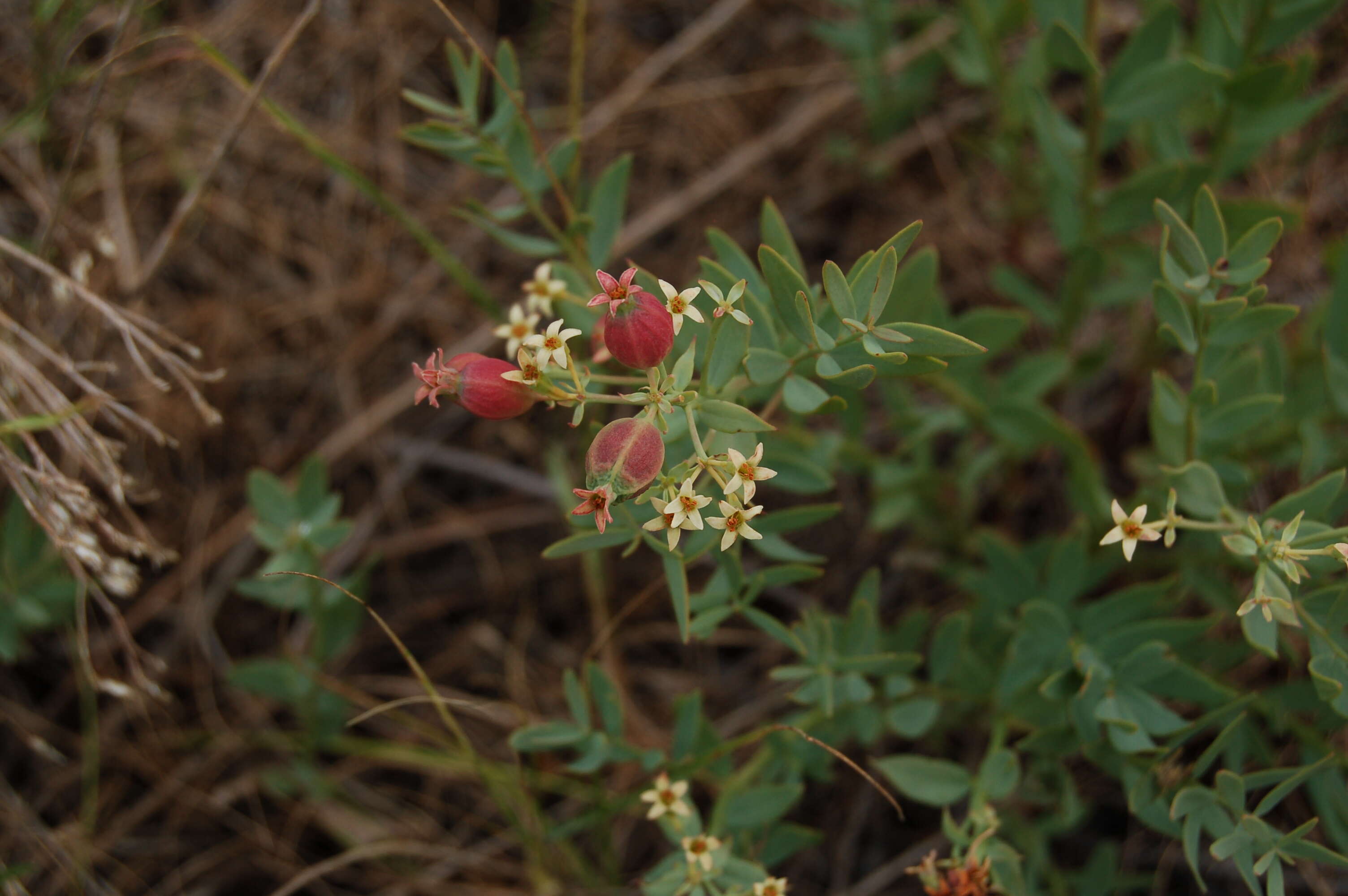
This is one of the few herbaceous plants of the prairie that produces edible fruit, although they are small-sized. Return
Creative Commons Attribution Non Commercial 3.0 (CC BY-NC 3.0)

© John Hilty

Source: Illinois Wildflowers

Trusted

Article rating from 0 people

Average rating: 2.5 of 5

Description

This is a native perennial plant up to 1' tall, which may be branched or unbranched. The stems are light green and smooth. The alternate leaves are up to 2' long and ¾' across. They are light green, hairless, and have smooth margins. Their shape may be oval or oblong, and they have short petioles or are sessile. Some of the stems terminate in a rather flattened cluster of a dozen or more small white flowers. Each shallow, tube-shaped flower is about ¼' across, and has 5 sepals that flare outward. The sepals are usually white, but may have light green or rose accents, particularly when the flower is still unopened. In the center, there are several yellow stamens. There is no noticeable scent. The blooming period occurs during the late spring or early summer and lasts about a month. Later, small oily fruits develop that are each about ¼' across, containing a single globular seed. They change in color from green to brown, and are said to have a sweet taste while still immature. The root system is fibrous, and it sends out slender underground suckers that parasitize other plants. Consequently, Bastard Toadflax is semi-parasitic. Deep horizontal rhizomes are also produced, causing the vegetative spread of this plant.
Creative Commons Attribution Non Commercial 3.0 (CC BY-NC 3.0)

© John Hilty

Source: Illinois Wildflowers

Trusted

Article rating from 0 people

Average rating: 2.5 of 5

Distribution

Range and Habitat in Illinois

Bastard Toadflax is widely distributed, but is less common in Southern Illinois. Sometimes, large populations of this plant occur locally at high quality sites. Habitats include mesic to dry black soil prairies, hill prairies, rocky open woodlands, lightly wooded ridges, and barrens with small stunted trees. Bastard Toadflax can parasitize a large variety of plant species, including some woody shrubs and trees.
Creative Commons Attribution Non Commercial 3.0 (CC BY-NC 3.0)

© John Hilty

Source: Illinois Wildflowers

Trusted

Article rating from 0 people

Average rating: 2.5 of 5

Localities documented in Tropicos sources

Comandra umbellata (L.) Nutt.:
Canada (North America)
United States (North America)

Note: This information is based on publications available through Tropicos and may not represent the entire distribution. Tropicos does not categorize distributions as native or non-native.
Creative Commons Attribution Non Commercial Share Alike 3.0 (CC BY-NC-SA 3.0)

© Missouri Botanical Garden, 4344 Shaw Boulevard, St. Louis, MO 63110 USA

Source: Missouri Botanical Garden

Trusted

Article rating from 0 people

Average rating: 2.5 of 5

National Distribution

Canada

Origin: Native

Regularity: Regularly occurring

Currently: Present

Confidence: Confident

United States

Origin: Native

Regularity: Regularly occurring

Currently: Present

Confidence: Confident

Type of Residency: Year-round

Creative Commons Attribution Non Commercial 3.0 (CC BY-NC 3.0)

© NatureServe

Source: NatureServe

Trusted

Article rating from 0 people

Average rating: 2.5 of 5

Ecology

Habitat

Range and Habitat in Illinois

Bastard Toadflax is widely distributed, but is less common in Southern Illinois. Sometimes, large populations of this plant occur locally at high quality sites. Habitats include mesic to dry black soil prairies, hill prairies, rocky open woodlands, lightly wooded ridges, and barrens with small stunted trees. Bastard Toadflax can parasitize a large variety of plant species, including some woody shrubs and trees.
Creative Commons Attribution Non Commercial 3.0 (CC BY-NC 3.0)

© John Hilty

Source: Illinois Wildflowers

Trusted

Article rating from 0 people

Average rating: 2.5 of 5

Associations

Faunal Associations

The most important visitors to the flowers are flies, including Soldier flies, Syrphid flies, Flesh flies, Blow flies, Muscid flies, and Anthomyiid flies. Various bees, butterflies, and beetles visit the flowers occasionally. All of these insects usually seek nectar. The small fruit is probably eaten by small mammals (e.g., mice), by which means the seeds are distributed.
Creative Commons Attribution Non Commercial 3.0 (CC BY-NC 3.0)

© John Hilty

Source: Illinois Wildflowers

Trusted

Article rating from 0 people

Average rating: 2.5 of 5

Flower-Visiting Insects of Bastard Toadflax in Illinois

Trusted

Article rating from 0 people

Average rating: 2.5 of 5

Molecular Biology and Genetics

Molecular Biology

Barcode data: Comandra umbellata

The following is a representative barcode sequence, the centroid of all available sequences for this species.


No available public DNA sequences.

Download FASTA File
Creative Commons Attribution 3.0 (CC BY 3.0)

© Barcode of Life Data Systems

Source: Barcode of Life Data Systems (BOLD)

Trusted

Article rating from 0 people

Average rating: 2.5 of 5

Statistics of barcoding coverage: Comandra umbellata

Barcode of Life Data Systems (BOLDS) Stats
Public Records: 6
Specimens with Barcodes: 10
Species With Barcodes: 1
Creative Commons Attribution 3.0 (CC BY 3.0)

© Barcode of Life Data Systems

Source: Barcode of Life Data Systems (BOLD)

Trusted

Article rating from 0 people

Average rating: 2.5 of 5

Conservation

Conservation Status

National NatureServe Conservation Status

Canada

Rounded National Status Rank: N5 - Secure

United States

Rounded National Status Rank: N5 - Secure

Creative Commons Attribution Non Commercial 3.0 (CC BY-NC 3.0)

© NatureServe

Source: NatureServe

Trusted

Article rating from 0 people

Average rating: 2.5 of 5

NatureServe Conservation Status

Rounded Global Status Rank: G5 - Secure

Creative Commons Attribution Non Commercial 3.0 (CC BY-NC 3.0)

© NatureServe

Source: NatureServe

Trusted

Article rating from 0 people

Average rating: 2.5 of 5

Relevance to Humans and Ecosystems

Benefits

Cultivation

The preference is full or partial sun, and average to dry conditions. This plant normally occurs in soil that is either loamy or rocky. It doesn't appear to be affected significantly by foliar disease. There is a preference for an acid pH.
Creative Commons Attribution Non Commercial 3.0 (CC BY-NC 3.0)

© John Hilty

Source: Illinois Wildflowers

Trusted

Article rating from 0 people

Average rating: 2.5 of 5

Wikipedia

Comandra

The genus Comandra contains a single species, C. umbellata, with 4 sub-species distributed in North America and the Mediterranean.[1] C. umbellata is considered to be semi-parasitic.

Contents

Description [edit]

Comandra is a small herb that lives as a parasite on plant roots and has tiny white flowers.[2]

Parasitism [edit]

Comandra is not an obligate parasite since it obtains nutrition through photosynthesis, however it does have a wide host range, including, but not limited to many herbs including Aster, Antennaria, Solidago, several shrub species Rosa, Rubus, Fragaria, Vaccinium, and several tree species Acer, Betula, Populus, as well as Carex, and various grasses.[3]

Pathogens [edit]

Comandra umbellata is the alternate host for the rust fungus Cronartium comandrae Peck., or comandra blister rust, that affects pine species in North America. Comandra blister rust can cause losses to volume of up to 7% in some regions where it is common.[4]

When Comandra umbellata is infected by Cronartium comandrae aeciospores that develop on the pine host, yellow blister-like spots bearing urediniospores appear on the leaves of the plant within 20 days. In the following weeks teliospores develop on brown hairlike telia that germinate to produce basidiospores, the Cronartium comandrae life-stage capable of infecting pines.[5]

References [edit]

  1. ^ Mabberley, DJ (2000). The Plant Book: A portable dictionary of the vascular plants. New York: Cambridge University Press. 
  2. ^ Eckel, P. M. (2000). "Tiny Species: Myosotis stricta Link, A Rare Component of Some Vernal Microfloras in New York and Ontario along the Niagara River". Clintonia 16 (1): 4. 
  3. ^ Moss, E. H. (1926). "Parasitism in the genus Comandra". New Phytologist 25 (4): 264–276. doi:10.1111/j.1469-8137.1926.tb06695.x. 
  4. ^ Woods, AJ; A. Nussbaum, B. Golding (2000). "Predicted impacts of hard pine stem rusts on lodgepole pine dominated stands in central British Columbia". Canadian Journal of Forest Research 30 (3): 476–481. doi:10.1139/cjfr-30-3-476. 
  5. ^ Johnson, David W. (1986). "Comandra Blister Rust". Forest Insect & Disease Leaflet 62. 
Creative Commons Attribution Share Alike 3.0 (CC BY-SA 3.0)


Source: Wikipedia

Unreviewed

Article rating from 0 people

Average rating: 2.5 of 5

Disclaimer

EOL content is automatically assembled from many different content providers. As a result, from time to time you may find pages on EOL that are confusing.

To request an improvement, please leave a comment on the page. Thank you!