Overview

Distribution

National Distribution

United States

Origin: Exotic

Regularity: Regularly occurring

Currently: Unknown/Undetermined

Confidence: Confident

Creative Commons Attribution Non Commercial 3.0 (CC BY-NC 3.0)

© NatureServe

Source: NatureServe

Trusted

Article rating from 0 people

Average rating: 2.5 of 5

Ecology

Associations

Associations

Plant / resting place / on
imago of Chrysolina cerealis may be found on plant of Satureja montana
Remarks: season: 4-early 10

Trusted

Article rating from 0 people

Average rating: 2.5 of 5

Molecular Biology and Genetics

Molecular Biology

Statistics of barcoding coverage: Satureja montana

Barcode of Life Data Systems (BOLDS) Stats
Public Records: 2
Species: 2
Species With Barcodes: 1

Creative Commons Attribution 3.0 (CC BY 3.0)

© Barcode of Life Data Systems

Source: Barcode of Life Data Systems (BOLD)

Trusted

Article rating from 0 people

Average rating: 2.5 of 5

Conservation

Conservation Status

National NatureServe Conservation Status

United States

Rounded National Status Rank: NNA - Not Applicable

Creative Commons Attribution Non Commercial 3.0 (CC BY-NC 3.0)

© NatureServe

Source: NatureServe

Trusted

Article rating from 0 people

Average rating: 2.5 of 5

NatureServe Conservation Status

Rounded Global Status Rank: GNR - Not Yet Ranked

Creative Commons Attribution Non Commercial 3.0 (CC BY-NC 3.0)

© NatureServe

Source: NatureServe

Trusted

Article rating from 0 people

Average rating: 2.5 of 5

Wikipedia

Winter savory

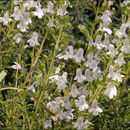
Winter savory (Satureja montana) is a perennial herb in the family Lamiaceae, native to warm temperate regions of southern Europe.

It is a semi-evergreen, semi-woody subshrub growing to over 230 cm (7.5 ft) tall. The leaves are opposite, oval-lanceolate, 1–2 cm long and 5 mm broad. The flowers are white.

Contents

Cultivation and uses

Easy to grow, it makes an attractive border plant for any culinary herb garden. It requires six hours of sun a day in soil that drains well. S. montana 'Nana' is a dwarf cultivar.

Winter savory is now little used, but for hundreds of years both it and summer savory have been grown and used, virtually side by side. Both have strong spicy flavour.

It is used as a companion plant for beans, keeping bean weevils away, and also roses, reducing mildew and aphids.[1].

Culinary Uses

In cooking, winter savory has a reputation for going very well with both beans and meats, very often lighter meats such as chicken or turkey, and can be used in stuffing. It has a strong flavour while uncooked but loses much of its flavour under prolonged cooking.

Medicinal Uses

Winter savory has been purported to have antiseptic, aromatic, carminative, and digestive benefits.[2] It has also been used as an expectorant and in the treatment of stings.[citation needed] The plant has a stronger action than the closely related summer savory.

Taken internally, it is said to be a remedy for colic and a cure for flatulence, whilst it is also used to treat gastro-enteritis, cystitis, nausea, diarrhoea, bronchial congestion, sore throat and menstrual disorders. It should not be prescribed for pregnant women.[citation needed] A sprig of the plant, rubbed onto bee or wasp stings, brings instant relief.[citation needed]

Therapeautic grade oil has been determined to inhibit growth of Candida albicans.[3]

Ethanolic extract (1:1) tested against eleven species of bacteria and five species of fungi. The hole-plate diffusion method pointed at the strongest activity against Bacillus subtilis, Sarcina flava, Candida tropicalis and Candida krusei.[4]

The plant is harvested in the summer when in flower and can be used fresh or dried. The essential oil forms an ingredient in lotions for the scalp in cases of incipient baldness. An ointment made from the plant is used externally to relieve arthritic joints.

In traditional herbal medicine, summer savory was believed to be an aphrodisiac, while winter savory was believed to inhibit sexual desire.

Chemical Constituents: Carvacrol (30 - 75%), thymol (1.0 - 5.0%), p-cymene (10 - 20%), gamma-terpineol (2.0 - 10%), 1,8-cineole (3.8%), borneol (12.5%), alpha-terpineol (2.5%)

References

  1. ^ winter savory
  2. ^ Plants for a Future
  3. ^ Oberg K, Rolling L, Oberg C. in The Journal of the Utah Academy of Sciences, Arts, and Letters. 2005;82:60-72
  4. ^ S. Pepeljnjak, G. Stanic and P. Potocki in Acta Pharmaceutica 49 (1999) 65–69
Creative Commons Attribution Share Alike 3.0 (CC BY-SA 3.0)


Source: Wikipedia

Unreviewed

Article rating from 0 people

Average rating: 2.5 of 5

Disclaimer

EOL content is automatically assembled from many different content providers. As a result, from time to time you may find pages on EOL that are confusing.

To request an improvement, please leave a comment on the page. Thank you!