IUCN threat status:

Vulnerable (VU)

Wikipedia

Read full entry

Russian tortoise

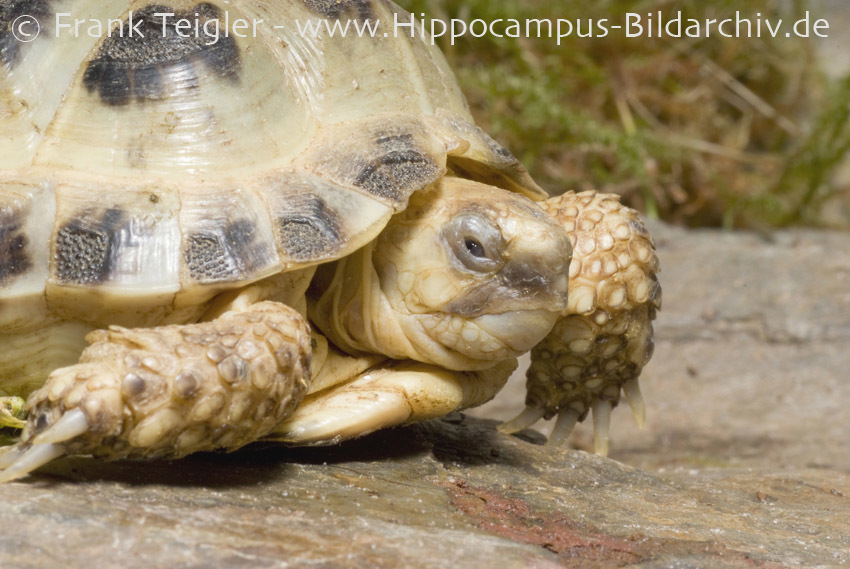
The Russian tortoise, Horsfield's tortoise or Central Asian tortoise Agrionemys horsfieldii, is a species of tortoise that is a popular pet. It is named after the American naturalist Thomas Horsfield.

Contents

Description [edit]

The Russian tortoise is a small tortoise species, ranging from about 13 to 25 cm (13–20 cm for males, 15–25 cm for females). They are sexually dimorphic in that the females grow slightly larger, males tend to have a longer tail that is generally tucked to the side, and females tend to have flared scutes on their shells, while males do not. Males have a concave bump on the bottom half of their shells so that they can mount females during intercourse while females have flat bottoms. Coloration varies, but the shell is usually a ruddy brown or black, fading to yellow between the scutes, and the body itself straw-yellow and brown. They have four toes. They live such a long time (about 50–75 years), that people who keep them as pets often leave them in their will. They are usually rather social with humans.

Systematics [edit]

This species is traditionally placed in Testudo. Due to distinctly different morphological characteristics, the monotypic genus Agrionemys was proposed for it in 1966. Today, Agrionemys horsfieldii is currently being accepted.[2] DNA sequence analysis generally concurs, but not too robustly so.[3] Some sources also list three separate subspecies of Russian Tortoise, but they are not widely accepted by taxonomists:[4]


Footnotes [edit]

  1. ^ Fritz Uwe; Peter Havaš (2007). "Checklist of Chelonians of the World". Vertebrate Zoology 57 (2): 301–302. ISSN 18640-5755. Archived from the original on 2010-12-17. Retrieved 29 May 2012. 
  2. ^ Khozatsky & Mlynarski (1966)
  3. ^ e.g. Fritz et al. (2005)
  4. ^ http://reptile-database.reptarium.cz/species.php?genus=Testudo&species=horsfieldii

References [edit]

Species Testudo horsfieldii at The Reptile Database
  • da Nóbrega Alves, Rômulo Romeu; da Silva Vieira; Washington Luiz & Gomes Santana, Gindomar (2008): Reptiles used in traditional folk medicine: conservation implications. Biodiversity and Conservation 17(8): 2037–2049. doi:10.1007/s10531-007-9305-0 (HTML abstract, PDF first page)
  • Fritz, Uwe; Kiroký, Pavel; Kami, Hajigholi & Wink, Michael (2005): Environmentally caused dwarfism or a valid species - Is Testudo weissingeri Bour, 1996 a distinct evolutionary lineage? New evidence from mitochondrial and nuclear genomic markers. Molecular Phylogenetics and Evolution 37: 389–401. doi:10.1016/j.ympev.2005.03.007
  • Khozatsky, L.I. & Mlynarski, M. (1966): Agrionemys - nouveau genre de tortues terrestres (Testudinidae). Bulletin de l'Académie Polonaise des Sciences II - Série des Sciences Biologiques 2: 123-125.
  • Tortoise & Freshwater Turtle Specialist Group (TFTSG) (1996). Testudo horsfieldii. 2006. IUCN Red List of Threatened Species. IUCN 2006. www.iucnredlist.org. Retrieved on 11 May 2006. Listed as Vulnerable (VU A2d v2.3)
  • Alderton, D.: Turtles and Tortoises of the World. New York, New York: Facts on File, 1988.
  • Ernst, C. H. and Barbour, R. W.: Turtles of the World. Washington D.C.: Smithsonian Institution Press, 1989.
  • Highfield, A. C.: Keeping and Breeding Tortoises in Captivity. Avon, England: R & A Publishing, 1990.
  • Obst, F. J.: Turtles, Tortoises and Terrapins. St. Martin's Press, New York, 1988.
  • Pritchard, P. C. H.: Encyclopedia of Turtles. Neptune City, New Jersey: T.F.H. Publications. 1979.
  • Pursall, B.: Mediterranean Tortoises. Neptune City, New Jersey: T.F.H. Publications, 1994.
  • Wahlquist, H.: Horsfield's tortoise, Agrionemys horsfieldii. Tortuga Gazette 27(6): 1-3, June 1991.

Unreviewed

Creative Commons Attribution Share Alike 3.0 (CC BY-SA 3.0)


Source: Wikipedia

Belongs to 1 community

Disclaimer

EOL content is automatically assembled from many different content providers. As a result, from time to time you may find pages on EOL that are confusing.

To request an improvement, please leave a comment on the page. Thank you!