Comprehensive Description
Read full entryDescription
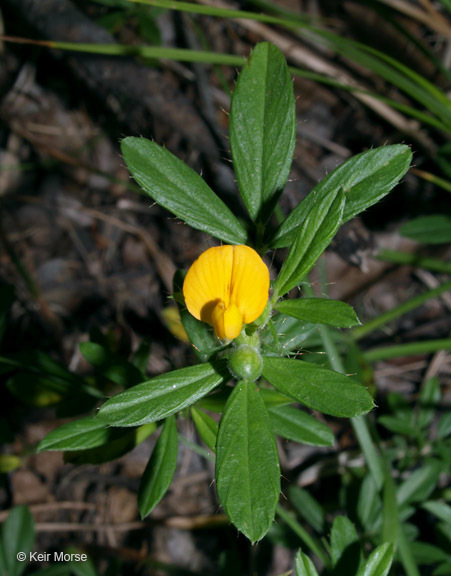
This perennial wildflower is 4-12' tall; it is branched at the base and often branched above. The ascending to erect stems are light to medium green, hairy, and terete. Alternate trifoliate leaves occur at intervals along the stems. The leaflets are ½-1½' long and 4-8 mm. across; they are elliptic in shape, while their margins are entire (smooth) and ciliate. The upper leaflet surface is medium green and glabrous to sparsely short-pubescent, while the lower leaflet surface is light green and sparsely short-pubescent. The petioles of the trifoliate leaves are up to ¼' long, light green, and hairy. The base of each petiole and a portion of the adjacent stem are surrounded by a pair of of green to brown stipules; each stipule tapers to a ciliate beak. The terminal leaflets have petiolules (basal stalklets) up to ¼' long, while the lateral leaflets are sessile (or nearly so). Leaf venation is pinnate; the veins along the upper leaflet surfaces often appear to be shiny. The flowers are produced individually (rare in clusters) from the axils of the leaves. The pedicels of the flowers are up to ¼' long. Each flower has 5 yellow petals, a light green calyx with 4-5 lobes, and the enclosed reproductive organs. The petals are arranged in a pea-like floral structure, consisting of a large banner, a pair of forward-projecting wings, and an enclosed keel. The flowers are oriented either laterally (with erect banners) or they are held erect (with the banners at the bottom). The blooming period occurs from late spring to late summer, lasting about 1½-3 months. Only a few flowers are in bloom at the same time. The flowers are replaced by small seedpods consisting of two segmentsTrusted