Overview

Brief Summary

Biology

This species is well adapted for survival in the dry areas it inhabits; it is able to live for nine to ten months without drinking, thanks to a number of specialisations including kidneys that minimise urine production and an ability to reach body temperatures of 46.5°C before beginning to perspire (9). In the wild, the scimitar-horned oryx lived in groups of up to 40, with much larger herds forming at certain times of year (9) (10). In the wet season these herds migrated to the north, returning at the onset of the dry season (9). Births occur mainly in March and October (2), and the female will separate herself from the herd for a few hours while she calves (6). The young become fully independent at around 14 weeks of age (6). Browsing in the relative cool of the early morning and evening (6), these oryx feed on a wide range of grass species, foliage and fruit (9) (10).
Creative Commons Attribution Non Commercial Share Alike 3.0 (CC BY-NC-SA 3.0)

© Wildscreen

Source: ARKive

Trusted

Article rating from 0 people

Average rating: 2.5 of 5

Comprehensive Description

Description

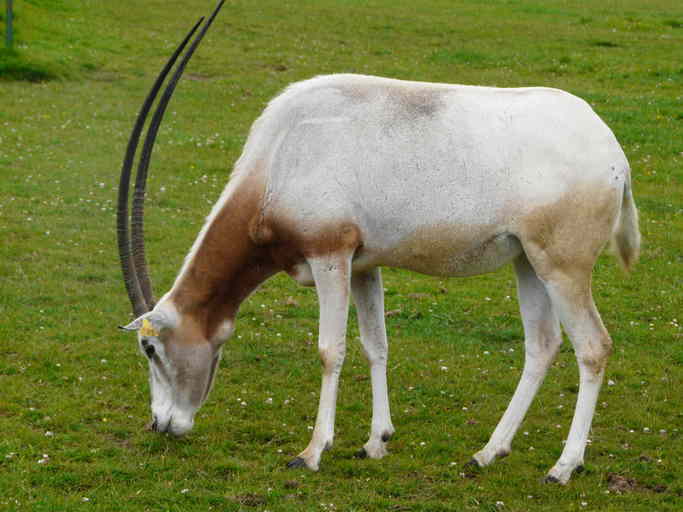
Large, pale ante­lope, distinctively marked and with long, back-curved horns. Pale, almost white above and below with indistinct or no flank stripe. Pale chestnut to reddish on neck, shoulders, along back to tail tuft. Legs white. Head whitish with brown along top of snout and between horns and patch or line run­ning vertically through the eye. Horns very long and curved back, thicker in male, thinner and slightly longer in female. Ringed. Tail down to below hock with terminal tuft. Voice a low grunt or, when threatened, a bleat.

Creative Commons Attribution Non Commercial Share Alike 3.0 (CC BY-NC-SA 3.0)

© Bibliotheca Alexandrina

Source: Bibliotheca Alexandrina

Trusted

Article rating from 0 people

Average rating: 2.5 of 5

Description

The scimitar-horned oryx, so named for its magnificent curved horns, is now thought to be Extinct in the Wild, hunted to the brink of extinction for its meat and exceptionally robust hide (4). The stocky body is a pale colour, with brown markings on the face and a reddish-brown neck and chest area (5). The large, spread hooves allow these antelope to walk on the sand of their dry habitat (6).
Creative Commons Attribution Non Commercial Share Alike 3.0 (CC BY-NC-SA 3.0)

© Wildscreen

Source: ARKive

Trusted

Article rating from 0 people

Average rating: 2.5 of 5

Distribution

Range Description

May formerly have been widespread across North Africa, at least in arid and Saharan areas, but now Extinct in the Wild over all its range. Captive herds are kept in fenced protected areas in Tunisia, Senegal and Morocco (Sous Massa National Park (probably outside the known historical range) as part of long-term reintroduction programmes.
Creative Commons Attribution Non Commercial Share Alike 3.0 (CC BY-NC-SA 3.0)

© International Union for Conservation of Nature and Natural Resources

Source: IUCN

Trusted

Article rating from 0 people

Average rating: 2.5 of 5

Geographic Range

The Scimitar-horned oryx is found in the desert to semidesert region of Africa known as the "Great Steppe." This area is a strip of arid grassland extending from Senegal to central Sudan, which borders the southern edge of the Sahara Desert.

Biogeographic Regions: ethiopian (Native )

Creative Commons Attribution Non Commercial Share Alike 3.0 (CC BY-NC-SA 3.0)

© The Regents of the University of Michigan and its licensors

Source: Animal Diversity Web

Trusted

Article rating from 0 people

Average rating: 2.5 of 5

Distribution in Egypt

In Egypt, formerly in Western Desert recorded in nineteenth century from around Siwa, Kharga, Dakhla, Wadi El Natrun, and the Fayoum. Now almost certainly extinct in the country.

Creative Commons Attribution Non Commercial Share Alike 3.0 (CC BY-NC-SA 3.0)

© Bibliotheca Alexandrina

Source: Bibliotheca Alexandrina

Trusted

Article rating from 0 people

Average rating: 2.5 of 5

Global Distribution

Formerly over much of North Africa from Senegal north to southern Morocco east through Niger, Mali, Chad to Libya, Egypt, and Sudan, east to Sinai. Now, like the Addax, exter­minated over much of its range, largely due to hunting, and in dan­ger of extinction in the wild. Captive breeding program currently underway in Tunisia.

Creative Commons Attribution Non Commercial Share Alike 3.0 (CC BY-NC-SA 3.0)

© Bibliotheca Alexandrina

Source: Bibliotheca Alexandrina

Trusted

Article rating from 0 people

Average rating: 2.5 of 5

Historic Range:
North Africa

Trusted

Article rating from 0 people

Average rating: 2.5 of 5

Range

The scimitar-horned oryx was once one of the most common large mammals of northern Africa with a range extending from Morocco and Tunisia to Egypt, reaching south to Mauritania and Sudan (7) (8). The range rapidly declined throughout the 20th Century, until in 1980 it was known only from Chad and Niger with a few individuals in Mali and Sudan. The species is believed to have become Extinct in the Wild in 1999 (9).
Creative Commons Attribution Non Commercial Share Alike 3.0 (CC BY-NC-SA 3.0)

© Wildscreen

Source: ARKive

Trusted

Article rating from 0 people

Average rating: 2.5 of 5

Physical Description

Morphology

Physical Description

The Scimitar-horned oryx, like other oryxes, has a black and and white face mask. However, in this species the black tends to fade to a brownish color. Their basic color is white with rusty brown necks and chests. Soms specimens have brown bands on their flanks along with a rusty brown spot outlined on the thigh. Like all orxyes, calves are born with yellow coats and lack distinguishing marks which appear later in life. The Scimitar-horned oryx is average in size compared to the larger East African oryx or the smaller Arabian oryx. Average length is 5.5 ft (1.7 m) with a shoulder height of about 3.8 ft (1.2 m)and an average weight of 148 lbs . It is the only oryx whose horns curve backwards. The horns average about 40 inches (1 m), but lengths of 50 inches (1.2 m) or more have been recorded. Both sexes have horns and, like other oryxes, the female's tend to be more slender.

Average mass: 200 kg.

Average mass: 177500 g.

Creative Commons Attribution Non Commercial Share Alike 3.0 (CC BY-NC-SA 3.0)

© The Regents of the University of Michigan and its licensors

Source: Animal Diversity Web

Trusted

Article rating from 0 people

Average rating: 2.5 of 5

Size

Size

Length 235-280cm; Tail. 45-60cm; Shoulder 110-125cm; Weight 135-180kg.

Creative Commons Attribution Non Commercial Share Alike 3.0 (CC BY-NC-SA 3.0)

© Bibliotheca Alexandrina

Source: Bibliotheca Alexandrina

Trusted

Article rating from 0 people

Average rating: 2.5 of 5

Ecology

Habitat

Habitat and Ecology

Habitat and Ecology
Primarily inhabits sub-desert, annual grassland steppe areas. Found in rolling dunes, grassy steppes and wooded inter-dunal depressions, rarely entering true desert or true Sahelian bush. The Scimitar-horned Oryx is well adapted to arid areas.

Systems
  • Terrestrial
Creative Commons Attribution Non Commercial Share Alike 3.0 (CC BY-NC-SA 3.0)

© International Union for Conservation of Nature and Natural Resources

Source: IUCN

Trusted

Article rating from 0 people

Average rating: 2.5 of 5

Habitat

The Scimitar-horned oryx is found in barren steppes of desert to semidesert environments.

Terrestrial Biomes: desert or dune ; chaparral

Creative Commons Attribution Non Commercial Share Alike 3.0 (CC BY-NC-SA 3.0)

© The Regents of the University of Michigan and its licensors

Source: Animal Diversity Web

Trusted

Article rating from 0 people

Average rating: 2.5 of 5

Habitat

Primarily inhabits sub-desert, annual grassland steppe areas. Found in rolling dunes, grassy steppes and wooded inter-dunal depressions, rarely entering true desert or true Sahelian bush. The Scimitar-horned Oryx is well adapted to arid areas.

Creative Commons Attribution Non Commercial Share Alike 3.0 (CC BY-NC-SA 3.0)

© Bibliotheca Alexandrina

Source: Bibliotheca Alexandrina

Trusted

Article rating from 0 people

Average rating: 2.5 of 5

Habitat

Inhabits sub-desert areas, the area between true desert and the Sahel where the annual rainfall is less than 350 millimetres, and lives in dunes, wooded depressions between dunes and grassy steppe (9) (10).
Creative Commons Attribution Non Commercial Share Alike 3.0 (CC BY-NC-SA 3.0)

© Wildscreen

Source: ARKive

Trusted

Article rating from 0 people

Average rating: 2.5 of 5

Trophic Strategy

Food Habits

The Scimitar-horned oryx is herbivorous, feeding on annual grasses, herbs, juicy roots, buds, and when water is scarce, fruits and vegetables. Like most inhabitants of arid environments it is subject to unpredictable and variable amounts of precipitation. Because of their great nomadic ability, the Scimitar-horned oryx will travel many miles in search of new new green grass which sprouts up quickly after sudden down pours. Though they tend to stay in small groups of about 40, when food is scarce and concentrated they can form herds of more than a hundrend.

Creative Commons Attribution Non Commercial Share Alike 3.0 (CC BY-NC-SA 3.0)

© The Regents of the University of Michigan and its licensors

Source: Animal Diversity Web

Trusted

Article rating from 0 people

Average rating: 2.5 of 5

Life History and Behavior

Behavior

Behaviour

Active in early morning and early evening and some­ times during night. Rests during day in shade, if available. Sociable, living in small herds of up to 20-30 animals led by an old male. In past, much larger groups recorded. Old males may be solitary. Nomadic, following rains to areas of vegetation. Diet includes grass and leaves, also roots and fruits, such as wild melons. Can survive on moisture from food and dew in absence of standing water. If water is available, will drink often. Predators such as Leopard and Hyena largely exterminated in modern Egypt where main threat, if it still survives, is human. Gestation 242-256 days. Gives birth to a single calf but timing of birth unknown in Egypt and variable elsewhere. Lives up to 22 years in captivity.

Creative Commons Attribution Non Commercial Share Alike 3.0 (CC BY-NC-SA 3.0)

© Bibliotheca Alexandrina

Source: Bibliotheca Alexandrina

Trusted

Article rating from 0 people

Average rating: 2.5 of 5

Life Expectancy

Lifespan/Longevity

Average lifespan

Status: captivity:
27.5 years.

Creative Commons Attribution Non Commercial Share Alike 3.0 (CC BY-NC-SA 3.0)

© The Regents of the University of Michigan and its licensors

Source: Animal Diversity Web

Trusted

Article rating from 0 people

Average rating: 2.5 of 5

Lifespan, longevity, and ageing

Maximum longevity: 27.5 years (captivity) Observations: One specimen was still living after 27.5 years in captivity (Richard Weigl 2005).
Creative Commons Attribution 3.0 (CC BY 3.0)

© Joao Pedro de Magalhaes

Source: AnAge

Trusted

Article rating from 0 people

Average rating: 2.5 of 5

Reproduction

Reproduction

Courting is done through the means of a mating circle. During this ritual, the male and female stand parallel to one another facing opposite directions. They then circle around one another until the cow allows the male to mount from behind. HOwever, if the female is not ready to mate, she can run away and circle in the reverse direction. Once the female oryx is impregnated, gestation lasts between 8 and 8.5 months. There is only one calf per birth, weighing an average of 20 to 33 lbs (9 to 15 kg).

Range number of offspring: 1 (low) .

Average number of offspring: 1.

Range gestation period: 8.07 to 8.53 months.

Average birth mass: 10317 g.

Average number of offspring: 1.

Average age at sexual or reproductive maturity (female)

Sex: female:
639 days.

Parental Investment: post-independence association with parents

Creative Commons Attribution Non Commercial Share Alike 3.0 (CC BY-NC-SA 3.0)

© The Regents of the University of Michigan and its licensors

Source: Animal Diversity Web

Trusted

Article rating from 0 people

Average rating: 2.5 of 5

Molecular Biology and Genetics

Molecular Biology

Statistics of barcoding coverage: Oryx dammah

Barcode of Life Data Systems (BOLDS) Stats
Public Records: 0
Species: 1
Species With Barcodes: 1

Creative Commons Attribution 3.0 (CC BY 3.0)

© Barcode of Life Data Systems

Source: Barcode of Life Data Systems (BOLD)

Trusted

Article rating from 0 people

Average rating: 2.5 of 5

Conservation

Conservation Status

IUCN Red List Assessment


Red List Category
EW
Extinct in the Wild

Red List Criteria

Version
3.1

Year Assessed
2008

Assessor/s
IUCN SSC Antelope Specialist Group

Reviewer/s
Mallon, D.P. & Plowman, A. (Antelope Red List Authority)

Contributor/s

Justification
There has been no definite evidence of the survival of this species in the wild for more than 15 years. Sporadic reports of animals sighted in Niger and Chad have never been substantiated, despite extensive surveys dedicated to detection of Sahelo-Saharan antelopes carried out in Chad and Niger in 2001-2004.

History
  • 2007
    Extinct in the Wild
  • 2000
    Extinct in the Wild
  • 1996
    Critically Endangered
  • 1994
    Endangered
    (Groombridge 1994)
  • 1990
    Endangered
    (IUCN 1990)
  • 1988
    Endangered
    (IUCN Conservation Monitoring Centre 1988)
  • 1986
    Endangered
    (IUCN Conservation Monitoring Centre 1986)
Creative Commons Attribution Non Commercial Share Alike 3.0 (CC BY-NC-SA 3.0)

© International Union for Conservation of Nature and Natural Resources

Source: IUCN

Trusted

Article rating from 0 people

Average rating: 2.5 of 5

Conservation Status

Though the Scimitar oryx's range has been greatly reduced, especially in the north, their numbers have stayed relatively high thanks to the large numbers living in captivity. Several large game preserves, mainly in Texas, have instigated successful programs for breeding the Scimitar-horned oryx. However, its habitat is being destroyed and reintroduction of large populations may prove difficult.

US Federal List: endangered

CITES: appendix i

IUCN Red List of Threatened Species: extinct in the wild

Creative Commons Attribution Non Commercial Share Alike 3.0 (CC BY-NC-SA 3.0)

© The Regents of the University of Michigan and its licensors

Source: Animal Diversity Web

Trusted

Article rating from 0 people

Average rating: 2.5 of 5

IUCN

Extinct in the Wild.

Creative Commons Attribution Non Commercial Share Alike 3.0 (CC BY-NC-SA 3.0)

© Bibliotheca Alexandrina

Source: Bibliotheca Alexandrina

Trusted

Article rating from 0 people

Average rating: 2.5 of 5

Current Listing Status Summary

Status: Endangered
Date Listed: 09/02/2005
Lead Region: Foreign (Region 10) 
Where Listed:


Population detail:

Population location: entire
Listing status: E

For most current information and documents related to the conservation status and management of Oryx dammah , see its USFWS Species Profile

Trusted

Article rating from 0 people

Average rating: 2.5 of 5

Status

Classified as Extinct in the Wild (EW) on the IUCN Red List 2007 (1). Listed on Appendix I of CITES and Appendices I and II of The Convention on Migratory Species (CMS or Bonn Convention) (3).
Creative Commons Attribution Non Commercial Share Alike 3.0 (CC BY-NC-SA 3.0)

© Wildscreen

Source: ARKive

Trusted

Article rating from 0 people

Average rating: 2.5 of 5

Population

Population
An estimated 500 Oryx survived at least until 1985 in Chad and Niger, but by 1988 only a few dozen individuals survived in the wild and since then there have been no confirmed reports of any wild oryx surviving in the wild (Morrow in press).

There are captive populations in fenced protected areas in several former range states: in Tunisia, there were 130 in Bou Hedma N.P. in 2005, 25 in Sidi-Toui N.P. (2006), and 12 in Oued Dekouk N.P. (2006); in Morocco, there were 240 in Souss-Massa N.P. in 2005; and in Senegal, there were 18 at Guembeul and 12 at Ferlo in 2004 (see Morrow in press, and refs therein). These populations are all maintained in fenced enclosures of varying sizes and are subject to different degrees of management. None is eligible for consideration as a released population for assessment purposes.
Creative Commons Attribution Non Commercial Share Alike 3.0 (CC BY-NC-SA 3.0)

© International Union for Conservation of Nature and Natural Resources

Source: IUCN

Trusted

Article rating from 0 people

Average rating: 2.5 of 5

Threats

Threats

Major Threats
Overhunting and habitat loss, including competition with domestic livestock, have been reported as the main reasons for the extinction of the wild population of Scimitar-horned Oryx (Mallon and Kingswood 2001, Devillers and Devillers-Terschuren 2005, Morrow in press).
Creative Commons Attribution Non Commercial Share Alike 3.0 (CC BY-NC-SA 3.0)

© International Union for Conservation of Nature and Natural Resources

Source: IUCN

Trusted

Article rating from 0 people

Average rating: 2.5 of 5

Threats

Originally the scimitar-horned oryx began to decline as a result of major climatic changes that caused the Sahara region to become dry. As the Sahara desert expanded, two populations of this oryx became increasingly isolated. The northern population was mostly lost prior to the 20th Century (8) (9). The decline of the southern population accelerated as Europeans began to settle the area and hunting for meat, hides and horn-trophies increased. It is thought that World War Two and the Civil War in Chad during the 1980s impacted heavily on the species through an increase in hunting for food (4) (9).
Creative Commons Attribution Non Commercial Share Alike 3.0 (CC BY-NC-SA 3.0)

© Wildscreen

Source: ARKive

Trusted

Article rating from 0 people

Average rating: 2.5 of 5

Management

Conservation Actions

Conservation Actions
The Scimitar-horned Oryx is listed on CMS Appendix 1. A global captive breeding programme was initiated in the 1960s. In 2005 there were at least 1,550 captive animals held in managed breeding programmes around the world (Gilbert 2005). In addition, a large number, probably >4,000 are kept in a private collection in the United Arab Emirates. Additional animals are likely held on private game ranches in the USA. As part of planned reintroduction projects, animals have been released into fenced protected areas in Tunisia (Bou Hedma National Park 1985, Sidi Toui National Park 1999, Oued Dekouk National Park 1999), Morocco (Souss-Massa National Park 1995), and Senegal (Ferlo Faunal Reserve 1998, Guembuel Wildlife Reserve 1999). Reintroduction is currently also planned at a site in Niger. It is listed on CITES Appendix I.
Creative Commons Attribution Non Commercial Share Alike 3.0 (CC BY-NC-SA 3.0)

© International Union for Conservation of Nature and Natural Resources

Source: IUCN

Trusted

Article rating from 0 people

Average rating: 2.5 of 5

Conservation

The species has successfully been bred in captivity and in 1985, five captive-bred pairs were reintroduced to Tunisia, and by 1989 the herd had produced 4 wild-born calves (9). Captive-bred oryx now exist in healthy numbers in both Tunisia and Morocco, and have been reintroduced into Senegal (1) (11). Individuals have also been introduced to Israel, although this was not within the historic range (9). Recent reports of sightings of oryx in Chad and Niger have been investigated but no animals found (1).
Creative Commons Attribution Non Commercial Share Alike 3.0 (CC BY-NC-SA 3.0)

© Wildscreen

Source: ARKive

Trusted

Article rating from 0 people

Average rating: 2.5 of 5

Relevance to Humans and Ecosystems

Benefits

Economic Importance for Humans: Positive

This oryx was used as a food source in the past, but now its most valuable contribution is probably its place in ecotourism. Both Africa and the United States are profiting greatly from the recent rise in this new form of tourism.

Creative Commons Attribution Non Commercial Share Alike 3.0 (CC BY-NC-SA 3.0)

© The Regents of the University of Michigan and its licensors

Source: Animal Diversity Web

Trusted

Article rating from 0 people

Average rating: 2.5 of 5

Wikipedia

Scimitar oryx

The scimitar oryx, or scimitar-Horned oryx, (Oryx dammah); also known as Sahara Oryx is a species of oryx which formerly inhabited the whole of North Africa. It has been classified as extinct in the wild by the IUCN.[1]

Contents

Etymology and taxonomy

The scimitar Oryx is named so referring to its magnificent horns,[3] resembling a scimitar. The name is composed of two words: orux (Greek), meaning a gazelle or antelope; and damma (Latin), meaning a fallow deer, an antelope, and also dammar (Arabic), meaning a sheep.[4] The nomenclature of this animal has undergone many changes since its discovery in the early 19th century. It was first described by Lorenz Oken, a German naturalist, in 1816 as Oryx algazel, but the name was soon replaced by Oryx dammah a decade later by Philipp Jakob Cretzschmar, a German physician. In 1827 the species name leucoryx was used, but was soon assigned a synonym to the Arabian Oryx (Oryx leucoryx).[5] Though the oldest name Oryx algazel was reintroduced after the name leucoryx failed, Sir John Ellerman (2nd Baronet), English shipowner, natural historian and philanthropist, and Terence Morrison-Scott, a British zoologist, realized that name was not suitable, in 1951. Finally in January 1956, the International Trust for Zoological Nomenclature accepted Oryx dammah as the scientific name, though many papers published shortly after that created confusion by using other names.[5]

Physical description

Close view of a scimitar oryx in the Werribee Open Range Zoo in Victoria, Australia.

The scimitar oryx is just over a meter (3.28 ft) at the shoulder and weighs around two hundred kilograms (440 lbs). Males are larger than females. Its coat is white with a red-brown chest and black markings on the forehead and down the length of the nose.[4] Calves are born with yellow coats and lack distinguishing marks which appear later in life.[6] Their pelage changes to adult coloration at 3–12 months old.[7] On a physiological level, the coat reflects the pale rays of the sun, while the black portions and tip of the tongue provide protection against sunburn.[7][8] The white coat helps in reflecting the heat of the desert.[9] Both sexes bear horns, and the females are more slender.[6] The horns are long, thin and symmetrical and curve backwards (a distinct feature of this species) and can reach a meter to a meter and a quarter (3.28 - 4.1 ft) on both the male and the female. The horns are so thin that they can break easily.[4] They have long tails measuring 60 centimeters (2 feet).[4] The female has 4 nipples.[2] The large, spread hooves are well-adapted and allow these antelopes to walk on the sand of their dry habitat.[3] A scimitar oryx can live as long as 20 years.[4][9][10]

Ecology

The scimitar oryx is a very sociable animal; for this reason, they form herds of mixed sex (the sex ratio being 50:50) containing up to 70 animals. Though not observed, it is believed that bachelor males form their own herds. Formerly they would gather in groups of several thousand for migration. During the wet season, herds migrate north into the Sahara Desert. Most often in any particular herd there will be a dominant or alpha bull. Usually these bulls provide guidance to the herd for their movements.[6] A diurnal animal, the scimitar oryx rests in the cool early mornings and evenings. Resting places include trees and shrubs, but when neither are available they dig holes in the soil with their hooves and rest there. The males fight several times, but these fights do not last long and are not violent. Mostly weak and young oryx can be killed by predators like lion, leopard, hyena, cheetah, golden jackal, vulture and Cape hunting dog.[4][5]

Adaptations

Scimitar oryx grazing in herds in a grassland.

With functioning metabolism at these high temperatures, less water is needed for evaporation in order to help conduct heat away from the body. This reduced evaporation of bodily fluids helps these oryx go long periods without water. They can also modify their body temperature to almost 46.5°C before beginning perspiration.[3] In times of ample supply, oryx can also use fluid loss through urination and feces, to lower their body temperatures below 97 F (36 C) at night, thus allowing them more time before maximum body temperature is reached the following day.[6] The oryx can tolerate high temperatures that would be lethal to most mammals. They have a network of fine blood vessels that carry blood from the heart to the brain. These blood vessels travel close to the nasal passage, allowing cooling of up to 5°F of the blood before it is pumped to the brain, one of the most heat sensitive organs of the body.[6][9]

Diet

Scimitar oryx natively inhabit steppe and desert where they eat foliage, grass, herbs, shrubs, succulent plants, legumes, juicy roots, buds, and fruit.[6] Scimitar Oryx can survive without water for even 9–10 months, a notable adaptation of the animal in the desert climate, because their kidneys prevent loss of water from urination. It can still rely upon water-rich plants such as the wild melon Citrullus colocynthis and leafless twigs Capparis decidua and Indigofera oblongifolia. In the night or early morning they often search for plants like Indigofera viscosa, which produce a hygroscopic secretion, which fulfills water requirements. They do not like to eat tuft grasses like Cymbopogon schoenanthus, though they could be immediately available after a rain, but prefer more palatable grasses like Cenchrus biflora, Panicum laetum and Dactyloctenium aegyptium. When the dry season begins, they feed upon seedpods of Acacia raddiana. During the dry season the oryx rely upon perennial grasses of genera like Panicum (notably Panicum turgidium),[2] Aristida and browse species like that of Leptadinia and species Cassia italica and Cornulaca monacantha.[5]

Reproduction

A young oryx with its mother.

Both males and females reach sexual maturity at 1.5–2 years of age.[4] Births peak in between March and October.[4] The frequency of matings depend upon the environmental conditions. The more favorable the conditions, the more the matings occur. Zoo males are active in autumn.[5] Courting is done through the means of a mating circle. The male and female stand parallel to one another facing opposite directions. They then circle around one another until the female allows the male to mount from behind. However, if the female is not ready to mate, she can run away and circle in the reverse direction.[6] Ejaculations occur in 30 minutes of courtship.[5] Pregnant females leave the herd for a week, give birth to the calf and re-conceive due to their postpartum estrus, with which it can produce a calf a year.[7] The gestation period lasts about 8–9 months, after which a single offspring is born, weighing an average of 20 to 33 lbs (9 to 15 kg).[6] Within hours after birth, both mothers and calves return to the main herd.[4] The female separates herself from the herd for a few hours while she nurses the young. Weaning starts at 3.5 months. The young become fully independent at around 14 weeks of age.[3] The Scimitar Oryx also breeds with other species like Gazella dorcas, Gazella dama, and others.

Habitat and distribution

The scimitar oryx inhabits grassy steppes, semi-deserts (mostly in the Great Steppe[6])and deserts in a narrow strip of central north Africa (Niger & Chad).[2][3][4] It is considered extinct in the wild, however. Now it is taken regionally extinct in Algeria, Burkina Faso, Chad, Egypt, Libyan Arab Jamahiriya, Mali, Mauritania, Morocco, Niger, Nigeria, Senegal, Sudan, Tunisia and western Sahara Desert.

Status and conservation

A group of scimitar oryx at Marwell Zoo in Hampshire, UK

Scimitar oryx were hunted for their horns, almost to extinction. Originally it began to decline as a result of major climatic changes that caused the Sahara Desert region to become dry. The northern population was mostly lost prior to the 20th century. The decline of the southern population accelerated as Europeans began to settle the area and hunting for meat, hides and horn-trophies increased. It is thought that World War II and the Civil War in Chad during the 1980s impacted heavily on the species through an increase in hunting for food.[3]

Where once they occupied the whole Sahara Desert, they are now considered to be extinct in the wild, with no confirmed sightings in the wild for over 15 years.[1] Although there have been unconfirmed sightings in Chad and Niger, these reports remain unsubstantiated, despite extensive surveys that were carried out throughout Chad and Niger in 2001-2004 in an effort to detect Sahelo-Sahara Desert antelopes.[1]

A global captive breeding programme was initiated in the 1960s. In 1996, there were at least 1,250 captive animals held in zoos and parks around the world with a further 2,145 on ranches in Texas.[citation needed] In 2005, at least 1,550 captives were managed as part of breeding programmes and it is believed that more than 4,000 are held in private collections in the United Arab Emirates.[1] As part of the reintroduction plans, there are fenced in herds in three reserves in Tunisia, one reserve in Morocco and two reserves in Senegal.[1]

A female calf was born in the National Zoo center in Front Royal, Virginia on April 16, 2010, increasing the Smithsonian's herd to 17.[11]

In culture

This woodcut is an illustration of the Unicorn from the book The History of Four-Footed Beasts and Serpents by Edward Topsell.

Primitive times

In ancient Egypt the scimitar oryx was domesticated[8] and tamed for uncertain causes, but believed to be offerings for religious ceremonies or food for people.[10] They were called 'ran' and bred in captivity. According to an inscription in a tomb, a certain Sabu of Sakkarah owned 1308 oryx during 2320–2150 BC. In ancient Rome the antelopes were kept in paddocks and used for coursings and were also a part of the buffet of wealthy Romans. It has been an integral animal for hunting for Sahelo-Sahara Desert tribes. The hide of the Scimitar Oryx is of a superior quality, and regarding this the king of Rio de Oro sent 1000 shields made of this hide to a contemporary in the Middle Ages. Since then this hide has been used to make many things like ropes, harnesses and saddlery.[5]

Unicorn myth

It has been suggested that the myth of the one-horned unicorn may originate from sightings of injured scimitar oryx; Aristotle and Pliny the Elder held that the oryx was the unicorn's "prototype".[12] From certain angles, the oryx may be mistaken for having one horn instead of two,[12] and given that its horns are made from hollow bone which cannot be regrown, if an oryx were to lose one of its horns, it would, for the rest of its life, have only one horn.

References

  1. ^ a b c d e f IUCN SSC Antelope Specialist Group (2008). Oryx dammah. In: IUCN 2008. IUCN Red List of Threatened Species. Downloaded on 9 September 2009.Database entry includes justification for why this species is listed as extinct in the wild.
  2. ^ a b c d (PDF) Oryx dammah. Institut royal des Sciences naturelles de Belgique. September 2006. pp. 3. http://www.gisbau.uniroma1.it/data/amd/amd340/amd340.pdf. 
  3. ^ a b c d e f "Scimitar-horned oryx (Oryx dammah)". ARKive. http://www.arkive.org/scimitar-horned-oryx/oryx-dammah/#text=All. 
  4. ^ a b c d e f g h i j Huffman, Brent. "Oryx dammah ( Scimitar-horned oryx )". Ultimate Ungulate. http://www.ultimateungulate.com/Artiodactyla/Oryx_dammah.html. 
  5. ^ a b c d e f g Juergen Engel, Tania Gilbert, Simon Wakefield, Renata Molcanova, Martina Horvathorva, Edmund Flach, Hans Peter Muller, Heiner Engel (2004). Tania Gilbert and Tim Woodfine. ed (PDF). The Biology, Husbandry and Conservation of Scimitar-horned Oryx (Oryx dammah) (2 ed.). Hampshire, UK: Marwell Preservation Trust. ISBN 0 9521397 2 3. http://www.saharaconservation.org/IMG/pdf/The_biology_husbandry_and_conservation_of_Scimitar-horned_oryx.pdf. 
  6. ^ a b c d e f g h i Johnson, Hugh. "Oryx dammah : Information". University of Michigan Museum of Zoology. Animal Diversity Web. http://animaldiversity.ummz.umich.edu/site/accounts/information/Oryx_dammah.html. 
  7. ^ a b c "Scimitar-horned Oryx (Oryx dammah)". World Association of Zoos and Aquariums (WAZA). http://www.waza.org/en/zoo/visit-the-zoo/giraffes-and-antelopes/antelopes-1256827903/oryx-dammah. 
  8. ^ a b "Oryx dammah". Sahelo-Saharan Megafauna. Sahelo-Saharan Antelopes. http://www.naturalsciences.be/science/projects/antilopes/ssa/oryx. 
  9. ^ a b c "Scimitar-horned Oryx". Smithsonian National Zoological Park. http://nationalzoo.si.edu/animals/africansavanna/fact-oryx.cfm. 
  10. ^ a b "Animal species: Algazellen (Oryx dammah) | Animal and nature: animals". Ours Life Force. http://www.ourslifeforce.com/animal-and-nature/animal-species-algazellen-oryx-dammah-animal-and-nature-animals-2. 
  11. ^ "Rare oryx born at National Zoo center," USA Today, May 6, 2010, p. 3D.
  12. ^ a b Rice, Michael (1994). The archaeology of the Arabian Gulf, c. 5000-323 BC. Routledge. pp. 63. ISBN 0415032687. 
Creative Commons Attribution Share Alike 3.0 (CC BY-SA 3.0)


Source: Wikipedia

Unreviewed

Article rating from 0 people

Average rating: 2.5 of 5

Disclaimer

EOL content is automatically assembled from many different content providers. As a result, from time to time you may find pages on EOL that are confusing.

To request an improvement, please leave a comment on the page. Thank you!