Overview

Comprehensive Description

Description

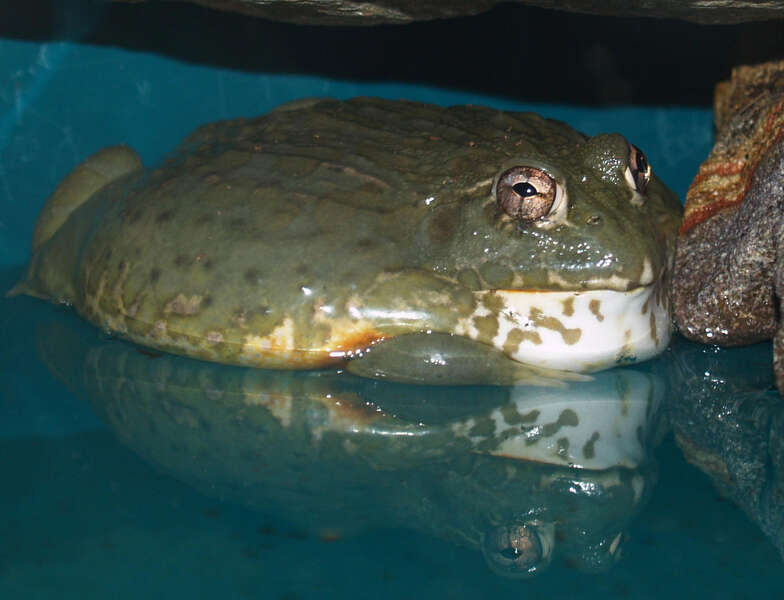
Giant bullfrogs are the largest amphibians found in southern Africa. In Gauteng males reach a snout-vent length of 245 mm and a mass of 1.4 kg. In contrast to most other frogs and toads, males are larger than the females. The head is very broad. Two large bony spines separated by a smaller spine project upwards from the lower jaw. Several prominent, interrupted skin ridges are present on the back. A spade-like inner metatarsal tubercle is present on each heel, and is used for digging (Minter et al. 2004).

In adults, the dorsum is dark olive-green, but may vary from brown to grey and even blue; short sections of the longitudinal skin ridges may be white or cream. In juveniles, a pale vertebral stripe is often present, contrasting sharply with the bright green ground colour. The abdomen is white to creamy-yellow, except in the region of the forelimbs, where it is bright yellow in breeding males. Dark mottling may be present in the gular region of males (Du Preez 1996)

  • Minter, L.R., Burger, M., Harrison, J.A., Braack, H.H., Bishop, P.J., and Kloepfer, D. (eds.) (2004). Atlas and Red Data Book of the Frogs of South Africa, Lesotho and Swaziland. Volume 9 SI/MAB Series. Smithsonian, Washington D.C..
  • Channing, A. (2001). Amphibians of Central and Southern Africa. Cornell University Press, Ithaca, NY.
  • Du Preez, L.H. (1996). Field guide and key to the frogs and toads of the Free State. University of the Orange Free State, Bloemfontein, South Africa.
Creative Commons Attribution 3.0 (CC BY 3.0)

© AmphibiaWeb © 2000-2011 The Regents of the University of California

Source: AmphibiaWeb

Trusted

Article rating from 0 people

Average rating: 2.5 of 5

Distribution

Range Description

This species occurs widely in South Africa, Swaziland, Namibia, Botswana, and Zimbabwe, extending north to southern Angola, Zambia, Malawi, Mozambique, Tanzania, and Kenya. It distribution needs re-examination in light of recent separation of Pyxicephalus edulus from P. adspersus. Many specimens have not been clearly assigned between these two species. It is presumed to occur in southern Democratic Republic of Congo, but there have not been any confirmed records from this country.
Creative Commons Attribution Non Commercial Share Alike 3.0 (CC BY-NC-SA 3.0)

© International Union for Conservation of Nature and Natural Resources

Source: IUCN

Trusted

Article rating from 0 people

Average rating: 2.5 of 5

Geographic Range

The range of Pyxicephalus adspersus is mostly sub-Saharan. Its range extends north and east into Somalia, west to Nigeria, and south to the Cape Provence, South Africa.

A closely related, slightly smaller species, Pyxicephalus edulis, occupies a smaller range in southern Africa, from Zimbabwe and northern South Africa to (probably) Botswana, Mozambique, and Zambia (Passmore and Carruthers, 1995; Channing et al., 1994).

Biogeographic Regions: ethiopian (Native )

Creative Commons Attribution Non Commercial Share Alike 3.0 (CC BY-NC-SA 3.0)

© The Regents of the University of Michigan and its licensors

Source: Animal Diversity Web

Trusted

Article rating from 0 people

Average rating: 2.5 of 5

Distribution

P. adspersus range extends to central Namibia, central and northern Botswana and across the highveld of Zimbabwe (Poynton and Broadley 1985). In South Africa, Lesotho, and Swaziland P. adspersus is widely distributed mainly at higher elevations (Text from Minter et al., 2004, © SI/MAB Biodiversity Program).

Creative Commons Attribution Non Commercial 3.0 (CC BY-NC 3.0)

© du Preez, L.H. ; Cook, C.L.

Source: African Amphibians Lifedesk

Trusted

Article rating from 0 people

Average rating: 2.5 of 5

Distribution and Habitat

Terra typica: „Promontorium Bonae Spei" (= Cape of Good Hope, Rep. South Africa)

Nigeria to Somalia, Kenya, Tanzania, Mozambique, Malawi, Zambia, Zimbabwe, Angola, abd Rep. South Africa, excluding of the southwestern Cape Province.

Found in drier savannas in large pans that fill with water during rains.

  • Minter, L.R., Burger, M., Harrison, J.A., Braack, H.H., Bishop, P.J., and Kloepfer, D. (eds.) (2004). Atlas and Red Data Book of the Frogs of South Africa, Lesotho and Swaziland. Volume 9 SI/MAB Series. Smithsonian, Washington D.C..
  • Channing, A. (2001). Amphibians of Central and Southern Africa. Cornell University Press, Ithaca, NY.
  • Du Preez, L.H. (1996). Field guide and key to the frogs and toads of the Free State. University of the Orange Free State, Bloemfontein, South Africa.
Creative Commons Attribution 3.0 (CC BY 3.0)

© AmphibiaWeb © 2000-2011 The Regents of the University of California

Source: AmphibiaWeb

Trusted

Article rating from 0 people

Average rating: 2.5 of 5

Physical Description

Morphology

Physical Description

Male Pyxicephalus adspersus can reach lengths of more than 9 inches and weigh over 2 pounds. Females are much smaller. Males are olive in color, with yellow to orange on the throat region. Females are olive to light brown with cream to white throat areas. Both sexes have ridges running laterally on the dorsal surface. Juveniles are much more colorful than adults. Several white to yellow lines run down the animal's dorsal area on an overall mottled background. Both these dorsal lines, and mottling disappear with age. Adults have a spade like metatarsal tubercle on each hind foot to aid in digging. The front toes are thick and blunt with no webbing, the rear toes are slightly webbed. These frogs have massive skeletons with extremely large, heavy skulls. The bottom jaw has three odontodes which act as huge teeth, and are used in restraining struggling prey (Moore 1997, Switak 1997).

Creative Commons Attribution Non Commercial Share Alike 3.0 (CC BY-NC-SA 3.0)

© The Regents of the University of Michigan and its licensors

Source: Animal Diversity Web

Trusted

Article rating from 0 people

Average rating: 2.5 of 5

Morphology

The following is a description from Smith (1849):

Colour.—The upper parts of the head, the back, and the upper parts of the sides rusty oil-green, shaded with reddish brown, and variegated with small spots and short longitudinal stripes of wine-yellow. Sides of head and outer and hinder surfaces of extremities light sap-green, the lower portion of the sides, the inner surface of the extremities, the toes, and all the under parts wine-yellow, shaded with brownish orange; and the under surface of the head blotched with irregular spots and stripes of a clove-brown colour. Eyes deep chestnut-brown, highly variegated with yellowish white dots having a strong metallic lustre. In young specimens the variegations in respect of colour are more defined, and consist of vertical bars on the upper lip and lower parts of the sides, of longitudinal waved stripes on the back and upper parts of the sides, and of transverse bars on the outer surface of the extremities.


Form, &c—Figure robust. Head depressed, posteriorly very broad, anteriorly narrow and rounded; its upper surface is rather concave, having a broad longitudinal depression extending from the hindhead nearly to the nose. The nostrils are situated at the upper and anterior part of the head, each about midway between the edge of the upper lip and the anterior canthus of the eye, are small, ovate, and with their opening directed outwards and backwards. Eyes moderately large, the upper eyelid broad and granular externally, except at its ciliary margin. Mouth large, and its angles about the same distance behind the eyes that the eyes are behind the nostrils Teeth rather strong, closely set, and slightly curved inwards; the lower jaw anteriorly has three prominent triangular processes, the intermediate one the shortest, and all three, when the jaws are closed, are received into depressions in the upper formed to admit them. Palatal teeth in two small clusters, one in front of the inner extremity of the internal opening of each nostril. The anterior extremities are short and nearly cylindrical, the toes four, strong, conical, and very short, the outermost the longest, and the innermost but one the shortest. The hinder extremities are powerful, but short when compared with the size of the frog; toes five, cylindrical and tapered to a point, the second, reckoning from the outside of the foot, very long, the first and third of equal length and much shorter, the other two very short; all connected at their base by a rudimentary web. Immediately posterior to the inner toe, particularly of the hinder feet, there is a large and hard compressed tubercle with the edge directed towards the middle of the foot rather sharp, somewhat keeled, and the under slll'face of each of the joints of the toes are cushioned with a pulpy granule or tubercle more or less developed. Tympanum nearly circular, about four lines in diameter, and situated directly over the angle of the mouth. The surface of the head, back, sides, and outer parts of the hinder extremities is rough and granular, and between the granulations of the hindhead, back, and sides, the skin is in various places puckered, so as to form prominent longitudinal rngre, as represented ill plate. The granulations of the hinder portion of the back and on the posterior extremities, especially towards the body, are larger and less numerous than on the other parts where they occur. The fore legs, the inner surface of the hinder legs, and the under parts of the head and body smooth. Tongue large, ovate, and deeply cmarginate behind. Length of hinder legs 6, of fore legs 3 inches. Length of head and body 5.5 inches; width of head posteriorly 3, of body 4.5 inches.

Creative Commons Attribution Non Commercial 3.0 (CC BY-NC 3.0)

© du Preez, L.H. ; Cook, C.L.

Source: African Amphibians Lifedesk

Trusted

Article rating from 0 people

Average rating: 2.5 of 5

Size

Size

P. adspersus is the largest amphibian found in southern Africa. Males reach a snout-vent length of 245 mm and a mass of 1.4 kg at its largest. In contrast to most other frogs, males are larger than females. In addition, territorial males are larger than non-territorial males (Text from Minter et al., 2004, © SI/MAB Biodiversity Program).

Creative Commons Attribution Non Commercial 3.0 (CC BY-NC 3.0)

© Zimkus, Breda

Source: African Amphibians Lifedesk

Trusted

Article rating from 0 people

Average rating: 2.5 of 5

Diagnostic Description

Diagnostic Description

The head is very broad. Two large bony spines, separated by a smaller spine, project upwards from the lower jaw. Several prominent, interrupted skin ridges are present on the back. Spade-like inner metatarsal tubercles are present on the heels, and are used for digging. In adults the dorsum is dark olive-green, but may vary from brown to grey and even blue; short sections of the longitudinal skin ridges may be white or cream. In juveniles, a pale vertebral stripe is often present, contrasting sharply with the bright green ground colour. The abdomen is white to creamy-yellow, except in the region of the forelimbs where it is bright yellow in breeding males. Du Preez (1996) adds that dark mottling may be present in the gular region of males (Text from Minter et al., 2004, © SI/MAB Biodiversity Program).

Creative Commons Attribution Non Commercial 3.0 (CC BY-NC 3.0)

© Zimkus, Breda

Source: African Amphibians Lifedesk

Trusted

Article rating from 0 people

Average rating: 2.5 of 5

Ecology

Habitat

Habitat and Ecology

Habitat and Ecology
It is a species of drier savannahs. It is fossorial for most of the year, remaining buried in cocoons. They emerge at the start of the rains, and breed in shallow, temporary waters in pools, pans and ditches. They are active by day during the breeding season. They can tolerate habitat alteration, but not urbanization.

Systems
  • Terrestrial
  • Freshwater
Creative Commons Attribution Non Commercial Share Alike 3.0 (CC BY-NC-SA 3.0)

© International Union for Conservation of Nature and Natural Resources

Source: IUCN

Trusted

Article rating from 0 people

Average rating: 2.5 of 5

Habitat

One of the most adaptable amphibians on earth, Pyxicephalus can tolerate some of the harshest environments in Africa.

Certain areas of their range can be completely dry for years at a time, and can reach surface temperatures over 100 degrees F, and drop to below freezing during the winter. Protected in an underground estivation chamber, the frogs wait it out until more suitable conditions occur. When the rainy season begins, they occupy temporary floodplains and rapidly drying puddles scattered around the African countryside.

Pyxicephalus have been known to inhabit extremely hostile regions from the Kalihari desert, to the high veld domains between 4000 and 5000 feet above sea level (Switak 1997).

Terrestrial Biomes: desert or dune ; savanna or grassland

Aquatic Biomes: lakes and ponds

Creative Commons Attribution Non Commercial Share Alike 3.0 (CC BY-NC-SA 3.0)

© The Regents of the University of Michigan and its licensors

Source: Animal Diversity Web

Trusted

Article rating from 0 people

Average rating: 2.5 of 5

Habitat and Ecology

P. adspersus inhabits a variety of vegetation types in the Grassland, Savanna, Nama Karoo and Thicket biomes (Text from Minter et al., 2004, © SI/MAB Biodiversity Program).

Creative Commons Attribution Non Commercial 3.0 (CC BY-NC 3.0)

© du Preez, L.H. ; Cook, C.L.

Source: African Amphibians Lifedesk

Trusted

Article rating from 0 people

Average rating: 2.5 of 5

Trophic Strategy

Food Habits

Pyxicephalus adspersus is carnivorous and will consume nearly any animal that can be overpowered and can fit in their huge mouths. Cannibalism is a common occurrence beginning the moment they metamorphose. Many of their first meals will be a member of the same egg mass. Other prey items may include invertebrates, other species of frogs, reptiles, small mammals, and even small birds. The tongue is folded over inside the mouth. To capture a potential meal, it will drop its lower jaw with considerable force, causing the tongue to flip over and out of the animal's mouth, siezing the prey (Moore 1997, Switak 1997).

Creative Commons Attribution Non Commercial Share Alike 3.0 (CC BY-NC-SA 3.0)

© The Regents of the University of Michigan and its licensors

Source: Animal Diversity Web

Trusted

Article rating from 0 people

Average rating: 2.5 of 5

Associations

Associations

P. adspersus feeds on a variety of prey items including small birds, rats, snakes, lizards, insects, scorpions, crabs, slugs and other frogs. The species exhibits cannibalism in the adult, juvenile and even tadpole stages. Birds are major predators of bullfrogs. Records of bird predators include various raptors, for example, the African Marsh Harrier, as well as Marsh Owl, Saddlebill Stork, pelicans and egrets. Tadpoles are preyed upon by various predators, such as terrapins, the Nile Monitor Varanus niloticus, Rinkhals Hemachatus haemachatus, and several fish species, including Barbel Clarias gariepinus and Vlei Tilapia Tilapia sparmanii (Text from Minter et al., 2004, © SI/MAB Biodiversity Program).

Creative Commons Attribution Non Commercial 3.0 (CC BY-NC 3.0)

© du Preez, L.H. ; Cook, C.L.

Source: African Amphibians Lifedesk

Trusted

Article rating from 0 people

Average rating: 2.5 of 5

Life History and Behavior

Behavior

Activity and Special Behaviors

Males vigorously defend their territories against intruding males. Males jump at each other with open mouths, and when a male takes hold of the leg or arm of another he will often flip the opponent into the air. Males often bear battle scars, sometimes even losing an eye or dying from punctured lungs. Kok et al. (1989) found that territorial males actively defend their offspring for the duration of their larval development. They scare off intruders by assuming an aggressive attitude and even jump and snap in their direction. If a school of tadpoles becomes isolated in a shrinking pool, the male will dig a channel through the mud to open water, thereby saving the tadpoles from desiccation (Text from Minter et al., 2004, © SI/MAB Biodiversity Program).

Creative Commons Attribution Non Commercial 3.0 (CC BY-NC 3.0)

© du Preez, L.H. ; Cook, C.L.

Source: African Amphibians Lifedesk

Trusted

Article rating from 0 people

Average rating: 2.5 of 5

Life Cycle

Metamorphosis

Channing (2001) recorded that small black tadpoles emerge from the capsules after 36 hours, and gather in schools. Over the next two days, schools fuse, creating larger schools until all the tadpoles form a single school. The tadpoles tend to congregate in shallow, warm water where they feed on algae, and complete metamorphosis 18–33 days later (Text from Minter et al., 2004, © SI/MAB Biodiversity Program).

Creative Commons Attribution Non Commercial 3.0 (CC BY-NC 3.0)

© du Preez, L.H. ; Cook, C.L.

Source: African Amphibians Lifedesk

Trusted

Article rating from 0 people

Average rating: 2.5 of 5

Life Expectancy

Lifespan/Longevity

Average lifespan

Status: captivity:
16.2 years.

Creative Commons Attribution Non Commercial Share Alike 3.0 (CC BY-NC-SA 3.0)

© The Regents of the University of Michigan and its licensors

Source: Animal Diversity Web

Trusted

Article rating from 0 people

Average rating: 2.5 of 5

Lifespan, longevity, and ageing

Maximum longevity: 45 years (captivity) Observations: These are the largest South African amphibians, with males reaching 1400g (http://amphibiaweb.org/).
Creative Commons Attribution 3.0 (CC BY 3.0)

© Joao Pedro de Magalhaes

Source: AnAge

Trusted

Article rating from 0 people

Average rating: 2.5 of 5

Reproduction

Reproduction

During the breeding season, males will congregate in large groups. Much aggression occurs in these groups with larger males pushing, pursuing, biting, even consuming smaller males. The large males will push their way to the center of the group, establish and defend a small area and begin calling. The call lasts about a second and can be described as a deep low-pitched whoop. The females will hear this call and swim underwater to the center of the group, to avoid the smaller males and surface in the defended area of a larger male. As they surface, they are persuaded until finally being seized by a male. Amplexus occurs in shallow water to allow the pair to stand on the bottom. Eggs are fertilized above the water's surface. As many as 4000 eggs may be released. The males exhibit parental care. Males will watch over and defend the eggs which hatch in two days. After hatching, the tadpoles will feed on each other, as well as on small fish and invertebrates. Defending males will continue to watch over the tadpoles which will metamorphose within three weeks. Moore states that during times when the pool nears dessication, the male will dig a channel between his offspring and the larger body of water. This parental care comes with a price, however, as the male will consume many of the tadpoles while he is defending them (Moore 1997; Channing et al., 1994).

Creative Commons Attribution Non Commercial Share Alike 3.0 (CC BY-NC-SA 3.0)

© The Regents of the University of Michigan and its licensors

Source: Animal Diversity Web

Trusted

Article rating from 0 people

Average rating: 2.5 of 5

Reproduction

P. adspersus is an explosive breeder, finding a mate and laying eggs within 48 hours. Spawning takes place during daylight, usually the morning after a heavy rainstorm. Adult males exhibit three size-related mating strategies, namely territorial, non-territorial (breeding arena) and satellite behaviour (Cook 1996). It typically breeds in seasonal, shallow, grassy pans in flat, open areas but also utilizes non-permanent vleis and shallow water on the margins of waterholes and dams. After heavy rain they congregate in large numbers at breeding sites. Successful breeding depends on the establishment of ephemeral pools large enough to hold water for at least 30 days. Continuous light rain does not seem to prompt emergence of the frogs, but when a downpour of at least 30 mm follows, within a few days, the first light spring rains, they emerge and move to their breeding sites (Text from Minter et al., 2004, © SI/MAB Biodiversity Program).

Non-territorial males gather in a breeding arena or lek where males fight amongst themselves for favourable positions in the centre of the lek (Channing et al. 1994a). Females maintain a low profile as they approach the arena, with barely more than their eyes projecting above the water’s surface. The moment a female is spotted, she is intercepted by the closest male. Amplexus displacement, in which a second male displaces an amplexing male, is frequently observed in groups of non-territorial males. Amplexus takes place in water 2–4 cm deep and lasts for an average of 15 minutes. Oviposition usually occurs between 08:00 and 12:00, but may continue until 18:00. When spawning, the male pushes the female’s head underwater and she raises her cloaca above the water; thus the eggs are fertilized before entering the water A spent female prompts the male to release her by shaking her head from side to side, and then moves away into deeper water (Text from Minter et al., 2004, © SI/MAB Biodiversity Program).

Creative Commons Attribution Non Commercial 3.0 (CC BY-NC 3.0)

© du Preez, L.H. ; Cook, C.L.

Source: African Amphibians Lifedesk

Trusted

Article rating from 0 people

Average rating: 2.5 of 5

Advertisement Call

The advertisement call is a long, low frequency “whoop”, 1–2 s in duration and with an emphasized frequency of 200–250 Hz (Text from Minter et al., 2004, © SI/MAB Biodiversity Program).

Creative Commons Attribution Non Commercial 3.0 (CC BY-NC 3.0)

© du Preez, L.H. ; Cook, C.L.

Source: African Amphibians Lifedesk

Trusted

Article rating from 0 people

Average rating: 2.5 of 5

Conservation

Conservation Status

IUCN Red List Assessment


Red List Category
LC
Least Concern

Red List Criteria

Version
3.1

Year Assessed
2004

Assessor/s
Alan Channing, John Poynton, Leslie Minter, Kim Howell, James Harrison

Reviewer/s
Global Amphibian Assessment Coordinating Team (Simon Stuart, Janice Chanson and Neil Cox)

Justification
Listed as Least Concern because, although it is losing breeding habitat in places due to urbanisation, and it is also eaten in parts of its range, it has a wide distribution, is tolerant of a broad range of habitats, has a presumed large population, and is unlikely to be declining fast enough to qualify for listing in a more threatened category.
Creative Commons Attribution Non Commercial Share Alike 3.0 (CC BY-NC-SA 3.0)

© International Union for Conservation of Nature and Natural Resources

Source: IUCN

Trusted

Article rating from 0 people

Average rating: 2.5 of 5

Conservation Status

No special legal status has been given to Pyxicephalus species. Switak (1997) notes that advancing civilization has driven it near extinction in certain parts of its range.

US Federal List: no special status

CITES: no special status

IUCN Red List of Threatened Species: least concern

Creative Commons Attribution Non Commercial Share Alike 3.0 (CC BY-NC-SA 3.0)

© The Regents of the University of Michigan and its licensors

Source: Animal Diversity Web

Trusted

Article rating from 0 people

Average rating: 2.5 of 5

IUCN Red List Category and Justification of Conservation Status

Harrison et al. (2001) recorded that the species has undergone severe population declines in certain areas, there was and was therefore classified Near Threatened in the atlas region (Text from Minter et al., 2004, © SI/MAB Biodiversity Program).

Creative Commons Attribution Non Commercial 3.0 (CC BY-NC 3.0)

© du Preez, L.H. ; Cook, C.L.

Source: African Amphibians Lifedesk

Trusted

Article rating from 0 people

Average rating: 2.5 of 5

Population

Population
It is common in many of the southern parts of its range, it has apparently declined in South Africa, especially in Gauteng Province, but it is still locally common in some places. Boycott (2001) declared the species to be extinct in Swaziland. It seems to be very uncommon in the northern parts of its range, with very few confirmed records from Zambia, Malawi, Tanzania and Kenya (though this might in part be due to identification problems).

Population Trend
Decreasing
Creative Commons Attribution Non Commercial Share Alike 3.0 (CC BY-NC-SA 3.0)

© International Union for Conservation of Nature and Natural Resources

Source: IUCN

Trusted

Article rating from 0 people

Average rating: 2.5 of 5

Life History, Abundance, Activity, and Special Behaviors

Male calls from shallow water. Breeding starts after heavy rain initiated by 65 mm of rain over the previous day or two. Breeding during day time, spawning from 7.00 to 16.00. Males have two breeding startegies, depending on their age. Younger males congregate in a small area, perhaps only 1 or 2 square meters of shallow water. The larger males occupy the center of these breeding arenas or leks and attempt to chase off other males. A female approaches the group of males by swimming along at the surface until she is within a few meters of the group. Female dives and reappears on the surface in the middle of the group. She is soon grasped by one of the larger males, and mating ensures. Eggs are laid in the shallow edge of the pond, but fertilization takes place above water level. Eggs are fertilized before they reach the water. Full grown males are more agressive. They fight, causing injury and even killing one another. The dominant male attempt to prevent other males from participating in breeding. Most of the females are mated by the dominant male in his territory. The dominant male takes care of the tadpoles. Egg laying occurs in a small area, and the tadpoles hatch together.

P. adspersus will eat just about anything, and are sometimes cannibalistic.

During the dry season the frogs live underground. P. adspersus can reach an age of 45 years. Predators of the adults are birds and of tadpoles include turtles (Pelusios) and monitors (Varanus niloticus).

  • Minter, L.R., Burger, M., Harrison, J.A., Braack, H.H., Bishop, P.J., and Kloepfer, D. (eds.) (2004). Atlas and Red Data Book of the Frogs of South Africa, Lesotho and Swaziland. Volume 9 SI/MAB Series. Smithsonian, Washington D.C..
  • Channing, A. (2001). Amphibians of Central and Southern Africa. Cornell University Press, Ithaca, NY.
  • Du Preez, L.H. (1996). Field guide and key to the frogs and toads of the Free State. University of the Orange Free State, Bloemfontein, South Africa.
Creative Commons Attribution 3.0 (CC BY 3.0)

© AmphibiaWeb © 2000-2011 The Regents of the University of California

Source: AmphibiaWeb

Trusted

Article rating from 0 people

Average rating: 2.5 of 5

Threats

Threats

Major Threats
The major threat through most of its range is harvesting of frogs for local consumption, which is believed to be responsible for some population declines. In South Africa, breeding habitat has been lost due to urbanization. This species is sometimes found in the international pet trade but at levels that do not currently constitute a major threat.
Creative Commons Attribution Non Commercial Share Alike 3.0 (CC BY-NC-SA 3.0)

© International Union for Conservation of Nature and Natural Resources

Source: IUCN

Trusted

Article rating from 0 people

Average rating: 2.5 of 5

Management

Conservation Actions

Conservation Actions
It occurs in many protected areas.
Creative Commons Attribution Non Commercial Share Alike 3.0 (CC BY-NC-SA 3.0)

© International Union for Conservation of Nature and Natural Resources

Source: IUCN

Trusted

Article rating from 0 people

Average rating: 2.5 of 5

Relevance to Humans and Ecosystems

Benefits

Economic Importance for Humans: Negative

Because these frogs are such resilient animals, they might potentially have negative effects on the surrounding ecosystem if introduced by humans beyond their natural range.

Creative Commons Attribution Non Commercial Share Alike 3.0 (CC BY-NC-SA 3.0)

© The Regents of the University of Michigan and its licensors

Source: Animal Diversity Web

Trusted

Article rating from 0 people

Average rating: 2.5 of 5

Economic Importance for Humans: Positive

African bullfrogs are eaten by humans, and have been collected for the commercial pet trade.

Creative Commons Attribution Non Commercial Share Alike 3.0 (CC BY-NC-SA 3.0)

© The Regents of the University of Michigan and its licensors

Source: Animal Diversity Web

Trusted

Article rating from 0 people

Average rating: 2.5 of 5

Wikipedia

African bullfrog

The African bullfrog (Pyxicephalus adspersus) is a species of frog in the Ranidae family. It is also known as the pixie frog due to its Latin name. It is found in Angola, Botswana, Kenya, Malawi, Mozambique, Namibia, South Africa, Swaziland, Tanzania, Zambia, Zimbabwe, and possibly Democratic Republic of the Congo. Its natural habitats are dry savanna, moist savanna, subtropical or tropical dry shrubland, intermittent freshwater lakes, intermittent freshwater marshes, arable land, pastureland, and canals and ditches. This is a large frog, with males weighing 1.4 kg (3.1 lb), though can eaily exceed 2 kg (4.4 lb) while females are half the size, making it unique among frogs as in most amphibans females are usually larger than males.[citation needed]

Contents

Feeding & Habits

The African bullfrog is carnivorous and a voracious eater, eating insects, small rodents, reptiles, small birds and other amphibians.[citation needed] This frog is also aggressive and has been known to bite when provoked.[1] An African bullfrog kept at the Pretoria Zoo in South Africa once ate 17 baby cobras (Hemachatus haemachatus).[2] They emit a loud croaking sound.

In pet trade

The African bullfrog is an exotic pet in many countries around the world, mostly in Germany, and owning it is not prohibited by any laws. Animals sold are generally bred in captivity. In this species the male is bigger than the female.

In popular culture

Principal Pixiefrog from "My Gym Partner's a Monkey" is an African bullfrog.

References

  1. ^ "African Bull Frog ant crusher". YouTube. http://www.youtube.com/watch?v=WlEzvdlYRes. Retrieved 22 December 2011. 
  2. ^ Branch, W. R. (1976). "Two exceptional food records for the African bullfrog, Pyxicephalus adspersus (Amphibia, Anura, Ranidae)". Journal of Herpetology 10 (3): 266–268. JSTOR 1562997. 

Related links

Creative Commons Attribution Share Alike 3.0 (CC BY-SA 3.0)


Source: Wikipedia

Unreviewed

Article rating from 0 people

Average rating: 2.5 of 5

Disclaimer

EOL content is automatically assembled from many different content providers. As a result, from time to time you may find pages on EOL that are confusing.

To request an improvement, please leave a comment on the page. Thank you!