Overview

Distribution

Range Description

The Zebra Duiker occurs from eastern Sierra Leone to south-western Côte d’Ivoire; their presence in south-eastern Guinea was confirmed by a report from the Ziama-Diecke Forest Reserves (East 1999; Hoppe-Dominik in press).
Creative Commons Attribution Non Commercial Share Alike 3.0 (CC BY-NC-SA 3.0)

© International Union for Conservation of Nature and Natural Resources

Source: IUCN

Trusted

Article rating from 0 people

Average rating: 2.5 of 5

Geographic Range

Cephalophus zebra is found in primary forest areas in the mid-western part of Africa; It inhabits the regions of Sierra Leone and the Ivory Coast, but is most commonly distributed in the eastern central country of Liberia (Kingdon, 1997).

Biogeographic Regions: ethiopian (Native )

Creative Commons Attribution Non Commercial Share Alike 3.0 (CC BY-NC-SA 3.0)

© The Regents of the University of Michigan and its licensors

Source: Animal Diversity Web

Trusted

Article rating from 0 people

Average rating: 2.5 of 5

Physical Description

Morphology

Physical Description

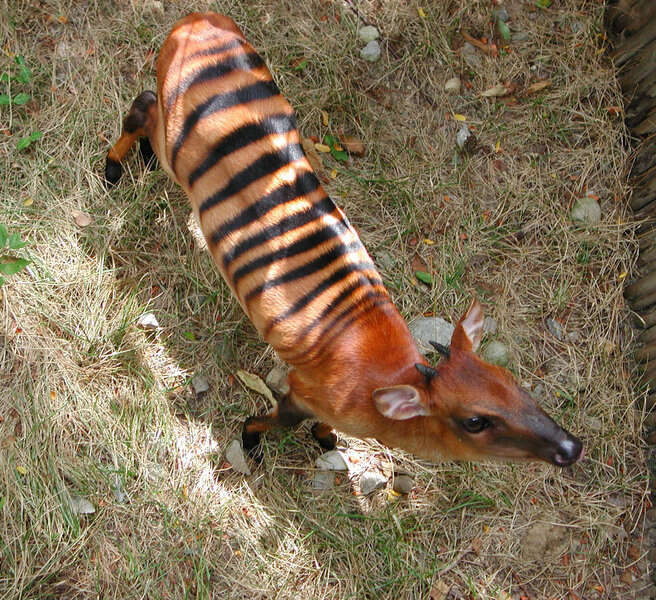
Cephalophus zebra, also known by the common name zebra duiker, has black vertical stripes over a cream colored area which is located dorsally on the mid-torso. The ventral surface is a solid cream color. The head, neck, rump, and limbs are red-brown with some patches of black found near the joints of the limbs (Kingdon, 1997).

Zebra duikers have a short, yet muscular stature, standing approximately 40-50 cm tall and weighing up to 20 kg (Kingdon, 1997). The limbs are short in relation to the body. Cephalophus zebra also has a pair of short and rounded horns, these horns taper sharply and point posteriorly (Kingdon, 1997). Sexual dimorphism occurs in this species with females being consistantly larger than male duikers (Wilson et. al., 1984).

Range mass: 15 to 20 kg.

Other Physical Features: endothermic ; homoiothermic; bilateral symmetry

Sexual Dimorphism: female larger

  • Wilson, V., J. Schmidt, J. Hanks. 1984. Age Determination and Body Growth of the Common Duiker Sylvicapra- Grimmia Mammalia. Journal of Zoology, 202: 283-298.
Creative Commons Attribution Non Commercial Share Alike 3.0 (CC BY-NC-SA 3.0)

© The Regents of the University of Michigan and its licensors

Source: Animal Diversity Web

Trusted

Article rating from 0 people

Average rating: 2.5 of 5

Ecology

Habitat

Habitat and Ecology

Habitat and Ecology
The Zebra Duiker appears to be dependent on undisturbed primary lowland forest, sometimes ranging into montane and hill forest (Hoppe-Dominik in press). Although it may be found in secondary growth and swidden cultivation (e.g., Newing 2001), Wilson (2001) considered them the least adaptable of all West African duiker species to deforestation and therefore the least likely to survive hunting pressure and habitat degradation.

Systems
  • Terrestrial
Creative Commons Attribution Non Commercial Share Alike 3.0 (CC BY-NC-SA 3.0)

© International Union for Conservation of Nature and Natural Resources

Source: IUCN

Trusted

Article rating from 0 people

Average rating: 2.5 of 5

Habitat

The zebra duiker is found in primary forests from low-lying areas such as river valleys to hill-forest habitats (Kingdon, 1997).

Terrestrial Biomes: forest

Creative Commons Attribution Non Commercial Share Alike 3.0 (CC BY-NC-SA 3.0)

© The Regents of the University of Michigan and its licensors

Source: Animal Diversity Web

Trusted

Article rating from 0 people

Average rating: 2.5 of 5

Trophic Strategy

Food Habits

Zebra duikers are fruit and foliage browsers. Their diet includes leaves, shoots, and seasonal fruits (Owen-Smith, 1997). Due to the duiker's short stature, they are not able to forage on fruits and leaves that exist in tall trees. Much of the food they consume is provided by climbing or flying animals such as monkeys, bats, or birds which will accidentally dislodge fruit or leaves to the forest floor during their normal foraging activities. Duikers will then feed upon this dropped vegetation (Kingdon, 1997).

Cephalophus zebra have a thickening of the frontal bone in the skull which seems to serve as a tool for cracking open hard-shelled fruits (Kingdon, 1997). This enables them to access a food source which is not available to many other forest inhabitants which cannot open these fruits.

Creative Commons Attribution Non Commercial Share Alike 3.0 (CC BY-NC-SA 3.0)

© The Regents of the University of Michigan and its licensors

Source: Animal Diversity Web

Trusted

Article rating from 0 people

Average rating: 2.5 of 5

Life History and Behavior

Life Expectancy

Lifespan, longevity, and ageing

Observations: Not much is known about the longevity of these animals, but one wild born specimen was about 13 years old when it died in captivity. A hybrid between a zebra duiker and a blue duiker lived 20.3 years (Richard Weigl 2005).
Creative Commons Attribution 3.0 (CC BY 3.0)

© Joao Pedro de Magalhaes

Source: AnAge

Trusted

Article rating from 0 people

Average rating: 2.5 of 5

Reproduction

Reproduction

Breeding in zebra duikers occurs about once a year with a gestation period of about 221 to 229 days. Females can mate again approximately ten days after giving birth (Schweers, 1984). The rather long gestation period is possibly an explanation for the larger size of females (Wilson et. al., 1984).

Scented secretions are found in several glands on the body. These secretions seem to aid in sexual communication. Male duikers secrete a more concentrated scent than that of the female (Burger et.al., 1990). The glands occur in the preorbital region, below the calcaneum on the hind legs, and in the groin (Kingdon, 1997).

It is thought that monogamous pair bonds are maintained (Kingdon, 1997).

Range number of offspring: 1 (low) .

Average number of offspring: 1.

Range gestation period: 7.37 to 7.63 months.

Average gestation period: 7.43 months.

Average birth mass: 1707.5 g.

Average number of offspring: 1.

Parental Investment: extended period of juvenile learning

Creative Commons Attribution Non Commercial Share Alike 3.0 (CC BY-NC-SA 3.0)

© The Regents of the University of Michigan and its licensors

Source: Animal Diversity Web

Trusted

Article rating from 0 people

Average rating: 2.5 of 5

Molecular Biology and Genetics

Molecular Biology

Statistics of barcoding coverage: Cephalophus zebra

Barcode of Life Data Systems (BOLDS) Stats
Public Records: 0
Species: 1
Species With Barcodes: 1

Creative Commons Attribution 3.0 (CC BY 3.0)

© Barcode of Life Data Systems

Source: Barcode of Life Data Systems (BOLD)

Trusted

Article rating from 0 people

Average rating: 2.5 of 5

Conservation

Conservation Status

IUCN Red List Assessment


Red List Category
VU
Vulnerable

Red List Criteria
A2cd; C1

Version
3.1

Year Assessed
2008

Assessor/s
IUCN SSC Antelope Specialist Group

Reviewer/s
Mallon, D.P. (Antelope Red List Authority) & Hoffmann, M. (Global Mammal Assessment)

Contributor/s

Justification
Listed as Vulnerable as it is estimated that the population has declined by as much as 30% over the past 15 years (3 generations) due to the combined effects of habitat loss and deforestation and hunting. The overall population size is probably less than 10,000 mature individuals (estimated less than 15'000 total) and a continuing decline of 10% over 15 years is more than plausible. The existence of good numbers of Zebra Duiker in regions such as the reasonably extensive remaining high forests of Liberia offers the potential for effective conservation of this species, but if present trends continue its status will decline to Endangered or Critically Endangered. Its long-term survival is dependent on the protection of its habitat and control of poaching in areas such as Tai and Sapo National Parks and other protected forests within its restricted range.

History
  • 1996
    Vulnerable
  • 1994
    Vulnerable
    (Groombridge 1994)
  • 1990
    Vulnerable
    (IUCN 1990)
  • 1988
    Vulnerable
    (IUCN Conservation Monitoring Centre 1988)
  • 1986
    Indeterminate
    (IUCN Conservation Monitoring Centre 1986)
Creative Commons Attribution Non Commercial Share Alike 3.0 (CC BY-NC-SA 3.0)

© International Union for Conservation of Nature and Natural Resources

Source: IUCN

Trusted

Article rating from 0 people

Average rating: 2.5 of 5

Conservation Status

Zebra duikers are limited to primary forest areas which are currently becoming restricted due to logging and development. Cephalophus zebra is considered threatened due to forest destruction. In areas such as Sierra Leone and the Ivory Coast populations are considered close to extinction (Kingdon, 1997).

US Federal List: threatened

CITES: appendix ii

IUCN Red List of Threatened Species: vulnerable

Creative Commons Attribution Non Commercial Share Alike 3.0 (CC BY-NC-SA 3.0)

© The Regents of the University of Michigan and its licensors

Source: Animal Diversity Web

Trusted

Article rating from 0 people

Average rating: 2.5 of 5

Population

Population
East (1999) produced a total population estimate of about 28,000. However, Wilson (2001) regarded this as an over-estimate, and doubted that there could be more than 15,000 animals across the range at most. The population trend is generally downwards because of poaching for meat and continuing destruction of West Africa’s few remaining primary forests. The only exceptions are a few localities where hunting pressures are low and/or there is effective protection against logging and poaching (East 1999).

Population Trend
Decreasing
Creative Commons Attribution Non Commercial Share Alike 3.0 (CC BY-NC-SA 3.0)

© International Union for Conservation of Nature and Natural Resources

Source: IUCN

Trusted

Article rating from 0 people

Average rating: 2.5 of 5

Threats

Threats

Major Threats
The major threats are habitat destruction and hunting for bushmeat. For example, in Côte d'Ivoire it is confined to primary rainforest in the south-west, to the west of the Niouniourou River. This region was sparsely populated until the early to mid-1970s. Since then, there has been large-scale immigration, and timber extraction, forest clearance and agricultural settlement have proceeded rapidly (East 1999).
Creative Commons Attribution Non Commercial Share Alike 3.0 (CC BY-NC-SA 3.0)

© International Union for Conservation of Nature and Natural Resources

Source: IUCN

Trusted

Article rating from 0 people

Average rating: 2.5 of 5

Management

Conservation Actions

Conservation Actions
The Zebra Duiker is now confined to the remaining areas of primary forest within its former range, with its main strongholds being the Gola Forests in Sierra Leone, Sapo National Park and other forests of south-eastern Liberia, and Taï National Park and the adjoining Haut Dodo-Rapide Grah-Hana Forest Reserves, and Cavally-Gouin, Scio and Niegre Forest Reserves in Côte d’Ivoire (East 1999; Hoppe-Dominik in press).
Listed on CITES Appendix II.
Creative Commons Attribution Non Commercial Share Alike 3.0 (CC BY-NC-SA 3.0)

© International Union for Conservation of Nature and Natural Resources

Source: IUCN

Trusted

Article rating from 0 people

Average rating: 2.5 of 5

Relevance to Humans and Ecosystems

Benefits

Economic Importance for Humans: Positive

Humans rarely encounter zebra duikers in the wild but they are sometimes hunted for their meat (Kingdon, 1997).

Positive Impacts: food ; body parts are source of valuable material

Creative Commons Attribution Non Commercial Share Alike 3.0 (CC BY-NC-SA 3.0)

© The Regents of the University of Michigan and its licensors

Source: Animal Diversity Web

Trusted

Article rating from 0 people

Average rating: 2.5 of 5

Wikipedia

Zebra Duiker

The zebra duiker (Cephalophus zebra) is a small antelope found in Ivory Coast, Guinea, Sierra Leone and Liberia.[1]

Zebra duikers have gold or red-brown coats with distinctive zebra-like stripes, dark markings on their upper legs and russet faces. They grow to 90 centimetres in length, 45 centimetres in height and weigh up to 20 kilogrammes. Their prong-like horns are 4.5 centimetres long in males and only 2.25 centimetres long in females.

Zebra duikers live in primary rainforest where they eat leaves and fruit. They are considered Vulnerable by the IUCN. The wild population is estimated at 28,000 individuals.

References

  1. ^ a b IUCN SSC Antelope Specialist Group (2008). Cephalophus zebra. In: IUCN 2008. IUCN Red List of Threatened Species. Downloaded on 16 January 2009.
Creative Commons Attribution Share Alike 3.0 (CC BY-SA 3.0)


Source: Wikipedia

Unreviewed

Article rating from 0 people

Average rating: 2.5 of 5

Disclaimer

EOL content is automatically assembled from many different content providers. As a result, from time to time you may find pages on EOL that are confusing.

To request an improvement, please leave a comment on the page. Thank you!