Articles on this page are available in 1 other language: Spanish (2) (learn more)
Overview
Brief Summary
Description
Links:
Mammal Species of the World
Click here for The American Society of Mammalogists species account
- Original description: Linnaeus, C., 1758. Systema Naturae per regna tria naturae, secundum classis, ordines, genera, species cum characteribus, differentiis, synonymis, locis. Tenth Edition, Laurentii Salvii, Uppsala, 1:46, 823 pp.
Trusted
Biology
Trusted
Comprehensive Description
Description
Trusted
Distribution
Range Description
Trusted
Geographic Range
Ermine have a circumpolar distribution. They are found in the north temperate regions of Eurasia and North America. In the New World, they range from east to west in a broad belt from the Arctic Ocean and adjacent islands of the Canadian Archipelago southward into the northern United States. Ermine are absent from the Great Plains.
Biogeographic Regions: nearctic (Native ); palearctic (Native )
Other Geographic Terms: holarctic
- Ruff, S., D. Wilson. 1999. The Smithsonian Book of North American Mammals. Washington [D.C.]: Smithsonian Institution Press in association with the American Society of Mammalogists.
Trusted
National Distribution
Canada
Origin: Native
Regularity: Regularly occurring
Currently: Present
Confidence: Confident
Type of Residency: Year-round
United States
Origin: Native
Regularity: Regularly occurring
Currently: Present
Confidence: Confident
Type of Residency: Year-round
Trusted
Global Range: Circumboreal range throughout North America, Europe, and Asia, from Greenland and the Canadian and Siberian Arctic islands south to about 35°N (King 1983, Fagerstone 1987). In North America, this species is found throughout Alaska and Canada south through most of the northern United States to central California, northern Arizona (Berna 1991), northern New Mexico, Iowa, the Great Lakes region, Pennsylvania, and northern Virginia (Fagerstone 1987).
Trusted
Range
Trusted
Physical Description
Morphology
Physical Description
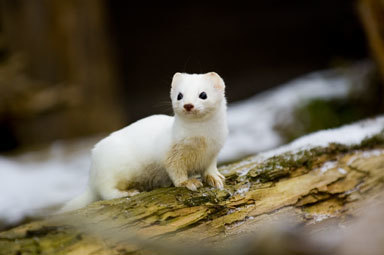
At full adult size total body length from head to rump is 170 mm to 330 mm. Males are generally twice as large as females, with males weighing from 67 to 116 grams and females from 25 to 80 grams. The tail length is about 35% of the total body length, ranging from 42 mm to 120 mm. Ermine have the typical weasel form: long body, short legs, long neck supporting a triangular head, slightly protruding round ears, bright black eyes, and long whiskers. Their short, moderately fine fur is white in the winter and the tip of the tail is black. In the summer, the dorsal fur is chocolate brown while the ventral fur extending to the upper lip is yellowish white.
Range mass: 25 to 116 g.
Range length: 170 to 330 mm.
Other Physical Features: endothermic ; homoiothermic; bilateral symmetry
Sexual Dimorphism: male larger
Average basal metabolic rate: 1.276 W.
Trusted
Size
Size in North America
Length:
Average: 272 mm males; 240 mm females
Range: 219-343 mm males; 190-292 mm females
Weight:
Average: 80 g males; 54 g females
Range: 67-116 g males; 25-80 g females
Trusted
Ecology
Habitat
Habitat and Ecology
Its local distribution is typically related to that of small rodents and lagomorphs (King, 1983). They tend to avoid dense forest and deserts, and are often found in successional or forest-edge habitats, in scrub, alpine meadows, marshes, riparian woodlands, hedgerows, and riverbanks that have high densities of small mammals, especially Microtus and Arvicola (King, 1983). Estimates for home range size range from 4 to 200 hectares for males, most often falling between 10 to 40 hectares (King, 1983).
Systems
- Terrestrial
Trusted
Habitat
Ermine prefer riparian woodlands, marshes, shrubby fencerows, and open areas adjacent to forests or shrub borders. Although ermine are primarily terrestrial, they climb trees and swim well. Tree roots, hollow logs, stone walls, and rodent burrows are used as dens. Dens are usually around 300 mm below ground. Ermine line their nests with dry vegetation, and fur and feathers from prey. Side cavities of burrows are used as food caches and latrines.
Habitat Regions: temperate ; terrestrial
Terrestrial Biomes: tundra ; taiga ; savanna or grassland ; forest ; scrub forest ; mountains
Other Habitat Features: riparian
Trusted
Comments: Prefers wooded areas with thick understory near watercourses. Rarely occurs in heavily forested regions. Has adapted to a wide variety of habitats. Dens in hollow log or under log, stump, roots, brushpile, or rocks. In winter in southern Ontario, usually stayed beneath snow surface (Simms 1979).
Trusted
Habitat
Trusted
Migration
Non-Migrant: Yes. At least some populations of this species do not make significant seasonal migrations. Juvenile dispersal is not considered a migration.
Locally Migrant: No. No populations of this species make local extended movements (generally less than 200 km) at particular times of the year (e.g., to breeding or wintering grounds, to hibernation sites).
Locally Migrant: No. No populations of this species make annual migrations of over 200 km.
Trusted
Trophic Strategy
Food Habits
Ermine are carnivores that hunt primarily at night. They are specialist predators on small, warm-blooded vertebrates, preferably mammals of rabbit size and smaller. When mammalian prey is scarce, ermine eat birds, eggs, frogs, fish, and insects. In severe climates, ermine frequently hunt under snow and survive entirely on small rodents and lemmings. Daily meals are essential to meet the ermine's exhorbitant energy and heat production demands. Ermine cache leftover meals as a way of dealing with these demands.
Once a potential prey is identified, the ermine approaches as closely as possible. With incredible speed it grasps the back of the victim's head and neck with sharp teeth, and wraps its body and feet around the victim. The victim dies from repeated bites to the base of the skull. Ermine have keen senses that help them locate prey. Hares and rodents are mainly followed by scent, insects by sound, and fish by sight.
Animal Foods: birds; mammals; amphibians; fish; eggs; insects
Foraging Behavior: stores or caches food
Primary Diet: carnivore (Eats terrestrial vertebrates)
Trusted
Comments: Mainly small mammals, and occasionally other small vertebrates and insects.
Trusted
Associations
Ecosystem Roles
Ermine are important predators on small mammal communities in the ecosystems in which they live.
Many ermine die from a parasitic nematode (Skrjabingylus nasicola) that infects the nasal passage, distorting the sinuses. Eventually the skull is perforated and pressure is exerted on the brain, causing death. Shrews are believed to be the carrier hosts of this parasite.
Commensal/Parasitic Species:
- nematode worms
Trusted
Predation
Ermine are fierce and aggressive, although diminutive, animals. Potential predators are larger carnivores including red fox, gray fox, martens, fishers, badgers, raptors, and occasionally domestic cats.
Known Predators:
- red foxes (Vulpes vulpes)
- gray foxes (Urocyon cinereoargenteus)
- American martens (Martes americana)
- fishers (Martes pennanti)
- American badgers (Taxidea taxus)
- raptors (Accipitridae)
- domestic cats (Felis silvestris)
Trusted
Known prey organisms
Leporidae
Microtus
Anas americana
Dendroica palmarum
Thomomys mazama
Clethrionomys californicus
Microtus longicaudus
Microtus xanthognathus
Microtus californicus
Eliomys quercinus
Clethrionomys glareolus
Sorex araneus
Based on studies in:
New Zealand (Grassland)
Russia (Tundra)
This list may not be complete but is based on published studies.
Trusted
Population Biology
Number of Occurrences
Note: For many non-migratory species, occurrences are roughly equivalent to populations.
Estimated Number of Occurrences: > 300
Comments: This species is represented by a large number of occurrences (subpopulations).
Trusted
Global Abundance
100,000 to >1,000,000 individuals
Comments: Total adult population size is unknown but certainly exceeds 100,000.
Trusted
General Ecology
Home range averages 12-16 ha (Jackson 1961). In southern Ontario, density over 95 ha averaged 6 per sq km; home range averaged 20-25 ha for males, smaller for females; most individuals remained on study site less than 1 year (Simms 1979).
Trusted
Life History and Behavior
Behavior
Communication and Perception
Ermine have keen senses of smell, vision, hearing, and touch that help them to locate prey. Most mustelids are fairly quiet animals, but some vocalizations may be used in intra-specific communication. Chemical cues are probably the main means of communicating reproductive readiness to potential mates.
Communication Channels: visual ; tactile ; acoustic ; chemical
Other Communication Modes: scent marks
Perception Channels: visual ; acoustic
Trusted
Cyclicity
Comments: Mainly nocturnal, can been seen frequently during the day.
Trusted
Life Expectancy
Lifespan/Longevity
The average life span of an ermine is 1 to 2 years; the maximum is 7 years.
Range lifespan
Status: wild: 7 (high) years.
Typical lifespan
Status: wild: 1 to 2 years.
Average lifespan
Status: wild: 1-2 years.
Range lifespan
Status: captivity: 12.5 (high) years.
Trusted
Lifespan, longevity, and ageing
Trusted
Reproduction
Reproduction
Ermine are a polygynous-promiscuous species, with males and females mating opportunistically.
Mating System: polygynandrous (promiscuous)
Ermine mate in late spring to early summer. Females are polyestrous, but produce only 1 litter per year. Young are born in April or May after an average gestation period of 280 days, which includes an 8 to 9 month period of developmental delay. Longer days beginning in March trigger the resumption of fetal development. Litter size ranges from 3 to 18 offspring and averages 4 to 9. The sex ratio is unequal. Young are blind and helpless. They are covered with fine white hair, and a prominent dark mane of dense fur develops around the neck by the third week (function unknown). The young grow quickly and are able to hunt with their mother by their eighth week. Although females do not reach adult size until a least 6 weeks after birth, they are able to mate when they are 60 to 70 days old, often before they are weaned. Males do not breed or gain adult dimensions until their second summer.
Females in nature may survive for at least 2 breeding seasons, while males generally do not survive this long. Reproductive success is highly dependent on food availability.
Breeding interval: Ermine generally breed once yearly.
Breeding season: Ermine mate in late spring to early summer.
Range number of offspring: 3 to 18.
Average number of offspring: 4-9.
Average gestation period: 280 days.
Average weaning age: 8-10 weeks.
Average age at sexual or reproductive maturity (female): 60-70 days.
Average age at sexual or reproductive maturity (male): 2 years.
Key Reproductive Features: iteroparous ; seasonal breeding ; gonochoric/gonochoristic/dioecious (sexes separate); fertilization ; viviparous ; delayed implantation ; embryonic diapause
Average birth mass: 2.3 g.
Average gestation period: 43 days.
Average number of offspring: 6.77.
Average age at sexual or reproductive maturity (male)
Sex: male: 365 days.
Average age at sexual or reproductive maturity (female)
Sex: female: 95 days.
Females exclusively care for their offspring, nursing and protecting them until they become independent. The young are born blind and helpless.
Parental Investment: no parental involvement; altricial ; pre-fertilization (Provisioning, Protecting: Female); pre-hatching/birth (Provisioning: Female, Protecting: Female); pre-weaning/fledging (Provisioning: Female, Protecting: Female); pre-independence (Provisioning: Female, Protecting: Female)
Trusted
Breeds July-August. Gestation lasts 255 days. Litter of 4-9 (average 6-7) is born mid-April to early May. Females are sexually mature in 3-4 months, males in 12 months (probably). Delayed implantation.
Trusted
Molecular Biology and Genetics
Molecular Biology
Statistics of barcoding coverage: Mustela erminea
Public Records: 0
Species: 86
Species With Barcodes: 1
Trusted
Conservation
Conservation Status
IUCN Red List Assessment
Red List Category
Red List Criteria
Version
Year Assessed
Assessor/s
Reviewer/s
Justification
History
- 1996Lower Risk/least concern(Baillie and Groombridge 1996)
Trusted
Conservation Status
Ermine are not considered threatened or endangered, although hunting pressure in some areas may impact populations severely.
US Federal List: no special status
CITES: no special status
State of Michigan List: no special status
IUCN Red List of Threatened Species: least concern
Trusted
National NatureServe Conservation Status
Canada
Rounded National Status Rank: N5 - Secure
United States
Rounded National Status Rank: N5 - Secure
Trusted
NatureServe Conservation Status
Rounded Global Status Rank: G5 - Secure
Reasons: Widespread and secure.
Trusted
Status
Trusted
Trends
Population
Population Trend
Trusted
Threats
Threats
Trusted
Comments: On a range-wide scale, no major threats are known. Locally the species may be threatened by unrestricted trapping and habitat loss due to timber harvest or natural disturbance (Fagerstone 1987).
Subspecies M. e. haidarum of the Queen Charlotte Islands, British Columbia, apparently is declining as a result of habitat destruction caused by introduced mammals (COSEWIC 2005).
Trusted
Threats
Trusted
Management
Conservation Actions
Trusted
Biological Research Needs: Research into ermine coexistence with least weasels and long-tailed weasels is needed, with special attention given to habitat and prey selection, as well as a comparison of possible threats and examination of declines in these three species. Continued study of morphology and genetics is needed to clarify subspecific taxonomic status, and to identify evolutionarily significant populations requiring special conservation.
Trusted
Global Protection: Very many (>40) occurrences appropriately protected and managed
Comments: Many occurrences are in national parks, wilderness areas, and other protected habitats.
Trusted
Conservation
Trusted
Relevance to Humans and Ecosystems
Benefits
Economic Importance for Humans: Negative
Ermine, and other Mustela species can take domestic fowl when they can gain access to them.
Trusted
Economic Importance for Humans: Positive
Humans trap thousands of ermine each season, but the demand for pelts has recently decreased. The white winter fur has long been used in trimming coats and making stoles. Ermine are excellent mousers, which makes them valuable to humans.
Positive Impacts: body parts are source of valuable material; controls pest population
Trusted
Wikipedia
Stoat
The stoat (Mustela erminea), also known as the ermine or short-tailed weasel, is a species of Mustelidae native to Eurasia and North America, distinguished from the least weasel by its larger size and longer tail with a prominent black tip. Its range has expanded since the late 19th century to include New Zealand, where it is held responsible for declines in native bird populations. It is classed by the IUCN as Least Concern, due to its wide circumpolar distribution, and because it does not face any significant threat to its survival.[1] It is listed among the 100 "world's worst invasive species".[2]
Contents |
Etymology
The root word for "stoat" is likely either the Belgic word stout, meaning "bold"[3] or the Gothic word stautan, meaning "to push".[4] According to John Guillim, in his Display of Heraldrie, the word "ermine" is likely derived from Armenia, the nation where it was thought the species originated,[3] though other authors have linked it to the Norman French from the Teutonic harmin (Anglo-Saxon hearma). This again seems to come from the Lithuanian word šarmu.[4] In Ireland (where the least weasel does not occur), the stoat is referred to as "weasel", while in North America it is called "short-tailed weasel". A male stoat is called a dog, hob or jack, while a female is called a bitch or jill. The collective noun for stoats is either "gang" or "pack".[5]
Evolution
The stoat's direct ancestor was Mustela palerminea, a common carnivore in central and eastern Europe during the Middle Pleistocene,[6] and probably reached North America in its current form during the late Blancan or early Irvingtonian.[7] The stoat is the product of a process begun 5–7 million years ago, when northern forests were replaced by open grassland, thus prompting an explosive evolution of small, burrowing rodents. The stoat's ancestors were larger than the current form, and underwent a reduction in size to exploit the new food source. The stoat first arose in Eurasia, shortly after the long-tailed weasel arose as its mirror image in North America 2 million years ago. The stoat thrived during the Ice Age, as its small size and long body allowed it to easily operate beneath snow, as well as hunt in burrows. The stoat and the long-tailed weasel remained separated until half a million years ago, when falling sea levels exposed the Bering land bridge.[8]
Combined phylogenetic analyses indicate the stoat's closest living relative is the mountain weasel (Mustela altaica), though it is also closely related to the least weasel (Mustela nivalis) and long-tailed weasel (Mustela frenata). Its next closest relatives are the New World Colombian weasel (Mustela felipei) and the Amazon weasel (Mustela africana).[9]
Subspecies
As of 2005[update],[10] 37 subspecies are recognised.
| Subspecies | Trinomial authority | Description | Range | Synonyms |
|---|---|---|---|---|
| Northern stoat M. e. erminea | Linnaeus, 1758 | A moderately sized to small subspecies, with a relatively short and broad facial region[11] | Kola Peninsula, Scandinavia | hyberna (Kerr, 1792) maculata (Billberg, 1827) |
| Middle Russian stoat M. e. aestiva | Kerr, 1792 | A moderately sized subspecies with dark, tawny or chestnut summer fur[11] | European Russia (except for the Kola Peninsula), Central and Western Europe | algiricus (Thomas, 1895) alpestris (Burg, 1920) |
| Junean stoat M. e. alascensis | Merriam, 1896 | Similar to M. e. richardsonii, but with a broader skull and more extensive white tips on the limbs[12] | Juneau, Alaska | |
| Vancouver Island stoat M. e. anguinae | Hall, 1932 | Vancouver Island | ||
| Tundra stoat M. e. arctica | Merriam, 1826 | A large subspecies, with a dark-yellowish brown summer coat, a deep yellow underbelly and a massive skull, it resembles Eurasian stoat subspecies more closely than any other American subspecies.[13] | Alaska, northwestern Canada, Arctic archipelago except Baffin Island | audax (Barrett-Hamilton, 1904) kadiacensis (Merriam, 1896) |
| M. e. augustidens | Brown, 1908 | |||
| Western Great Lakes stoat M. e. bangsi | Hall, 1945 | Region west of the Great Lakes | cicognani (Mearns, 1891) pusillus (Aughey, 1880) | |
| Mustela e. celenda | Hall, 1944 | |||
| Bonaparte's stoat M. e. cigognanii | Bonaparte, 1838 | A small subspecies, with a dark brown summer coat, its skull is more lightly built than that of richardsonii.[14] | Region north and east of the Great Lakes | pusilla (DeKay, 1842) vulgaris (Griffith, 1827) |
| M. e. fallenda | Hall, 1945 | |||
| Fergana stoat M. e. ferghanae | Thomas, 1895 | A small subspecies, it has a very light, straw-brownish or greyish coat, which is short and soft. Light spots, sometimes forming a collar, are present on the neck. It does not turn white in winter.[15] | Montane Tien Shan and Pamir-Alaisk system, Afghanistan, India, western Tibet and adjacent parts of Tien Shan China | shnitnikovi (Ognev, 1935) whiteheadi (Wroughton, 1908) |
| Mustela e. gulosa | Hall, 1945 | |||
| Queen Charlotte stoat M. e. haidarum | Preble, 1898 | Queen Charlotte Islands | ||
| Irish stoat M. e. hibernica | Thomas and Barrett-Hamilton, 1895 | Larger than aestiva, but smaller than stabilis, it is distinguished by the irregular pattern on the dividing line between dark and pale fur on the flanks, though 13.5% of Irish stoats exhibit the more typical straight dividing line.[16] | Ireland, Isle of Man | |
| M. e. initis | Hall, 1945 | |||
| M. e. invicta | Hall, 1945 | |||
| Kodiak stoat M. e. kadiacensis | Merriam, 1896 | Kodiak Island | ||
| East Siberian stoat M. e. kaneii | Baird, 1857 | A moderately sized subspecies, it is smaller than M. e. tobolica, with close similarities to M. e. arctica. The colour of the summer coat is relatively light, with varying intensities of browning-yellow tinges.[17] | Eastern Siberia and the Russian Far East including Kamchatka, except the Amur Oblast and Ussuriland, Transbaikalia and Sayan | baturini (Ognev, 1929) digna (Hall, 1944) |
| Karaginsky stoat M. e. karaginensis | Jurgenson, 1936 | A very small subspecies with a light chestnut coloured summer coat[18] | Karaginsky Island along the eastern coast of Kamchatka | |
| Altai stoat Mustela e. lymani | Hollister, 1912 | A moderately sized subspecies with less dense fur than M. e. tobolica, the colour of its summer coat consists of weakly developed reddish-brown tones. The skull is similar to that of M. e. aestiva.[17] | Mountains of southern Siberia eastwards to Baikal and contiguous parts of Mongolia | |
| M. e. martinoi | Ellerman and Morrison-Scott, 1951 | birulai (Martino and Martino, 1930) | ||
| Swiss stoat M. e. minima | Cavazza, 1912 | Switzerland | ||
| Gobi stoat M. e. mongolica | Ognev, 1928 | Govi-Altai Province | ||
| Southwestern stoat M. e. muricus | Bangs, 1899 | Southwestern extremity of the species' American range (Nevada, Utah, Colorado and other states) | leptus (Merriam, 1903) | |
| Japanese stoat | Cabrera, 1913 | Japan | ||
M. e. ognevi | Jurgenson, 1932 | |||
| Olympic stoat M. e. olympica | Hall, 1945 | Olympic Peninsula, Washington | ||
| Polar stoat M. e. polaris | Barrett-Hamilton, 1904 | Greenland | ||
| Richardson's stoat M. e. richardsonii | Bonaparte, 1838 | Similar to M. e. cigognanii, but larger, with a dull chocolate brown summer coat[14] | Newfoundland, Labrador and nearly all of Canada save for the territories of other stoat subspecies | imperii (Barrett-Hamilton, 1904) microtis (J. A. Allen, 1903) |
| Hebrides stoat M. e. ricinae | Miller, 1907 | Hebrides | ||
| M. e. salva | Hall, 1944 | |||
| M. e. seclusa | Hall, 1944 | |||
| Baffin stoat M. e. semplei | Sutton and Hamilton, 1932 | Baffin Land and adjacent parts of the mainland | labiata (Degerbøl, 1935) | |
| British stoat M. e. stabilis | Barrett-Hamilton, 1904 | Larger than mainland European stoats[16] | Great Britain, introduced to New Zealand | |
| M. e. stratori | Merriam, 1896 | |||
| Caucasian stoat M. e. teberdina | Korneev, 1941 | A small subspecies with coffee to reddish tawny summer coat[11] | Northern slope of the middle part of the main Caucasus range | balkarica (Basiev, 1962) |
| Tobolsk stoat M. e. tobolica | Ognev, 1923 | A large subspecies, it is somewhat larger than aestiva, with long and dense fur.[19] | Western Siberia, eastwards to the Yenisei and Altai and in Kazakhstan |
Physical description
Build
The stoat is entirely similar to the least weasel in general proportions, manner of posture, and movement, though the tail is relatively longer, always exceeding a third of the body length,[20] though it is shorter than that of the long-tailed weasel. The stoat has an elongated neck, the head being set exceptionally far in front of the shoulders. The trunk is nearly cylindrical, and does not bulge at the abdomen. The greatest circumference of body is little more than half its length.[21] The skull, although very similar to that of the least weasel, is relatively longer, with a narrower braincase. The projections of the skull and teeth are weakly developed, but stronger than those of the least weasel.[22] The eyes are round, black and protrude slightly. The whiskers are brown or white in colour, and very long. The ears are short, rounded and lie almost flattened against the skull. The claws are not retractable, and are large in proportion to the digits. Each foot has five toes. The male stoat has a curved baculum with a proximal knob which increases in weight as it ages.[23] Fat is deposited primarily along the spine and kidneys, then on gut mesenteries, under the limbs and around the shoulders. The stoat has four pairs of nipples, though they are only visible in females.[23]
The dimensions of the stoat are variable, but not to the extent as the least weasel.[24] Unusual among the Carnivora, the size of stoats tends to decrease proportionally with latitude, in contradiction to Bergmann's rule.[6] Sexual dimorphism in size is pronounced, with males being 1.5-2.0 times the weight of females.[16] On average, males measure 187–325 mm (7.4–12.8 in) in body length, while females measure 170–270 mm (6.7–11 in). The tail measures 75–120 mm (3.0–4.7 in) in males and 65–106 mm (2.6–4.2 in) in females. In males, the hind foot measures 40.0–48.2 mm (1.57–1.90 in), while in females it is 37.0–47.6 mm (1.46–1.87 in). The height of the ear measures 18.0–23.2 mm (0.71–0.91 in) in males and 14.0–23.3 mm (0.55–0.92 in). The skulls of males measure 39.3–52.2 mm (1.55–2.06 in) in length, while those of females measure 35.7–45.8 mm (1.41–1.80 in). Males weigh 258 grams (9.1 oz), while females weigh less than 180 grams (6.3 oz).[24]
The stoat has large anal scent glands measuring 8.5 × 5 mm (0.33 × 0.20 in) in males and smaller in females. Scent glands are also present on the cheeks, belly and flanks.[23] Epidermal secretions, which are deposited during body rubbing, are chemically distinct from the anal scent glands, which contain a higher proportion of volatile chemicals. When attacked or aggressive, the stoat excretes the contents of its anal glands, producing a strong, musky odour produced by several sulphuric compounds, which is distinct from that of least weasels.[25]
Fur
The winter fur is very dense and silky, but quite closely lying and short, while the summer fur is rougher, shorter and sparse.[20] In summer, the fur is sandy-brown on the back and head and a white below. The division between the dark back and the light belly is usually straight, though this trait is only present in 13.5% of Irish stoats. The stoat moults twice a year. In spring, the moult is slow, starting from the forehead, across the back, toward the belly. In autumn, the moult is quicker, progressing in the reverse direction. The moult, initiated by photoperiod, starts earlier in autumn and later in spring at higher latitudes. In the stoat's northern range, it adopts a completely white coat (save for the black tail-tip) during the winter period.[23] Differences in the winter and summer coats are less apparent in southern forms of the species.[26] In the species' southern range, the coat remains brown, but is denser and sometimes paler than in summer.[23]
Behaviour
Reproduction and development
Mating occurs in the April–July period. In spring, the male's testes are enlarged, a process accompanied by an increase of testosterone concentration in the plasma. Spermatogenesis occurs in December, and the males are fertile from May–August, after which the testes regress. Stoats are not monogamous, with litters often being of mixed paternity. The gestation period lasts circa 280 days. Males play no part in rearing the young, which are born blind, deaf, toothless and covered in fine white or pinkish down. The milk teeth erupt after three weeks, and solid food is eaten after four weeks. The eyes open after five to six weeks, with the black tail-tip appearing a week later. Lactation ends after 12 weeks. Prior to the age of five to seven weeks, kits have poor thermoregulation, so they huddle for warmth when the mother is absent. Males become sexually mature at 10–11 months, while females are sexually mature at the age of 2–3 weeks whilst still blind, deaf and hairless, and are usually mated with adult males before being weaned.[27]
Territorial and sheltering behaviours
Stoat territoriality has a generally mustelid spacing pattern, with male territories encompassing smaller female territories, which they defend from other males. The size of the territory and the ranging behaviour of its occupants varies seasonally, depending on the abundance of food and mates. During the breeding season, the ranges of females remain unchanged, while males either become roamers, strayers or transients. Dominant older males have territories 50 times larger than those of younger, socially inferior males. Both sexes mark their territories with urine, faeces and two types of scent marks; anal drags are meant to convey territorial occupancy, and body rubbing is associated with agonistic encounters.[25]
The stoat does not dig its own burrows, instead using the burrows and nest chambers of the rodents it kills. The skins and underfur of rodent prey are used to line the nest chamber. The nest chamber is sometimes located in seemingly unsuitable places, such as among logs piled against the walls of houses. The stoat also inhabits old and rotting stumps, under tree roots, in heaps of brushwood, haystacks, in bog hummocks, in the cracks of vacant mud buildings, in rock piles, rock clefts, and even in magpie nests. Males and females typically live apart, but close to each other.[28] Each stoat has several dens dispersed within its range. A single den has several galleries, mainly within 30 cm (12 in) of the surface.[29]
Diet
As with the least weasel, mouse-like rodents predominate in the stoat's diet. However, unlike the least weasel which almost exclusively feeds on small voles, the stoat regularly preys on larger rodent and lagomorph species. In Russia, its prey includes rodents such as European water voles, common hamsters, pikas and others, which it overpowers in their burrows. Prey species of secondary importance include small birds, fish and shrews and, more rarely, amphibians, lizards and insects.[30] In Great Britain, European rabbits are an important food source, with the frequency in which stoats prey on them having increased between the 1960s and mid 1990s since the end of the myxomatosis epidemic. Typically, male stoats prey on rabbits more frequently than females do, which depend to a greater extent on smaller rodent species. British stoats rarely kill shrews, rats, squirrels and water voles, though rats may be an important food source locally. In Ireland, shrews and rats are frequently eaten. In mainland Europe, water voles make up a large portion of the stoat's diet. Hares are sometimes taken, but are usually young specimens.[31] In North America, where the ecological niche for rat and rabbit sized prey is taken by the larger long-tailed weasel, the stoat preys on mice, voles, shrews and young cottontails.[32] In New Zealand, the stoat feeds principally on birds, including the rare kiwi, kaka, mohua, yellow-crowned parakeet and New Zealand dotterel.[31] Cases are known of stoats preying on young muskrats. The stoat typically eats about 50 grams (1.8 oz) of food a day, which is equivalent to 25% of the animal's live weight.[33]
The stoat is an opportunistic predator, which moves rapidly and checks every available burrow or crevice for food. Because of their larger size, male stoats are less successful than females in pursuing rodents far into tunnels. The stoat regularly climbs trees to gain access to bird's nests, and are common raiders of nest boxes, particularly those of large species. The stoat reputedly immobilises prey such as rabbits by mesmerising them with a "dance", though this behaviour could be linked to Skrjabingylus infections.[31] When tackling large prey, the stoat bites the nape of the neck whilst grasping it with its forefeet, intertwines its body around the animal then scratches its lower body with its back feet. Contrary to popular belief, blood which flows from resulting wounds is not sucked, but lapped up. The stoat may surplus kill when the opportunity arises, though excess prey is usually cached and eaten later to avoid obesity, as overweight stoats tend to be at a disadvantage when pursuing prey into their burrows.[32] Small prey typically die instantly from a bite to the back of the neck, while larger prey, such as rabbits, typically die of shock, as the stoat's canine teeth are too short to reach the spinal column or major arteries.[31]
Communication
The stoat is a usually silent animal, but can produce a range of sounds similar to those of the least weasel. Kits produce a fine chirping noise. Adults trill excitedly before mating, and indicate submission through quiet trilling, whining and squealing. When nervous, the stoat hisses, and will intersperse this with sharp barks or shrieks and prolonged screeching when aggressive.[25]
Aggressive behaviour in stoats is categorised in these forms:[25]
- Noncontact approach, which is sometimes accompanied by a threat display and vocalisation from the approached animal
- Forward thrust, accompanied by a sharp shriek, which is usually done by stoats defending a nest or retreat site
- Nest occupation, when a stoat appropriates the nesting site of a weaker individual
- Kleptoparasitism, in which a dominant stoat appropriates the kill of a weaker one, usually after a fight
Submissive stoats express their status by avoiding higher-ranking animals, fleeing from them or making whining or squealing sounds.[25]
Range and population
The stoat has a circumboreal range throughout North America, Europe, and Asia, from Greenland and the Canadian and Siberian Arctic islands south to about 35°N. Stoats in North America are found throughout Alaska and Canada south through most of the northern United States to central California, northern Arizona, northern New Mexico, Iowa, the Great Lakes region, Pennsylvania, and northern Virginia. The stoat in Europe is found as far south as 41ºN in Portugal, and inhabits most islands with the exception of Iceland, Svalbard, the Mediterranean islands and some small North Atlantic islands. In Japan, it is present in central mountains (northern and central Japan Alps) to northern part of Honshu (primarily above 1,200 m) and Hokkaido. Its vertical range is from sea level to 3,000 m.[1]
Introduction to New Zealand
Stoats were introduced into New Zealand during the late 19th century to control rabbits and hares, but are now a major threat to native bird populations. The introduction of stoats was opposed by scientists in New Zealand and Britain, including the New Zealand ornithologist Walter Buller. The warnings were ignored and stoats began to be introduced from Britain in the 1880s, thus resulting in a noticeable decline in bird populations within six years.[34] Stoats are a serious threat to ground- and hole-nesting birds, since they have very little means of escaping predation. The highest rates of stoat predation occur after seasonal gluts in southern beechmast seeds, which encourage the reproduction of rodents on which stoats also feed, thus encouraging stoats to increase their own numbers.[35] For instance, the endangered takahe's wild population dropped by a third between 2006 and 2007, after a stoat plague triggered by the 2005–06 mast wiped out more than half the takahe in untrapped areas.[36]
Diseases and parasites
Tuberculosis has been recorded in stoats inhabiting the former Soviet Union and New Zealand. They are largely resistant to tularemia, but are reputed to suffer from canine distemper in captivity. Symptoms of mange have also been recorded.[37]
Stoats are vulnerable to ectoparasites associated with their prey and the nests of other animals on which they do not prey. The louse Trichodectes erminea is recorded in stoats living in Canada, Ireland and New Zealand. In continental Europe, 26 flea species are recorded to infest stoats, including Rhadinospylla pentacantha, Megabothris rectangulatus, Orchopeas howardi, Spilopsyllus ciniculus, Ctenophthalamus nobilis, Dasypsyllus gallinulae, Nosopsyllus fasciatus, Leptospylla segnis, Ceratophyllus gallinae, Parapsyllus n. nestoris, Amphipsylla kuznetzovi and Ctenopsyllus bidentatus. Tick species known to infest stoats are Ixodes canisuga, I. hexagonus, and I. ricinus and Haemaphysalis longicornis. Louse species known to infest stoats include Mysidea picae and Polyplax spinulosa. Mite species known to infest stoats include Neotrombicula autumnalis, Demodex erminae, Eulaelaps stabulans, Gymnolaelaps annectans, Hypoaspis nidicorva, and Listrophorus mustelae.[37]
The nematode Skrjabingylus is particularly serious to stoats, as it erodes the bones of the nasal sinuses and decreases fertility. One symptom includes fits, which may explain the "dancing" behaviour usually associated with hunting. Other nematode species known to infect stoats include Capillaria putorii, Molineus patens and Strongyloides martes. Cestode species known to infect stoats include Taenia tenuicollis, Mesocestoides lineatus and rarely Acanthocephala.[37]
Relationships with humans
Folklore and mythology
In Irish mythology, stoats were viewed anthrophomorphically as animals with families, which held rituals for their dead. They were also viewed as noxious animals prone to thieving, and their saliva was said to be able to poison a grown man. To encounter a stoat when setting out for a journey was considered bad luck, but one could avert this by greeting the stoat as a neighbour.[38] Stoats were also supposed to hold the souls of infants who died before baptism.[39] In the folklore of the Komi peoples, stoats are symbolic of beautiful and coveted young women.[40] In the Zoroastrian religion, the stoat is considered a sacred animal, as its white winter coat represented purity. Similarly, Mary Magdalene was depicted as wearing a white stoat pelt as a sign of her reformed character. One popular European legend had it that a white stoat would die before allowing its pure white coat to be besmirched. When it was being chased by hunters, it would supposedly turn around and give itself up to the hunters rather than risk soiling itself.[41]
Fur use
Stoat skins are prized by the fur trade, especially in winter coat, and used to trim coats and stoles. The fur from the winter coat is referred to as ermine. There is also a design, also called ermine, which is inspired by the winter coat of the stoat but which is painted onto other furs, such as rabbit.[42] In Europe these furs are a symbol of royalty and high status; the ceremonial robes of members of the UK House of Lords and the academic hoods of the Universities of Oxford and Cambridge are traditionally trimmed with ermine[42] although in practice rabbit or fake fur is now often used instead due to expense and/or animal rights issues. Prelates of the Catholic Church still wear ecclesiastical garments featuring ermine (a sign of their status equal to that of the nobility). Cecilia Gallerani is depicted holding an ermine in her portrait, "Lady with an Ermine". Henry Peacham's Emblem 75, which depicts an ermine being pursued by a hunter and two hounds, is entitled "Cui candor morte redemptus" or "Purity bought with his own death". Peacham goes on to preach that men and women should follow the example of the ermine and keep their minds and consciences as pure as the legendary ermine keeps its fur.[43] The stoat was a fundamental item in the fur trade of the Soviet Union, with no less than half the global catch coming from within its borders. The Soviet Union also contained the highest grades of stoat pelts, with the best grade North American pelts being comparable only to the 9th grade in the quality criteria of former Soviet stoat standards. However, stoat harvesting never became a specialty in any Soviet republic, with most stoats being captured incidentally in traps or near villages. Stoats in the Soviet Union were captured either with dogs or with box-traps or jaw-traps. Guns were rarely used, as they could damage the skin.[44]
References
Notes
- ^ a b c Reid, F. & Helgen, K. (2008). Mustela erminea. In: IUCN 2008. IUCN Red List of Threatened Species. Downloaded on 21 March 2009. Database entry includes a brief justification of why this species is of least concern
- ^ "100 of the World's Worst Invasive Species". Invasive Species Specialist Group. http://www.issg.org/database/species/ecology.asp?si=98&fr=1&sts=&lang=EN.
- ^ a b Coues 1877, pp. 124–125
- ^ a b Johnston 1903, p. 160
- ^ Harris & Yalden 2008, p. 456
- ^ a b Kurtén 1968, pp. 101–102
- ^ Kurtén 1980, p. 150
- ^ Macdonald 1992, p. 205
- ^ Harris & Yalden 2008, p. 458
- ^ Wozencraft, W. Christopher (16 November 2005). "Order Carnivora (pp. 532-628)". In Wilson, Don E., and Reeder, DeeAnn M., eds. Mammal Species of the World: A Taxonomic and Geographic Reference (3rd ed.). Baltimore: Johns Hopkins University Press, 2 vols. (2142 pp.). ISBN 978-0-8018-8221-0. OCLC 62265494. http://www.bucknell.edu/msw3/browse.asp?id=14001334.
- ^ a b c Heptner & Sludskii 2002, p. 1010
- ^ Merriam 1896, pp. 12–13
- ^ Merriam 1896, p. 15
- ^ a b Merriam 1896, pp. 11–12
- ^ Heptner & Sludskii 2002, p. 1014
- ^ a b c Harris & Yalden 2008, p. 459
- ^ a b Heptner & Sludskii 2002, p. 1012
- ^ Heptner & Sludskii 2002, p. 1013
- ^ Heptner & Sludskii 2002, p. 1011
- ^ a b Heptner & Sludskii 2002, p. 997
- ^ Coues 1877, pp. 117–121
- ^ Heptner & Sludskii 2002, p. 999
- ^ a b c d e Harris & Yalden 2008, p. 457
- ^ a b Heptner & Sludskii 2002, p. 1002
- ^ a b c d e Harris & Yalden 2008, pp. 460–461
- ^ Heptner & Sludskii 2002, p. 998
- ^ Harris & Yalden 2008, pp. 464–465
- ^ Heptner & Sludskii 2002, pp. 1021–1022
- ^ Harris & Yalden 2008, p. 461
- ^ Heptner & Sludskii 2002, p. 1018
- ^ a b c d Harris & Yalden 2008, p. 463
- ^ a b Verts & Carraway 1998, p. 417
- ^ Heptner & Sludskii 2002, p. 1020
- ^ King, Carolyn (1984). Immigrant Killers. Auckland, NZ: Oxford University Press. ISBN 0-19-558121-0.
- ^ Purdey, D. C.; C. M. King, B Lawrence (2004). "Age structure, dispersion and diet of a population of stoats (Mustela erminea) in southern Fiordland during the decline phase of the beechmast cycle". New Zealand Journal of Zoology (The Royal Society of New Zealand) 31 (3): 205–225. doi:10.1080/03014223.2004.9518373. http://researchcommons.waikato.ac.nz/bitstream/10289/230/1/content.pdf. Retrieved 2009-11-30.
- ^ "Stoats decimating takahe in Fiordland". stuff.co.nz. 4 March 2008. http://www.stuff.co.nz/environment/298858. Retrieved 23 April 2011.
- ^ a b c Harris & Yalden 2008, p. 466
- ^ Monaghan, Patricia (2004) The encyclopedia of Celtic mythology and folklore: Facts on File library of religion and mythology, page 426, Infobase Publishing, ISBN 0-8160-4524-0
- ^ Daniels, Cora Linn & Stevans, C. M. Encyclopedia of Superstitions, Folklore, and the Occult Sciences of the World, Volume 2 (2003), The Minerva Group, Inc., ISBN 1-4102-0915-6
- ^ Laakso, Johanna (2005) Our otherness: Finno-Ugrian approaches to women's studies, or vice versa, Volume 2 of Finno-Ugrian studies in Austria, LIT Verlag Münster, ISBN 3-8258-8626-3
- ^ Sax, Boria (2001) The mythical zoo: an encyclopedia of animals in world myth, legend, and literature, ABC-CLIO, ISBN 1-57607-612-1
- ^ a b "A house of traditions". BBC News. January 19, 1999. http://news.bbc.co.uk/2/hi/special_report/1999/01/99/lords_reform/235653.stm.
- ^ The Minerva Britanna Project
- ^ Heptner & Sludskii 2002, pp. 1029–1030
Bibliography
- Ahern, Albert (1922). Fur Facts. St. Louis: C. P. Curran printing company. http://www.archive.org/details/furfacts00aherrich.
- Coues, Elliott (1877). Fur-bearing Animals: A Monograph of North American Mustelidae. Government Printing Office. http://www.archive.org/details/furbearinganima00couegoog.
- Harris, Stephen; Yalden, Derek (2008). Mammals of the British Isles (4th Revised ed.). Mammal Society. ISBN 0-906282-65-9.
- Johnston, Harry Hamilton (1903). British mammals; an attempt to describe and illustrate the mammalian fauna of the British islands from the commencement of the Pleistocene period down to the present day. London, Hutchinson. http://www.archive.org/details/britishmammalsat00john.
- Kurtén, Björn (1968). Pleistocene mammals of Europe. Weidenfeld and Nicolson.
- Kurtén, Björn (1980). Pleistocene mammals of North America. Columbia University Press. ISBN 0-231-03733-3.
- Heptner, V. G.; Sludskii, A. A. (2002). Mammals of the Soviet Union. Vol. II, part 1b, Carnivores (Mustelidae and Procyonidae). Washington, D.C. : Smithsonian Institution Libraries and National Science Foundation. ISBN 90-04-08876-8. http://www.archive.org/details/mammalsofsov212001gept.
- Macdonald, David (1992). The Velvet Claw: A Natural History of the Carnivores. New York: Parkwest. ISBN 0-563-20844-9.
- Merriam, Clinton Hart (1896). Synopsis of the weasels of North America. Washington : Govt. Print. Off.. http://www.archive.org/details/synopsisofweasel00merriala.
- Verts, B. J.; Carraway, Leslie N. (1998). Land Mammals of Oregon. University of California Press. ISBN 0-520-21199-5. http://books.google.co.uk/books?id=8KI1AmzIDnwC&pg=PA415&dq=mustela+erminea#v=onepage&q=mustela%20erminea&f=false.
Further reading
- The Natural History of Weasels and Stoats: Ecology, Behavior and Management. 2nd Edition.(2007). Carolyn M. King and Roger A. Powell. Oxford University Press. ISBN- 13 978-0-19-530056-7
Unreviewed
Names and Taxonomy
Taxonomy
Comments: Twenty subspecies are recognized in the New World, fewer in the Old World (King 1983). Of the seven subspecies that occur in Alaska, six are endemic to the state; Mustela erminea arctica occurs throughout mainland Alaska and northern Canada, M. e. kadiacensis only on the Kodiak archipelago, M. e. salva on Admiralty Island, M. e. initis on Chichagof and Baranof Islands, M. e. alascensis on the Southeast Alaska mainland and nearshore islands, and M. e. celenda and M. e. seclusa on several islands at the south end of the Alexander Archipelago (Hall 1981). Taxonomic status for many subspecies remains unclear and review based on more specimens is needed (e.g., recognition of M. e. seclusa as a subspecies was based on a single specimen; MacDonald and Cook 1996).
Recent studies of skull characteristics and ermine genetics suggest the existence of 3 clades (possibly 3 species) in North America, members of all of which are found in Southeast Alaska: a Beringian lineage including M. e. salva and M. e. kadiacensis distributed in Alaska, eastern Russia, Japan, and Ireland; a continental lineage including M. e. initis and M. e. alascensis occurring from Alaska and western Canada across the U.S. to Wisconsin, California and New Mexico; and an island lineage including M. e. celenda and M. e. seclusa distributed on Prince of Wales and adjacent islands in the Alexander Archipelago and Haida Gwaii (Queen Charlotte Islands), British Columbia (Eger 1990, Cook et al. 2001, Fleming and Cook 2002). Subspecies M. e. haidarum may be distinct enough to be reclassified as a separate species Mustela haidarum (previous name until 1951, Preble 1898), and under the rules of priority, would subsume both celenda and seclusa (MacDonald and Cook 2005).
See Eger (1990) for patterns of geographic skull variation in Nearctic populations.
Trusted
Disclaimer
EOL content is automatically assembled from many different content providers. As a result, from time to time you may find pages on EOL that are confusing.
To request an improvement, please leave a comment on the page. Thank you!