Overview
Distribution
Range Description
Trusted
Geographic Range
Angolan genets occur in a narrow band across southern Africa from the Atlantic to the Indian Ocean between 5 and 15 degrees S latitude.
Biogeographic Regions: ethiopian (Native )
- Haltenorth, T., H. Diller. 1980. A field guide to the mammals of Africa. London: Collins Sons & Co..
Trusted
Physical Description
Morphology
Physical Description
The Angolan genet is a cat-sized carnivore with a small head on a long, slender body with relatively short legs and a long tail. Genets have large eyes and blunt, triangular ears of medium size. Fore and hind feet have five digits equipped with short, sharp claws that are curved and semi-retractile. The soles of the feet are furred between the digital and plantar pads. Hindfeet are further equipped with long, narrow metatarsal pads. There are four teats and the males have a well-developed baculum. Both sexes have paired anal and perineal glands. Genets have 40 teeth with a tooth formula of 3/3 1/1 4/4 2/2; the molars are broad and relatively unspecialized. Males may be slightly larger and heavier than females.
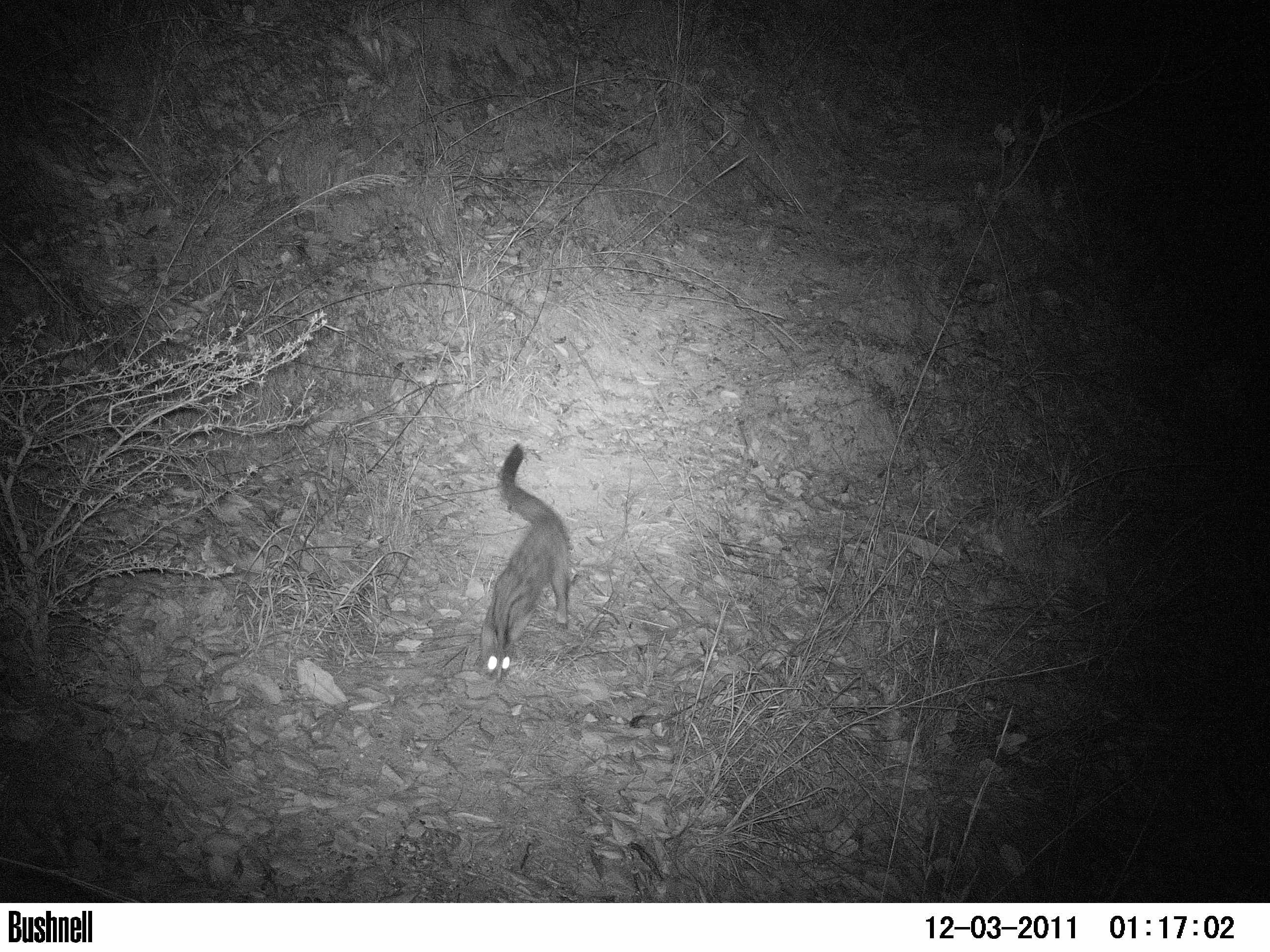
The pelage of the Angolan genet is a dark gray or dark reddish-gray background with black to brownish-black spots in a complex, symmetrical pattern. On the neck and back are round or elongate dark brown to black spots forming five longitudinal rows on either side of the dark dorsal crest. The upper two rows of spots may blend together, and the lower rows are often imperfect. Separate spots continue down the proximal portion of each limb. The underside of the body is paler gray and unspotted. The undersides of the fore and hindfeet (to the heel) are grayish-black to black. The spinal hair crest of G. angolensis is relatively long (up to 6 cm) and erectile. The tail is more thickly furred than in other species of Genetta and sports a black underside and eight black rings. The tail tip may be light, or the last black tail ring may merge into a black tip. Angolan genets have a dark gray face with a slightly paler supra-orbital spot. The sub-orbital region, front of the upper lip, and chin are white, while the back of the upper lip and dorsal surface of the nose are black. There is also a black stripe from the middle of the forehead that is continuous with the black spinal crest. Very dark or melanistic individuals are not uncommon.
Range mass: 1 to 2 kg.
Other Physical Features: endothermic ; homoiothermic; bilateral symmetry
Sexual Dimorphism: male larger
- Estes, R. 1991. The Behavior Guide to African Mammals. Berkeley: University of California Press.
- Ewer, R. 1973. The carnivores. Ithaca: Cornell University Press.
Trusted
Ecology
Habitat
Habitat and Ecology
Systems
- Terrestrial
Trusted
Rain forests and moist savannahs (Haltenorth & Diller 1980, Estes 1991).
Terrestrial Biomes: savanna or grassland ; rainforest
Trusted
Trophic Strategy
Food Habits
Details unknown. Presumed to be similar to G. genetta in being a generalized predator, taking a wide variety of small vertebrate and invertebrate prey. May also eat fruit and carrion.
Primary Diet: carnivore (Eats terrestrial vertebrates, Insectivore )
Trusted
Life History and Behavior
Reproduction
Details unknown. Presumed to be similar to G. genetta with the range of single male overlapping that of several females, and from 1-2 reproductive cycles per year depending upon latitude. Males and females probably come together only for breeding, with 1-4 young born helpless and blind in a burrow or tree cavity after a gestation period of 70-77 days.
Key Reproductive Features: iteroparous ; gonochoric/gonochoristic/dioecious (sexes separate); viviparous
- Estes, R. 1991. The Behavior Guide to African Mammals. Berkeley: University of California Press.
- Haltenorth, T., H. Diller. 1980. A field guide to the mammals of Africa. London: Collins Sons & Co..
Trusted
Conservation
Conservation Status
IUCN Red List Assessment
Red List Category
Red List Criteria
Version
Year Assessed
Assessor/s
Reviewer/s
Justification
History
- 1996Lower Risk/least concern
Trusted
The classification of genets (genus Genetta), particularly allocation to subspecies, is uncertain, so the status of different groups is also uncertain. The Angolan genet may be relatively common within its range, however the habitats known to be important to this species are shrinking due to human land-use practices which include logging, farming, and grazing of livestock in lands set aside for wildlife .
US Federal List: no special status
CITES: no special status
IUCN Red List of Threatened Species: least concern
Trusted
Trends
Population
Population Trend
Trusted
Threats
Trusted
Management
Conservation Actions
Trusted
Relevance to Humans and Ecosystems
Benefits
Economic Importance for Humans: Negative
Details for this species unknown. Other species of Genetta are known to occasionally attack and kill poultry.
Trusted
Economic Importance for Humans: Positive
Details for this species unknown. However, as important predators on small vertebrates including rodents, Genetta spp. are often tolerated around farms and towns and even kept as pets in some areas.
Positive Impacts: controls pest population
- Macdonald, D. 1984. The encyclopedia of mammals. New York: Facts on File, Inc..
Trusted
Wikipedia
Angolan genet
The Angolan genet (Genetta angolensis), is a mammal from the Carnivora order, related to civets and linsangs. It is one of fourteen species of genets. It is endemic to Angola, Democratic Republic of the Congo, Malawi, Mozambique, Tanzania, Zambia and Zimbabwe.[1][2]
Description
The Angolan genet has fur that is reddish grey to dark grey in color, with small brown spots on its body and stripes on its ringed tail that is bushier than that of other genets. It has a black muzzle, with white around the eyes and mouth. This species has a dark dorsal stripe who runs from the base of the skull down to the tail, which can be raised defensively like a mane when the animal is threatened. Five rows of elongated spots or stripes run down either side of its neck. Melanistic individuals also exist.[3]
Its claws are semi-retractable. Its body is long and lean, set on short legs. It can erect a mane of hair along its back when frightened. The Angolan genet's mane is relatively long, being about 2 inches (6 cm) in length. Like all viverrids, it has well-developed musk glands used to mark territory. Genets have 40 teeth. Females have 4 teats, and males have a well-developed baculum. Both the front and hind feet have five digits, with well-furred soles. Its eyes are large and round, and its ears are large and triangular shaped.
Notes
- ^ a b Wozencraft, W. Christopher (16 November 2005). "Order Carnivora (pp. 532-628)". In Wilson, Don E., and Reeder, DeeAnn M., eds. Mammal Species of the World: A Taxonomic and Geographic Reference (3rd ed.). Baltimore: Johns Hopkins University Press, 2 vols. (2142 pp.). ISBN 978-0-8018-8221-0. OCLC 62265494.
- ^ a b Gaubert P, Crawford-Cabral J & Hoffmann M (2008). Genetta angolensis. In: IUCN 2008. IUCN Red List of Threatened Species. Retrieved 2008-10-13.
- ^ White, P. 2000. "Genetta angolensis", Animal Diversity Web. Accessed November 27, 2011, at Animal Diversity Web.
| Wikimedia Commons has media related to: Genetta angolensis |
| This article about a carnivoran is a stub. You can help Wikipedia by expanding it. |
Unreviewed
Disclaimer
EOL content is automatically assembled from many different content providers. As a result, from time to time you may find pages on EOL that are confusing.
To request an improvement, please leave a comment on the page. Thank you!