Overview
Brief Summary
Biology
Trusted
Comprehensive Description
Description
Trusted
Distribution
Range Description
Sun bears are uncommon at the northern and western edges of their range (southern Yunnan province, southeastern Tibet, northeast India, and Bangladesh; (Chauhan 2006, Gong and Harris 2006); this lower abundance was apparent in historical times (e.g., in India; Higgins 1932) so is probably a natural gradient unrelated to human exploitation.
Trusted
Geographic Range
Helarctos malayanus ranges from the eastern Himalayas to Szechuan in China, then southward throughout Burma, parts of Indochina and the Malayan peninsula. Their range is probably greater than what is actually known.
Biogeographic Regions: oriental (Native )
Trusted
Range
Trusted
Physical Description
Morphology
Physical Description
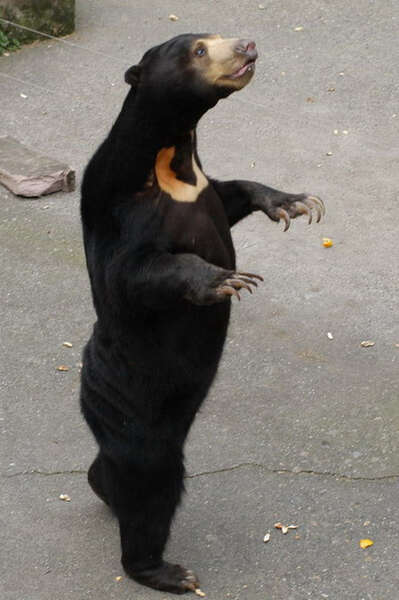
Sun bears are the smallest bears in the family Ursidae. They stand 70 cm at the shoulder and are 1.2 to 1.5 m from head to tail. The tail itself is 3 to 7 cm. Males are larger than the females but only by 10 to 20%. They have short, wide, flat heads with small round ears. Their fur is rather coarse but appears sleek. This coat is entirely black except for a "U" shaped patch on the chest and a grey to faintly orange muzzle. The yellowish or white chest patch is highly variable, "U" shaped in some and completely absent in others. This mark may exaggerate bears' sizes during fights. The young are born with soft, shiny coats. The paws are fairly large with sickle-shaped claws and naked soles which are thought to be helpful in climbing trees. These bears have an interesting walk, with all four legs turned in while walking.
Range mass: 27 to 65 kg.
Range length: 1.2 to 1.5 m.
Other Physical Features: endothermic ; homoiothermic; bilateral symmetry
Sexual Dimorphism: male larger
- International Association for Bear Research and Management (IBA), 1999. "Sun Bear" (On-line). Accessed Nov. 27, 2001 at http://www.bearbiology.com/sudesc.html.
- Nowak, R. 1997. ""Walker's Mammals of the World"" (On-line). Accessed Nov. 1, 2001 at http://www.press.jhu.edu/books/walkers_mammals_of_the_world/special.html.
Trusted
Ecology
Habitat
Habitat and Ecology
In contrast, sun bears in mainland Southeast Asia inhabit seasonal ecosystems with a long dry season (3–7 months), during which rainfall is <100 mm per month. Seasonal forest types are usually interspersed in a mosaic that includes semi-evergreen, mixed deciduous, dry dipterocarp (<1,000 m elevation), and montane evergreen forest (>1,000 m). The range of sun bears overlaps that of Asiatic black bears (Ursus thibetanus) in this seasonal forest mosaic.
Sun bears also have been reported in mangrove forest, although their occurrence in this forest type probably depends on proximity to other, more favored habitats. Sun bears use selectively logged areas (Wong et al. 2004, Meijaard et al. 2005), and oil palm plantations near forest edges (Nomura et al. 2004). However, there is no evidence that sun bears can survive in deforested or agricultural areas in the absence of nearby forest (Augeri 2005).
Sun bears occur from near sea level to over 2,100 m elevation, but appear to be most common in lower elevation forests. In Indonesia and western Thailand, for example, sun bears occur primarily below 1,200 m (Augeri 2005, Vinitpornsawan et al. 2006). Sun bears have been observed up to 2,100 m in Myanmar (Saw Htun 2006), 1,600 m in Lao PDR (Steinmetz et al. 1999), and 2,143 m in Sumatra (Augeri 2005).
Sun bears are omnivores, feeding primarily on termites, ants, beetle larvae, bee larvae and honey, and a large variety of fruit species, especially figs (Ficus spp.), when available (McConkey and Galetti 1999, Wong et al. 2002, Augeri 2005, Fredriksson et al. 2006). Occasionally, growth shoots of certain palms and some species of flowers are consumed (Fredriksson et al. 2006), but otherwise vegetative matter rarely occurs in the diet. In Bornean forests, fruits of the families Moraceae, Burseraceae and Myrtaceae make up more than 50% of the fruit diet (Fredriksson et al. 2006), whereas in western Thailand fruits of Lauraceae and Fagaceae are the most commonly consumed (Vinitpornsawan et al. 2006). In Thailand sun bears and Asiatic black bears use many of the same habitats and have extensive overlap in diet. However, in montane forests >1,200 m elevation (where ground cover is sparse) Asiatic black bears are more abundant than sun bears (Vinitpornsawan et al. 2006).
Little is known about social structure or reproduction in sun bears. Except for females with their offspring, sun bears are usually solitary. They may congregate to feed from large fruiting trees, but this behavior appears to be rare. Sun bears do not seem to have a defined breeding season anywhere in their range and usually give birth to only one cub (less commonly two; Schwarzenberger et al. 2004). Female bears use cavities of either standing or fallen large hollow trees as birthing sites. As sun bears occur in tropical regions with year-round available foods, they do not hibernate.
Systems
- Terrestrial
Trusted
Habitat
Sun bears are found in dense lowland tropical forests. They can commonly be found climbing in trees.
Habitat Regions: tropical ; terrestrial
Terrestrial Biomes: forest ; rainforest
Trusted
Habitat
Trusted
Trophic Strategy
Food Habits
Sun bears are opportunistic omnivores, with bees, termites, and earthworms comprising the main part of their diet. Fruit is also eaten when available. The former are more regular food sources than fruit and usually there is no need for H. malayanus to cover great distances in their search for food. These bears have long tongues that are helpful for obtaining insects from trees, termites from their nests, and honey from bee hives. Should the opportunity present itself, sun bears will eat small rodents, birds, and lizards along with scavenging tiger kills. In human populated areas their diet may include rubbish, livestock, and agricultural fruit such as bananas.
Animal Foods: birds; mammals; carrion ; insects; terrestrial worms
Plant Foods: fruit
Primary Diet: omnivore
Trusted
Associations
Ecosystem Roles
In certain regions, sun bears are important in seed dispersal. In a study of H. malayanus in Borneo, one sample of these bear feces was found to contain 309 seeds of a certain species of plant. They also impact the colonial insect populations that they prey on.
Ecosystem Impact: disperses seeds
- McConkey, K., M. Galetti. 1999. Seed dispersal by sun bear *Helarctos malayanus* in Central Borneo. Tropical Ecology, 15: 237-241.
Trusted
Predation
Predation on sun bears is not reported. Because of their size they are likely to have few natural predators. Young bears may be killed by aggressive conspecifics or by tigers.
Anti-predator Adaptations: cryptic
Trusted
Known prey organisms
Annelida
Insecta
Aves
Mammalia
This list may not be complete but is based on published studies.
Trusted
Life History and Behavior
Behavior
Communication and Perception
Like other bear species, sun bears have a keen sense of smell. Bears tend to use their senses of smell and touch to find and manipulate food. They probably use olfactory cues to find potential mates and use some vocalizations.
Communication Channels: acoustic ; chemical
Perception Channels: visual ; acoustic
Trusted
Life Expectancy
Lifespan/Longevity
In captivity sun bears have lived up to 24 years and nine months.
Range lifespan
Status: captivity: 24.75 (high) years.
Average lifespan
Status: captivity: 35.9 years.
- Helin, S. 1999. Mammalian of China. Beijing, China: China Forestry Publishing House.
Trusted
Lifespan, longevity, and ageing
Trusted
Reproduction
Reproduction
Little is known about mating in sun bears.
Little is known about the reproductive behavior of sun bears in the wild. Gestation period lasts about 95 days, but there is evidence of delayed implantation. Some sun bear pregnancies in a zoo in Fort Worth lasted 174 to 240 days. A sun bear at the Berlin Zoo actually gave birth two times in one year in 1961, first in April, then again in August, but this is rare. Litter size is usually around one to two but occasionally there are three. Newborns are blind, hairless, and helpless and weigh a mere 300 grams. Cubs stay with their mothers until fully grown and reach sexual maturity around three years of age.
Breeding interval: Frequency of breeding in females is unknown.
Breeding season: Breeding occurs throughout the year.
Range number of offspring: 1 to 3.
Average number of offspring: 1-2.
Range gestation period: 95 to 240 days.
Average age at sexual or reproductive maturity (female): 3 years.
Average age at sexual or reproductive maturity (male): 3 years.
Key Reproductive Features: iteroparous ; year-round breeding ; gonochoric/gonochoristic/dioecious (sexes separate); viviparous ; delayed implantation
Average birth mass: 325 g.
Average number of offspring: 1.
Average age at sexual or reproductive maturity (female)
Sex: female: 2372 days.
Like other bear species, sun bear females invest large amounts of energy into raising their altricial young to a stage at which they are able to be independent.
Parental Investment: altricial ; pre-fertilization (Provisioning, Protecting: Female); pre-hatching/birth (Provisioning: Female, Protecting: Female); pre-weaning/fledging (Provisioning: Female, Protecting: Female); pre-independence (Provisioning: Female, Protecting: Female); extended period of juvenile learning
- International Association for Bear Research and Management (IBA), 1999. "Sun Bear" (On-line). Accessed Nov. 27, 2001 at http://www.bearbiology.com/sudesc.html.
Trusted
Molecular Biology and Genetics
Molecular Biology
Barcode data: Helarctos malayanus
There are 3 barcode sequences available from BOLD and GenBank. Below is a sequence of the barcode region Cytochrome oxidase subunit 1 (COI or COX1) from a member of the species. See the BOLD taxonomy browser for more complete information about this specimen and other sequences.
-- end --
Download FASTA File
Trusted
Statistics of barcoding coverage: Helarctos malayanus
Public Records: 3
Species: 3
Species With Barcodes: 1
Trusted
Conservation
Conservation Status
IUCN Red List Assessment
Red List Category
Red List Criteria
Version
Year Assessed
Assessor/s
Reviewer/s
Contributor/s
Justification
In addition, Sun Bear numbers have been reduced by uncontrolled exploitation for body parts. It is expected that commercial exploitation will continue during the next 30 years unless abated by the implementation of significant anti-poaching measures.
History
- 1996Data Deficient
- 1994Vulnerable(Groombridge 1994)
- 1990Vulnerable(IUCN 1990)
Trusted
Conservation Status
Sun bears are one of the rarest bears. The exact number alive today is not known, but the population is steadily declining due to deforestation and hunting. Habitat destruction is causing these bears to live in smaller and more isolated patches. The land is being cleared to create coffee, rubber and oil palm plantations. Poachers are flocking to protected areas and reserves because they know there are bears there. Reserves may not even be providing sufficient habitats for these bears because their needs are not completely known. Not many conservation attempts have been done to save these bears because so little is known about them.
US Federal List: no special status
CITES: appendix i
IUCN Red List of Threatened Species: vulnerable
- Servheen Christopher, March/April 1999. "Bear COnservation Around the World" (On-line). Accessed Nov. 27, 2001 at http://www.fonz.org/zoogoer/zg1999/28%282%29bearconserve.htm.
Trusted
Status
Trusted
Trends
Population
Population Trend
Trusted
Threats
Threats
Human-caused fires in parts of Sundaland are also diminishing habitat quality for sun bears. These fires are more extensive during El Niño-related droughts. On Borneo, periods of prolonged drought have disrupted fruiting patterns (e.g., Harrison 2000), which in combination with reduced habitat availability due to logging and fires, resulted in starvation among sun bears, even in primary forest areas (Wong et al. 2005, Fredriksson et al. 2006b).
Commercial poaching of bears for the wildlife trade is a considerable threat in most countries (Meijaard 1999, Nea and Nong 2006, Nguyen Xuan Dang 2006, Saw Htun 2006, Tumbelaka and Fredriksson 2006, Wong 2006), and is the main threat where deforestation is currently negligible (for example in Thailand where nearly all remaining forest is within protected areas; Vinitporsawan et al. 2006). Killing bears is illegal in all range countries but is largely uncontrolled. In Thailand, local hunters in one area estimated that commercial poaching reduced the abundance of sun bears by 50% in 20 years (Steinmetz et al. 2006).
In Myanmar, Thailand, Lao PDR, Cambodia and Viet Nam, sun bears are commonly poached for their gall bladders (i.e., bile) and bear-paws; the former is used as a Traditional Chinese Medicine, and the latter as an expensive delicacy. In China and Viet Nam, bile is milked from commercially-farmed bears; however, as there are few sun bears in China, farms there contain mainly Asiatic black bears. Conversely, both sun bears and Asiatic black bears are farmed in Viet Nam, in small private enterprises. Bears are routinely removed from the wild to stock or restock these small farms (Nguyen Xuan Dang 2006, B. Long, MOSAIC and WWF-Viet Nam pers. comm.).
Other motivations for killing bears include: preventing damage to crops (Fredriksson 2005), subsistence use, fear of bears near villages, and capture of cubs for pets (the mother being killed in the process). Although few sun bears exist in India, villagers there still kill sizeable numbers (Chauhan and Singh 2006).
Despite significant poaching within extant forest areas, sun bear populations appear to persist longer than some other heavily-exploited large carnivores. For example, tiger (Panthera tigris) populations have been severely reduced or extirpated in 12 of 15 protected areas surveyed in Myanmar, whereas sun bears were still encountered relatively frequently in 13 of these areas (Lynam 2003, Saw Htun 2006). Similarly, in Thailand tigers are close to extirpation in the Khao Yai forest complex, but sun bears and their signs are still consistently encountered there (Lynam et al. 2006, Vinitpornsawan et al. 2006).
Trusted
Threats
Trusted
Management
Conservation Actions
Conservation measures and priorities vary by country. None of the range countries have established specific conservation measures for sun bears, and some taking is permitted (Servheen 1999). General measures to reduce forest loss and poaching would help conserve the species. The most beneficial conservation measure in Indonesia and Malaysia would be protection of remaining forests from conversion to other land-uses, eliminating unsustainable logging practices, and prevention of forest fires. Establishment of new and effectively managed protected areas in Indonesia and Malaysia should be promoted in order to preempt land conversion (Augeri 2005, Tumbelaka and Fredriksson 2006, Wong 2006).
Reducing the trade in bear parts would be highly beneficial for the survival of the species in mainland Southeast Asia. However, given available resources, the patrolling and monitoring of entire protected areas is currently an overwhelming task. To make this problem more manageable, a network of small bear recovery zones (100–200 km²) could be established within key protected areas. The patrolling efforts of rangers could then be focused on these zones. Recovery zones should be locations with plentiful bear foods such as trees from the families Lauraceae, Moraceae, Burseraceae, Myrtaceae and Fagaceae. Such zones would provide a biologically meaningful, geographically focused, and logistically realistic way for the efforts of protected area staff to be translated into population recovery for bears (and other wildlife species).
Recently, the Bear Specialist Group mapped the current, range-wide distribution of sun bears. Important habitat blocks for long-term survival of sun bears were identified (Bear Conservation Units-BCUs). Anti-poaching efforts within these BCUs should be a high priority. Trends in bear occurrence and relative abundance within BCUs could be monitored using standardized sign surveys and camera trapping. Results of such monitoring could indicate which management or ecological conditions promote successful bear conservation, and which do not, and provide a means to assess the results of conservation efforts (e.g., future range expansion and/or increased bear density being indicative of effective conservation efforts). Additional field studies also would be helpful in this regard; few intensive studies have been conducted on this species.
Trusted
Conservation
Trusted
Relevance to Humans and Ecosystems
Benefits
Economic Importance for Humans: Negative
Sun bears have been known to cause damage to crops such as oil palms, coconuts, and bananas.
Negative Impacts: crop pest
Trusted
Economic Importance for Humans: Positive
The gall bladders and other body parts of sun bears are used in folk medical practices. It has been proven, though, that they have no medicinal value. People hunt them for sport and profit. They are commonly sold as pets when they are cubs, but quickly outgrow the stage when they are manageable as pets.
Positive Impacts: pet trade ; source of medicine or drug ; controls pest population
Trusted
Wikipedia
Sun bear
The sun bear (Ursus malayanus), also known as the honey bear, is a bear found primarily in the tropical rainforest (the dense lowland forests) in Southeast Asia; North-East India, Bangladesh, Myanmar, Thailand, Laos, Cambodia, Vietnam, Southern China, Peninsular Malaysia, and the islands of Sumatra and Borneo.[2]
Contents |
Description
The sun bear is 120–150 cm (47–60 in) long, making it the smallest member in the bear family (Ursidae).[3] Males tend to be 10–45% larger than females;[4] the former normally weigh between 30 and 70 kg (66–154 lb), and the latter between 20 and 40 kg (44–88 lb).[5] The shoulder height is about 60–78 cm (24–28 in).[6] The sun bear possesses sickle-shaped claws that are relatively light in weight. It has large paws with naked soles, probably to assist in climbing. Its inward-turned feet make the bear's walk pigeon toed, but it is an excellent climber. It has small, round ears and a stout snout. The tail is 1.2–2.8 inches (3–7 cm) long.[4] Despite its small size, the sun bear possesses a very long, slender tongue, ranging from 8 to 10 inches (20–25 cm) in length. The bear uses it to extract honey from beehives.[7]
Unlike other bears, the sun bear's fur is short and sleek. This adaptation is probably due to the lowland climates it inhabits. Dark black or brown-black fur covers its body, except on the chest, where there is a pale orange-yellow marking in the shape of a horseshoe. Similar colored fur can be found around the muzzle and the eyes. These distinctive markings give the sun bear its name.
Diet
The diet of the sun bear consists mainly of invertebrates and fruits but as omnivores they will eat a wide variety of foods including small vertebrates, such as lizards, birds, and turtles, eggs, the young tips of palm trees, nests of bees, berries, sprouts, roots, and coconuts. In fact, sun bears have been observed to eat over 100 insect species and over 50 plant species.[8]
Despite being able to eat many leaves, the sun bear has certain favourite food sources. This was demonstrated in a study where termites, ants, beetles and beetle larvae made up the majority of the invertebrates eaten, whilst figs were the most important fruit source consumed.[9] They eat termites by thrusting their paws into termite mounds and licking them off their paws.[10]
The sun bear's fondness for honey gives rise to its alternative name of the 'honey bear'. In Malay and Indonesian, it is known as 'Beruang Madu' which translates to honey bear.
Its powerful jaws can crack open nuts. Its long, powerful claws are used to break into tree trunks and fallen logs to access honey, grubs and termites. Much of the sun bear's food must be detected using its keen sense of smell, as its sight is poor.
Lifestyle and reproduction
The sun bear does not hibernate, and, as a result, it can reproduce year-round. The offspring reach sexual maturity after 3–4 years and may live up to 30 years in captivity. A female sun bear can produce 1 to 2 cubs per year. Sun bears undergo a roughly 96 day gestation period after which the 300 to 400 g cub is born blind and hairless. The cub is initially totally dependent on its mother and suckling can continue for about 18 months. After 1 to 3 months, the young cub can run, play and forage near its mother. Male sun bears grow larger than females. Females are observed to mate at about 3 years. During time of mating, the sun bear will show behaviour like hugging, mock fighting and head bobbing with its mate.
Being a primarily nocturnal creature, the sun bear tends to rest during the day on lower limbs not far above the ground. Because it spends so much time in trees, the sun bear can sometimes cause damage to property. It has been known to destroy coconut palms and cacao trees on plantations.
Threats
Adult sun bears have few predators except humans, due to their fierce reputation and formidable teeth.[11] Occasionally, they may be overwhelmed by tigers, or large reticulated pythons. Other possible predators include the leopard, the clouded leopard, and the sun bear's larger sympatric relative, the Asiatic black bear.[5] The bear's loose skin on its neck allows it to wriggle its body inside its skin far enough to turn around and bite its attacker when grabbed.
The recent decline in the sun bear population can be largely attributed to the hunting of "nuisance bears" that destroy crops and widespread poaching driven by the market for their fur and for their bile, which is used in Chinese medicine.
Sometimes, sun bears are captured or bred to be domestic pets—a role for which they are considered desirable, due to their relatively inoffensive nature and small size in comparison with other bears.[12]
The IUCN reclassified the sun bear from "data deficient" to "vulnerable" status in 2007.[13]
Subspecies
- Helarctos malayanus malayanus
- Helarctos malayanus euryspilus, found only on the island of Borneo.
References
- ^ Fredriksson, G., Steinmetz, R., Wong, S. & Garshelis, D.L. (2008). Helarctos malayanus. In: IUCN 2008. IUCN Red List of Threatened Species. Downloaded on 26 January 2009.
- ^ Stirling I., 1993; Bears, majestic creatures of the World. Rodale Press, Emmaus
- ^ Sun Bears, Sun Bear Pictures, Sun Bear Facts – National Geographic. Animals.nationalgeographic.com. Retrieved on 2011-09-26.
- ^ a b Brown, Gary (1996). Great Bear Almanac. p. 340. ISBN 1-55821-474-7.
- ^ a b Fredriksson, Gabriella M. (2005). "Predation on Sun Bears by Reticulated Python in East Kalimantan, Indonesian Borneo". Raffles Bulletin of Zoology 53 (1): 165–168. http://rmbr.nus.edu.sg/rbz/biblio/53/53rbz165-168.pdf.
- ^ ADW: Helarctos malayanus: Information. Animaldiversity.ummz.umich.edu. Retrieved on 2011-09-26.
- ^ Sun Bear at Arktofile. Arktofile.net. Retrieved on 2011-03-26.
- ^ Frediksson Gabriella, 2001; "Beruang madu." "Sahabat Alam, LORIES. Jan 2001:3–6."
- ^ Wong Siew Te, Servheen Christopher, Ambu Laurentius (2002). "Food habits of Malayan Sun Bears in lowland tropical forests of Borneo". Ursus 13: 127–136. http://www.cfc.umt.edu/GrizzlyBearRecovery/pdfs/Wong%20et%20al.%20%202002.pdf.
- ^ Menon, Vivek (2009). Princeton Field Guides "Mammals of India". Princeton University Press. ISBN [[Special:BookSources/97806911470674|97806911470674]].
- ^ San Diego Zoo's Animal Bytes: Sun Bear. Sandiegozoo.org. Retrieved on 2011-09-26.
- ^ Bunnell, Fred (1984). Macdonald, D.. ed. The Encyclopedia of Mammals. New York: Facts on File. p. 97. ISBN 0-87196-871-1.
- ^ Concern grows for the smallest bear. BBC News. 12 November 2007. accessed 2007-11-12
Unreviewed
Disclaimer
EOL content is automatically assembled from many different content providers. As a result, from time to time you may find pages on EOL that are confusing.
To request an improvement, please leave a comment on the page. Thank you!