Overview
Distribution
Range Description
In Lao PDR, most recent records are from the central part of the country, with some from the north, although historic records come also from the south (Duckworth 1997, Duckworth et al. 1999). There are recent indirect reports (unsubstantiated villager reports) from many survey areas in Lao PDR, but few documented records (R.J. Timmins and J.W. Duckworth pers. comm. 2006); in aggregate, these suggest that this species was present in the recent past, but has more or less been hunted out from quite wide areas (J.W. Duckworth in litt. 2006). Deuve (1972) considered that the species occurred in the southern region of Lao PDR, listing several lowland sites; however, Deuve’s Lao range information is often faulty (e.g. Timmins and Duckworth 1999), so this cannot be taken as complete confirmation the animal was formerly widespread in Lao lowlands. All seven records in 1992-1996 were from in and around the Nam Theun catchment at sites above 500 m (Duckworth 1997), while both historical sites listed by Delacour (1940) are in mountainous areas: Phongsali and the Bolaven Plateau. The post-1996 records are also from hills and mountains (Duckworth et al. 1999).
Trusted
Geographic Range
Hog badgers, Arctonyx collaris, have a wide distribution in southeast Asia. This distribution is mostly tropical. The species os found from Sikkim and northeastern China to Thailand. To the west, its range is bounded by the Indian subcontinent. Hog badgers also are found on the island of Sumatra (Nowak, 1999; Ernest, 1977; Ernest, 1986; Jackson, 2001; Long et al., 1983).
Biogeographic Regions: oriental (Native )
Other Geographic Terms: island endemic
Trusted
Physical Description
Morphology
Physical Description
A. collaris is very similar in size and build to Meles meles, a Eurasian badger. Hog badgers are typically 550 mm to 700 mm in length, and have tails 120 mm to 170 mm long. Weight ranges from 7 to 14 kg.
Fur on the body is yellowish to grey, although the feet and belly are black. Black eye stripes run from the nose to the ears. There are also stripes that run from the mouth to the main stripe. The black stripes are contrasted by white fur on the head. As with Meles, the coloration pattern has been interpreted to be a warning to potential enemies that this creature should be left undisturbed.
A. collaris has long, pale-colored claws, a useful distinction from Meles, which has dark claws. Hog badgers also have a pig-like snout, which has a patch of naked skin at its tip.
(Nowak, 1999; Ernest, 1977; Ernest, 1986; Jackson, 2001; Long et al., 1983).
Range mass: 7 to 14 kg.
Range length: 550 to 700 mm.
Other Physical Features: endothermic ; bilateral symmetry
Trusted
Ecology
Habitat
Habitat and Ecology
often referred to as nocturnal, however, analysis of numerous camera-trap pictures from Myanmar show no peak at either day or night; it can be active at any time (Than Zaw et al. in press). It is usually found in forested areas as high as 3,500 m, and it feeds on “tubers, roots, earthworms, insects, and other small living creatures” (Lekagul and McNeely 1977). Wang and Fuller (2003) conducted a study on the food habits of this species in a rural agricultural area of southeastern China (Taohong Village, Jiangxi Province), and found that this species ate more mammals and gastropods than other species studied. Little is known about its breeding habits, though litter size seems to be two to three young, and individuals have lived up to seven years in captivity (Lekagul and McNeely 1977).
In Lao PDR, the hog badger is found in forested areas, and mainly now on hills and mountains (Duckworth et al. 1999), however, this altitudinal restriction may be a secondary effect of overhunting. In contrast to Lao PDR, this species in Cambodia occurs in level lowlands, in mosaics of deciduous and semi-evergreen forests, which is a further line of supposition that its current Lao distribution reflects anthropogenic restriction.
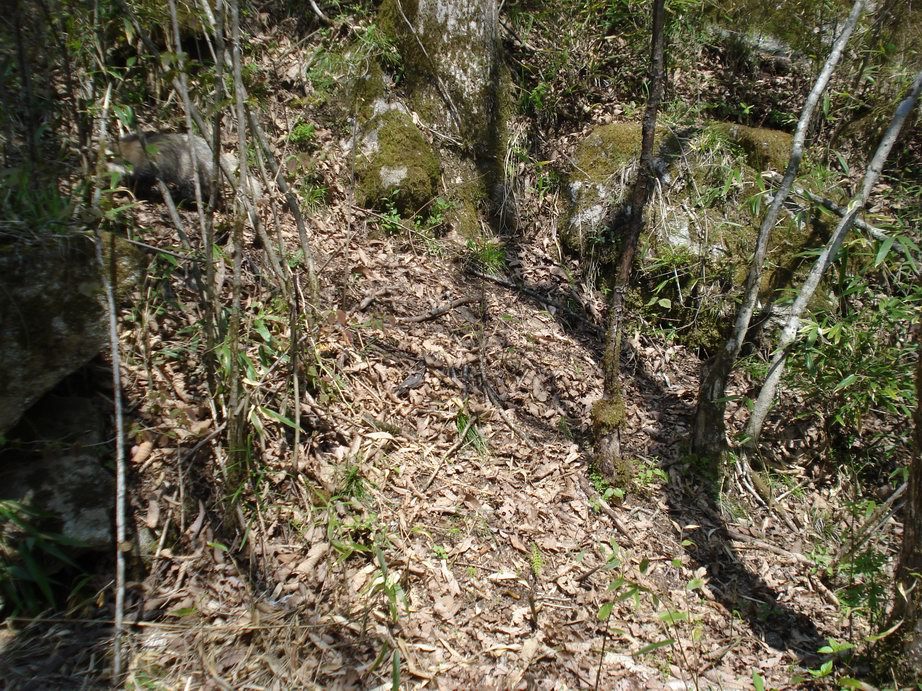
In India, this species is fairly common within grassland habitats of Terai, as well as in dense, tropical evergreen and semi-evergreen forests, and tall grassland -woodland mosaic. In Thailand it is also found in rubber plantations adjacent to forests (B. Kanchanaska pers. comm.). In Myanmar, the hog badger has been recorded in forest including bamboo stands under tree cover (Than Zaw et al. in press), and it is also found in limestone forests in Viet Nam (Roberton et al. in prep.). It mainly occurs in upper montane forest in Sumatra (Holden 2006).
Systems
- Terrestrial
Trusted
Habitat
A. collaris prefers forested areas along with lowland jungles. Hog badgers have been observed to inhabitat areas up to 3,500 m in elevation, and use a wide array of habitat types throughout southeast Asia, including grasslands and agricultural areas (Nowak, 1999; Ernest, 1977; Ernest, 1986; Jackson, 2001; Long et al., 1983).
Range elevation: 0 to 3,500 m.
Habitat Regions: tropical
Terrestrial Biomes: forest ; rainforest ; mountains
Other Habitat Features: agricultural
Trusted
Trophic Strategy
Food Habits
A. collaris will eat just about anything, including worms, invertebrates, fruits, and roots. It forages for food using its sense of smell. Hog badgers use their snouts, incisors, and the canine teeth of the lower jaw to root in the ground much like a pig. Hog badgers will eat other small animals (such as small mammals) if given the opportunity. However, as with Eurasiam badgers, their favorite food appears to be earthworms. (Nowak, 1999; Ernest, 1977; Ernest, 1986; Jackson, 2001; Long et al., 1983).
Animal Foods: mammals; insects; terrestrial worms
Plant Foods: roots and tubers; fruit
Primary Diet: carnivore (Vermivore)
Trusted
Associations
Ecosystem Roles
Not much is known about roles that A. collaris plays in the ecosystem. Becuase of their dietary habits, these badgers likely play some role in regulating populations of invertebrates. They dig into the soil, so they contribute to aeration of the soil. To the extent that other small animals use abandoned burrows, they create habitat.
Ecosystem Impact: soil aeration
Trusted
Predation
A. collaris has big claws, strong jaws, thick and flexible loose skin, and a nasty disposition. All of thes attributes help hog badgers fend off predators. Their coloration pattern is though to be aposematic--a warning that they are dangerous and should be left alone (Nowak, 1999). Hog badgers are good diggers, and can dig out of sight if threatend. Like other mustelids, they can also produce secretions from their anal glands, but it is not known if this is used as a defense mechanism (Jackson, 2001).
Known Predators:
- tigers (Panthera tigris)
- leopards (Panthera pardus)
Trusted
Known prey organisms
Annelida
Insecta
Mammalia
This list may not be complete but is based on published studies.
- Myers, P., R. Espinosa, C. S. Parr, T. Jones, G. S. Hammond, and T. A. Dewey. 2006. The Animal Diversity Web (online). Accessed February 16, 2011 at http://animaldiversity.org. http://www.animaldiversity.org
Trusted
Known predators
Panthera pardus
Panthera tigris
This list may not be complete but is based on published studies.
- Myers, P., R. Espinosa, C. S. Parr, T. Jones, G. S. Hammond, and T. A. Dewey. 2006. The Animal Diversity Web (online). Accessed February 16, 2011 at http://animaldiversity.org. http://www.animaldiversity.org
Trusted
Life History and Behavior
Behavior
Communication and Perception
Communication patterns in A. collaris have not been documented. They likely involve scents, as well as vocalizations and some tactile communication, as in other species of mustelid.
Communication Channels: visual ; tactile ; acoustic ; chemical
Trusted
Life Expectancy
Lifespan/Longevity
Not much is known about the lifespan of A. collaris in the wild. However, in captivity one hog badger reached 13 years 11 months of age (Jackson, 2001; Nowak, 1999).
Range lifespan
Status: captivity: 14 (high) years.
Average lifespan
Status: captivity: 13.9 years.
Trusted
Lifespan, longevity, and ageing
Trusted
Reproduction
Reproduction
The mating system and behavior of this species is not known.
Not much is known about the reproductive behavior of A. collaris. In the wild, the young are born in a burrow and litter sizes typically range from 2 to 4 cubs (Ernest, 1977; Ernest, 1986; Jackson, 2001; Long et al., 1983). Mating occurs in May, and births occur the following February or March, indicating a pregancy length of 10 months. This has suggested a period of delayed implantation, as is found in Eurasian badgers, Meles meles (Nowak, 1999). Weaning apparently occurs around four months of age (Nowak, 1999).
In captivity, young hog badgers reach adult size around 7.5 months of age. Mating at the Toronto zoo was observed throughout the spring and summer months, although birth of a litter occurred the following February. Delayed implantation was again suspected, and the actual gestation was estimated as 6 weeks. This is also about the duration of embyonic development in M. meles, which ranges from 6 to 8 weeks. The female hog badger at the Toronto zoo produced litters during each of two successive years. (Nowak, 1999)
Breeding season: Breeding appears to occur in May, with births occurring the following February or March.
Range number of offspring: 2 to 4.
Average gestation period: 10 months.
Average weaning age: 4 months.
Key Reproductive Features: iteroparous ; seasonal breeding ; gonochoric/gonochoristic/dioecious (sexes separate); sexual ; fertilization (Internal ); viviparous ; delayed implantation
Average birth mass: 58 g.
Average gestation period: 42 days.
Average number of offspring: 3.
Females of this species nurse their young for about 4 months (Nowak, 1999).
Parental Investment: female parental care
Trusted
Conservation
Conservation Status
IUCN Red List Assessment
Red List Category
Red List Criteria
Version
Year Assessed
Assessor/s
Reviewer/s
Contributor/s
Justification
History
- 1996Lower Risk/least concern
Trusted
Conservation Status
There is no information available on conservation of A. collaris. The species is not listed by CITES or by IUCN.
IUCN Red List of Threatened Species: near threatened
Trusted
Trends
Population
Population Trend
Trusted
Threats
Threats
The snaring intensity in Cambodia is considerably lower than that in Lao PDR and Viet Nam, and the relatively larger number of recent records from Cambodia than from Viet Nam and Lao PDR is strong indirect evidence that trapping levels are driving reductions in these latter countries. In Viet Nam and presumably elsewhere, gun-hunting poses another threat to the species (Timmins et al. 1999).
While threats similar to those in Lao PDR and Viet Nam are known to exist in Thailand, it is generally thought that the hunting is operating at much lower intensities and are therefore not as serious. In Sumatra as well, the threats are minimal, because the zone of occurrence is above where the majority of hunting takes place (Holden 2006)
Trusted
Management
Conservation Actions
Trusted
Relevance to Humans and Ecosystems
Benefits
Economic Importance for Humans: Negative
There is no information on how A. collaris adversely affects humans. The Eurasian badger, however, is known to carry bovine tuberculosis (Nowak, 1999). It is possible that hog bagers also carry diseases common to livestock. Eurasian badgers, which have a diet very like that of hog badgers, are also known to damage crops (Nowak, 1999), and it is likely that A. collaris is similar in that regard.
Trusted
Economic Importance for Humans: Positive
There is no information on the benefits of A. collaris for humans.
Trusted
Wikipedia
Hog badger
The hog badger (Arctonyx collaris) is a terrestrial species of the mustelid family. It has medium-length brown hair, stocky body, white throat, two black stripes on an elongated white face and a pink, pig-like snout. The head-and-body length is 55–70 cm (22–28 in), the tail measures 12–17 cm (4.7–6.7 in) and the body weight is 7–14 kg (15–31 lb).[2] It is monotypic within the genus Arctonyx.
The hog badger is found in Southeast Asian tropical rainforests. Its appearance generally resembles the European badger, but it is smaller, with larger claws on the front feet. Its tail has long white hairs, and its front feet have white claws.
The hog badger is omnivorous, its diet consisting of fruits, roots and small animals. It is nocturnal.
The hog badger is uncommon and declining throughout its large range, and has been evaluated as of Near Threatened on the IUCN Red List of Threatened Species. It was previously listed as Least Concern.
References
- ^ Timmins, R.J., Long, B., Duckworth, J.W., Wang Ying-Xiang & Than Zaw (2008). Arctonyx collaris. In: IUCN 2008. IUCN Red List of Threatened Species. Downloaded on 21 March 2009. Database entry includes a brief justification of why this species is of near threatened
- ^ Boitani, Luigi, Simon & Schuster's Guide to Mammals. Simon & Schuster/Touchstone Books (1984), ISBN 978-0-671-42805-1
Unreviewed