Overview

Distribution

Range Description

This species is found in Central Africa, East Africa and southern Africa (it is broadly distributed across southern Africa). It has been recorded from Cameroon (Aellen 1952), Equatorial Guinea (Rio Muni), Gabon, Congo and Angola in the west, through southern Democratic Republic of the Congo and Rwanda, being distributed in East Africa from Uganda, Kenya and southern Somalia in the north, through Tanzania (including the island of Zanzibar), Zambia, Malawi and Mozambique into Zimbabwe, eastern and southern South Africa and Swaziland. There is a need to confirm the presence of this species in Cameroon and Equatorial Guinea. It ranges from sea level to around 2,000 m asl.
Creative Commons Attribution Non Commercial Share Alike 3.0 (CC BY-NC-SA 3.0)

© International Union for Conservation of Nature and Natural Resources

Source: IUCN

Trusted

Article rating from 0 people

Average rating: 2.5 of 5

Geographic Range

The Walberg's epauletted fruit bat can be found in Africa, anywhere south of the Sahara desert. These bats live in woodland and savannah areas, and prefer the edges of forests. During the summer, they migrate in large numbers to Taaween, in the Zoutpansberg district of South Africa, attracted by the ripening crop of guavas.

Biogeographic Regions: ethiopian (Native )

Creative Commons Attribution Non Commercial Share Alike 3.0 (CC BY-NC-SA 3.0)

© The Regents of the University of Michigan and its licensors

Source: Animal Diversity Web

Trusted

Article rating from 0 people

Average rating: 2.5 of 5

Physical Description

Morphology

Physical Description

Wahlberg's epauletted fruit bats are volant creatures. They have a prominent keel on their sternum, which supports the flight muscles. The total body length is between 125mm and 250mm long, and the wing span in males is about 508mm. They weigh between 40 grams and 120 grams. Both the first and second digits of the foreleg are clawed. The face and head resembles that of a dog.

These bats are grayish brown, russet, or tawny in color. Air sacks are present on the necks of males. These sacks are used in food collection, and may aid in creating a megaphone effect of the calls used by males to attract females during courtship. The males have shoulder epaulets that are used in courtship displays.

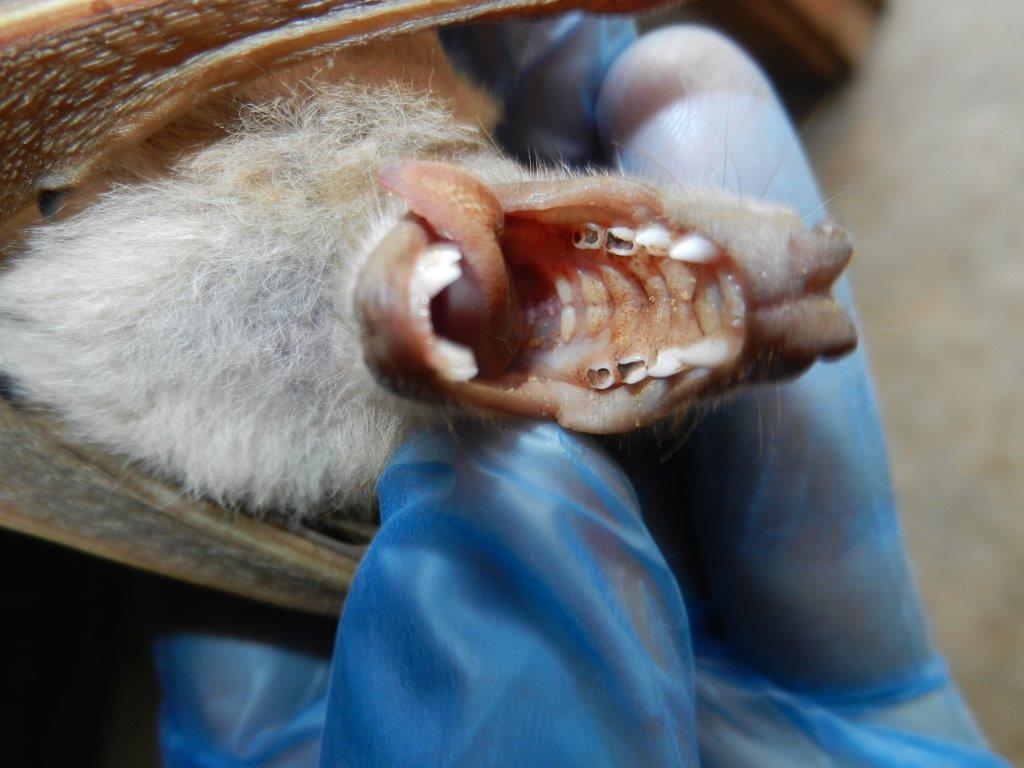
White spots of fur are located at the top part of the base of the ear in both sexes. Scent glands are located at the places where the white ear spots and shoulder epaulets are found. The ear is simple and oval, forming an unbroken ring, with no tragus. These bats do not have a nose leaf. The tail is short, and sticks out of the uropatagium, which is very narrow in this species. They have a simple wing, when compared to other bat species. They are strong fliers, and travel as far as ten kilometers to find food. Their eyes are very large. Sight, as well as smell, are what these bats use most often to locate their surroundings. Their jaws are strong, and their teeth are adapted to a fruit diet. The cheek teeth are large and flat, just the right surface for chewing fruit.

Range mass: 40 to 120 g.

Creative Commons Attribution Non Commercial Share Alike 3.0 (CC BY-NC-SA 3.0)

© The Regents of the University of Michigan and its licensors

Source: Animal Diversity Web

Trusted

Article rating from 0 people

Average rating: 2.5 of 5

Ecology

Habitat

Habitat and Ecology

Habitat and Ecology
mosaics of these habitat types. It appears to be largely absent from densely forested areas, but has been recorded from mangrove and riverine forest with fruiting trees. Roosting sites are often under the canopy of trees, in thick foliage, with animals sometimes present in considerable numbers. The species is somewhat adaptable to habitat modification, with populations recorded from well wooded urban and suburban areas, where it is associated with fruit-bearing trees. Animals occasionally roost in man-made structures.

Systems
  • Terrestrial
Creative Commons Attribution Non Commercial Share Alike 3.0 (CC BY-NC-SA 3.0)

© International Union for Conservation of Nature and Natural Resources

Source: IUCN

Trusted

Article rating from 0 people

Average rating: 2.5 of 5

Habitat

During the day, they live in hollow trees, underneath large leaves, and beneath the eaves of buildings. They often roost where there in considerable light. Every few days, they will move to a new roosting site. They roost in small groups containing mixed ages of males and females, the size of which range from three to one hundred individuals. They often choose the same spot to roost, at certain times of the year, for many consecutive years. While hanging from their feet in their roosts, they will isolate themselves from their neighbors by short distances. While roosting, they remain relatively quiet, and do not move very much. They make it a point to not intrude on each other's space.

Terrestrial Biomes: rainforest

Creative Commons Attribution Non Commercial Share Alike 3.0 (CC BY-NC-SA 3.0)

© The Regents of the University of Michigan and its licensors

Source: Animal Diversity Web

Trusted

Article rating from 0 people

Average rating: 2.5 of 5

Trophic Strategy

Food Habits

These bats are frugivorous. They chew the fruit, swallow the juice, and spit out most of the pulp and seeds. They swallow some of the softer pulp, and some of the seeds. The swallowed food goes through the simple digestive tract, usually within a half an hour. They use several methods to get the fruit from the tree. They either bite the fruit while hovering; or they hang from a branch with one foot while using the other foot to hold the fruit while they eat it; or they chop the fruit from a branch by holding the fruit in their mouths, and making a twisting motion in flight until the fruit drops off of the stem. The structure of their lips and windpipe creates suction that helps them to suck the juices from softer parts of the fruit. They also chew flowers to get the nectar and juices. They feed on figs, mangoes, guavas, bananas, peaches, apples, papayas, and small berries. The smell of ripening fruit is what attracts them to their food source. Fruits are nutritious because they contain high quantities of carbohydrates. Many fruits contain fats, which are of benefit, as well.

Creative Commons Attribution Non Commercial Share Alike 3.0 (CC BY-NC-SA 3.0)

© The Regents of the University of Michigan and its licensors

Source: Animal Diversity Web

Trusted

Article rating from 0 people

Average rating: 2.5 of 5

Life History and Behavior

Life Expectancy

Lifespan/Longevity

Average lifespan

Status: captivity:
10.1 years.

Creative Commons Attribution Non Commercial Share Alike 3.0 (CC BY-NC-SA 3.0)

© The Regents of the University of Michigan and its licensors

Source: Animal Diversity Web

Trusted

Article rating from 0 people

Average rating: 2.5 of 5

Lifespan, longevity, and ageing

Maximum longevity: 10.1 years (captivity) Observations: One specimen was still alive after 10.1 years in captivity (Richard Weigl 2005).
Creative Commons Attribution 3.0 (CC BY 3.0)

© Joao Pedro de Magalhaes

Source: AnAge

Trusted

Article rating from 0 people

Average rating: 2.5 of 5

Reproduction

Reproduction

During the breeding season, the males use the shoulder epaulets as a part of courtship. This courtship behavior is called an arena, or Îlekâ, mating system. The males congregate at traditional sites, where they puff up their white shoulder patches, and begin using mating calls, in an attempt to get passing females to select them. The call used by the males to attract females combines four short chirps that range from 2.0 kHz to 7.5kHz, and is one second in duration.

Young are born singly, in most cases, but twins are occasionally seen. As she forages for food, the mother caries her offspring clinging to her chest. Females have one pair of mammae located on the chest. The male sexual organ resembles that of some primates. Mating occurs twice per year on a seasonal basis, with births occurring around the end of February, and the beginning of September. Gestation lasts from five to six months. Females are the only ones who rear the young. The males don't give assistance. Other bats from the same family, (Pteropus poliocephalis, Pteropus giganteus, and Rousettus aegyptiacus), recognize their young through vocalizations and olfaction. They nurse their own young, and do not scent mark them. By inference, it is assumed that the Walberg's epauletted fruit bat does the same for its young.

Average number of offspring: 1.

Creative Commons Attribution Non Commercial Share Alike 3.0 (CC BY-NC-SA 3.0)

© The Regents of the University of Michigan and its licensors

Source: Animal Diversity Web

Trusted

Article rating from 0 people

Average rating: 2.5 of 5

Molecular Biology and Genetics

Molecular Biology

Statistics of barcoding coverage: Epomophorus wahlbergi

Barcode of Life Data Systems (BOLDS) Stats
Public Records: 0
Species: 8
Species With Barcodes: 1

Creative Commons Attribution 3.0 (CC BY 3.0)

© Barcode of Life Data Systems

Source: Barcode of Life Data Systems (BOLD)

Trusted

Article rating from 0 people

Average rating: 2.5 of 5

Conservation

Conservation Status

IUCN Red List Assessment


Red List Category
LC
Least Concern

Red List Criteria

Version
3.1

Year Assessed
2008

Assessor/s
Mickleburgh, S., Hutson, A.M. & Bergmans, W.

Reviewer/s
Hutson, A.M., Racey, P.A. (Chiroptera Red List Authority) & Cox, N. (Global Mammal Assessment Team)

Justification
Listed as Least Concern in view of its wide distribution, presumed large population, and because it is unlikely to be declining fast enough to qualify for listing in a more threatened category

History
  • 2004
    Least Concern
  • 1996
    Lower Risk/least concern
Creative Commons Attribution Non Commercial Share Alike 3.0 (CC BY-NC-SA 3.0)

© International Union for Conservation of Nature and Natural Resources

Source: IUCN

Trusted

Article rating from 0 people

Average rating: 2.5 of 5

Conservation Status

This species is in jeopardy from the human destruction of tropical forests. The practice of bat-banding also threatens their existence, if the banding injures the delicate flight membranes, and if the banding causes stress to the bat. The public's attitude toward bats needs to change, in order for these animals to survive. Education is the key toward changing the misconceptions that many people have. Bats are a unique and irreplaceable value to man and the ecosystems of the earth.

IUCN Red List of Threatened Species: least concern

Creative Commons Attribution Non Commercial Share Alike 3.0 (CC BY-NC-SA 3.0)

© The Regents of the University of Michigan and its licensors

Source: Animal Diversity Web

Trusted

Article rating from 0 people

Average rating: 2.5 of 5

Population

Population
Common.

Population Trend
Stable
Creative Commons Attribution Non Commercial Share Alike 3.0 (CC BY-NC-SA 3.0)

© International Union for Conservation of Nature and Natural Resources

Source: IUCN

Trusted

Article rating from 0 people

Average rating: 2.5 of 5

Threats

Threats

Major Threats
There appear to be no major threats to this species as a whole.
Creative Commons Attribution Non Commercial Share Alike 3.0 (CC BY-NC-SA 3.0)

© International Union for Conservation of Nature and Natural Resources

Source: IUCN

Trusted

Article rating from 0 people

Average rating: 2.5 of 5

Management

Conservation Actions

Conservation Actions
It is present in many protected areas. No direct conservation measures are currently needed for this species as a whole.
Creative Commons Attribution Non Commercial Share Alike 3.0 (CC BY-NC-SA 3.0)

© International Union for Conservation of Nature and Natural Resources

Source: IUCN

Trusted

Article rating from 0 people

Average rating: 2.5 of 5

Relevance to Humans and Ecosystems

Benefits

Economic Importance for Humans: Negative

Control measures, in the form of poisoned fruit for bait, are sometimes utilized in areas where they feed extensively on cultivated fruit.

Creative Commons Attribution Non Commercial Share Alike 3.0 (CC BY-NC-SA 3.0)

© The Regents of the University of Michigan and its licensors

Source: Animal Diversity Web

Trusted

Article rating from 0 people

Average rating: 2.5 of 5

Economic Importance for Humans: Positive

The seedlings of most tropical plant species will not grow and mature in the shade of the parent plant. Therefore, the seeds must be carried beyond the area where the parent plants are found. Fig seeds will not germinate unless the seeds pass through the digestive tract of a bat, or bird. These bats are an important agent of seed dispersal in the tropics. Although bats may at times be local pests of fruit crops, their value in the preservation of the rain forests, is critical. These bats travel to areas where the seeds in their droppings help to expand the rain forest acreage. These bats pollinate baobab (Adansonia digitata), an economically important tree in the African savannah.

Creative Commons Attribution Non Commercial Share Alike 3.0 (CC BY-NC-SA 3.0)

© The Regents of the University of Michigan and its licensors

Source: Animal Diversity Web

Trusted

Article rating from 0 people

Average rating: 2.5 of 5

Wikipedia

Wahlberg's Epauletted Fruit Bat

The Wahlberg's epauletted fruit bat (Epomophorus wahlbergi) is a species of megabat in the Pteropodidae family. It is commonly found across southern Africa.

Contents

Description

Wahlberg’s epauletted fruit bat is brown to tawny colored with white hair patches at the base of the ears. Males are typically darker in coloration than females.[1] This species is named for erectable epaulettes of hair that form around large scent glands in males only.[2][3] Males are also distinguished from females by air sacs on the neck that may increase the volume of courtship calls.[4] Scent glands are located near the white ear patches in both sexes.[3] Wings are broad as compared to other bat species.[5] Adult wingspan is 510–600 mm (20–24 in) and 456–540 mm (18.0–21 in) for males and females, respectively. Adults weight 54–125 g (1.9–4.4 oz).[6][7]

The eyes of are E. wahlbergi are large. Ears are simple, oval-shaped, and lack a tragus. The nose is also simple, but the lips are highly folded and expansible.[3] Skulls are 44–57 mm (1.7–2.2 in) and 41–49 mm (1.6–1.9 in) long for males and females, respectively. [6]

Species of the genus Epomophorus can be distinguished from other megabats (Family Pteropodidae) by their eponymous white epaulettes.[1] A single post-dental palatal ridge in E. wahlbergi distinguishes this species from other members of the genus.[8]

Ecology

Range and Habitat

Wahlberg’s epauletted fruit bat is found across southern Africa in forest, shrubland, and savanna habitats at altitudes from sea level up to 2,000 m (6,600 ft).[4][9] Populations have also been found in wooded urban areas and roosting in man-made structures.[9]

Diet

Wahlberg’s epauletted fruit bat is frugivorous, its diet mainly consisting of figs, guava, and various fruits of Diospyros species.[10][5] Collected fruit is typically carried away from the source tree to another tree. The soft tissue and fruit are consumed while the seeds and skins are discarded. [5][11] Leaves from Balanites species and several insects may also be eaten. [10]

Behavior

Roosting

E. wahlbergi in a roost tree in Arusha, Tanzania

E. wahlbergi is nocturnal. It roosts in well-lit open trees[5], under palm fronds, in dense forests near rivers, under thatched roofs of sheds, and, rarely, in caves. [11] Roosting groups may be 3-100 individuals. Bats typically change roost locations daily or every few days and may fly as far as 4 km (2.5 mi) to feeding areas. Roost locations may follow the ripening of fruit trees. [4] Alternatively, frequently changing roost sites may be a strategy to decrease predation. [5] Females travel greater distances to feeding areas early in the night while males travel farther closer to dawn. Roost trees may be shared with other Epomophorus species, though roosting groups are formed by single species. [5][8]

While roosting, E. wahlbergi is camouflaged by cryptic fur patters. White ear spots are present in all members of the genus Epomophorus and may function to break up the outline of the head when viewed from below.[12]

Flight

Flight in Wahlberg’s epauletted fruit bat is relatively slow and somewhat clumsy, often bumping into other individuals and obstacles. [5] An extensive grooming period, lasting up to 30 minutes, usually precedes departure from the roost tree. Most flight occurs in the first three hours of the night. [11]

Mating and reproduction

Outside of breeding activities and parental care, social interaction typically only occurs while roosting. [11] During the mating season, males leave the roost tree, fly to another tree, and make frog-like courtship calls while displaying their erected epaulettes for up to an hour before moving to another tree. [3] Calling males position themselves approximately 50 m (175 ft) from other males and make 75-120 calls per minute. [5]

Two birth periods occur per year, the first from February to March and the second from October to December[2][13] The first birth period coincides with peak fruit availability in the rainy season. Gestation is 5-6 months.[14] Litter size is usually one, but, occasionally, two pups may be born.[15] Bats are typically full-grown at 15 months. Females are able to reproduce at 12 months old, while males reach sexual maturity after this but before 18 months of age. [13]

Physiology

Though it does not enter torpor, E. wahlbergi is heterothermic, lowering its core body temperature while roosting. In winter, this heterothermy is more pronounced. [16] Portions of the geographic range of E. wahlbergi incur the largest seasonal temperature variations of the entire Afrotropical region. [17] Metabolic rates increase up to 30% during the winter as compared to summer, allowing individuals to overcome heat loss in lower ambient temperatures. Body mass also increases in winter. An individual's thermoneutral zone may also be broader in the winter than in the summer, allowing a greater temperature tolerance and thus decreasing energy expenditure typically used to compensate for minor changes in core body temperature. In times of heat stress, excessive salivation, wing fanning, body licking, and panting help to lower body temperature. [18] Some individuals are intolerant of extreme heat and die at temperatures greater than 40°C (104°F).[16]

References

  1. ^ a b Hayman, R.W. and J.E. Hill. 1971. Order Chiroptera. In Meester, J. and H.W. Setzer (eds.) The mammals of Africa: an indentification manual. Smithsonian Institution Press, Washington, D.C.
  2. ^ a b Andersen, K. 1912. Catalogue of the Chiroptera in the collection of the British Museum. Trustees of the British Museum, London.
  3. ^ a b c d Nowak, R. M. 1994. Walker’s Bats of the World. Johns Hopkins University Press, Baltimore.
  4. ^ a b c Kingdon, J. 1974. East African mammals: an atlas of evolution in Africa. Academic Press, New York.
  5. ^ a b c d e f g h Wickler, W. and U. Seibt. 1976. Field studies of the African fruit bat Epomophorus wahlbergi (Sundevall), with special reference to male calling. Zeitschrift fur Tierpsychologie 40: 345-376.
  6. ^ a b Bergmans, W. 1988. Taxonomy and biogeography of African fruit bats (Mammalian, Megachiroptera). Beaufortia 38: 75-146.
  7. ^ Happold, D.C.D., M. Happold, and J.E. Hill. 1987. The bats of Malawi. Mammalia 51: 337-414.
  8. ^ a b Smithers, R.N.H. 1983. The mammals of the southern African subregion. University of Praetoria, Transvaal.
  9. ^ a b Mickleburgh, S., A.M. Hutson, and W. Bergmans. 2008. Epomophorus wahlbergi. In: IUCN 2011. IUCN Red List of Threatened Species. Version 2011.2.<www.iucnredlist.org>. Downloaded on 12 April 2012.
  10. ^ a b Pienaar, U., I.L. Rautenbach, and G. de Graaf. 1980. The small mammals of the Kruger National Park. National Parks Board of Trustees, Pretoria.
  11. ^ a b c d Fenton, M.B., R.M. Brigham, A.M. Mills, and I.L. Rautenbach. 1985. The roosting and foraging areas of Epomophorus wahlbergi (Pteropodidae) and Scotophilus viridis (Vespertilionidae) in Kruger National Park, South Africa. Journal of Mammalogy 66: 461-468.
  12. ^ Fenton, M.B. 1992. Pelage patterns and crypsis in roosting bats: Taphozous mauritianus and Epomophorus wahlbergi. Koedoe 35: 49-55.
  13. ^ a b Bergmans, W. 1979. Taxonomy and zoogeography of the fruit bats of the People’s Republic of Congo, with notes on their reproductive biology (Mammalia, Megachiroptera). Bijdragen Tot De Dierkunde 48: 161-186.
  14. ^ Thomas, D.W. and A.G. Marshall. 1984. Reproduction and growth in three species of West African fruit bats. Journal of Zoology 202: 265-281.
  15. ^ Anciaux de Faveaux, M. 1972. Repartition biogeographique et cycles annuels des chiropteres d’Afrique centrale. Ph.D. dissertation, l’Universite de Paris, France.
  16. ^ a b Downs, C.T, M.M. Zungu, and M. Brown. 2012. Seasonal effects on thermoregulatory abilities of the Wahlberg’s epauletted fruit bat (Epomophorus wahlbergi) in KwaZulu-Natal, South Africa. Journal of Thermal Biology 37: 144-150.
  17. ^ Jury, M.R. and S.E. Nkosi. 2000. Easterly flow in the tropical Indian Ocean and climate variability over south-east Africa. Water S.A. 26: 147-152.
  18. ^ McNab, B.K., 1982. Evolutionary alternatives in the physiological ecology of bats. In: Kunz, T.H. (ed.) Ecology of Bats, Plenum, New York.
Creative Commons Attribution Share Alike 3.0 (CC BY-SA 3.0)


Source: Wikipedia

Unreviewed

Article rating from 0 people

Average rating: 2.5 of 5

Disclaimer

EOL content is automatically assembled from many different content providers. As a result, from time to time you may find pages on EOL that are confusing.

To request an improvement, please leave a comment on the page. Thank you!