Overview
Distribution
Range Description
Trusted
Geographic Range
The yellow mongoose is endemic to and widely distributed throughout Southern Africa. Highly populated areas include Namibia, Botswana, the Orange Free State, northwestern Natal, western Transvaal, Zimbabwe, and throughout the Cape Providence (Taylor and Meester, 1993).
Biogeographic Regions: neotropical (Native )
Trusted
Physical Description
Morphology
Physical Description
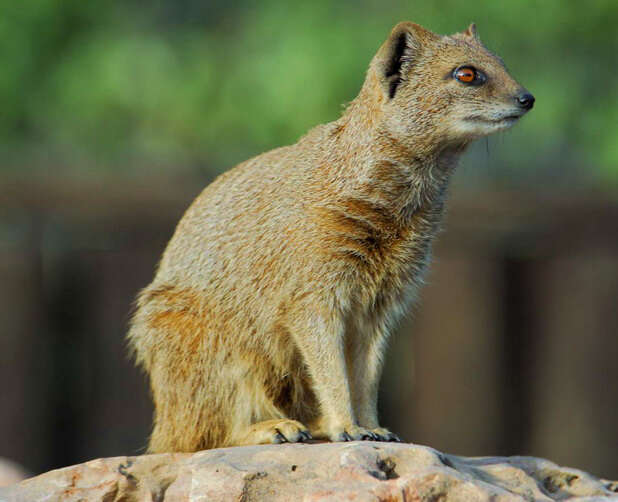
As many as 12 subspecies of yellow mongoose have been recognized in the past, distinguished predominantly by color, size, and length of hair and tail (Skinner and Smithers 1990). There is a zone of rapid geographic change which separates individuals from northern Nambia, Botswana and northern Transvaal from individuals in the south. Individuals between these two areas may be intermediate in traits. This creates clinal variation, making the distinction between subspecies impossible (Skinner and Smithers 1990). Variation may be genetic or may be due to the amount and intensity of sunlight at a given location (Taylor et al. 1990). Southern specimens (South Africa, Namibia) are usually larger with tawny-yellowish pelage whereas northern individuals (Botswana) are smaller with a grizzled, greyish-yellow coat. This grizzled appearance results from contrasting, alternating black (eumelanin) and pale yellow (phaeomelanin) bands in individual guard hairs (Taylor and Meester 1993). Seasonal variation in pelage color has been seen in southern specimens, but not so much in specimens from the north (Taylor et al. 1990). Southern specimens of the yellow mongoose have long, white-tipped tails and long-haired coats whereas northern individuals have shorter hair and possess a shorter tail without a white tip (Skinner and Smithers 1990). In all yellow mongoose specimens, the longest hair is found in the tail. This bushy tail, and relatively large, rounded ears gives the yellow mongoose a fox-like appearance.
Five digits are present on the forefeet and four on the hindfeet of the yellow mongoose. The first digit in the forefoot is raised above the rest of the digits and it does not make an impression in the spoor (Taylor and Meester 1993). The palm is basically naked in the forefeet and hairy in the hindfeet. Claws are longer in the forefeet than the hindfeet.
The yellow mongoose is smaller than most other mongooses. Within the same geographic region, there is no body size differences between males and females.
The yellow mongoose possesses a glandular anal sac that contains a milky fluid with a sour, cheesy smell (Taylor and Meester 1993).
Average mass: 598.5 g.
Trusted
Ecology
Habitat
Habitat and Ecology
Systems
- Terrestrial
Trusted
Habitat
The yellow mongoose prefers semi-arid, open habitats (grasslands, scrub, and semi-desert scrub) and is almost entirely absent from desert, forest, and montane habitats (Taylor and Meester, 1993).
Terrestrial Biomes: savanna or grassland ; scrub forest
Trusted
Trophic Strategy
Food Habits
The yellow mongoose is primarily insectivorous, although it opportunistically feeds on vertebrate prey. Carrion has also been utilized as a food source (Skinner and Smithers 1990). Stomach analyses of mongooses from several yellow mongoose populations have found many different organisms including beetles (adult and larval forms), termites, locusts, caterpillars, ants, mice, birds, grass, seeds, reptiles, and amphibians (Taylor and Meester, 1993). The yellow mongoose has also been known to take hen's eggs and free-ranging chickens.
Trusted
Life History and Behavior
Life Expectancy
Lifespan/Longevity
Average lifespan
Status: captivity: 15.2 years.
Average lifespan
Status: captivity: 15.0 years.
Trusted
Lifespan, longevity, and ageing
Trusted
Reproduction
Reproduction
Many individuals of the yellow mongoose begin mating in the first week of July. Copulation lasts for about 30-60 seconds, during which the male makes a soft purring sound while the female bites or licks the male's ears and neck continuously (Taylor and Meester 1990). The gestation period varies between 42 and 57 days. The birth season is estimated to occur from August to November, possibly extending into January. The reproductive season might be more prolonged in northern specimens of the yellow mongoose (Taylor and Meester 1993). Young are born in clean chambers in the burrows which are devoid of bedding material. The mean litter size is 1.8 young per litter. Females have three pairs of abdominal mammae (Skinner and Smithers 1990).
Weaning takes place at about 10 weeks of age. It is not known if the male participates in the feeding and caring of the young. It is believed that males and females are not capable of reproducing until at least one year of age (Taylor and Meester 1993).
Average gestation period: 56 days.
Average number of offspring: 2.
Average age at sexual or reproductive maturity (female)
Sex: female: 730 days.
Trusted
Conservation
Conservation Status
IUCN Red List Assessment
Red List Category
Red List Criteria
Version
Year Assessed
Assessor/s
Reviewer/s
Justification
History
- 1996Lower Risk/least concern
Trusted
Conservation Status
---
IUCN Red List of Threatened Species: least concern
Trusted
Trends
Population
Population Trend
Trusted
Threats
Threats
Trusted
Management
Conservation Actions
Trusted
Relevance to Humans and Ecosystems
Benefits
Economic Importance for Humans: Negative
Yellow mongooses are regarded as the most important rabies vectors on the central plateau of South Africa (Penzhorn and Chaparro 1994). The geographical incidence of this disease corresponds closely with the distribution of the species. The prevalence of rabies in the yellow mongoose is attributed to their abundance in certain areas and their burrow-dwelling habit. Living in burrows brings individuals into close proximity, thereby increasing the chances of transmitting the virus. There is a high correlation between the seasonal incidence of rabies and the breeding cycle of the yellow mongoose (Taylor and Meester 1993). Many farmers feel that the yellow mongoose is a danger and a pest to themselves and their livestock. Many methods of extermination have been attempted to decrease the number of possible carriers. These methods included sealing and gassing burrows with cyanide gas, phospine, carbon monoxide, or carbon dioxide followed by setting traps for possible survivors (Taylor and Meester 1993).
Trusted
Economic Importance for Humans: Positive
May help control harmful species of insects and rodents.
Trusted
Wikipedia
Yellow Mongoose
The Yellow Mongoose (Cynictis penicillata), sometimes referred to as the Red Meerkat, is a small mammal averaging about 1 lb (1/2 kg) in weight and about 20 in (500 mm) in length. A member of the mongoose family, it lives in open country, from semi-desert scrubland to grasslands in Angola, Botswana, South Africa, Namibia, and Zimbabwe.
Contents |
Taxonomy
Cynictis penicillata is the only member of its genus, but as many as twelve subspecies of yellow mongoose have been described. In general, the yellow mongoose has lighter highlights on the underbelly and chin, a bushy tail, and a complete lack of sexual dimorphism. Southern yellow mongooses are larger, have yellow or reddish fur, longer fur, and a longer tail with a characteristic white tip. Northern subspecies tend towards smaller size, grey colouration, a grey or darker grey tip to the tail, and shorter hair more appropriate to the hotter climate.
Habits
The yellow mongoose is carnivorous, consuming mostly arthropods but also other small mammals, lizards, snakes and eggs of all kinds.
The yellow mongoose is primarily diurnal, though nocturnal activity has been observed. Living in colonies of up to 20 individuals in a permanent underground burrow complex, the yellow mongoose will often co-exist with Cape Ground Squirrels or suricates and share maintenance of the warren, adding new tunnels and burrows as necessary. The tunnel system has many entrances, nearby which the yellow mongoose makes its latrines.
Social structure
The social structure of the yellow mongoose is hierarchical, based around a central breeding pair and their most recent offspring. There are also subadults, the elderly, or adult relatives of the central pair. Male ranges tend to overlap, while females from other dens have contiguous non-overlapping ranges. Every day, the alpha male will mark members of his group with anal gland secretions, and his boundaries with facial and anal secretions, as well as urine. The alpha male also rubs his back against raised objects, leaving behind hair as a visual marker of territory. Other members of the group mark their dens with cheek secretions.
Predators
Predators of the yellow mongoose are birds of prey, snakes and jackals. When frightened, the yellow mongoose will growl and secrete from its anal glands. It can also scream, bark, and purr, though these are exceptions, as the yellow mongoose is usually silent, and communicates mood and status through tail movements.
Mating season
The mating season of the yellow mongoose is between July and September, and it gives birth underground between October and December, with no bedding material, in a clean chamber of the burrow system. Usually, two offspring are produced per pregnancy, and they are weaned at 10 weeks, reaching adult size after 10 months.
Cynictis penicillata and Rabies
There is some concern about the role of Cynictis penicillata as a natural reservoir of rabies. Most African wild animals will die within a several weeks of infection with rabies, but it seems that certain genetic strains of the yellow mongoose can carry it asymptomatically, but infectiously, for years[2].
Publications
- N.L. Avenant; J.A.J. Nel: Comparison of the diet of the yellow mongoose in a coastal and a Karoo area in South African Journal of Wildlife Research (1992), Volume: 22, p.89-93
- O.A.E. Rasa; B.A. Wenhold; P. Howard; A. Marais: Reproduction in the yellow mongoose revisited in South African Journal of Zoology (1992), Vol. 27, No. 4, p.192
- B.A. Wenhold; O.A.E. Rasa: Territorial marking in the Yellow mongoose Cynictis penicillata: sexual advertisement for subordinates? in Zeitschrift für Säugetierkunde (1994), Vol.59, No.3, p.129
References
- ^ Taylor, P.J. & Hoffmann, M. (2008). Cynictis penicillata. In: IUCN 2008. IUCN Red List of Threatened Species. Downloaded on 22 March 2009. Database entry includes a brief justification of why this species is of least concern
- ^ Taylor PJ (December 1993). "A systematic and population genetic approach to the rabies problem in the yellow mongoose (Cynictis penicillata)". Onderstepoort J. Vet. Res. 60 (4): 379–87. PMID 7777324.
Trusted
Disclaimer
EOL content is automatically assembled from many different content providers. As a result, from time to time you may find pages on EOL that are confusing.
To request an improvement, please leave a comment on the page. Thank you!