Overview
Brief Summary
Biology
Trusted
Comprehensive Description
Description
Trusted
Distribution
Range Description
Trusted
Geographic Range
Hydrochoerus hydrochaeris is a strictly South American rodent species. Its range extends throughout most of Brazil, Uruguay, Venezuela, and Columbia, south into the Argentinian pampas, and west to the Andes.
Biogeographic Regions: neotropical (Native )
- 2009. "Capybara" (On-line). Bristol Zoo Gardens. Accessed April 12, 2009 at http://www.bristolzoo.org.uk/learning/animals/mammals/capybara.
- 2002. Capybara. Pp. 382-384 in M Burton, R Burton, eds. International Wildlife Encyclopedia, Vol. 1, 3 Edition. Tarrytown, New York: Marshall Cavendish.
- 2001. Capybara. Pp. 678-681 in D Macdonald, S Norris, eds. The Encyclopedia of Mammals, Vol. 1, 3 Edition. London: The Brown Reference Group.
Trusted
Range
Trusted
Physical Description
Morphology
Physical Description
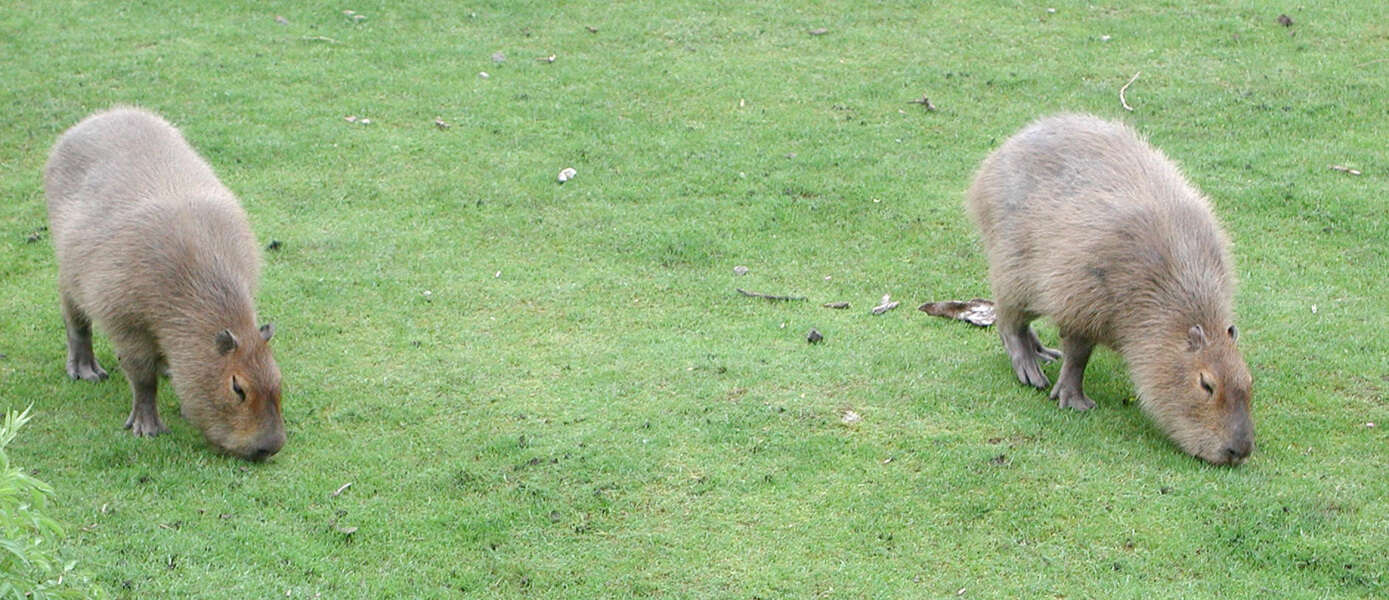
Capybaras are the largest of rodents, weighing from 35 to 66 kg and standing up to 0.6 meters at the shoulder, with a length of about 1.2 meters. Females of this species are slightly larger than males. Their fur is coarse and thin, and is reddish brown over most of the body, turning yellowish brown on the belly and sometimes black on the face. The body is barrel-shaped, sturdy, and tailless. The front legs are slightly shorter than the hind legs, and the feet are partially webbed. This, in addition to the location of the eyes, ears, and nostrils on top of the head, make capybaras well-suited to semi-aquatic life.
Range mass: 35 to 66 kg.
Range length: 106 to 134 cm.
Other Physical Features: endothermic ; homoiothermic; bilateral symmetry
Sexual Dimorphism: female larger
Trusted
Type Information
Collection: Smithsonian Institution, National Museum of Natural History, Department of Vertebrate Zoology, Division of Mammals
Sex/Stage: Male; Adult
Preparation: Skin; Skull; Anatomical
Collector(s): Collector Unknown
Year Collected: 1909
Locality: Paraguay, South America
- Type: 1914 Mar 20. Proc. Biol. Soc. Washington. 27: 58.
Trusted
Ecology
Habitat
Habitat and Ecology
Systems
- Terrestrial
- Freshwater
Trusted
Habitat
Capybaras are found only in areas where water is easily accessible: flooded grasslands are a favored habitat, as are marsh edges and lowland forests where grazing is good and there is water year-round. However, they occupy a range of habitats, including dry forest, scrub, and grasslands throughout South America.
Habitat Regions: temperate ; tropical ; terrestrial
Terrestrial Biomes: savanna or grassland ; forest ; rainforest ; scrub forest
Wetlands: marsh ; swamp
Other Habitat Features: riparian
Trusted
Habitat
Trusted
Trophic Strategy
Food Habits
Capybaras are grazers, feeding mainly on grasses and aquatic plants. Bark and fruit are consumed occasionally. They are also cophrophagous and spend part of each morning re-ingesting the previous day’s food.
Plant Foods: leaves; wood, bark, or stems; seeds, grains, and nuts; fruit
Other Foods: dung
Primary Diet: herbivore (Folivore , Lignivore); coprophage
Trusted
Associations
Ecosystem Roles
In many parts of South America capybaras are the only large grazing species and can have a dramatic effect on the vegetation in an area. They are also mutualists or commensals with several types of birds which pick parasitic insects out of capybara fur or follow grazing capybaras and eat the insects they stir up from the grass. In addition, they are an important prey species for many different animals, as mentioned above.
Ecosystem Impact: creates habitat
Mutualist Species:
- southern caracaras (Caracara plancus)
- rufous horneros (Furnarius rufus)
- yellow-headed caracaras (Milvago chimachima)
Commensal/Parasitic Species:
- cattle tyrants (Machetornis rixosa)
- shiny cowbirds (Molothrus bonariensis)
- Tomazzoni, A., E. Pedo, S. Hartz. 2005. Feeding associations between capybaras and birds in the Lami Biological Reserve. Revista Brasileira de Zoologia, 22:3: 712-716.
Trusted
Predation
Especially while young, capybaras are an important food source for many large predators, including anacondas, caimans, jaguars, and humans. While grazing, they are constantly on the lookout for predators and give an alarm bark when one is spotted. They often hide in the water, with just their nostrils and eyes exposed, and can stay completely submerged for up to five minutes.
Known Predators:
- jaguars (Panthera onca)
- green anacondas (Eunectes murinus)
- spectacled caimans (Caiman crocodilus)
- humans (Homo sapiens)
Trusted
Life History and Behavior
Behavior
Communication and Perception
Vocalization appears to be very important in capybara groups, but the purpose of many of the sounds made is unknown. However, young vocalize almost constantly and vocal communication among adults is also common. Individuals bark to warn the group of danger, this often results in the whole group rushing into the relative safety of the water. Scent is also important, especially in mating and establishing dominance. Male capybaras have a bare lump on the top of the snout, known as the morillo gland, which secretes a white liquid. The scent of this liquid acts as an olfactory “fingerprint”, signaling the status of the individual. It is rubbed on trees or shrubs to mark territory, or smeared on the male’s body to advertise his status and willingness to mate. Both males and females have two glands on either side of the anus. The combination of chemicals in the liquid they secrete is also highly individualized and seems to be used to recognize group members and mark territory.
Communication Channels: acoustic ; chemical
Other Communication Modes: pheromones ; scent marks
Perception Channels: visual ; acoustic
Trusted
Life Expectancy
Lifespan/Longevity
Capybaras live about 6 years on average (and as many as 10 years) in the wild and up to 12 years in captivity.
Range lifespan
Status: wild: 10 (high) years.
Average lifespan
Status: wild: 6 years.
Range lifespan
Status: captivity: 12 (high) years.
Trusted
Lifespan, longevity, and ageing
Trusted
Reproduction
Reproduction
Capybaras are polygynous to promiscuous. Dominant males in social groups try to monopolize mating activity, but this can be nearly impossible, especially in larger groups. Little research has been done on female mate choice in capybaras, but females have been observed mating with both dominant and subordinate males.
Mating System: polygynous ; polygynandrous (promiscuous) ; cooperative breeder
Capybaras breed throughout the year, with a peak in breeding activity at the beginning of the rainy season. When a female comes into estrus, a male will begin to follow her closely, sometimes for long periods of time, before mating occurs. During this time, the male is often driven off by a more dominant male, who then takes his place. Copulation occurs in the water and typically lasts only a few seconds, but a female usually copulates several times per estrus period. Young are born after 150 days, in litters ranging in size from 2 to 8.The young are precocial, beginning to stand and walk shortly after birth, and can graze within a week of being born. They are weaned at about 3 months old, during which time they suckle both from their own mother and the other females in the group, who are usually closely related.
Breeding interval: Capybaras produce one litter of young per year.
Breeding season: Breeding occurs year-round with a peak in May and June, the beginning of the rainy season.
Range number of offspring: 2 to 8.
Average number of offspring: 4.
Average gestation period: 150 days.
Average birth mass: 1.5 kg.
Average weaning age: 3 months.
Average time to independence: 1 years.
Average age at sexual or reproductive maturity (female): 18 months.
Average age at sexual or reproductive maturity (male): 18 months.
Key Reproductive Features: iteroparous ; year-round breeding ; gonochoric/gonochoristic/dioecious (sexes separate); viviparous
Young capybaras stay with their parents' group until they are about a year old. They nurse for the first three months of this time. Both before and after weaning, the young move around together in a creche, and some of the work of parenting (such as suckling and watching for danger) is shared among all adults in the group. During much of their first year of life, the young are small, slow, and easily tired, making them especially vulnerable to predators. The protection of their natal group is essential to staying alive. Little is known about individual parental care in capybaras, but it seems that, because of the precocial state of the young and the system of cooperative parenting, the time and resources spent by each parent after birth are minimal.
Parental Investment: precocial ; pre-fertilization (Provisioning, Protecting: Female); pre-hatching/birth (Provisioning: Female, Protecting: Female); pre-weaning/fledging (Provisioning: Female, Protecting: Male, Female); pre-independence (Protecting: Male, Female)
- Ojasti, J. 1968. Notes on the mating behavior of the capybara. Journal of Mammalogy, 49: 3: 534-535.
- 2009. "Capybara" (On-line). Bristol Zoo Gardens. Accessed April 12, 2009 at http://www.bristolzoo.org.uk/learning/animals/mammals/capybara.
- 2002. Capybara. Pp. 382-384 in M Burton, R Burton, eds. International Wildlife Encyclopedia, Vol. 1, 3 Edition. Tarrytown, New York: Marshall Cavendish.
- 2001. Capybara. Pp. 678-681 in D Macdonald, S Norris, eds. The Encyclopedia of Mammals, Vol. 1, 3 Edition. London: The Brown Reference Group.
Trusted
Conservation
Conservation Status
IUCN Red List Assessment
Red List Category
Red List Criteria
Version
Year Assessed
Assessor/s
Reviewer/s
Contributor/s
Justification
History
- 1996Lower Risk/least concern
Trusted
Conservation Status
The IUCN lists capybaras as a species of least concern, citing its large population, large distribution, and frequent occurrence within protected areas. However, some local populations are in decline due to over-hunting.
US Federal List: no special status
CITES: no special status
IUCN Red List of Threatened Species: least concern
- 2008. "IUCN Red List" (On-line). Accessed April 09, 2009 at http://www.iucnredlist.org/.
Trusted
Status
Trusted
Trends
Population
Population Trend
Trusted
Threats
Threats
Trusted
Threats
Trusted
Management
Conservation Actions
Trusted
Conservation
Trusted
Relevance to Humans and Ecosystems
Benefits
Economic Importance for Humans: Negative
Capybaras sometimes raid gardens or farms in search of food, such as melons, squashes, or grains. It has also been hypothesized that they are carriers of certain livestock diseases.
Negative Impacts: crop pest; causes or carries domestic animal disease
Trusted
Economic Importance for Humans: Positive
Capybaras are hunted for their meat and leather, both of which are said to be very high-quality. Capybara meat is especially popular during Lent, the 40-day period prior to Easter, because it is approved by the Catholic church as an alternative to beef or pork. (Presumably, the semiaquatic habit of the capybara convinced early priests that it was similar to fish.) Large-scale ranching of capybaras has been proposed to curtail illegal hunting and the animals have proved easy to domesticate, at least in small numbers. In fact, capybaras are more efficient grazers than cattle or other introduced livestock and are already an important source of food for many local people.
Positive Impacts: food ; body parts are source of valuable material
- Grant, W. 2009. "Venezuela's Giant Rodent Cuisine" (On-line). BBC News. Accessed April 12, 2009 at http://news.bbc.co.uk/2/hi/americas/7987587.stm.
Trusted
Wikipedia
Capybara
The capybara (Hydrochoerus hydrochaeris) is the largest extant rodent in the world. Its closest relatives are agouti, chinchillas, coyphillas, and guinea pigs. Native to South America, the capybara inhabits savannas and dense forests and lives near bodies of water. It is a highly social species and can be found in groups as large as 100 individuals, but usually lives in groups of 10–20 individuals. The capybara is not a threatened species, though it is hunted for its meat and skin.
Contents |
Etymology
Its common name, derived from kapiÿva in the Guarani language, means "master of the grasses",[2] while its scientific name, both hydrochoerus and hydrochaeris, comes from Greek ὕδωρ (hydor = water) + χοίρος (choiros = pig, hog).[3][4]
Classification and phylogeny
The capybara and the lesser capybara belong to the subfamily Hydrochoerinae along with the rock cavies. The living capybaras and their extinct relatives were previously classified in their own family Hydrochoeridae.[5] Since 2002, molecular phylogenetic studies have recognized a close relationship between Hydrochoerus and Kerodon[6] supporting placement of both genera in a subfamily of Caviidae.[3] Paleontological classifications have yet to incorporate this new taxonomy, and continue to use Hydrochoeridae for all capybaras, while using Hydrochoerinae for the living genus and its closest fossil relatives, such as Neochoerus.[7][8] The taxonomy of fossil hydrochoerines is also in a state of flux. In recent years, the diversity of fossil hydrochoerines has been substantially reduced.[7][8] This is largely due to the recognition that capybara molar teeth show strong variation in shape over the life of an individual.[7] In one instance, material once referred to four genera and seven species on the basis of differences in molar shape is now thought to represent differently aged individuals of a single species, Cardiatherium paranense.[7]
Description
Capybaras have heavy, barrel-shaped bodies and short heads with reddish-brown fur on the upper part of their body that turns yellowish-brown underneath. The sweat glands of the capybara can be found in its haired skin surface, an unusual trait among rodents.[5] The animal lacks underhair and there is little difference between the guard hair and overhair. Adult capybaras grow to 107 to 134 cm (3.51 to 4.40 ft) in length, stand 50 to 64 cm (20 to 25 in) tall at the withers and typically weigh 35 to 66 kg (77 to 150 lb), with an average in the Venezuelan llanos of 48.9 kg (108 lb).[9][10] The top recorded weight are 91 kg (200 lb) for a wild female from Brazil and 73.5 kg (162 lb) for a wild male from Uruguay.[5][11] The dental formula is
.[5] Capybaras have slightly webbed feet and a vestigial tail.[5] Their back legs are slightly longer than their front legs and their muzzles are blunt with eyes, nostrils, and ears on top of their head. Females are slightly heavier than males.
Its karyotype has 2n = 66 and FN = 102.[3]
Ecology
Capybaras are semiaquatic mammals[10] found throughout almost all countries of South America (except Chile[2]) in densely forested areas near bodies of water, such as lakes, rivers, swamps, ponds and marshes,[9] as well as flooded savannah and along rivers in tropical forest. Capybara have flourished in cattle ranches.[5] They roam in home ranges averaging 10 hectares in high-density populations.[5]
Many escapees from captivity can also be found in similar watery habitats around the world. Sightings are fairly common in Florida, although a breeding population has not yet been confirmed.[12] In 2011, it was spotted in the Central Coast of California.[13]
Diet and predation
Capybaras are herbivores, grazing mainly on grasses and aquatic plants,[9][14] as well as fruit and tree bark.[10] They are very selective feeders[15] and will feed on the leaves of one species and disregard other species surrounding it. They eat a greater variety of plants during the dry season, as fewer plants are available. While they eat grass during the wet season, they have to switch to more abundant reeds during the dry season.[16] Plants that capybaras eat during the summer lose their nutritional value in the winter and thus are not consumed at that time.[15] The capybara's jaw hinge is not perpendicular and they thus chew food by grinding back-and-forth rather than side-to-side.[17] Capybaras are coprophagous, meaning they eat their own feces as a source of bacterial gut flora, to help digest the cellulose in the grass that forms their normal diet, and to extract the maximum protein and vitamins from their food. They may also regurgitate food to masticate again, similar to cud-chewing by a cow.[18]
Like its cousin the guinea pig, the capybara does not have the capacity to synthesize vitamin C, and capybaras not supplemented with vitamin C in captivity have been reported to develop gum disease as a sign of scurvy.[19]
They can have a life span of 8–10 years in the wild,[20] but live less than four years on average, as they are "a favourite food of jaguar, puma, ocelot, eagle and caiman".[2] The capybara is also the preferred prey of the anaconda.[21]
Natural history
Capybaras are very gregarious. While they do sometimes live solitarily, they are more commonly found in groups that average 10–20 individuals, with two to four adult males, four to seven adult females and the rest juveniles.[22] Capybara groups can consist of as many as 50 or 100 individuals during the dry season,[18][23] when the animals gather around available water sources. Males are organized in stable, linear hierarchies. The dominant male in each group is significantly heavier than any of the subordinates, but among subordinates, status is not correlated with weight.[24] The dominant male is positioned in the center of the group while subordinates are on the periphery. These hierarchies are established early in life among the young with play fights and mock copulations.[22] The most dominant males have access to the best resources.[24] Capybaras are very vocal and, when in groups, chatter with each other to establish social bonds, dominance or general group census.[23] They can make dog-like barks[18] when threatened or when females are herding young.[25] Capybaras have two different scent glands; a morillo, located on the snout, and an anal gland.[26] Both sexes have those glands, but males have larger morillos and their anal pockets can open more easily. The anal glands of males are also lined with detachable hairs. A crystalline form of scent secretion is coated on these hairs and are released when in contact with objects like plants. These hairs have a longer-lasting scent mark and are tasted by other capybaras. A capybara marks by rubbing its morillo on an object or by walking over a scrub and marking with its anal gland. A capybara can spread its scent further by urinating. However, females usually mark without urinating and mark less frequently than males overall. Females mark more often during the wet season when they are in estrus. In addition to objects, males will also mark females.[26]
Reproduction
When in estrus, the female's scent changes subtly and nearby males begin pursuit.[24] In addition, a female will alert males she is in estrus by whistling though her nose.[18] During mating, the female has the advantage and mating choice. Capybaras mate only in water, and if a female does not want to mate with a certain male, she will either submerge or leave the water.[18][23] Dominant males are highly protective of the females, but they usually cannot prevent all the subordinates from copulating.[24] The larger the group, the harder it is for the male to watch all the females. Dominant males secure significantly more matings than each subordinate, but subordinate males, as a class, are responsible for more matings than each dominant male.[24] The lifespan of the capybara's sperm is longer than that of other rodents.[27]
Capybara gestation is 130–150 days, and usually produces a litter of four capybara babies, but may produce between one and eight in a single litter.[5] Birth is on land and the female will rejoin the group within a few hours of delivering the newborn capybaras, which will join the group as soon as they are mobile. Within a week, the young can eat grass, but will continue to suckle—from any female in the group—until weaned at about 16 weeks. The young will form a group within the main group.[2] Alloparenting has been observed in this species.[23] Breeding peaks between April and May in Venezuela and between October and November in Mato Grosso, Brazil.[5] Like other rodents, the front teeth of capybaras grow continually to compensate for the constant wear from eating grasses;[2] their cheek teeth also grow continuously.[17]
Activities
Capybaras are excellent swimmers, and can remain completely submerged for up to five minutes,[9] an ability they use to evade predators. Capybaras can sleep in water if need be, only keeping their noses out of the water. During midday, as temperatures increase, they wallow in water and then graze in late afternoons and early evenings.[5] They rest around midnight and then continue to graze before dawn.
Conservation and human interaction
Capybaras are on the IUCN list,[1] but are not considered a threatened species; their population is stable through most of their South American range, though in some areas, hunting has reduced their numbers.[2][9]
Capybaras are hunted for their meat and pelts in some areas,[28] and otherwise killed by humans who see their grazing as competition for livestock. In some areas, they are farmed, which has the effect of ensuring the wetland habitats are protected. Their survival is aided by their ability to breed rapidly.[2]
Capybaras can be found in many areas in zoos and parks,[17] and may live for 12 years in captivity.[2] Capybaras are gentle and will usually allow humans to pet and hand-feed them.
Capybara are farmed for meat and skins in South America.[29] The meat is considered unsuitable to eat in some areas, while in other areas it is considered an important source of protein.[5] During Lent, capybara meat is especially popular in parts of South America, especially in Venezuela, as the Catholic Church, in a special dispensation, is claimed to have allowed eating capybara meat when meat consumption was otherwise not allowed. Accounts differ of how the dispensation arose.[30] Capybaras are occasionally kept as pets in the United States,[31] though it is illegal in some states and in various other countries.
See also
- Beaver
- In medicine, see Kurloff cells
References
- ^ a b Queirolo, D., Vieira, E. & Reid, F. (2008). "Hydrochoerus hydrochaeris". IUCN Red List of Threatened Species. Version 2011.1. International Union for Conservation of Nature. http://www.iucnredlist.org/apps/redlist/details/10300. Retrieved 17 June 2011.
- ^ a b c d e f g h Bristol Zoo Gardens (UK) ''Capybara''. Bristolzoo.org.uk. Retrieved on 2011-12-07.
- ^ a b c Woods, Charles A.; Kilpatrick, C. William (16 November 2005). "Infraorder Hystricognathi (pp. 1538-1600)". In Wilson, Don E., and Reeder, DeeAnn M., eds. Mammal Species of the World: A Taxonomic and Geographic Reference (3rd ed.). Baltimore: Johns Hopkins University Press, 2 vols. (2142 pp.). p. 1556. ISBN 978-0-8018-8221-0. OCLC 62265494. http://www.bucknell.edu/msw3/browse.asp?id=13400218.
- ^ Darwin, Charles R. (1839). Narrative of the surveying voyages of His Majesty's Ships Adventure and Beagle between the years 1826 and 1836, describing their examination of the southern shores of South America, and the Beagle's circumnavigation of the globe. Journal and remarks. 1832–1836.. London: Henry Colburn. p. 619.
- In page 57, Darwin says "The largest gnawing animal in the world, the Hydrochærus Capybara (the water-hog), is here also common."
- See it also in The Complete Work of Charles Darwin Online
- ^ a b c d e f g h i j k Anon (16 June 1986). "Hydrochoerus hydrochaeris. Brisson, 1762". Mammalian Species 264: 1–7. http://www.science.smith.edu/msi/pdf/i0076-3519-264-01-0001.pdf.
- ^ Rowe, D. L.; Honeycutt, R. L. (2002). "Phylogenetic relationships, ecological correlates, and molecular evolution within the Cavioidea (Mammalia, Rodentia)". Molecular Biology and Evolution 19 (3): 263–277. ISSN 07374038. PMID 11861886. http://mbe.oxfordjournals.org/content/19/3/263.abstract. Retrieved 2011-10-03.
- ^ a b c d Vucetich, M. G.; Deschamps, C. M.; Olivares, A. I.; Dozo, M. T. (2005). "Capybaras, size, shape, and time: A model kit". Acta Palaeontologica Polonica 50 (2): 259-272. http://vanina-ue.academia.edu/ItatiOlivares/Papers/1301590/Capybaras_size_shape_and_time_A_model_kit. Retrieved 2012-05-21.
- ^ a b Deschamps, C. M.; Olivares, A. I.; Vieytes, E. C.; Vucetich, M. G. (2007-09-12). "Ontogeny and diversity of the oldest capybaras (Rodentia: Hydrochoeridae; late Miocene of Argentina". Journal of Vertebrate Paleontology 27 (3): 683-692. JSTOR 30126368. http://www.jstor.org/stable/10.2307/30126368. Retrieved 2012-05-21.
- ^ a b c d e Capybara Facts. Smithsonian National Zoological Park. Retrieved on December 16, 2007.
- ^ a b c Capybara. Palm Beach Zoo. Retrieved on December 17, 2007.
- ^ World Association of Zoos and Aquariums. WAZA. Retrieved on 2011-12-07.
- ^ Florida Fish and Wildlife Conservation Commission: Capybara – ''Hydrochaeris hydrochaeris''. Myfwc.com. Retrieved on 2011-12-07.
- ^ Mather, Kate (18 August 2011). "A gnawing question answered: It's a capybara roaming Paso Robles". Los Angeles Times. http://www.latimes.com/news/local/la-me-0818-capybara-20110818,0,104462.story. Retrieved 10 January 2012.
- ^ J Forero-Montana, J Betancur, J Cavelier. (2003). "Dieta del capibara Hydrochaeris hydrochaeris (cavia: Hydrochaeridae) en Caño Limón, Arauca, Colombia". Rev. Biol. Trop 51 (2): 571–578. PMID 15162749. http://www.scielo.sa.cr/scielo.php?script=sci_arttext&pid=S0034-77442003000200029&lng=es&nrm=iso. PDF
- ^ a b Quintana, R.D., S. Monge, A.I. Malvárez (1998). "Feeding patterns of capybara Hydrochaeris hypdrochaeris (Rodentia, Hydrochaeridae) and cattle in the non-insular area of the Lower Delta of the Parana River, Argentina". Mammalia 62 (1): 37–52. doi:10.1515/mamm.1998.62.1.37.
- ^ Barreto, Guillermo R.; Herrera, Emilio A. (1998). "Foraging patterns of capybaras in a seasonally flooded savanna of Venezuela". Journal of Tropical Ecology 14: 87. doi:10.1017/S0266467498000078. JSTOR 2559868.
- ^ a b c Capybara. Hydrochaeris hydrochaeris. San Francisco Zoo
- ^ a b c d e Lord-Rexford, D. (1994). "A descriptive account of capybara behaviour". Studies on neotropical fauna and environment 29 (1): 11–22. doi:10.1080/01650529409360912.
- ^ Cueto, GR; Allekotte, R; Kravetz, FO (2000). "Scurvy in capybaras bred in captivity in Argentine". Journal of wildlife diseases 36 (1): 97–101. PMID 10682750.
- ^ Burton M and Burton R. The International Wildlife Encyclopedia. Marshall Cavendish, 2002, ISBN 0-7614-7269-X, p. 384
- ^ Capybara, the master of the grasses: pest or prey Sounds and Colours. Retrieved on January 23, 2011.
- ^ a b Alho C. J. R., Rondon N. L. (1987). "Habitats, population densities, and social structure of capybaras (hydrochaeris hypdrochaeris rodentia) in the pantanal Brazil". Revista Brasileira de Zoologia 4 (2): 139–149.
- ^ a b c d Macdonald, D. W. (1981). "Dwindling resources and the social behavior of Capybaras, (Hydrochoerus hydrochaeris) (Mammalia)". Journal of Zoology 194 (3): 371–391. doi:10.1111/j.1469-7998.1981.tb04588.x.
- ^ a b c d e Herrera, Emilio A.; MacDonald, David W. (1993). "Aggression, dominance, and mating success among capybara males (Hydrochaeris hypdrochaeris)". Behavioral Ecology 4 (2): 114. doi:10.1093/beheco/4.2.114.
- ^ Murphey, R; Mariano, J; Mouraduarte, F (1985). "Behavioral observations in a capybara colony (Hydrochaeris hypdrochaeris)". Applied Animal Behaviour Science 14: 89. doi:10.1016/0168-1591(85)90040-1.
- ^ a b D. W. Macdonald, K. Krantz and R. T. Aplin. "Behavioral anatomical and chemical aspects of scent marking among capybaras Hydrochaeris-hypdrochaeris rodentia caviomorpha". Journal of Zoology 202 (3): 341–360. doi:10.1111/j.1469-7998.1984.tb05087.x.
- ^ Paula, T.A.R.; Chiarini-Garcia, H.; França, L.R. (1999). "Seminiferous epithelium cycle and its duration in capybaras (Hydrochaeris hypdrochaeris)". Tissue and Cell 31 (3): 327–34. doi:10.1054/tice.1999.0039. PMID 10481304.
- ^ Andy Thompson Trip to South America gives new meaning to outdoors life. Richmond Times. January 18, 2008
- ^ San Diego Zoo. "Capybara, Hydrochoerus hydrochaeris: October 2008". http://library.sandiegozoo.org/factsheets/capybara/capybara.htm. Retrieved 22 June 2011.
- ^ Ellsworth, Brian. "In Days Before Easter, Venezuelans Tuck Into Rodent-Related Delicacy". New York Sun. March 24, 2005
- ^ Lombardi, Linda. "Rodents of unusual size: Capybaras aren't for all". www.ajc.com. http://www.ajc.com/lifestyle/rodents-of-unusual-size-289164.html. Retrieved 7 December 2011.
Unreviewed