Overview

Brief Summary

Biology

The blue wildebeest is a grazer, its broad mouth adapted to bulk feeding on short grass. However, its dependence on short grass, together with its need to drink at least every other day, limits the species to moist grassland and to areas within reach of water (4) (8), although interestingly it is also known to survive in waterless regions of the Kalahari by feeding on melons and water-storing roots and tubers (4). The need to follow seasonal grazing and water supplies leads the blue wildebeest to form some of the largest migratory herds of all antelopes, with those in the Serengeti-Masai Mara ecosystem of Kenya and Tanzania forming part of the world's largest remaining aggregations of large land mammals (4). However, not all wildebeest migrate, with some remaining in the same area year-round, generally forming small herds of up to ten females plus immature offspring (2) (4). The females in these herds tend to establish dominance hierarchies and harass any outsiders who attempt to join. In contrast, the only stable associations in migratory herds are between a female and offspring. Depending on the environmental conditions, different blue wildebeest populations, and even the same population at different times, may show every variation between these social extremes (4). The blue wildebeest has an unusually restricted breeding season. Around 80 to 90 percent of calves are born within a two to three week period, usually at the start of the rains, when conditions are most favourable (2) (4). This also helps to protect the calves by creating a glut for predators. The female blue wildebeest gives birth annually, to a single calf, after a gestation period of around eight months. The calf follows the female from the moment it can stand, usually within 15 minutes of birth, and is weaned by nine months (2). The young male is pushed out of the herd by territorial males after the first year, after which it joins a bachelor herd, which may also contain older and non-territorial males (2) (4). After reaching sexual maturity at three to four years old, the male becomes solitary and attempts to establish its own territory, which may be temporary in migratory populations, or may be continuously occupied and defended for years (2). Territorial competition between males typically involves ritualised displays, pushing with the horns, and the loud 'ge-nu' call that gives the wildebeest its other name, the gnu (2) (6). The lifespan of the blue wildebeest is around 20 years in the wild (3).
Creative Commons Attribution Non Commercial Share Alike 3.0 (CC BY-NC-SA 3.0)

© Wildscreen

Source: ARKive

Trusted

Article rating from 0 people

Average rating: 2.5 of 5

Comprehensive Description

Description

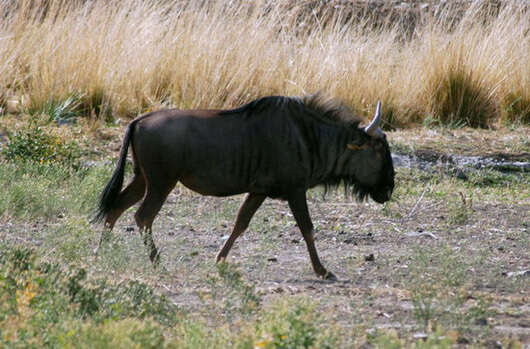
A distinctive, high-shouldered antelope, with a long, broad muzzle and cow-like horns, the blue wildebeest is famous for forming vast migratory herds (4). The species gets its common name from the silvery-blue sheen to the coat, the base colour of which varies from greyish to brown. The forequarters bear vertical black stripes - the 'brindled' colouration that gives the species one of its alternative names - and the front of the face, the long tail, and the mane are also black (3) (5). The long beard may be black or white, depending on the subspecies (2). Both the male and female have unridged horns, which curve downward laterally before pointing upward and inward (6), and in older animals may have a knobby base (5). Five subspecies of blue wildebeest are recognised: the western white-bearded wildebeest (Connochaetes taurinus mearnsi), the eastern white-bearded wildebeest (Connochaetes taurinus albojubatus), the Johnston's or Nyassa wildebeest (Connochaetes taurinus johnstoni), Cookson's wildebeest (Connochaetes taurinus cooksoni), and the blue wildebeest (Connochaetes taurinus taurinus). C. t. mearnsi, the smallest of these, with the shortest horns (4), is the subspecies which forms the famous large herds of the Serengeti-Masai Mara (7). The blue wildebeest can be distinguished from the black wildebeest (or white-tailed gnu), Connochaetes gnu, by its larger size, lighter colouration, and a black rather than white tail (4).
Creative Commons Attribution Non Commercial Share Alike 3.0 (CC BY-NC-SA 3.0)

© Wildscreen

Source: ARKive

Trusted

Article rating from 0 people

Average rating: 2.5 of 5

Distribution

Range Description

Formerly distributed from southern Kenya southwards to northern and eastern Namibia, Botswana, the Orange River in South Africa, and Mozambique (East 1999; Estes in press). Common Wildebeest have also been introduced to regions outside their former distribution range, such as the Eastern Highlands of Zimbabwe and private farmland in Namibia (East 1999).

The ranges of the five subspecies are as follows (following East 1999 and Estes in press):

C. t. taurinus (Blue Wildebeest). Namibia and South Africa to Mozambique north of the Orange River, and from Mozambique to Zambia south of the Zambezi River, and from south-west Zambia to south-east and southern Angola.

C. t. cooksoni (Cookson’s Wildebeest). Restricted to the Luangwa Valley, Zambia. May have ranged as vagrants onto the adjacent plateau into central Malawi.

C. t. johnstoni (Nyassa or Johnston’s Wildebeest). North of Zambezi River in Mozambique to east-central Tanzania, and formerly in southern Malawi, where now extinct.

C. t. albojubatus (Eastern White-bearded Wildebeest). Northern Tanzania to central Kenya just south of the Equator, west to the Gregory Rift Valley.

C. t. mearnsi (Western White-bearded Wildebeest of the Serengeti ecosystem). Northern Tanzania and southern Kenya west of the Gregory Rift Valley, reaching Lake Victoria at Speke Bay.
Creative Commons Attribution Non Commercial Share Alike 3.0 (CC BY-NC-SA 3.0)

© International Union for Conservation of Nature and Natural Resources

Source: IUCN

Trusted

Article rating from 0 people

Average rating: 2.5 of 5

Geographic Range

Blue wildebeest are common in eastern and southern Africa, from Kenya to eastern Namibia. Their southern range is bordered by the Orange River in South Africa.

Biogeographic Regions: ethiopian (Native )

  • Estes, R. 1991. The Behavior Guide to African Mammals- Including Hoofed Mammals, Carnivores, Primates. Los Angeles: University of California Press.
Creative Commons Attribution Non Commercial Share Alike 3.0 (CC BY-NC-SA 3.0)

© The Regents of the University of Michigan and its licensors

Source: Animal Diversity Web

Trusted

Article rating from 0 people

Average rating: 2.5 of 5

Range

The blue wildebeest has a wide distribution from Kenya and Tanzania southwards, to Zambia, Namibia, Botswana, Mozambique, northern South Africa and southern Angola. C. t. cooksoni has probably the most restricted range, being found only in the Luangwa Valley in Zambia (1) (5).
Creative Commons Attribution Non Commercial Share Alike 3.0 (CC BY-NC-SA 3.0)

© Wildscreen

Source: ARKive

Trusted

Article rating from 0 people

Average rating: 2.5 of 5

Physical Description

Morphology

Physical Description

Wildebeest are African bovids with broad shoulders, cow like horns, and a broad muzzle. The horns are unridged, have a parenthetical shape, and are thicker in males than in females. Of the two species in the genus Connochaetes, blue wildebeest are smaller and lighter in weight and are slate gray with tan forelegs. They range in mass from 118 kg to 270 kg. Adult males are generally darker than females. Blue wildebeest are uniquely marked by dark vertical stripes on the shoulders and back. In general, wildebeest have a mane and a beard, which is usually white to tan colored.

Range mass: 118 to 270 kg.

Average length: 123 cm.

Other Physical Features: endothermic ; homoiothermic; bilateral symmetry

Sexual Dimorphism: male larger; sexes colored or patterned differently; male more colorful; ornamentation

Average basal metabolic rate: 230.073 W.

Creative Commons Attribution Non Commercial Share Alike 3.0 (CC BY-NC-SA 3.0)

© The Regents of the University of Michigan and its licensors

Source: Animal Diversity Web

Trusted

Article rating from 0 people

Average rating: 2.5 of 5

Ecology

Habitat

Habitat and Ecology

Habitat and Ecology
This species occurs in short-grass plains, and bordering Acacia savanna open bushland and woodland in drier areas. Serengeti wildebeests thrive on short grasslands on alkaline and volcanic soils during the rainy season, and withdraw to longer grasslands in areas of higher rainfall and permanent water during the dry season. They are rarely found above 1,800-2,100 m (e.g., the Ngorongoro Crater). Common Wildebeest are pure grazers, requiring water at least every day or two in the dry season (Estes in press).

Systems
  • Terrestrial
Creative Commons Attribution Non Commercial Share Alike 3.0 (CC BY-NC-SA 3.0)

© International Union for Conservation of Nature and Natural Resources

Source: IUCN

Trusted

Article rating from 0 people

Average rating: 2.5 of 5

Habitat

Blue wildebeest can be found in a wide variety of habitats, from dense bush to open woodland floodplains, however, they appear to prefer acacia savannahs and plains with rapidly regrowing grasses and moderate soil moisture levels.

Range elevation: 600 (low) m.

Average elevation: 1000 m.

Habitat Regions: terrestrial

Terrestrial Biomes: savanna or grassland

  • Kingdon, J. 1989. East African Mammals. Chicago: University of Chicago Press.
Creative Commons Attribution Non Commercial Share Alike 3.0 (CC BY-NC-SA 3.0)

© The Regents of the University of Michigan and its licensors

Source: Animal Diversity Web

Trusted

Article rating from 0 people

Average rating: 2.5 of 5

Habitat

Generally inhabiting open short-grass plains, as well as Acacia savanna, open bushland and woodland in drier areas (1) (2), the blue wildebeest prefers habitats which are neither too dry nor too wet (8).
Creative Commons Attribution Non Commercial Share Alike 3.0 (CC BY-NC-SA 3.0)

© Wildscreen

Source: ARKive

Trusted

Article rating from 0 people

Average rating: 2.5 of 5

Trophic Strategy

Food Habits

Wildebeest are grazers, and will eat during both the day and moonlit nights. Their primary food consists of rapidly growing colonial grasses found on the savannah and the plains. When grasses are sparse, they may eat leaves off of shrubs and trees. During times of decreased food abundance, migratory herds of several thousand wildebeest travel hundreds of kilometers to find food.

Plant Foods: leaves

Primary Diet: herbivore (Folivore )

  • Codron, D., J. Codron, J. Lee-Thorp, M. Sponheimer, D. De Ruiter, J. Sealy, R. Grant, N. Fourie. 2007. Diets of savanna ungulates from stable carbon isotope composition of faeces. Journal of Zoology, 273: 21-29.
Creative Commons Attribution Non Commercial Share Alike 3.0 (CC BY-NC-SA 3.0)

© The Regents of the University of Michigan and its licensors

Source: Animal Diversity Web

Trusted

Article rating from 0 people

Average rating: 2.5 of 5

Associations

Ecosystem Roles

Blue wildebeest are grazers and fertilize the grasses they consume with urine and feces. Wildebeest are considered a nuisance by local farmers because they reduce forage abundance for cattle and can transmit a number of pathogens to livestock.

Creative Commons Attribution Non Commercial Share Alike 3.0 (CC BY-NC-SA 3.0)

© The Regents of the University of Michigan and its licensors

Source: Animal Diversity Web

Trusted

Article rating from 0 people

Average rating: 2.5 of 5

Predation

The major predators of wildebeest are lions, cheetahs, spotted hyenas, and African wild dogs. Individuals in larger herds fall victim to predation more often than those in smaller herds. This is thought to be a side-effect of herd size, as individuals in large herds tend to be less vigilant. When a potential predator is identified, wildebeest bunch together, stamp, and utter loud, shrill alarm calls. They often trail or follow predators in an effort to ward them off. Wildebeest mothers often defend their calves successfully against individual hyenas or cheetahs.

Known Predators:

Creative Commons Attribution Non Commercial Share Alike 3.0 (CC BY-NC-SA 3.0)

© The Regents of the University of Michigan and its licensors

Source: Animal Diversity Web

Trusted

Article rating from 0 people

Average rating: 2.5 of 5

Life History and Behavior

Behavior

Communication and Perception

Wildebeest communicate visually, vocally, and through olfaction. A male's bellow can carry up to 2 km. Preorbital and pedal gland secretions are important in olfactory communications, along with urine and feces. Pedal glands allow herds to follow one another during migrations. Wildebeest rub their preorbital glands and faces on the behinds of others for social contact. Individuals may also sniff and rub their nose and neck on other individuals.

Communication Channels: visual ; tactile ; acoustic ; chemical

Other Communication Modes: choruses ; scent marks

Perception Channels: visual ; acoustic

Creative Commons Attribution Non Commercial Share Alike 3.0 (CC BY-NC-SA 3.0)

© The Regents of the University of Michigan and its licensors

Source: Animal Diversity Web

Trusted

Article rating from 0 people

Average rating: 2.5 of 5

Life Expectancy

Lifespan/Longevity

On average, blue wildebeest live for 20 years in the wild and 21 years in captivity, with the oldest known captive individual living to be 24.3 years old.

Average lifespan

Status: wild:
20 years.

Range lifespan

Status: captivity:
24.3 (high) years.

Average lifespan

Status: captivity:
21 years.

Average lifespan

Status: wild:
20 years.

Average lifespan

Status: captivity:
20 years.

Average lifespan

Status: captivity:
21.5 years.

Average lifespan

Status: captivity:
20.0 years.

Creative Commons Attribution Non Commercial Share Alike 3.0 (CC BY-NC-SA 3.0)

© The Regents of the University of Michigan and its licensors

Source: Animal Diversity Web

Trusted

Article rating from 0 people

Average rating: 2.5 of 5

Lifespan, longevity, and ageing

Maximum longevity: 24.3 years (captivity) Observations: Although they may be sexually mature earlier, males can only breed when they are about 2.5 years old. Females may breed at earlier ages. One specimen lived 24.3 years in captivity (Richard Weigl 2005).
Creative Commons Attribution 3.0 (CC BY 3.0)

© Joao Pedro de Magalhaes

Source: AnAge

Trusted

Article rating from 0 people

Average rating: 2.5 of 5

Reproduction

Reproduction

Mating season, also known as rut, lasts three weeks and coincides with favorable climatic conditions, yielding a high conception rate. Optimal reproductive conditions occur immediately after the rainy season, when wildebeest can feed on lush healthy grasses. Although blue wildebeest can reproduce at 16 months, average age of first reproduction is 28 months. Rut typically begins during a full moon, when bellowing males form leks. Leading up to the rut, increased testosterone production stimulates sperm production, resulting in increased calling, herding, and fighting amongst males. Males do not sleep or eat while there are sexually active females in the vicinity, and are constantly mating with or herding together as many females together as possible. When in close proximity of mature females, bachelors and territorial males serenade them by humming, bellowing, and croaking. Males compete for access to mates via direct physical contact, which includes sparring. Once a particular male gains access to mate, the female remains near her mate, and as long as she and her herd are stationary, up to several dozen copulations may occur. During calving season, pregnant mothers, mothers with recently born young, groups of yearlings separated from their mothers, and bachelor males segregate into separate groups. Calving usually coincides with a migration to more fertile lands, which also them decrease risk of predation due to decreased predator abundance. Evidence suggests that blue wildebeest are both polygynous and polygynandrous.

Mating System: polygynous ; polygynandrous (promiscuous)

Blue wildebeest breed once yearly during a 3 week period that immediately follows the rainy season. After gestation, which lasts an average of 8 months, a single calf is born. Average birth weight of new born calves is approximately 19 kg. Approximately 6 minutes after birth, calves can stand on their own and begin to nurse. Imprinting is critical, and the mother must remain near the calf to ensure that the process is successful. Mother-offspring recognition is originally achieved by scent alone. At about 8 months old, young leave their mothers and form peer groups. Females become sexually mature by 16 months of age, and males become sexually mature by 24 months.

Breeding interval: Once yearly

Breeding season: 1 month

Range number of offspring: 1 to 2.

Average number of offspring: 1.

Range gestation period: 7 to 9 months.

Average birth mass: 18 kg.

Average time to independence: 8 months.

Average age at sexual or reproductive maturity (female): 16 months.

Average age at sexual or reproductive maturity (male): 2 years.

Key Reproductive Features: iteroparous ; seasonal breeding ; gonochoric/gonochoristic/dioecious (sexes separate); viviparous

Average birth mass: 18125 g.

Average number of offspring: 1.

Average age at sexual or reproductive maturity (male)

Sex: male:
912 days.

Average age at sexual or reproductive maturity (female)

Sex: female:
411 days.

Young calves stay very close to their mothers for the first few months of their lives. The synchronicity of births in the herd limit predation, as does the calves innate behavior of following their mothers. Mothers protect young from predation, and males aid in the protection of the herd. Once imprinting has occurred, mothers and their calves continue to recognize one another through scent, even when they become separated during large herd movements.

Parental Investment: female parental care ; pre-hatching/birth (Provisioning: Female, Protecting: Female); pre-weaning/fledging (Provisioning: Female, Protecting: Male, Female); pre-independence (Provisioning: Female, Protecting: Male, Female); extended period of juvenile learning

  • Clay, A., R. Estes, K. Thompson, D. Wildt, S. Monfort. 2010. Endocrine patterns of the estrous cycle and pregnancy of wildebeest in the Serengeti ecosystem. General and Comparative Endocrinology, 166: 365-371.
  • Estes, R. 1991. The Behavior Guide to African Mammals- Including Hoofed Mammals, Carnivores, Primates. Los Angeles: University of California Press.
Creative Commons Attribution Non Commercial Share Alike 3.0 (CC BY-NC-SA 3.0)

© The Regents of the University of Michigan and its licensors

Source: Animal Diversity Web

Trusted

Article rating from 0 people

Average rating: 2.5 of 5

Conservation

Conservation Status

IUCN Red List Assessment


Red List Category
LC
Least Concern

Red List Criteria

Version
3.1

Year Assessed
2008

Assessor/s
IUCN SSC Antelope Specialist Group

Reviewer/s
Mallon, D.P. (Antelope Red List Authority) & Hoffmann, M. (Global Mammal Assessment)

Justification
Listed as Least Concern as the species overall is widespread and numerous, and present in many protected areas throughout its range. However, recent population estimates suggest that the future prospect of some subpopulations or subspecies is of some concern, particularly that of the Eastern White-bearded Wildebeest (which, it seems, may have undergone a precipitous decline in numbers). Furthermore, several subpopulations remain entirely dependent on management regimes, particularly the migratory wildebeest population of the Serengeti-Mara ecosystem, which accounts for some 70% of total population numbers.

History
  • 1996
    Lower Risk/conservation dependent
Creative Commons Attribution Non Commercial Share Alike 3.0 (CC BY-NC-SA 3.0)

© International Union for Conservation of Nature and Natural Resources

Source: IUCN

Trusted

Article rating from 0 people

Average rating: 2.5 of 5

Conservation Status

Blue wildebeest are classified as a species of least concern on the IUCN's Red List of Threatened Species. They are widespread and abundant, and a significant portion of their large population inhabits protected areas. Potential threats to their longterm persistence include the spread of civilization and agriculture, the reduction of water resources, poaching, and diseases that can be transmitted by cattle into local wildebeest populations.

US Federal List: no special status

CITES: no special status

State of Michigan List: no special status

IUCN Red List of Threatened Species: least concern

  • IUCN SSC Antelope Specialist Group 2008, 2010. "IUCN Redlist" (On-line). Accessed April 19, 2011 at http://www.iucnredlist.org/apps/redlist/details/5229/0.
Creative Commons Attribution Non Commercial Share Alike 3.0 (CC BY-NC-SA 3.0)

© The Regents of the University of Michigan and its licensors

Source: Animal Diversity Web

Trusted

Article rating from 0 people

Average rating: 2.5 of 5

Status

Classified as Least Concern (LC) on the IUCN Red List (1).
Creative Commons Attribution Non Commercial Share Alike 3.0 (CC BY-NC-SA 3.0)

© Wildscreen

Source: ARKive

Trusted

Article rating from 0 people

Average rating: 2.5 of 5

Population

Population
During the late 1990s, estimates were available for all of the major surviving populations of this species, mainly from aerial surveys, producing a total population in excess of 1,200,000 (correcting for undercounting bias in aerial surveys). The migratory Serengeti-Mara population represented about 70% of global species numbers (942,000, having dropped below one million following the severe 1993 drought). Other population estimates were: Blue Wildebeest, 150,000 (with about half in protected areas, and one-quarter on private land and conservancies); Cookson’s Wildebeest, 16,000 (about 60% in protected areas); Nyassa Wildebeest, 96,000 (about two-thirds in protected areas, particularly Selous); and Eastern White-bearded Wildebeest, 94,000 (with about two-thirds in and around protected areas) (East 1999).

The most recent estimate of the total population size of Common Wildebeest is around 1,550,000 (R.D. Estes and R. East, in Estes in press), largely due to the rebounding of the Serengeti population to about 1,300,000 (Thirgood et al. 2004); other subspecies populations are estimated at 130,000 Blue Wildebeest, 5,000-10,000 Cookson’s, and 50,000-75,000 Nyassa. However, estimates of Eastern White-bearded Wildebeest indicate a steep decline in the subspecies’ populations to a current level of perhaps 6,000-8,000 animals.

Citing various authors, East (1999) indicates that population densities estimated by aerial surveys range from less than 0.15/km² in areas such as Kafue, Etosha, Hwange and the central and southern Kalahari, to 0.6-1.3/km² in areas such as Kruger, North Luangwa, Selous and Kajiado, and 3.6/km² in Tarangire. Recent total counts in areas where the species is abundant have produced population density estimates as high as 34.0-35.0/km², e.g., Serengeti and Ngorongoro Crater.

Population Trend
Stable
Creative Commons Attribution Non Commercial Share Alike 3.0 (CC BY-NC-SA 3.0)

© International Union for Conservation of Nature and Natural Resources

Source: IUCN

Trusted

Article rating from 0 people

Average rating: 2.5 of 5

Threats

Threats

Major Threats
Once often found in large concentrations, the numbers and distribution of Common Wildebeest have been reduced by the spread of settlement and livestock, elimination of water sources through watershed deforestation and expropriation for irrigation, poaching for meat, the loss of the seasonal ranges of some migratory populations, and game eradication programs in failed efforts to eliminate the wild hosts of sleeping sickness (nagana) and other diseases of domestic livestock (East 1999; Estes in press).

Fences that blocked migration between wet and dry-season ranges have caused mass die-off events, by denying access to water and to higher-rainfall refuges during severe droughts. A notorious example is the decline in numbers and episodes of mass mortality of Botswana wildebeest caused by veterinary cordon fences that blocked drought-induced migrations, particularly after thousands died at Lake Xau in the north-east of the Kalahari Desert in 1980 (Owens and Owens 1980).
Creative Commons Attribution Non Commercial Share Alike 3.0 (CC BY-NC-SA 3.0)

© International Union for Conservation of Nature and Natural Resources

Source: IUCN

Trusted

Article rating from 0 people

Average rating: 2.5 of 5

Threats

Although the blue wildebeest is thought to undergo natural periodic population declines due to environmental factors such as drought (2) (9), the species is also under threat from the spread of human settlement, livestock and agriculture, as well as poaching for meat (1) (3). If the number of blue wildebeest killed by humans increases as human populations increase, the species could face a permanent decline (9). However, perhaps the greatest threats are human activities that prevent the blue wildebeest migrating or accessing its seasonal ranges. These include fences, and the elimination of water sources as a result of deforestation and irrigation practices. The dependence of some migratory populations on seasonal access to unprotected areas, where the wildebeest are more vulnerable to poaching and habitat loss, could also result in smaller, resident populations that are confined within protected areas (1).
Creative Commons Attribution Non Commercial Share Alike 3.0 (CC BY-NC-SA 3.0)

© Wildscreen

Source: ARKive

Trusted

Article rating from 0 people

Average rating: 2.5 of 5

Management

Conservation Actions

Conservation Actions
The vulnerability of this species to illegal hunting and loss of habitat caused by the encroachment of settlement is increased by the dependence of some migratory populations on seasonal access to unprotected rangelands. In these cases, e.g., Liuwa Plain, Tarangire and Kajiado, effective protection and management of national parks which contain only part of the population’s annual range may be insufficient to prevent major population declines. Loss of range outside protected areas may result in the replacement of migratory populations with much smaller (but nevertheless substantial) resident populations within protected areas, as has occurred in areas such as Etosha National Park and Central Kgalagadi Game Reserve. Some wildebeest populations are naturally relatively sedentary and/or their seasonal movements are generally accommodated within protected areas, e.g., Kafue, Luangwa, Hwange and Selous. The overall status of the species may not change in the long term if it continues to be well represented in protected areas and on private land, but if current trends continue its populations will become increasingly sedentary within fenced parks, reserves and farms (East 1999).

The future of the enormous migratory wildebeest population of the Serengeti-Mara ecosystem will have a major impact on the species’ overall conservation status. This population has shown signs of recovery from its decline in the early 1990s (Thirgood et al. 2004), but two sections of the migration route – the Ikoma Open Area and the Mara Group Ranches – currently receive limited protection and are threatened by poaching or agriculture.

Other smaller, but substantial populations, of Common Wildebeest occur in areas such as: Kafue and Liuwa Plain (Zambia), Etosha (Namibia), Okavango, Makgadikgadi-Nxai Pan, Ngamiland and the central and southern Kalahari (Botswana), Hwange (Zimbabwe), Kruger, Hluhluwe-Umfolozi and Mkuzi (South Africa), Hlane (Swaziland) and private farmland (Namibia, Botswana, Zimbabwe and South Africa) (Blue Wildebeest); the Luangwa Valley (Zambia) (Cookson’s Wildebeest); the Selous ecosystem (Tanzania) (Nyassa Wildebeest); Ngorongoro Crater (Tanzania) (Western White-bearded Wildebeest); and Tarangire (Tanzania) and Kajiado (Kenya) (Eastern White-bearded Wildebeest). Most of these populations are currently stable or increasing. Some populations have decreased substantially from historical levels because of the loss of their former migration routes, e.g., Etosha, Kalahari.
Creative Commons Attribution Non Commercial Share Alike 3.0 (CC BY-NC-SA 3.0)

© International Union for Conservation of Nature and Natural Resources

Source: IUCN

Trusted

Article rating from 0 people

Average rating: 2.5 of 5

Conservation

The blue wildebeest is still widespread and numerous, and occurs in many protected areas throughout its range, including the Serengeti National Park in Tanzania, a World Heritage Site (1) (10). However, some populations and subspecies are of concern, particularly C. t. albojubatus, which is thought to have undergone large declines (1). In addition, even within many protected areas the blue wildebeest is already dependent on deliberate management and conservation policies for its survival (3). The Serengeti-Masai Mara ecosystem may contain around 70 percent of the global population of blue wildebeest, meaning the future of the population here will have a significant impact on the species' overall conservation status (1). As the dominant large herbivore in many of these areas, wildebeest have a major influence on the whole ecosystem (8). Monitoring and protection of this distinctive antelope may therefore be essential for the conservation of these ecosystems as a whole.
Creative Commons Attribution Non Commercial Share Alike 3.0 (CC BY-NC-SA 3.0)

© Wildscreen

Source: ARKive

Trusted

Article rating from 0 people

Average rating: 2.5 of 5

Relevance to Humans and Ecosystems

Benefits

Economic Importance for Humans: Negative

Blue wildebeest are often considered a nuisance by local farmers, as they compete with cattle for forage and can transmit a number of pathogens to livestock.

Negative Impacts: causes or carries domestic animal disease

Creative Commons Attribution Non Commercial Share Alike 3.0 (CC BY-NC-SA 3.0)

© The Regents of the University of Michigan and its licensors

Source: Animal Diversity Web

Trusted

Article rating from 0 people

Average rating: 2.5 of 5

Economic Importance for Humans: Positive

Large herds of blue wildebeest are often sought during safari excursions, which create jobs and bring in foreign investments.

Positive Impacts: ecotourism

Creative Commons Attribution Non Commercial Share Alike 3.0 (CC BY-NC-SA 3.0)

© The Regents of the University of Michigan and its licensors

Source: Animal Diversity Web

Trusted

Article rating from 0 people

Average rating: 2.5 of 5

Wikipedia

Blue wildebeest

The blue wildebeest (Connochaetes taurinus), also called the common wildebeest or the white-bearded wildebeest, is a large antelope and one of two species of wildebeest.[2] It grows to 115–145 cm shoulder height and attains a body mass of 168–274 kg.[3] They range the open plains, bushveld, and dry woodlands of Southern and East Africa, living for more than twenty years. The male is highly territorial, using scent markings and other devices to protect his domain. The largest population is in the Serengeti, numbering over one million animals. They are a major prey item for lions, hyenas, and crocodiles.

Contents

Names

The name “blue wildebeest” derives from a conspicuous silvery blue sheen[4] to its short haired hide, differentiating this species from the plainer black wildebeest. (The plural of wildebeest is denoted either "wildebeest" or "wildebeests".) Other common terms for wildebeest include gnu (play /ˈn/ or /ˈnj/) and nyumbu (Swahili). The name "gnu" originates from the Khoikhoi name for these animals, gnou.

The blue wildebeest is sometimes called brindled gnu. The blue wildebeest and black wildebeest or white-tailed gnu (C. gnou) are the two species of the genus Connochaetes, within the family Bovidae, which includes antelopes, cattle, goats, and other even-toed horned ungulates.

Western white-bearded wildebeest (C. t. mearnsi), Ngorongoro, Tanzania

The animal's specific name taurinus is Latin for "like a bull".

Description

It has a beefy muscular front-heavy appearance with a distinctive robust muzzle, it strides with relatively slender legs and moves gracefully and quietly most of the time, belying the reputation for stampeding in herds; however the stampeding characteristic may sometimes be observed.

Blue wildebeest from rear angle showing stripes that look like wrinkles

Probably the most conspicuous feature of the blue wildebeest are the large horns shaped like parentheses, extending outward to the side and then curving up and inward. In the male the horns can attain a total span of almost 90 cm, while the female's horn width is about half the size of the male's. These cow-like horns of both sexes are somewhat broad at the base and are without ridges. However, as further sexual dimorphism, the male horns have a boss-like structure joining the two horns. The male is larger than the female with a total body length of up to 2.5 m.

Young blue wildebeest are born tawny brown, and begin to take on their adult colouration at age nine weeks. The adult's hue actually varies from a deep slate or bluish gray all the way to light gray or even grayish-brown. The dorsal coat and flanks are slightly lighter in hue than the ventral hide and underparts. Dark brown vertical bands of slightly longer hair mark the neck and forequarters, and from a distance lend a perception of skin wrinkling. The manes of both sexes appear long, stiff, thick and jet black, a colour assumed by the tail and face as well. Sexual dichromism is exhibited by the males displaying decidedly darker colouration than the females. All features and markings of this species are bilaterally symmetric for both sexes.

Distribution and habitat

Wildebeest drinking and grazing with zebras

Blue wildebeest are found in open and bush-covered savanna in south and east Africa, thriving in areas that are neither too wet nor too arid. They can be found in places that vary from overgrazed areas with dense bush to open woodland floodplains. Wildebeests prefer the bushveld and grasslands of the southern savanna.[5] The terrestrial biome designations for these preferred habitats are savanna, grassland, open forest and scrub forest.

Large herds numbering into the thousands may be observed on the Tanzanian Serengeti equatorial plain, and in Zambia in Liuwa Plain National Park, in their annual migration. Smaller herds of about thirty are found in northern Botswana, Zimbabwe[6] and the South African locations of Waterberg, Kruger National Park, and Mala Mala. Some herds can be found almost to the southern tip of South Africa.

Blue wildebeests can tolerate arid regions, as long as a potable water supply is available. Since all wildebeests require a long drink every day or two, they must have water within about 15 to 25 km distance. Their blunt muzzles are best equipped for biting short green grasses,[4] since a wide incisor row prevents more selective feeding. Short grasses of these type are usually only found on alkaline or volcanic soils. Blue wildebeests are a favorite prey item to lions, spotted hyenas, and Nile crocodiles. The latter stalk them at river crossings. The young also fall prey to cheetahs, leopards, and wild dogs.

Conservation

Wildebeest killed by trophy hunters (photo 1906–1918)

The Serengeti boasts over one million blue wildebeests, but southern Africa's large herds have diminished over the last several centuries under pressure from hunting, cattle ranching and habitat intrusion stemming from overpopulation of humans. In southern Africa some efforts are being made to enhance grasslands and repair damage of cattle grazing and excessive fencing. These activities are particularly evident in the Waterberg Biosphere, where invasive brush (induced by excess cattle grazing) is being extirpated and many fences are coming down to promote wildlife migration.[7] While the species status is considered secure as a whole, there is concern for smaller herds in the southern Africa habitats which have already become marginalized.

Behaviour

A herd of wildebeest in the Ngorongoro Crater. The leader in the centre is watching the others.

The Serengeti herds are purely migratory and abandon the usual plains after the rainy season has ended to seek higher grasses in wetter areas. Grasslands bordering alkaline lakes or pans are particularly choice dry season (winter) habitats.[3] Herds may be mixed gender with a dominant male, female only, or bachelor only. Blue wildebeest often graze together with other species such as plains zebras for purposes of mutual protection. Zebras in particular are beneficial to co-exist with since they mow down highly vegetated areas leaving the wildebeests to eat the newly exposed and more nutritional short grasses, which is what they prefer. A Blue wildebeest can attain maximum a speed of up to 65 kilometres per hour (40 mph) to 80 kilometres per hour (50 mph)[8] according to the individuals.

Territoriality

Blue wildebeest are unusually territorial, adult males occupying their territories for a month or for the entire year. The physical size of territories ranges from one to two hectares. The bulls mark territory boundaries with dung heaps, preorbital gland secretions, hoof scent glands and pawing of the earth. When competing over territory, males grunt quite loudly, make a thrusting motion with their horns and perform other displays of aggression.

Territories are advertised by actions of the bull as well as scent marking.[4] Body language used by the territorial male include standing at an erect posture, profuse ground pawing and horning, frequent defecation, rolling on his back and bellowing the sound "ga-noo".[4] To attract the opposite sex at the beginning of courtship the male (and less frequently the female) will rub its preorbital gland on a tree and then proceed with a destructive horning of said tree. This behaviour is not only effective in enticing a mate, but serves the function of providing more grassland for future wildebeest generations by promoting grassland extent.

Reproduction

Blue wildebeest, Etosha National Park, Namibia
Adult with a calf in the Ngorongoro Crater, Tanzania
Blue wildebeests at the waterhole in the Etosha National Park, Namibia

Males exhibit rivalry when staking out territory and when competing for females. In the actual clashes between males, they face off resting on bent front knees, exchanging horn thrusts for brief periods. Elaborate individual displays are made in the rivalry and courtship process, where males bellow, snort and protrude their horns into the soil. The mating process is thought to begin at the first full moon at the end of the rainy season. Once territory is established, the male attempts to lure or corral the female into his domain.[9] A female may copulate with several different males, visiting several different territories.[9] Most mating occurs during a three to four week period at the end of the rainy season (March to April), when this species is at its maximum vigour.[9]

The female reaches sexual maturity at age three, and the male at age four; however, it is more typically age five when the male has developed sufficient strength and experience to defend territory. Generally fewer than half of the adult males create territories in a given year. In the Serengeti, population densities are so high that there may be 270 territorial bulls within one square kilometer. Estes terms the total volume of noise created during the Serengeti rutting season as “indescribable” in its amplitude and variety of snorting, bellowing and fighting.[3] When the dry season is well underway about August, territories cease to exist.

Female wildebeest give birth in the middle of a herd rather than go out alone.[9] The gestation period is approximately 8.5 months, with calves able to stand within seven minutes and run with the herd in less than two hours from birth. These precocial features are warranted since the calves are vulnerable to predators. To escape predation calves remain close to the mother for a significant time, and in fact may suckle for up to one year. In large herds 80 percent of wildebeest offspring survive the first month, compared to a 50 percent survival rate within small herds.

Subspecies

C. taurinus consists of five subspecies: C. t. taurinus (blue wildebeest or brindled gnu; southern Africa) individuals are silvery slate gray in colour, the origin of the common name "blue" wildebeest. C. t. johnstoni (Nyassaland wildebeest), occurring in southeastern Tanzania and northern Mozambique), is the largest subspecies. The western white-bearded wildebeest (C. t. mearnsi) is the smallest and is found only in southwestern Kenya and northwestern Tanzania. C. t. mearnsi is the darkest hued wildebeest while C. t. albojubatus (eastern white-bearded wildebeest) is the palest in colouration and found in southeastern Kenya and northeastern Tanzania. The last subspecies, Cookson's wildebeest (C. t. cooksoni), is restricted to the Luangwa Valley.[10] While most subspecies have an at least partially black beard, C. t. mearnsi and C. t. albojubatus both have pale beards, as also suggested by their common names, western and eastern white-bearded wildebeest.

References

  1. ^ IUCN SSC Antelope Specialist Group (2008). "Connochaetes taurinus". IUCN Red List of Threatened Species. Version 2010.2. International Union for Conservation of Nature. http://www.iucnredlist.org/apps/redlist/details/5229. Retrieved 28 August 2010.  Database entry includes a brief justification of why this species is of least concern.
  2. ^ Grubb, Peter (16 November 2005). "Order Artiodactyla (pp. 637-722)". In Wilson, Don E., and Reeder, DeeAnn M., eds. Mammal Species of the World: A Taxonomic and Geographic Reference (3rd ed.). Baltimore: Johns Hopkins University Press, 2 vols. (2142 pp.). p. 676. ISBN 978-0-8018-8221-0. OCLC 62265494. http://www.bucknell.edu/msw3/browse.asp?id=14200508. 
  3. ^ a b c Richard D. Estes, The Safari Companion, Chelsea Green Publishing Company, Vermont (1999) ISBN 0-7974-1159-3
  4. ^ a b c d Estes, R. (1991). The Behavior Guide to African Mammals, Including Hoofed Mammals, Carnivores, Primates. Los Angeles, The University of California Press. pgs. 150-156
  5. ^ Kingdon, J., East African Mammals: An Atlas of Evolution in Africa, Volume III, Part C (Bovids), The University of Chicago Press; Chicago. (1989)
  6. ^ Mike Unwin, Southern African Wildlife, Globe Pequot Press, USA (2003) ISBN 10:1 84162 060 2
  7. ^ C.M. Hogan, Mark L. Cooke and Helen Murray, The Waterberg Biosphere May 22, 2006, published by Lumina Technologies for Ant Africa Enterprises, Limpopo Province, South Africa luminatechnologies.org
  8. ^ Top10land.com
  9. ^ a b c d Moss, C. (1975). Portraits in the Wild, Boston, Houghton Mifflin Company.
  10. ^ Lyndon, Estes; Leticia Greyling. "Zambezian and Mopane woodlands". Terrestrial Ecoregions. World Wildlife Fund. http://www.worldwildlife.org/wildworld/profiles/terrestrial/at/at0725_full.html. Retrieved 2006-06-29. 
Creative Commons Attribution Share Alike 3.0 (CC BY-SA 3.0)


Source: Wikipedia

Unreviewed

Article rating from 0 people

Average rating: 2.5 of 5

Disclaimer

EOL content is automatically assembled from many different content providers. As a result, from time to time you may find pages on EOL that are confusing.

To request an improvement, please leave a comment on the page. Thank you!