Wikipedia
Strombidae
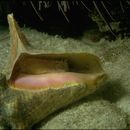
Strombidae, commonly known as the true conchs, is a taxonomic family of medium-sized to very large sea snails, marine gastropod mollusks in the superfamily Stromboidea.
The family Strombidae includes the genera Strombus, Lambis, Tibia, and their allies. Many more species existed in the geological past than are now extant.
The term true conchs, being a common name, does not have an exact meaning. It may refer generally to any of the Strombidae[1] but sometimes is used more specifically to include only Strombus and Lambis[2] or just Strombus itself.[3]
Contents |
Distribution
Strombid gastropods live mainly in tropical and subtropical waters. These animals are widespread in the Indo-West Pacific, where most species and genera occur.[4] Nearly forty of the living species of the genus Strombus can be found in the Indo-Pacific region.[5] They also occur in the eastern Pacific and Western Atlantic, and a single species can be found on the African Atlantic coast.[4] Six species of strombids are found in the wider Caribbean region, including the queen conch Lobatus gigas, the goliath conch Lobatus goliath, the hawk-wing conch Lobatus raninus, the rooster tail conch Lobatus gallus, the milk conch Lobatus costatus, the West Indian fighting conch Strombus pugilis and the Florida fighting conch Strombus alatus. Until recently, all of these species were placed in the genus Strombus, but now many species are being moved into new genera.[6]
Morphology and life habits
Strombids have long eye stalks, a long and narrow aperture, and a siphonal canal. The shell margin has an indentation near the anterior end which accommodates one of the eye stalks. This indentation is called a strombid or stromboid notch. The stromboid notch may be more or less conspicuous depending on the species. The shell of most species in this family grow a flared lip upon reaching sexual maturity, and they lay eggs in long, gelatinous strands. The genera Strombus and Lambis have many similarities between them, both anatomical and reproductive, though their shells show some conspicuous differences.
Strombid gastropods were widely accepted as carnivores by several authors in the 19th century, an erroneous conception that persisted for several decades into the first half of the 20th century. This ideology was probably born in the writings of Lamarck, who classified strombids alongside other supposedly carnivorous snails, and was posteriorly recovered by other authors. However, the many claims of those authors were never supported by the observation of animals in their natural habitat.[7] Nowadays, strombids are known to be specialized herbivores and occasional detritivores. They are usually associated with shallow water reefs and seagrass meadows.[8]
Behavior
Unlike most snails, which glide slowly across the substrate on their foot, strombid gastropods have a characteristic mean of locomotion, using their pointed, sickle-shaped, horny operculum to propel themselves forward in a so called leaping motion.[1][9]
Burrowing behavior, in which an individual sinks itself entirely or partially into the substrate, is also frequent among strombid gastropods. The burrowing process itself, which involves ditinct sequential movements and sometimes complex behaviors, is very characteristic of each species. Usually, large strombid gastropods such as the queen conch Eustrombus gigas and the spider conch Lambis lambis, won't burry themselves, except during their juvenile stage. On the other hand, smaller species such as the dog conch Strombus canarium and Strombus epidromis may burry themselves even after adulthood, though this is not an absolute rule.[10]
Genera
The family Strombidae comprises several genera (extinct genera are marked with a dagger †), including[11]:
- Barneystrombus Blackwood, 2009
- Canarium Schumacher, 1817
- Conomurex Bayle in P. Fischer, 1884
- Dolomena Wenz, 1940
- Doxander Wenz, 1940
- Euprotomus Gill, 1870
- Gibberulus Jousseaume, 1888
- Harpago Mörch, 1852
- Labiostrombus Oostingh, 1925
- Laevistrombus Abbott, 1960
- Lambis Röding, 1798
- Lentigo Jousseaume, 1886
- Lobatus Swainson, 1837
- Margistrombus Bandel, 2007
- Mirabilistrombus Kronenberg, 1998
- Persististrombus Kronenberg & Lee, 2007
- Pyramis Röding, 1798
- Sinustrombus Bandel, 2007
- Strombus Linnaeus, 1758
- Terestrombus Kronenberg & Vermeij, 2002
- Thersistrombus Bandel, 2007
- Tricornis Jousseaume, 1886
- Tridentarius Kronenberg & Vermeij, 2002
- † Rimella Agassiz, 1840
Cladograms
A cladogram (a tree of descent) based on an extensive morpho-anatomical analysis of representatives of Aporrhaidae, Strombidae, Xenophoridae and Struthiolariidae was proposed by Simone (2005).[12] A simplified part of this analysis, comprising only Strombidae representatives, is depicted bellow:
| Strombidae | |||||||||||||||||||||||||||||||||||||||||||
Another cladogram, this time based on sequences of nuclear histone H3 and mitochondrial cytochrome-c oxidase I (COI) genes was proposed by Latiolais et al. (2006). The phylogenic relations of (32 analyzed) species in the genus Strombus and Lambis are shown bellow[8]:
| |||||||||||||||||||||||||||||||||||||||||||||||||||||||||||||||||||||||||||||||||||||||||||||||||||||||||||||||||||||||||
References
- ^ a b Abbott, R. T.; Dance, S. P. (2000). Compendium of Seashells. California: Odyssey Publishing. p. 75. ISBN 0-9661720-0-0.
- ^ Goodenough, W. H. & Sugita, H. (1980). "Trukese-English dictionary". Philadelphia: American Philosophical Society. p. 235]
- ^ worldwideconchiology.com Strombidae article
- ^ a b Beesley, P. L.; Ross, G. J. B.; Wells, A. (1998). Mollusca: The Southern Synthesis. Fauna of Australia: Part B. Melbourne, AU: CSIRO Publishing. p. 766. ISBN 0 643 05756 0.
- ^ Abbott, R.T. (1960). "The genus Strombus in the Indo-pacific". Indo-Pacific Mollusca 1(2): 33-144
- ^ Landau, B. M.; Kronenberg G. C.; Herbert, G. S. (2008). "A large new species of Lobatus (Gastropoda: Strombidae) from the neogene of the Dominican Republic, with notes on the genus". The Veliger (Santa Barbara: California Malacozoological Society, Inc.) 50 (1): 31–38. ISSN 0042-3211.
- ^ Robertson, R. (1961). "The feeding of Strombus and related herbivorous marine gastropods". Notulae Naturae of the Academy of Natural Sciences of Philadelphia (343): 1–9.
- ^ a b Latiolais J. M., Taylor M. S., Roy K. & Hellberg M. E. (2006). "A molecular phylogenetic analysis of strombid gastropod morphological diversity". Molecular Phylogenetics and Evolution 41: 436-444. doi:10.1016/j.ympev.2006.05.027. PDF.
- ^ Parker, G. H. (1922). "The leaping of the stromb (Strombus gigas Linn.)". Journal of Experimental Zoology 36: 205-209.
- ^ Savazzi, E. (1989). "New observations on burrowing in strombid gastropods". Stuttgarter Beiträge zur Naturkunde. Serie A (Biologie) (Staatliches Museum für Naturkunde) (434): 1–10. ISSN 0341-0145.
- ^ Strombidae Rafinesque, 1815. World Register of Marine Species, accessed 26 October 2010.
- ^ Simone, L. R. L. (2005). "Comparative morphological study of representatives of the three families of Stromboidea and the Xenophoroidea (Mollusca, Caenogastropoda), with an assessment of their phylogeny". Arquivos de Zoologia (São Paulo, Brazil: Museu de Zoologia da Universidade de São Paulo) 37 (2): 141–267. ISSN 0066-7870. http://www.revistasusp.sibi.usp.br/pdf/azmz/v37n2/a01v37n2.pdf.
Further reading
- Roy K. (1996). "The roles of mass extinction and biotic interaction in large-scale replacements: a reexamination using the fossil record of stromboidean gastropods". Paleobiology 22(3): 436-452. pdf JSTOR
- Roy K., Balch D. P. & Hellberg M. E. (2001). "Spatial patterns of morphological diversity across the Indo-Pacific: analyses using strombid gastropods". Proceedings of the Royal Society B 268: 2503-2508. doi:10.1098/rspb.2000.1428. PDF
Unreviewed
Disclaimer
EOL content is automatically assembled from many different content providers. As a result, from time to time you may find pages on EOL that are confusing.
To request an improvement, please leave a comment on the page. Thank you!