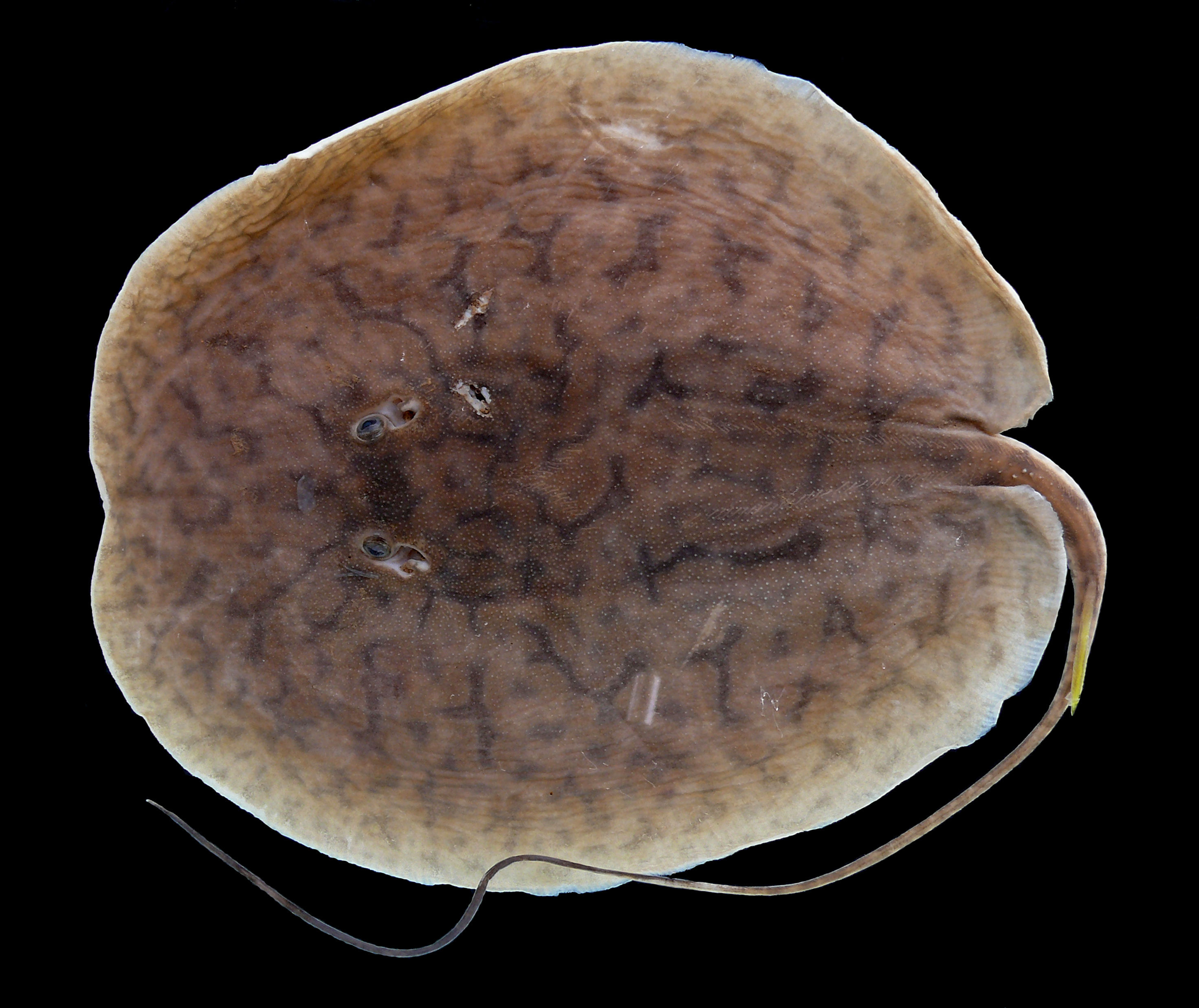
Overview
Comprehensive Description
Biology
Common in shallow areas and near banks (Ref. 27749). Reproductive biology in upper Orinoco basin provided by Lasso et al. (1997a), where females appear to bear only two young per gestation. Larger individuals may attain 25 kg in weight. Food includes insects, crustaceans and fishes (Ref. 36687).
-
de Carvalho, M.R., N. Lovejoy and R.S. Rosa 2003 Potamotrygonidae (River stingrays). p. 22-28. In R.E. Reis, S.O. Kullander and C.J. Ferraris, Jr. (eds.) Checklist of the Freshwater Fishes of South and Central America. Porto Alegre: EDIPUCRS, Brasil. (Ref. 36687)
http://www.fishbase.org/references/FBRefSummary.php?id=36687&speccode=50646
Trusted
Distribution
South America: Amazon River basin (Ucayali, Solimões, Amazon, Negro, Branco, Madeira and its affluents in Bolivia, and Tocantins River) and Orinoco basin.
-
de Carvalho, M.R., N. Lovejoy and R.S. Rosa 2003 Potamotrygonidae (River stingrays). p. 22-28. In R.E. Reis, S.O. Kullander and C.J. Ferraris, Jr. (eds.) Checklist of the Freshwater Fishes of South and Central America. Porto Alegre: EDIPUCRS, Brasil. (Ref. 36687)
http://www.fishbase.org/references/FBRefSummary.php?id=36687&speccode=50646
Trusted
Range Description
South America inland waters: Amazon?Solimões River and tributaries in Brazil and the Rio Orinoco drainage in Venezuela, Northern Bolivia, Peru and Ecuador.
FAO Area: 03.
FAO Area: 03.
Trusted
Amazon River and Oronico River basins: Bolivia, Brazil, Ecuador, Peru and Venezuela [if treated with this authorship].
Trusted
Physical Description
Size
Max. size
80.0 cm WD (male/unsexed; (Ref. 36687)); 78 cm WD (female); max. published weight: 14.0 kg (Ref. 27749); max. published weight: 25 kg
-
de Carvalho, M.R., N. Lovejoy and R.S. Rosa 2003 Potamotrygonidae (River stingrays). p. 22-28. In R.E. Reis, S.O. Kullander and C.J. Ferraris, Jr. (eds.) Checklist of the Freshwater Fishes of South and Central America. Porto Alegre: EDIPUCRS, Brasil. (Ref. 36687)
http://www.fishbase.org/references/FBRefSummary.php?id=36687&speccode=50646
-
Lasso, C.A., A. Rial B. and O. Lasso-Alcalá. 1997 Notes on the biology of the freshwater stingrays Paratrygon aiereba (Müller & Henle, 1841) and Potamotrygon orbignyi (Castelnau, 1855) (Chondrichthyes: Potamotrygonidae) in the Venezuelan Llanos. Aqua, J. Ichthyol. Aquat. Biol. 2(3):39-52. (Ref. 27749)
http://www.fishbase.org/references/FBRefSummary.php?id=27749&speccode=50646
Trusted
Ecology
Habitat
Habitat and Ecology
Habitat and Ecology
Systems
This species occupies shallow warm waters with temperatures around 25ºC. Juveniles inhabit areas with sandy beaches and small creeks while adults inhabit main river channels and sandy beaches, mainly during the night when it uses these areas to forage. In the Rio Negro, the species apparently shows daily movements between deeper and shallow water.
Information on reproductive biology is known only from Brazil and Venezuela. Reproductive mode is matrotrophic viviparity with trophonemata. The duration of the reproductive cycle is around two years. Gestation period is estimated as nine months. Ovarian fecundity is 3?5 and the average uterine fecundity is two embryos. Sexual segregation has been observed in this species. Size at birth 16 cm DW; size at maturity 60 cm DW (males) and 72 cm DW (females); maximum size is 130 cm DW.
Diet includes small fishes, shrimps, worms and insect larvae.
Information on reproductive biology is known only from Brazil and Venezuela. Reproductive mode is matrotrophic viviparity with trophonemata. The duration of the reproductive cycle is around two years. Gestation period is estimated as nine months. Ovarian fecundity is 3?5 and the average uterine fecundity is two embryos. Sexual segregation has been observed in this species. Size at birth 16 cm DW; size at maturity 60 cm DW (males) and 72 cm DW (females); maximum size is 130 cm DW.
Diet includes small fishes, shrimps, worms and insect larvae.
Systems
- Freshwater
Trusted
Trophic Strategy
Feeds on fish, benthic organisms, plants and detritus (Ref. 27749).
-
Lasso, C.A., A. Rial B. and O. Lasso-Alcalá. 1997 Notes on the biology of the freshwater stingrays Paratrygon aiereba (Müller & Henle, 1841) and Potamotrygon orbignyi (Castelnau, 1855) (Chondrichthyes: Potamotrygonidae) in the Venezuelan Llanos. Aqua, J. Ichthyol. Aquat. Biol. 2(3):39-52. (Ref. 27749)
http://www.fishbase.org/references/FBRefSummary.php?id=27749&speccode=50646
Trusted
Molecular Biology and Genetics
Molecular Biology
Statistics of barcoding coverage: Paratrygon aiereba
Barcode of Life Data Systems (BOLDS) Stats
Public Records: 0
Specimens with Barcodes: 24
Species With Barcodes: 1
Public Records: 0
Specimens with Barcodes: 24
Species With Barcodes: 1
Trusted
Conservation
Conservation Status
IUCN Red List Assessment
Red List Category
DD
Data Deficient
Red List Criteria
Version
3.1
Year Assessed
2009
Assessor/s
Góes de Araújo, M.L. & Rincón, G.
Reviewer/s
Kyne, P.M., Cavanagh, R.D. & Fowler, S.L. (Shark Red List Authority)
Contributor/s
Justification
The Manzana Ray (Paratrygon aiereba) is a common, widespread species of the Amazonas Basin and the only species in this monotypic genus of the Potamotrygonidae, the Manzana Ray attains a size of about 130 cm disc width and 60 kg. Its export for the ornamental fish trade is illegal from Brazil, but it is regularly exported from Peru and from Colombia, where it does not occur in the wild. It is also taken by commercial fisheries and, like other potamotrygonids, habitat degradation and persecution are of concern. Although widespread, this species faces numerous threats, and, given its large size and low fecundity (two offspring every second year), it is potentially vulnerable to the effects of these threats. However, due to an overall lack of information, the species is assessed as Data Deficient and should be reassessed in the near future as new information comes to light.
Trusted
Trends
Population
Population
Population Trend
This species is widespread around the Amazonas-Solimões River and tributaries. Around the Rio Negro in Brazil this species occurs in at least 42 tributaries, and is known to occur in high densities.
Population Trend
Unknown
Trusted
Threats
Data deficient (DD)
-
IUCN 2006 2006 IUCN red list of threatened species. www.iucnredlist.org. Downloaded July 2006.
http://www.fishbase.org/references/FBRefSummary.php?id=57073
Trusted
Major Threats
Habitat degradation. Persecution in popular tourism areas due to fear of injury. This species is taken as bycatch in commercial fisheries with trawl nets along the Solimões-Amazonas River. Commercial fisheries retain and market this species. Its export for the ornamental fish trade is illegal from Brazil, but it is regularly exported from Peru and Colombia.
Trusted
Management
Conservation Actions
The capture and exportation of this species for the ornamental fish trade is illegal in Brazil. However, local people on Brazilian borders complain that specimens captured in Brazil are exported from Colombia or Peru. An international program to regulate the export of freshwater stingrays in the ornamental fish trade is necessary.
There are no regulations or controls on catches by commercial fisheries.
Habitat protection and fisheries monitoring programs are recommended.
There are no regulations or controls on catches by commercial fisheries.
Habitat protection and fisheries monitoring programs are recommended.
Trusted