Articles on this page are available in 1 other language: Arabic (7) (learn more)

Overview

Comprehensive Description

General Description

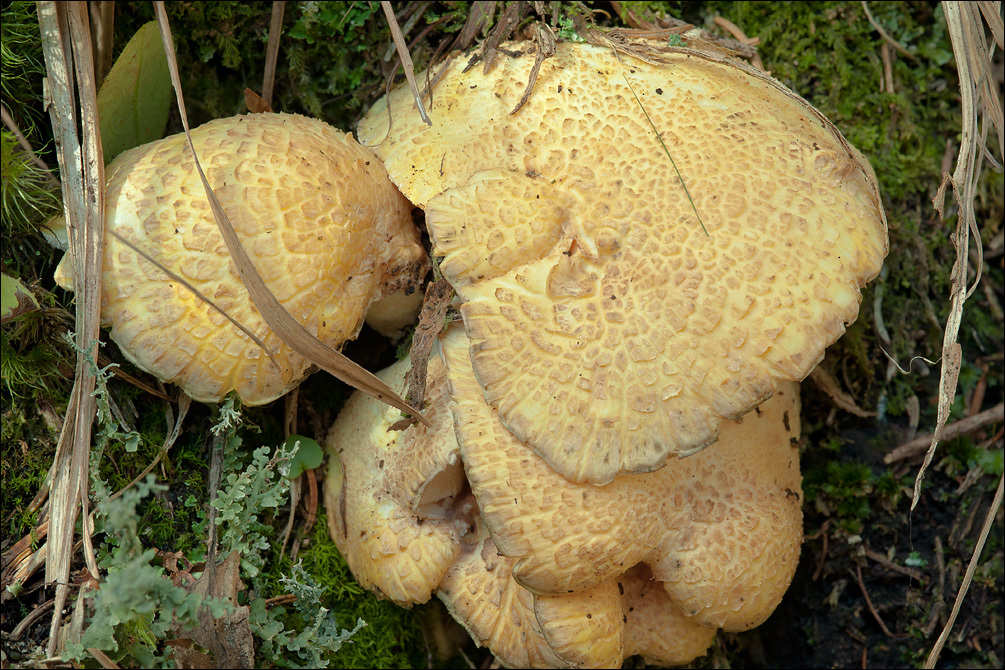
Albatrellus ovinus is a white to cream-colored mushroom, but is often tan and drab colored and less distinctive. Unlike many related members of the genus Albatrellus, A. ovinus is mycorrhizal as it is found on the ground near coniferous trees, rather than a saprophyte or parasite on wood. Mycorrhizal in coniferous forests in temperate and boreal climates; appearing in late summer and autum. Pileus 4-20 cm across, 3-10 mm thick, fleshy, usually circular but sometimes irregular; slightly convex, flat, or shallowly depressed in age; rarely fused; dry; smooth at first, then becoming cracked with pale to yellowish flesh exposed inside cracks; whitish or buff when young, aging to tan. Pore surface desceding the stem. Flesh is whitish aging to yellowish. Stipe 3-10 cm long, 1-4 cm wide; central or a bit off-center; whitish to tan; smooth or very finely velvety. White spore print.


Basidiospores 4-5 × 2.5-3.5 micrometers in size; smooth; hyaline; subglobose to broadly elliptic; inamyloid in Melzer’s Reagent; walls fairly thick. The hyphal strucutre is monomitic.


Application of KOH instantly turns the usually whitish flesh to golden yellow in color. Grows gregariously, sometimes in dense clusters. Both odor and taste are not distinctive.


Common name: Sheep polypore. Polyporus ovinus is a previous, out-dated scientific name.


Creative Commons Attribution Non Commercial Share Alike 3.0 (CC BY-NC-SA 3.0)

© Tom Volk, Zach Duga

Source: Mushroom Observer

Trusted

Article rating from 0 people

Average rating: 2.5 of 5

Distribution

Distribution

Albatrellus ovinus is found within the United States in both the Rocky and Appalachian Mountains and also coastal California. It can also be found in Finland and other parts of Europe. Prefers to grow in high elevations; mountainous regions.

Creative Commons Attribution Non Commercial Share Alike 3.0 (CC BY-NC-SA 3.0)

© Tom Volk, Zach Duga

Source: Mushroom Observer

Trusted

Article rating from 0 people

Average rating: 2.5 of 5

Physical Description

Diagnostic Description

Diagnostic Description

Unlike most members of the genus Albatrellus, A. ovinus is mycorrhizal mushroom as it is found on the ground near conifer trees.

Creative Commons Attribution Non Commercial Share Alike 3.0 (CC BY-NC-SA 3.0)

© Tom Volk, Zach Duga

Source: Mushroom Observer

Trusted

Article rating from 0 people

Average rating: 2.5 of 5

Look Alikes

Look Alikes

Albatrellus confluens is closely related and also very similar looking. The distinguishing characteristic between the two species is that with the application of KOH, the flesh of A. confluens turns purple, while the flesh of A. ovinus turns golden yellow.


Creative Commons Attribution Non Commercial Share Alike 3.0 (CC BY-NC-SA 3.0)

© Tom Volk, Zach Duga

Source: Mushroom Observer

Trusted

Article rating from 0 people

Average rating: 2.5 of 5

Ecology

Habitat

Habitat

Mycorrhizal mushroom in association with conifer trees. Found on the ground in coniferous forests in temperate and boreal climates. It is also found under Englemann spruce, subalpine fur, Norway spruce, and under other various firs, pines, and spruces.

Creative Commons Attribution Non Commercial Share Alike 3.0 (CC BY-NC-SA 3.0)

© Tom Volk, Zach Duga

Source: Mushroom Observer

Trusted

Article rating from 0 people

Average rating: 2.5 of 5

Relevance to Humans and Ecosystems

Benefits

Uses

This mushroom is considered to be a fine edible in Finland. Considered edible when young. There have been reports of problems after eating Albatrellus ovinus, such as “laxative effects” when consumed in large quantities and also “intoxication from eating it.”

Creative Commons Attribution Non Commercial Share Alike 3.0 (CC BY-NC-SA 3.0)

© Tom Volk, Zach Duga

Source: Mushroom Observer

Trusted

Article rating from 0 people

Average rating: 2.5 of 5

Wikipedia

Albatrellus ovinus

Albatrellus ovinus
View the Mycomorphbox template that generates the following list
Mycological characteristics
pores on hymenium

cap is convex

or flat
hymenium is decurrent
stipe is bare
ecology is mycorrhizal
edibility: edible

Albatrellus ovinus is a terrestrial polypore fungus found in Northern Europe. It is very closely related to the more common A. subrubescens,[1] from which it may be distinguished microscopically by the amyloid spore wall. It is edible and sold commercially in Finland.[2]

Similar species

Albatrellus subrubescens is similar in appearance, but different color. Microscopically, the spores of A. subrubescens are amyloid, while the ones of A. ovinus are not.[3][4]

References

  1. ^ Hibbett DS, Pine EM, Langer E, Langer G, Donoghue MJ. (1997). "Evolution of gilled mushrooms and puffballs inferred from ribosomal DNA sequences". Proceedings of the National Academy of Sciences U.S.A. 94 (22): 12002–6. doi:10.1073/pnas.94.22.12002. PMC 23683. PMID 9342352. http://www.pnas.org/cgi/pmidlookup?view=long&pmid=9342352. Retrieved 2008-11-11. 
  2. ^ Pelkonen,, Riina; Alfthan, Georg, Järvinen, Olli (2008). Element Concentrations in Wild Edible Mushrooms in Finland. Helsinki: Finnish Environment Institute. pp. 32. ISBN 978-952-11-3153-0. http://www.ymparisto.fi/download.asp?contentid=87635. Retrieved 2009-02-20. 
  3. ^ W. Julich, 1984: Die Nichtblatterpilze, Gallertpilze und Bauchpilze. Kleine Kryptogamenflora Band II Teil b/1
  4. ^ J. Breitenbach, F. Kranzlin, 1986: Pilze der Schweiz, Band 2. Nichtblatterpilze.
Creative Commons Attribution Share Alike 3.0 (CC BY-SA 3.0)


Source: Wikipedia

Unreviewed

Article rating from 0 people

Average rating: 2.5 of 5

Disclaimer

EOL content is automatically assembled from many different content providers. As a result, from time to time you may find pages on EOL that are confusing.

To request an improvement, please leave a comment on the page. Thank you!