Overview
Distribution
Range Description
Trusted
Geographic Range
Antilopine wallaroos inhabit savanna woodlands throughout the northern, tropical regions of Australia, from the Kimberley to the Gulf of Carpentaria. They are also found in the Cape York Peninsula.
Biogeographic Regions: australian
Other Geographic Terms: island endemic
- 2007. "The Kangaroo trail" (On-line). Accessed March 04, 2009 at http://www.rootourism.com/fsheet16.htm.
- Croft, D. 1987. Socio-Ecology of the Antilopine Wallaroo, Macropus-Antilopinus, in the Northern-Territory, With Observations on Sympatric Macropus-Robustus-Woodwardii and Macropus-Agilis. Australian Wildlife Research, 14: 243-255.
- Croft, D. 1982. Some observations on the behaviour of the antelopine wallaroo Macropus antilopinus (Marsupialia: Macropodidea). Journal of the Australian Mammal Society Inc., 5: 5-13.
- Davey, K. 2005. "Antilopine Wallaroo" (On-line). Accessed April 09, 303 at http://homepage.mac.com/keithdavey/macropods/antilopine-wallaroo.htm.
- Hirst, S. 2006. "National Wildlife Rehabilitation Conference 2006" (On-line). The Antilopine Wallaroo: an unusual ‘roo. Accessed March 04, 2009 at http://www.nwrc.com.au/2k6/html/papers.htm.
- Ritchie, E., J. Martin, A. Krockenberger, S. Garnett, C. Johnson. 2008. Large-herbivore distribution and abundance: intra- and interspecific niche variation in the tropics.. Ecological Monographs, 78.1: 105-122.
Trusted
Physical Description
Morphology
Physical Description
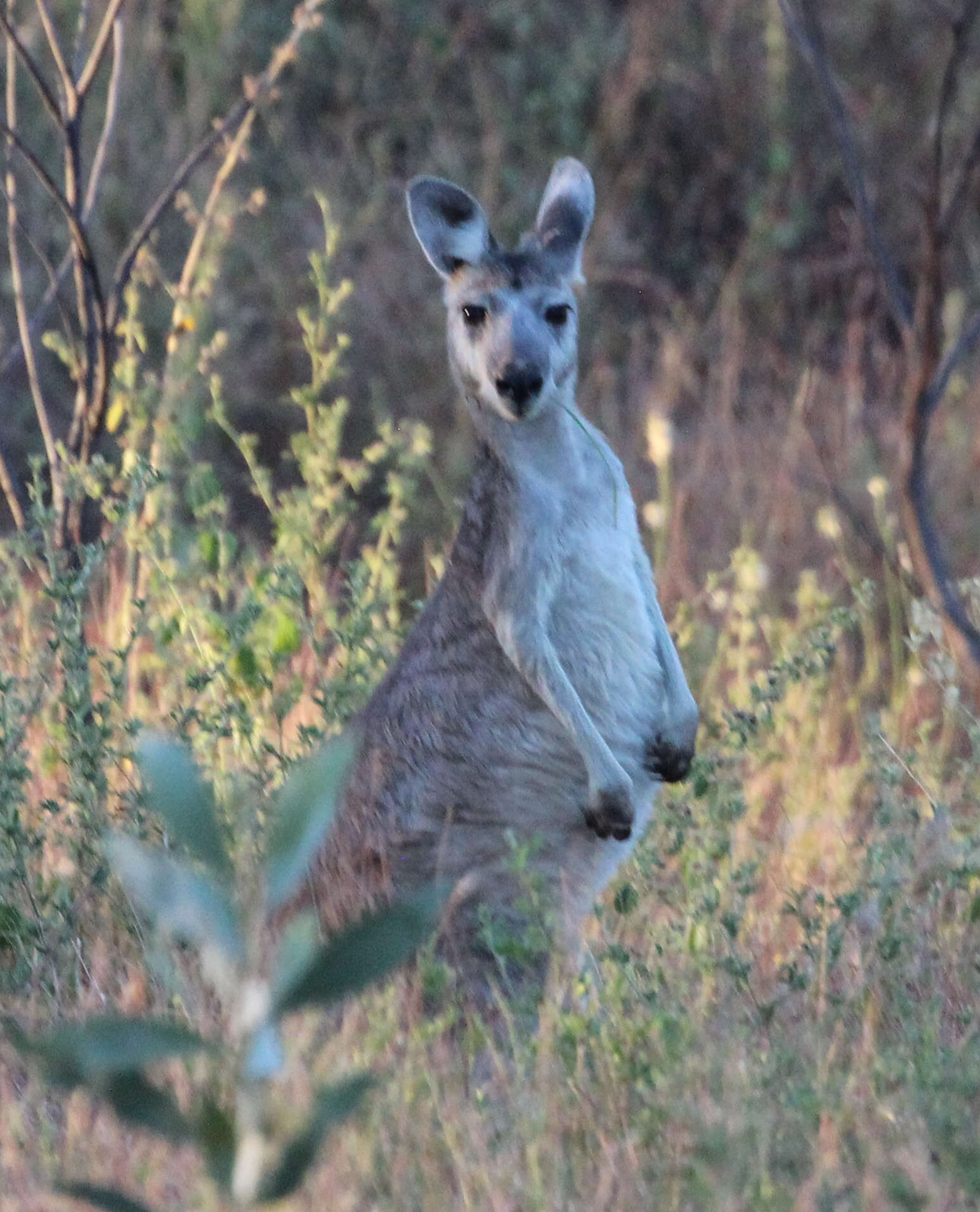
Male and female antilopine wallaroos are very sexually dimorphic. Adult males are usually a reddish tan color. Females, however, are brownish tan in the back and hind parts and usually have gray heads and shoulders. Females also have white tips on the back of their ears. Paws and feet of both sexes are white on the ventral side and are black tipped. Adult males have a distinct swelling of the nose above the nostrils that is possibly used for cooling. Males are also much larger than the females, reaching up to 70 kg. A female of this species ranges from 15 kg to 30 kg. Females develop their pouches after about 20 months. In joeys, the fur coloration is apparent after 6 to 7 months. The shape of a female joey’s head is more petite than the male joey’s.
Range mass: 15 to 70 kg.
Range length: 1.5 to 1.9 m.
Sexual Dimorphism: male larger; sexes colored or patterned differently; male more colorful; ornamentation
Trusted
Ecology
Habitat
Habitat and Ecology
Systems
- Terrestrial
Trusted
Antilopine wallaroos inhabit the savanna woodlands of Australia. During the day they reside in shaded wooded areas to avoid the hot sun. At dusk they graze in grasslands and at dawn return to wooded areas. During the cooler wet season, antilopine wallaroos may also graze during the day, but they seek shelter from rain in wooded areas. Eastern populations may be found on slopes and tops of small hills. They may also be found in valleys and low-lying depressions on the floodplains of major rivers, especially in moist areas populated with short green grass. Northern populations favor sites with permanent water where fires occur late in the season.
Habitat Regions: tropical ; terrestrial
Terrestrial Biomes: savanna or grassland ; forest
Trusted
Trophic Strategy
Food Habits
Antilopine wallaroos are herbivorous, and their diet is mainly composed of grass. They seek areas with short grass, like low tussock grass, or where tall grass has been burnt and reduced to shoots.
Plant Foods: leaves
Primary Diet: herbivore (Folivore )
Trusted
Associations
Ecosystem Roles
Antilopine wallaroos consume a variety of grasses and act as hosts for mites, nematodes, fleas, and ticks.
Trusted
Predation
There are no known predators of antilopine wallaroos other than humans.
Known Predators:
- humans homo sapiens
Trusted
Life History and Behavior
Behavior
Communication and Perception
Before fighting, males make an audible hiss as an alarm. This is usually followed by a foot thump. Males also perform a “head tossing” motion before fighting.
Communication Channels: visual ; tactile ; acoustic
Perception Channels: visual
Trusted
Life Expectancy
Lifespan/Longevity
Little information is available regarding the average lifespan of antilopine wallaroos. The longest lived antilopine wallaroo in the wild was 16 years of age, while the longest lived antilopine wallaroo in captivity was 15.9 years of age.
Range lifespan
Status: wild: 16 (high) years.
Range lifespan
Status: captivity: 15.9 (high) years.
- Max, , Planck, Gesellschaft. 2002. "Longevity Records Life Spans of Mammals, Birds, Amphibians, Reptiles, and Fish" (On-line). Mammals. Accessed March 10, 2009 at http://www.demogr.mpg.de/longevityrecords/0203.htm.
Trusted
Lifespan, longevity, and ageing
Trusted
Reproduction
An increased amount of fighting by male antilopine wallaroos has been observed near the beginning of the breeding season. To attract a mate, a male sniffs the female’s cloacal region, then shows his ventral surface and erect penis.
Male antilopine wallaroos reach sexual maturity at 2 years of age, whereas females reach sexual maturity at 16 months and develop their pouch after 20 months. Females come into estrous within a few days of each other. Although estrous of females does not seem to be related to the age of their young (joeys), estrous always occurs after the permanent emergence of the joey. Gestation lasts about 35 days.
Only one offspring is produced per breeding season. After birth the neonate climbs into the mother's pouch, much like all macropods. After about 20 weeks, the joey begins to emerge from the pouch. At about 6 months the joey completely comes out of the pouch for the first time, and at about 37 weeks the mother does not allow the joey back in the pouch. A joey is gradually weaned, feeding less and less from its mother until about 15 months after birth.
Breeding interval: Antilopine wallaroos breed once yearly with births during the wet season.
Breeding season: Mating of antilopine wallaroos occurs at the beginning of the wet season, usually around December.
Average number of offspring: 1.
Range gestation period: 34.1 to 35.9 days.
Average weaning age: 15 months.
Average time to independence: 15 months.
Range age at sexual or reproductive maturity (female): 16 to 20 months.
Average age at sexual or reproductive maturity (female): 16 months.
Average age at sexual or reproductive maturity (male): 2 years.
Key Reproductive Features: seasonal breeding ; gonochoric/gonochoristic/dioecious (sexes separate); fertilization ; viviparous
Male antilopine wallaroos lose interest in their mate and young once the neonate reaches its mother's pouch. Once all neonates reach their mother's pouch, the group sexually segregates; large males form small groups while females and young remain together in large groups. Even after weaning, young antilopine wallaroos maintain a close relationship with their mother, resting together and grooming each other.
Parental Investment: female parental care ; pre-hatching/birth (Provisioning: Female, Protecting: Female); pre-weaning/fledging (Provisioning: Female, Protecting: Female); post-independence association with parents
- 2007. "The Kangaroo trail" (On-line). Accessed March 04, 2009 at http://www.rootourism.com/fsheet16.htm.
- Croft, D. 1987. Socio-Ecology of the Antilopine Wallaroo, Macropus-Antilopinus, in the Northern-Territory, With Observations on Sympatric Macropus-Robustus-Woodwardii and Macropus-Agilis. Australian Wildlife Research, 14: 243-255.
- Croft, D. 1982. Some observations on the behaviour of the antelopine wallaroo Macropus antilopinus (Marsupialia: Macropodidea). Journal of the Australian Mammal Society Inc., 5: 5-13.
- Davey, K. 2005. "Antilopine Wallaroo" (On-line). Accessed April 09, 303 at http://homepage.mac.com/keithdavey/macropods/antilopine-wallaroo.htm.
- Hirst, S. 2006. "National Wildlife Rehabilitation Conference 2006" (On-line). The Antilopine Wallaroo: an unusual ‘roo. Accessed March 04, 2009 at http://www.nwrc.com.au/2k6/html/papers.htm.
Trusted
Conservation
Conservation Status
IUCN Red List Assessment
Red List Category
Red List Criteria
Version
Year Assessed
Assessor/s
Reviewer/s
Justification
History
- 1996Lower Risk/least concern
- 1996Lower Risk/least concern(Baillie and Groombridge 1996)
Trusted
Although populations of antilopine wallarooos are decreasing, the species is classified of least concern by the IUCN. This species has likely benefited from human conversion of land to agricultural and grassland areas.
US Federal List: no special status
CITES: no special status
IUCN Red List of Threatened Species: least concern
- 2008. "The IUNC Red List of Threatened Species" (On-line). Accessed April 26, 2009 at http://www.iucnredlist.org/search.
Trusted
Trends
Population
Population Trend
Trusted
Threats
Trusted
Management
Conservation Actions
Trusted
Relevance to Humans and Ecosystems
Benefits
Economic Importance for Humans: Negative
Because both species graze in grasslands, Antilopine wallaroos may compete with cattle.
Trusted
Economic Importance for Humans: Positive
Antilopine wallaroos are hunted by the Aboriginal people of Australia.
Positive Impacts: food
Trusted
Wikipedia
Antilopine kangaroo
The antilopine kangaroo (Macropus antilopinus), sometimes called the antilopine wallaroo or the antilopine wallaby, is a species of macropod found in northern Australia: in Cape York Peninsula in Queensland, the Top End of the Northern Territory, and the Kimberley region of Western Australia. It is a locally common, gregarious grazer.[3]
The name antilopine means antelope-like.
The antilopine kangaroo is one of few macropods to display sexual dimorphism, with the male being mostly a reddish colour above, and females being considerably greyer. It is one of the largest macropods, being only slightly smaller than the red kangaroo (Macropus rufus) and the eastern grey kangaroo (Macropus giganteus).[3]
References
- ^ Groves, C. P. (2005). Wilson, D. E.; Reeder, D. M. eds. Mammal Species of the World (3rd ed.). Baltimore: Johns Hopkins University Press. pp. 63–64. OCLC 62265494. ISBN 0-801-88221-4. http://www.bucknell.edu/msw3.
- ^ Woinarski, J., Ritchie, E. & Winter, J. (2008). Macropus antilopinus. In: IUCN 2008. IUCN Red List of Threatened Species. Retrieved 30 December 2008.
- ^ a b Menkhorst, Peter (2001). A Field Guide to the Mammals of Australia. Oxford University Press. p. 110.
Unreviewed
Disclaimer
EOL content is automatically assembled from many different content providers. As a result, from time to time you may find pages on EOL that are confusing.
To request an improvement, please leave a comment on the page. Thank you!