Articles on this page are available in 1 other language: Dutch (1) (learn more)
Overview
Brief Summary
Trusted
Comprehensive Description
Description
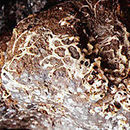
This demosponge species is either encrusting, branching, or forms flattened lobes. The skeleton is composed of irregularly and loosely packed, siliceous spicules. Spicule type includes megascleres (oxeas) only, measuring 170-300 mm in length. Color variants include gold, yellowish-tan, or olive-brown; surface is often translucent. For complete description, see Lee et al., 2007.
Trusted
Description
- Microscopic examination of the spicules reveals that they are relatively long and thin, and taper to the apices.
- Named after James S. Bowerbank (1797-1877), a pioneering authority on sponges.
- Easily confused with Halichondria panicea but Halichondria bowerbanki is distinguished by the absence of the chimney-like oscules that occur in Halichondria panicea.
Trusted
Description
Trusted
Distribution
-
Felder, D.L. and D.K. Camp (eds.), Gulf of Mexico–Origins, Waters, and Biota. Biodiversity. Texas A&M Press, College Station, Texas.
http://www.marinespecies.org/porifera/porifera.php?p=sourcedetails&id=145245
-
Burton, M. 1930b. Additions to the Sponge Fauna at Plymouth. Journal of the Marine Biological Association of the United Kingdom 16 (2): 489-507.
http://www.marinespecies.org/porifera/porifera.php?p=sourcedetails&id=7266
-
Vethaak, A.D.; Cronie, R.J.A.; Van Soest, R.W.M. 1982.Ecology and distribution of two sympatric, closely related spongespecies, Halichondria panicea (Pallas, 1766) and H. bowerbanki Burton,1930 (Porifera, Demospongiae), with remarks on their speciation. Bijdragen tot de Dierkunde 52(2): 82-102.
http://www.marinespecies.org/porifera/porifera.php?p=sourcedetails&id=8507
-
Lamarck, J.B.P. De Monet, Comte De, 1813-1814. Sur les polypiers empâtés. Suite du mémoire intitulé: Sur les Polypiers empâtés. Suite des éponges. Annales du Muséum national d’histoire naturelle, Paris 20 (6): 294-312 (published 1813), 370-386, 432-458 (published 1814).
http://www.marinespecies.org/porifera/porifera.php?p=sourcedetails&id=7763
-
Hartman, W.D. 1958b. Natural History of the Marine Sponges of Southern New England. Bulletin of the Peabody Museum of Natural History 12: 1-155.
http://www.marinespecies.org/porifera/porifera.php?p=sourcedetails&id=7590
-
MEDIN (2011). UK checklist of marine species derived from the applications Marine Recorder and UNICORN, version 1.0.
http://www.marinespecies.org/asteroidea/aphia.php?p=sourcedetails&id=149081
Trusted
National Distribution
United States
Origin: Native
Regularity: Regularly occurring
Currently: Present
Confidence: Confident
Type of Residency: Year-round
Trusted
Halichondria bowerbanki has been introduced to the Northeast Pacific, with confirmed records from British Columbia to central California. This species is native to the Northeast Atlantic, distributed from the Bay of Fundy to Cape Hatteras.
Trusted
Physical Description
Look Alikes
In the Northeast Pacific, Halichondria bowerbanki is most similar to H. panicea (Pallas, 1766).
Trusted
Ecology
Habitat
Water temperature and chemistry ranges based on 23 samples.
Environmental ranges
Depth range (m): 0 - 108
Temperature range (°C): 11.054 - 24.233
Nitrate (umol/L): 0.501 - 8.267
Salinity (PPS): 34.903 - 36.315
Oxygen (ml/l): 4.476 - 6.346
Phosphate (umol/l): 0.100 - 0.838
Silicate (umol/l): 0.805 - 5.123
Graphical representation
Depth range (m): 0 - 108
Temperature range (°C): 11.054 - 24.233
Nitrate (umol/L): 0.501 - 8.267
Salinity (PPS): 34.903 - 36.315
Oxygen (ml/l): 4.476 - 6.346
Phosphate (umol/l): 0.100 - 0.838
Silicate (umol/l): 0.805 - 5.123
Note: this information has not been validated. Check this *note*. Your feedback is most welcome.
Trusted
Trusted
Trusted
Conservation
Conservation Status
National NatureServe Conservation Status
United States
Rounded National Status Rank: NNR - Unranked
Trusted
Wikipedia
Halichondria bowerbanki
Halichondria bowerbanki is a species of sponge that lives on rocky surfaces in the shallow subtidal, with occasional intertidal specimens under overhanging rocks. The physical appearance and structure of the species is variable and it has tassel-like irregular branches. Colonies can be up to 25 centimeters high with branches reaching 12 centimeters high. The color of the species is beige to brown in the summer, and light grey/yellow in the winter.[2]
References
| This poriferan- (or sponge-) related article is a stub. You can help Wikipedia by expanding it. |
Unreviewed
Disclaimer
EOL content is automatically assembled from many different content providers. As a result, from time to time you may find pages on EOL that are confusing.
To request an improvement, please leave a comment on the page. Thank you!