Overview

Distribution

Ao Sawi, Bais, Balapitiya, Bangladeshi Exclusive Economic Zone, Beninese Exclusive Economic Zone, Brunei darussalam, Buswang, Cambodian Exclusive Economic Zone, Chinese Exclusive Economic Zone, Creek Town, Devinuwara Lagoon, Dickwella, East India, Gin Oya, Hikkaduwa, Hinchinbrook Channel, Indonesian Exclusive Economic Zone, Japanese Exclusive Economic Zone, Kemaman District, Kirama Oya Mouth, Madampa Ganga, Maggona, Malaysian Exclusive Economic Zone, Micronesian Exclusive Economic Zone, Myanmar Exclusive Economic Zone, North East Australia, North West Australia, Northern Marianes and Guam Exclusive Economic Zone, Palau Exclusive Economic Zone, Papua New Guinean Exclusive Economic Zone, Polwatumodara, Rekawa, Singaporean Exclusive Economic Zone, Sipighat junction, Solomon Islands Exclusive Economic Zone, Songkhla Lake, Southern Nigeria, Sri Lankan Exclusive Economic Zone, Taiwanese Exclusive Economic Zone, Talalla, Thailand Exclusive Economic Zone, Tillawatawana, Togolese Exclusive Economic Zone, Vietnamese Exclusive Economic Zone, Volta Estuary
Creative Commons Attribution 3.0 (CC BY 3.0)

© WoRMS for SMEBD

Source: World Register of Marine Species

Trusted

Article rating from 0 people

Average rating: 2.5 of 5

Range Description

This species ranges from Sri Lanka and the Ganges Delta through to the west Pacific. In South and South-East Asia it is found in Bangladesh, Brunei Darussalam, Cambodia, China (Hainan Island), India, Indonesia, Japan (the most northern distribution is Iriomote Island), Malaysia, Myanmar, Singapore, Sri Lanka (where it also has a range extention due to planting), Thailand, and Viet Nam. In Australasia, it is found in northwest and northeast Australia, the Federated States of Micronesia, Guam, Palau, Papua New Guinea, Solomon Islands.

The species has been introduced to Cameroon and Nigeria in West Africa and to Panama in Central America and Trinidad and Tobago in the Caribbean. In much of its native range it has been planted and exists in large or small-scale plantations. It is unknown if inclusion of plantations would be representative of the natural range.
Creative Commons Attribution Non Commercial Share Alike 3.0 (CC BY-NC-SA 3.0)

© International Union for Conservation of Nature and Natural Resources

Source: IUCN

Trusted

Article rating from 0 people

Average rating: 2.5 of 5

Localities documented in Tropicos sources

Nypa fruticans Wurmb:
Australia (Oceania)
Burma (Asia)
Bangladesh (Asia)
Cambodia (Asia)
Guyana (South America)
Indonesia (Asia)
India (Asia)
Japan (Asia)
New Guinea (Asia)
Sri Lanka (Asia)
China (Asia)
Panama (Mesoamerica)
Philippines (Asia)
Thailand (Asia)
Vietnam (Asia)
Solomon Isl (Oceania)

Note: This information is based on publications available through Tropicos and may not represent the entire distribution. Tropicos does not categorize distributions as native or non-native.
Creative Commons Attribution Non Commercial Share Alike 3.0 (CC BY-NC-SA 3.0)

© Missouri Botanical Garden, 4344 Shaw Boulevard, St. Louis, MO 63110 USA

Source: Missouri Botanical Garden

Trusted

Article rating from 0 people

Average rating: 1.0 of 5

Ecology

Habitat

Habitat and Ecology

Habitat and Ecology
This species is found in the upstream estuarine zone in low, mid, and high intertidal regions (Robertson and Alongi 1992). It forms extensive belts along brackish to tidal freshwater creeks and rivers. It is very fast growing, especially in fresh water, and is a competitive species.

In Papua New Guinea, Nypa fruticans dominates vast areas of the upper Fly River and other south coast estuaries with high tide river water salinities of 1-10 o/oo (Robertson et al. 1991). The species occurs at similar positions in the Sunderbans Delta of India, which has a relatively high rate of sea-level rise, but this species is blocked from inland migration owing to coastal development, and its area and occurrence has been declining (K. Kathiresan pers. comm.)

Systems
  • Terrestrial
  • Freshwater
  • Marine
Creative Commons Attribution Non Commercial Share Alike 3.0 (CC BY-NC-SA 3.0)

© International Union for Conservation of Nature and Natural Resources

Source: IUCN

Trusted

Article rating from 0 people

Average rating: 2.5 of 5

Depth range based on 3 specimens in 1 taxon.

Environmental ranges
  Depth range (m): 0 - 0
 
Note: this information has not been validated. Check this *note*. Your feedback is most welcome.
Public Domain

Trusted

Article rating from 0 people

Average rating: 2.5 of 5

Molecular Biology and Genetics

Molecular Biology

Barcode data: Nypa fruticans

The following is a representative barcode sequence, the centroid of all available sequences for this species.


No available public DNA sequences.

Download FASTA File
Creative Commons Attribution 3.0 (CC BY 3.0)

© Barcode of Life Data Systems

Source: Barcode of Life Data Systems (BOLD)

Trusted

Article rating from 0 people

Average rating: 2.5 of 5

Statistics of barcoding coverage: Nypa fruticans

Barcode of Life Data Systems (BOLDS) Stats
Public Records: 7
Specimens with Barcodes: 7
Species With Barcodes: 1
Creative Commons Attribution 3.0 (CC BY 3.0)

© Barcode of Life Data Systems

Source: Barcode of Life Data Systems (BOLD)

Trusted

Article rating from 0 people

Average rating: 2.5 of 5

Conservation

Conservation Status

IUCN Red List Assessment


Red List Category
LC
Least Concern

Red List Criteria

Version
3.1

Year Assessed
2010

Assessor/s
Ellison, J., Koedam, N.E., Wang, Y., Primavera, J., Jin Eong, O., Wan-Hong Yong, J. & Ngoc Nam, V.

Reviewer/s
Polidoro, B.A., Livingstone, S.R., Carpenter, K.E. (Global Marine Species Assessment Coordinating Team) & Baker, W.J. (Palm Red List Authority)

Contributor/s

Justification
This species is widespread and can be locally common. There are some localized threats to this species from habitat loss and extraction, but this species is planted in many areas and is used for many goods and services. As a result, the population is very dynamic with declines in some regions and increases in others. There has been an estimated 20% decline in mangrove area within this species range since 1980. Mangrove species are more at risk from coastal development and extraction at the extremes of their distribution, and are likely to be contracting in these areas more than in other areas. It is also likely that changes in climate due to global warming will further affect these parts of the range. Although there are overall range declines in many areas, they are not enough to reach any of the threatened category thresholds. This species is listed as Least Concern.
Creative Commons Attribution Non Commercial Share Alike 3.0 (CC BY-NC-SA 3.0)

© International Union for Conservation of Nature and Natural Resources

Source: IUCN

Trusted

Article rating from 0 people

Average rating: 2.5 of 5

Population

Population
This species has a very dynamic population. It has experienced general declines due to localized threats throughout its range. This species has almost disappeared in the Indian Sundarbans due to reduced fresh water flow (Kathiresan pers. comm.). However, in some areas it is also increasing due to planting. In the Phillippines for example, other mangrove species have been cleared to plant this species, which may pose a threat to mangrove biodiversity (J. Primavera pers. comm.). In some parts of Africa where it has been introduced, it has become invasive and is considered a pest.

Population Trend
Unknown
Creative Commons Attribution Non Commercial Share Alike 3.0 (CC BY-NC-SA 3.0)

© International Union for Conservation of Nature and Natural Resources

Source: IUCN

Trusted

Article rating from 0 people

Average rating: 2.5 of 5

Threats

Major Threats
As this species prefers more freshwater environments, hyper-saline conditions and strong wave action (including that caused by passing ships) can threaten this species. Although local estimates are uncertain due to differing legislative definitions of what is a 'mangrove' and to the imprecision in determining mangrove area, current consensus estimates of mangrove loss in the last quarter-century report an approximately 20% decline in mangrove areas in countries within this species range since 1980 (FAO 2007).

Sea level rise is a major threat, especially to back mangroves that have no area in which to expand. Mangrove species with a habitat on the landward margin may be particularly vulnerable to sea-level rise if owing to coastal development their movement inland is blocked. In the Sunderbans Delta of India, for example, which has a relatively high rate of sea-level rise, provides insight to what may be common elsewhere as global sea levels rise (Mukherjee 1984). There, Nypa fruticans is blocked from inland migration owing to coastal development, and its area and occurrence has been declining (K. Kathiresan pers. comm.)

All mangrove ecosystems occur within mean sea level and high tidal elevations, and have distinct species zonations that are controlled by the elevation of the substrate relative to mean sea level. This is because of associated variation in frequency of elevation, salinity and wave action (Duke et al. 1998). With rise in sea-level, the habitat requirements of each species will be disrupted, and species zones will suffer mortality at their present locations and re-establish at higher elevations in areas that were previously landward zones (Ellison 2005). If sea-level rise is a continued trend over this century, then there will be continued mortality and re-establishment of species zones. However, species that are easily dispersed and fast growing/fast producing will cope better than those which are slower growing and slower to reproduce.

In addition, mangrove area is declining globally due to a number of localized threats. The main threat is habitat destruction and removal of mangrove areas. Reasons for removal include cleared for shrimp farms, agriculture, fish ponds, rice production and salt pans, and for the development of urban and industrial areas, road construction, coconut plantations, ports, airports, and tourist resorts. Other threats include pollution from sewage effluents, solid wastes, siltation, oil, and agricultural and urban runoff. Climate change is also thought to be a threat, particularly at the edges of a species range. Natural threats include cyclones, hurricane and tsunamis.
Creative Commons Attribution Non Commercial Share Alike 3.0 (CC BY-NC-SA 3.0)

© International Union for Conservation of Nature and Natural Resources

Source: IUCN

Trusted

Article rating from 0 people

Average rating: 2.5 of 5

Management

Conservation Actions

Conservation Actions
There are no conservation measures specific to this species, but its range may include some marine and coastal protected areas. Continued monitoring and research is recommended, as well as the inclusion of mangrove areas in marine and coastal protected areas.
Creative Commons Attribution Non Commercial Share Alike 3.0 (CC BY-NC-SA 3.0)

© International Union for Conservation of Nature and Natural Resources

Source: IUCN

Trusted

Article rating from 0 people

Average rating: 2.5 of 5

Wikipedia

Nypa fruticans

Nypa fruticans, commonly known as the nipa palm, is a species of palm native to the coastlines and estuarine habitats of the Indian and Pacific Oceans. It is the only palm considered adapted to the mangrove biome. This species is the only member of its genus Nypa which is in turn, the only member of the subfamily Nypoideae forming monotypic taxa.[1]

Contents

Description[edit]

The trunk or stem of the nipa palm is under the mud. Only the leaves project upwards
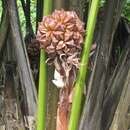
A globular flower cluster on a nipa palm
A globular fruit cluster of the nipa palm

The nipa palm has a horizontal trunk that grows beneath the ground and only the leaves and flower stalk grow upwards above the surface. Thus, it is an unusual tree, and the leaves can extend up to 9 m (30 ft) in height. The flowers are a globular inflorescence of female flowers at the tip with catkin-like red or yellow male flowers on the lower branches. The flower yields a woody nut, these arranged in a cluster compressed into a ball up to 25 cm (10 in) across on a single stalk. The ripe nuts separate from the ball and are floated away on the tide, occasionally germinating while still water-borne.

Names[edit]

Nypa fruticans is also known as attap (Singapore), nipa (Philippines), buah atap (Indonesia), buah nipah (Malaysia), dừa nước (Vietnam), ging pol (Sri Lanka), gol pata (West Bengal, Bangladesh), and dani (Burma).

Distribution[edit]

Nipa palms grow in soft mud and slow-moving tidal and river waters that bring in nutrients. The palm can be found as far inland as the tide can deposit the floating nuts. It is common on coasts and rivers flowing into the Indian and Pacific Oceans, from Bangladesh to the Pacific Islands. The plant will survive occasional short-term drying of its environment. It has become naturalised on the Atlantic side of Panama's coast.

Uses[edit]

The long, feathery leaves of the nipa palm are used by local populations as roof material for thatched houses or dwellings. The leaves are also used in many types of basketry and thatching. Large stems are used to train swimming in Burma as it has buoyancy.

On the islands of Roti and Savu, nipa palm sap is fed to pigs during the dry season. This is said to impart a sweet flavour to the meat. The young leaves are used to wrap tobacco for smoking.

Food and beverages[edit]

In the Philippines and Malaysia, the flower cluster (inflorescence) can be tapped before it blooms to yield a sweet, edible sap collected to produce a local alcoholic beverage called tuba, bahal or tuak. Tuba can be stored in tapayan (balloon vases) for several weeks to make a kind of vinegar known as sukang paombong in the Philippines and cuka nipah in Malaysia. Tuba can also be distilled to make arrack, locally known as lambanog in Filipino and arak in Indonesian.

Young shoots are also edible and the flower petals can be infused to make an aromatic tisane. Attap chee (Chinese: 亞答子; pinyin: yà dá zǐ) (chee meaning "seed" in several Chinese dialects) is a name for the immature fruits—sweet, translucent, gelatinous balls used as a dessert ingredient in Thailand, Malaysia, and Singapore.

Biofuel[edit]

The nipa palm has a very high sugar-rich sap yield. Fermented into ethanol or butanol, the palm's large amount of sap may allow for the production of 6,480-15,600 liters (per year) of fuel per hectare. Sugarcane yields 5,000–8,000 liters per hectare (per year) and an equivalent area planted in corn would produce just 2000 liters (per year) per hectare.

Fossil record[edit]

Fossil mangrove palm pollen has been dated to 70 million years ago.[citation needed] Fossilized nuts of Nypa dating to the Eocene epoch occur in the sandbeds of Branksome, Dorset, and in London Clay on the Isle of Sheppey, Kent,[2] testifying to much warmer climatic conditions in the British Isles at that time.

See also[edit]

References[edit]

  1. ^ John Leslie Dowe. Australian Palms: Biogeography, Ecology and Systematics. p. 83. Retrieved April 20, 2012. 
  2. ^ plant_material
Creative Commons Attribution Share Alike 3.0 (CC BY-SA 3.0)


Source: Wikipedia

Unreviewed

Article rating from 0 people

Average rating: 2.5 of 5

Nypa fruticans

Nypa fruticans, known as the attap palm (Singapore), nipa palm (Philippines), and mangrove palm or buah atap (Indonesia), buah nipah (Malaysia), dừa nước (Vietnam), and gol pata (Bangladesh), dani (Burma). It is the only palm considered a mangrove in the Mangroves Biome. This species is a monotypic taxon, the only one in the genus Nypa, grows in southern Asia and northern Australia within the Indomalaya ecozone.

Contents

Distribution

Nipa palms grow in soft mud and slow moving tidal and river waters that bring in nutrients. The palm can be found as far inland as the tide can deposit the floating nuts. It is common on coasts and rivers flowing into the Indian and Pacific Oceans, from Bangladesh to the Pacific Islands. The plant will survive occasional short term drying of its environment.

Description

The trunk or stem of the Nipa palm is under the mud. Only the leaves project upwards
Nipa palm vinegar (sukang paombong)

Nypa fruticans, the Nipa palm, has a horizontal trunk that grows beneath the ground and only the leaves and flower stalk grow upwards above the surface. Thus, it is an unusual tree, and the leaves can extend up to 9 m (30 ft) in height. The flowers are a globular inflorescence of female flowers at the tip with catkin-like red or yellow male flowers on the lower branches. The flower yields a woody nut, these arranged in a cluster compressed into a ball up to 25 cm (10 in) across on a single stalk. The ripe nuts separate from the ball and are floated away on the tide, occasionally germinating while still water-borne.

Uses

The long, feathery leaves of the Nipa palm are used by local populations as roof material for thatched houses or dwellings. The leaves are also used in many types of basketry and thatching.

A globular flower cluster on a Nipa palm
A globular fruit cluster of the Nipa palm

The flower cluster (inflorescence) can be tapped before it blooms to yield a sweet, edible sap collected to produce a local alcoholic beverage called Tuba(TUAK). Tuba is also stored in Tapayan (balloon vases) for several weeks to make 'CUKA NIPAH' in the Malaysia, commonly known as Sukang Paombong (pure vinegar made from the province of Paombong, Bulacan). Young shoots are also edible and the flower petals can be infused to make an aromatic tisane. Attap chee (simplified Chinese: 亞答子; pinyin: yà dá zǐ) ("chee" meaning "seed" in several Chinese dialects) is a name for the immature fruits—sweet, translucent, gelatinous balls used as a dessert ingredient in Thailand, Malaysia and Singapore. On the islands of Roti and Savu, Nipah sap is fed to pigs during the dry season. This is said to impart a sweet flavour to the meat. The young leaves are used to wrap tobacco for smoking. Large stems are used to train swimming in Burma as it has buoyancy.

Nipah has a very high sugar-rich sap yield(NIRA). Fermented into Etanol/Butanol the palm's large amount of sap may allow for the production of 6,480-15,600 liters (per day) of Ethanol/Butanol per hectare. Sugarcane yields 5,000–8,000 liters per hectare(per year) and an equivalent area planted in corn would produce just 2000 liters(per year)per hectare.

Pre-history

Fossil mangrove palm pollen has been dated to 70 million years ago. Fossilized nuts of Nypa dating to the Eocene epoch occur in the sandbeds of Branksome, Dorset, and in London Clay on the Isle of Sheppey, Kent,[1] testifying to much warmer climatic conditions in the British Isles at that time.

Endangered species

Nypa fruticans is an endangered species in Singapore.

References

Creative Commons Attribution Share Alike 3.0 (CC BY-SA 3.0)


Source: Wikipedia

Unreviewed

Article rating from 0 people

Average rating: 2.5 of 5

Disclaimer

EOL content is automatically assembled from many different content providers. As a result, from time to time you may find pages on EOL that are confusing.

To request an improvement, please leave a comment on the page. Thank you!