Overview

Distribution

Eriophorum viridicarinatum (Engelm.) Fernald:
Canada (North America)
United States (North America)
Creative Commons Attribution Non Commercial Share Alike 3.0 (CC BY-NC-SA 3.0)

© Missouri Botanical Garden, 4344 Shaw Boulevard, St. Louis, MO 63110 USA

Source: Missouri Botanical Garden

Trusted

Article rating from 0 people

Average rating: 2.5 of 5

National Distribution

Canada

Origin: Native

Regularity: Regularly occurring

Currently: Present

Confidence: Confident

United States

Origin: Unknown/Undetermined

Regularity: Regularly occurring

Currently: Unknown/Undetermined

Confidence: Confident

Creative Commons Attribution Non Commercial 3.0 (CC BY-NC 3.0)

© NatureServe

Source: NatureServe

Trusted

Article rating from 0 people

Average rating: 2.5 of 5

Global Range: Widespread distribution in eastern Canada, with spotty distribution in western Canada to Alaska.

Creative Commons Attribution Non Commercial 3.0 (CC BY-NC 3.0)

© NatureServe

Source: NatureServe

Trusted

Article rating from 0 people

Average rating: 2.5 of 5

Physical Description

Morphology

Description

Plants cespitose or single-stemmed. Culms 20–90 cm × 0.9–1.2 mm distally. Leaves: blades flat, trigonous in cross section distally, to 30 cm × 2–6 mm; distal leaf blade much longer than sheath. Inflorescences: blade-bearing involucral bracts 2–4, sometimes brown-tinged proximally, leaflike, to 7 cm. Spikelets 3–30, in subumbels, lax, oblong-ovoid, 6–10 mm in flower, 15–30 mm in fruit; peduncles (2–)10–60 mm, scabrous; scales dark green to gray, pale proximally, darker distally, ovate to lanceolate, 4–6 mm, margins scarious 0–0.1 mm wide, to 12 weak lateral ribs, midrib prominent, enlarged distally, reaching tip, sometimes excurrent, apex acute. Flowers: perianth bristles 10 or more, white to pale brown, 15–25 mm, smooth; anthers 0.8–2 mm. Achenes dark brown, narrowly obovoid, 2.5–3.5 mm.
  • Flora of North America @ eFloras.org
Creative Commons Attribution Non Commercial Share Alike 3.0 (CC BY-NC-SA 3.0)

© Missouri Botanical Garden, 4344 Shaw Boulevard, St. Louis, MO, 63110 USA

Source: Missouri Botanical Garden

Trusted

Article rating from 0 people

Average rating: 2.5 of 5

Diagnostic Description

Synonym

Eriophorum latifolium Hoppe var. viridicarinatum Engelmann, Amer. J. Sci. Arts 46: 103. 1844 (as viridi-carinatum)
  • Flora of North America @ eFloras.org
Creative Commons Attribution Non Commercial Share Alike 3.0 (CC BY-NC-SA 3.0)

© Missouri Botanical Garden, 4344 Shaw Boulevard, St. Louis, MO, 63110 USA

Source: Missouri Botanical Garden

Trusted

Article rating from 0 people

Average rating: 2.5 of 5

Ecology

Habitat

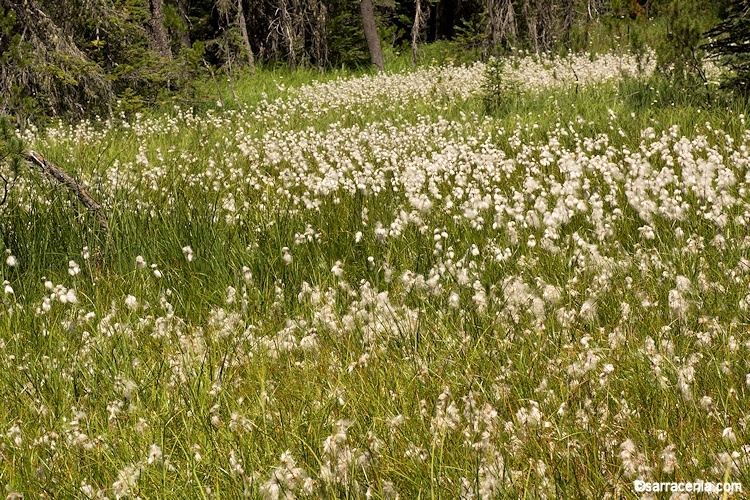
Comments: Sphagnum bogs.

Creative Commons Attribution Non Commercial 3.0 (CC BY-NC 3.0)

© NatureServe

Source: NatureServe

Trusted

Article rating from 0 people

Average rating: 2.5 of 5

Habitat & Distribution

Fruiting summer. Marshes, meadows, bogs, fens, wet woods; 0–2000 m; St. Pierre and Miquelon; Alta., B.C., Man., N.B., Nfld. and Labr., N.W.T., N.S., Ont., P.E.I., Que., Sask.; Alaska, Colo., Conn., Idaho, Ill., Ind., Iowa, Maine, Mass., Mich., Minn., N.H., N.Y., N.Dak., Ohio, Pa., R.I., Vt., Wis., Wyo.
  • Flora of North America @ eFloras.org
Creative Commons Attribution Non Commercial Share Alike 3.0 (CC BY-NC-SA 3.0)

© Missouri Botanical Garden, 4344 Shaw Boulevard, St. Louis, MO, 63110 USA

Source: Missouri Botanical Garden

Trusted

Article rating from 0 people

Average rating: 2.5 of 5

Molecular Biology and Genetics

Molecular Biology

Statistics of barcoding coverage: Eriophorum viridicarinatum

Barcode of Life Data Systems (BOLDS) Stats
Public Records: 1
Species: 2
Species With Barcodes: 1

Creative Commons Attribution 3.0 (CC BY 3.0)

© Barcode of Life Data Systems

Source: Barcode of Life Data Systems (BOLD)

Trusted

Article rating from 0 people

Average rating: 2.5 of 5

Conservation

Conservation Status

National NatureServe Conservation Status

Canada

Rounded National Status Rank: N5 - Secure

United States

Rounded National Status Rank: NNR - Unranked

Creative Commons Attribution Non Commercial 3.0 (CC BY-NC 3.0)

© NatureServe

Source: NatureServe

Trusted

Article rating from 0 people

Average rating: 2.5 of 5

NatureServe Conservation Status

Rounded Global Status Rank: G5 - Secure

Reasons: Patchy widespread distribution in northern North America (especially eastern) with thousands of occurrences.

Creative Commons Attribution Non Commercial 3.0 (CC BY-NC 3.0)

© NatureServe

Source: NatureServe

Trusted

Article rating from 0 people

Average rating: 2.5 of 5

Wikipedia

Eriophorum viridicarinatum

Eriophorum viridicarinatum is a species of sedge known by the common names thinleaf cottonsedge, green-keeled cottongrass, and bog cottongrass. It is native to northern North America, where it occurs in Alaska and throughout much of Canada, its range extending into the northern contiguous United States.[1] Its distribution is more patchy in the west but it is widespread in eastern Canada.[2]

This perennial sedge forms tufts of stiff, erect stems, sometimes just a single stem, and basal leaves up to 30 centimeters long. It grows from a rhizome. The inflorescence is accompanied by two to four leaflike bracts each a few centimeters long. There are up to 30 spikelets, increasing in size as the fruit develops, reaching 3 centimeters in length. Each flower has a tuft of white or brown bristles that are long and cottony, measuring up to 2.5 centimeters long.[1][3]

This plant grows at high latitudes and high elevations, in cold, wet habitat types such as sphagnum bogs and tundra overlying permafrost. It is stimulated to grow in the spring when the thaw begins to increase moisture in the environment.[1]

References

  1. ^ a b c Williams, Tara Y. 1990. Eriophorum viridi-carinatum. In: Fire Effects Information System, [Online]. U.S. Department of Agriculture, Forest Service, Rocky Mountain Research Station, Fire Sciences Laboratory.
  2. ^ Eriophorum viridicarinatum. The Nature Conservancy.
  3. ^ Eriophorum viridicarinatum. Flora of North America.
Creative Commons Attribution Share Alike 3.0 (CC BY-SA 3.0)


Source: Wikipedia

Unreviewed

Article rating from 0 people

Average rating: 2.5 of 5

Disclaimer

EOL content is automatically assembled from many different content providers. As a result, from time to time you may find pages on EOL that are confusing.

To request an improvement, please leave a comment on the page. Thank you!