Overview
Comprehensive Description
Description
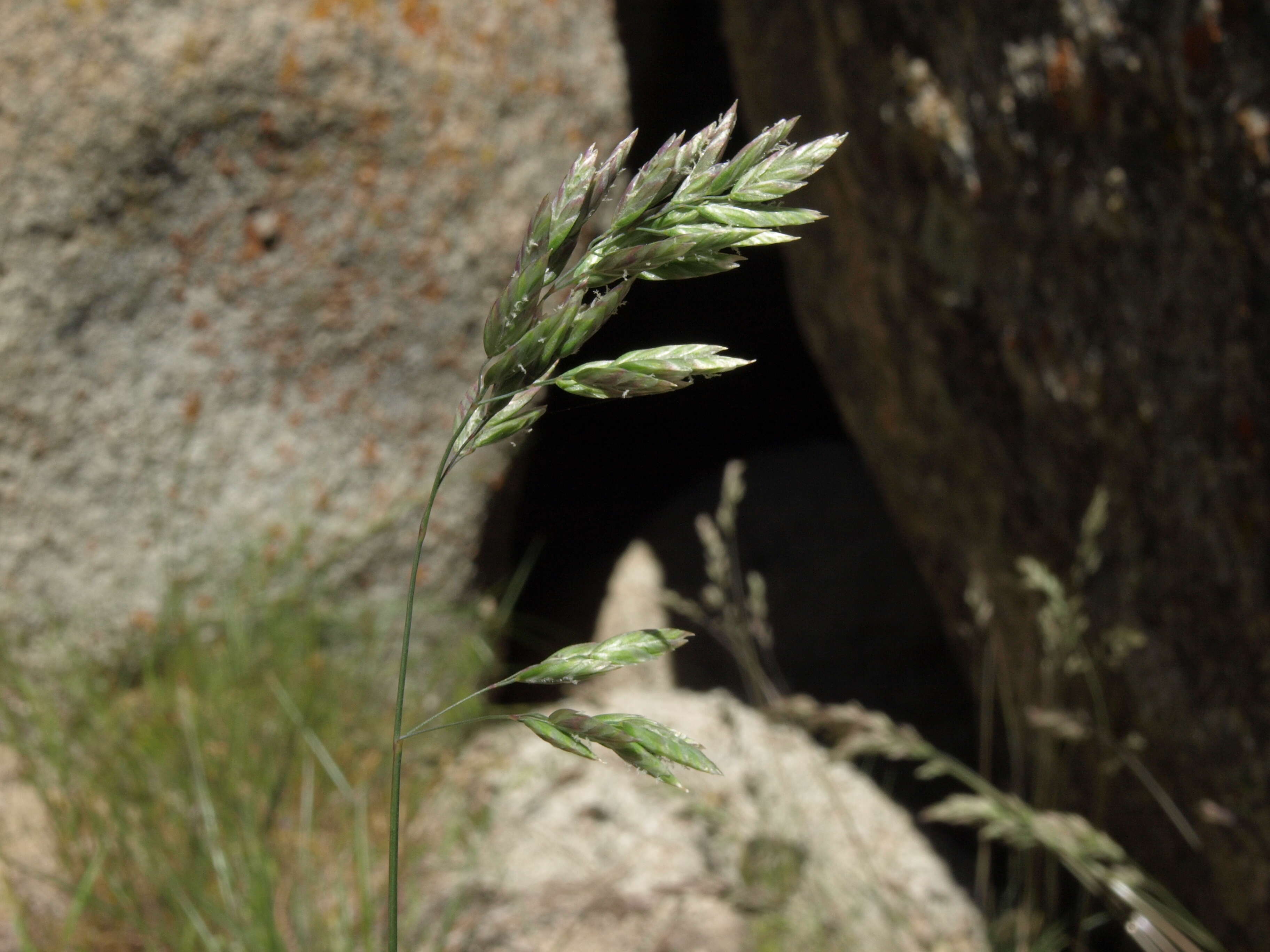
General: Muttongrass is a perennial bunchgrass growing 0.7 to 2.5 feet tall with narrow leaves (1 to 3mm wide). The species is generally considered apomictic (not requiring fertilization for seed production). The flowers are typically pistillate (only female), but occasional staminate (male) flowers arise giving the species the ability to hybridize with other bluegrasses (Welsh and others 2003). Some plants may also reproduce sexually from pollen received from male plants of other bluegrass species (Cronquist and others 1977).
Distribution: For current distribution, consult the Plant Profile page for this species on the PLANTS Web site. Historic records show muttongrass ranges from southern Canada to Texas and east to the Dakotas.
Habitat: Muttongrass is an important late successional understory component in juniper and piñon-juniper communities. Plants can also be found throughout ponderosa pine and into aspen forests and Engelmann spruce-lodgepole pine zones.
Trusted
Alternative names
Early bluegrass, mutton bluegrass, Eragrostis fendleriana, Poa eatoni, P. montana, P. longiligula
Trusted
Distribution
Localities documented in Tropicos sources
Canada (North America)
Mexico (Mesoamerica)
United States (North America)
Note: This information is based on publications available through Tropicos and may not represent the entire distribution. Tropicos does not categorize distributions as native or non-native.
-
Soreng, R. J., G. Davidse, P. M. Peterson, F. O. Zuloaga, E. J. Judziewicz, T. S. Filgueiras & O. Morrone. 2003 and onwards. On-line taxonomic novelties and updates, distributional additions and corrections, and editorial changes since the four published volumes of the Catalogue of New World Grasses (Poaceae) published in Contr. U.S. Natl. Herb. vols. 39, 41, 46, and 48. http://www.tropicos.org/Project/CNWG:. In R. J. Soreng, G. Davidse, P. M. Peterson, F. O. Zuloaga, T. S. Filgueiras, E. J. Judziewicz & O. Morrone Internet Cat. New World Grasses. Missouri Botanical Garden, St. Louis.
http://www.tropicos.org/Reference/1024044
-
Beetle, A. A. 1999. Gram. México 5: 1–466. Secretaria de Agricultura y Recursos Hidraulícos: COTECOCA, México.
http://www.tropicos.org/Reference/1019700
-
Soreng, R. J. 1994. Poa in G. W. Douglas, G. B. Straley, and D. Meidinger (eds.). 129–138. In Vasc. Pl. Brit. Columbia. Research Branch, Ministry of Forests, Victoria.
http://www.tropicos.org/Reference/1001699
-
Soreng, R. J. & T. R. V. Devender. 1989. Late Quarternary fossils of Poa fendeleriana (muttongrass): Holocene expansions of apmicts. SouthW. Naturalist 34: 35–45.
http://www.tropicos.org/Reference/26092
-
Soreng, R. J., L. M. Giussani & M. A. Negritto. 2003. Poa. In Catalogue of New World Grasses (Poaceae): IV. Subfamily Pooideae. Contr. U.S. Natl. Herb. 48: 505–580.
http://www.tropicos.org/Reference/46337
-
Soreng, R. J. 1985. Poa in New Mexico, with a key to middle and southern Rocky Mountain species (Poaceae). Great Basin Naturalist 45: 395–422.
http://www.tropicos.org/Reference/31468
-
Soreng, R. J. & P. M. Peterson. 2012. Revision of Poa L. (Poaceae, Pooideae, Poeae, Poinae) in Mexico: new records, re-evaluation of P. ruprechtii, and two new species, P. palmeri and P. wendtii. PhytoKeys 15: 1–104.
http://www.tropicos.org/Reference/100009492
Trusted
Localities documented in Tropicos sources
Mexico (Mesoamerica)
Note: This information is based on publications available through Tropicos and may not represent the entire distribution. Tropicos does not categorize distributions as native or non-native.
-
SPECIMEN BASED RECORD. Published protolog data.
http://www.tropicos.org/Reference/9990002
Trusted
Localities documented in Tropicos sources
Mexico (Mesoamerica)
Note: This information is based on publications available through Tropicos and may not represent the entire distribution. Tropicos does not categorize distributions as native or non-native.
-
SPECIMEN BASED RECORD. Published protolog data.
http://www.tropicos.org/Reference/9990002
Trusted
Localities documented in Tropicos sources
Mexico (Mesoamerica)
Note: This information is based on publications available through Tropicos and may not represent the entire distribution. Tropicos does not categorize distributions as native or non-native.
-
SPECIMEN BASED RECORD. Published protolog data.
http://www.tropicos.org/Reference/9990002
Trusted
Localities documented in Tropicos sources
Canada (North America)
Mexico (Mesoamerica)
United States (North America)
Note: This information is based on publications available through Tropicos and may not represent the entire distribution. Tropicos does not categorize distributions as native or non-native.
-
Soreng, R. J., G. Davidse, P. M. Peterson, F. O. Zuloaga, E. J. Judziewicz, T. S. Filgueiras & O. Morrone. 2003 and onwards. On-line taxonomic novelties and updates, distributional additions and corrections, and editorial changes since the four published volumes of the Catalogue of New World Grasses (Poaceae) published in Contr. U.S. Natl. Herb. vols. 39, 41, 46, and 48. http://www.tropicos.org/Project/CNWG:. In R. J. Soreng, G. Davidse, P. M. Peterson, F. O. Zuloaga, T. S. Filgueiras, E. J. Judziewicz & O. Morrone Internet Cat. New World Grasses. Missouri Botanical Garden, St. Louis.
http://www.tropicos.org/Reference/1024044
-
Espejo Serna, A., A. R. López-Ferrari & J. Valdés-Reyna. 2000. Poaceae. Monocot. Mexic. Sinopsis Floríst. 10: 7–236 [and index].
http://www.tropicos.org/Reference/1015183
-
Beetle, A. A. 1977. Noteworthy grasses from Mexico V. Phytologia 37(4): 317–407.
http://www.tropicos.org/Reference/2538
-
Gould, F. W. & R. Moran. 1981. The grasses of Baja California, Mexico. Mem. San Diego Soc. Nat. Hist. 12: 1–140.
http://www.tropicos.org/Reference/11232
-
Beetle, A. A. 1999. Gram. México 5: 1–466. Secretaria de Agricultura y Recursos Hidraulícos: COTECOCA, México.
http://www.tropicos.org/Reference/1019700
-
Soreng, R. J. 1994. Poa in G. W. Douglas, G. B. Straley, and D. Meidinger (eds.). 129–138. In Vasc. Pl. Brit. Columbia. Research Branch, Ministry of Forests, Victoria.
http://www.tropicos.org/Reference/1001699
-
Correll, D. S. & M. C. Johnston. 1970. Man. Vasc. Pl. Texas i–xv, 1–1881. The University of Texas at Dallas, Richardson.
http://www.tropicos.org/Reference/1493
-
Great Plains Flora Association. 1986. Fl. Great Plains i–vii, 1–1392. University Press of Kansas, Lawrence.
http://www.tropicos.org/Reference/637
-
Munz, P. A. & D. D. Keck. 1959. Cal. Fl. 1–1681. University of California Press, Berkeley.
http://www.tropicos.org/Reference/1717
-
Munz, P. A. 1974. Fl. S. Calif. 1–1086. University of California Press, Berkeley.
http://www.tropicos.org/Reference/1719
-
Soreng, R. J., L. M. Giussani & M. A. Negritto. 2003. Poa. In Catalogue of New World Grasses (Poaceae): IV. Subfamily Pooideae. Contr. U.S. Natl. Herb. 48: 505–580.
http://www.tropicos.org/Reference/46337
-
Soreng, R. J. 1985. Poa in New Mexico, with a key to middle and southern Rocky Mountain species (Poaceae). Great Basin Naturalist 45: 395–422.
http://www.tropicos.org/Reference/31468
-
Peterson, P. M., R. J. Soreng & Y. Herrera Arrieta. 2006. Poa matri-occidentalis (Poaceae: Pooideae: Poeae: Poinae), a new species from Mexico. Sida 22(2): 905–914.
http://www.tropicos.org/Reference/1030331
-
Cronquist, A. J., A. H. Holmgren, N. H. Holmgren & Reveal. 1977. Vascular Plants of the Intermountain West, U.S.A. 6: 1–584. In A. J. Cronquist, A. H. Holmgren, N. H. Holmgren, J. L. Reveal & P. K. Holmgren (eds.) Intermount. Fl. Hafner Pub. Co., New York.
http://www.tropicos.org/Reference/1725
-
Soreng, R. J. & P. M. Peterson. 2012. Revision of Poa L. (Poaceae, Pooideae, Poeae, Poinae) in Mexico: new records, re-evaluation of P. ruprechtii, and two new species, P. palmeri and P. wendtii. PhytoKeys 15: 1–104.
http://www.tropicos.org/Reference/100009492
Trusted
National Distribution
Canada
Origin: Unknown/Undetermined
Regularity: Regularly occurring
Currently: Unknown/Undetermined
Confidence: Confident
United States
Origin: Unknown/Undetermined
Regularity: Regularly occurring
Currently: Unknown/Undetermined
Confidence: Confident
Trusted
Adaptation
Muttongrass is among the most drought tolerant bluegrasses and should be considered for restoration and native diversification projects in western states. It is limited in its use however due to its low seed viability.
This species performs best on well-drained clay loams but is also found in drier, less fertile, gravelley and sandy soils (USDA 1937). Muttongrass is adapted to sites receiving 10 to 22 inches annual precipitation. In the northern extent of its range, muttongrass occupies lower elevation plant communities while it is found at higher elevations to the south.
Muttongrass has shown limited tolerance to fire. Some evidence indicates that muttongrass stands have responded well following fires (Gartner and others 1978) while others have observed stands being damaged.
Trusted
Physical Description
Morphology
Physical Description
Trusted
Type Information
Catalog Number: US 278727
Collection: Smithsonian Institution, National Museum of Natural History, Department of Botany
Verification Degree: Original publication and alleged type specimen examined
Preparation: Pressed specimen
Collector(s): M. E. Jones
Year Collected: 1894
Locality: Silver Reef; 3500 ft., Utah, United States, North America
Elevation (m): 1067 to 1067
- Holotype: Scribner, F. L. & Williams, T. A. 1899. U.S.D.A. Div. Agrostol. Circ. 9: 3.
Trusted
Catalog Number: US 257401
Collection: Smithsonian Institution, National Museum of Natural History, Department of Botany
Verification Degree: Card file verified by examination of alleged type specimen
Preparation: Pressed specimen
Collector(s): G. Breninger
Year Collected: 1891
Locality: Table Rock., Colorado, United States, North America
Elevation (m): 2200 to 2200
- Isotype: Scribner, F. L. & Williams, T. A. 1899. U.S.D.A. Div. Agrostol. Circ. 9: 2.
Trusted
Catalog Number: US 556790
Collection: Smithsonian Institution, National Museum of Natural History, Department of Botany
Preparation: Pressed specimen
Collector(s): E. Harbor & J. Harbour
Year Collected: 1862
Locality: Rocky Mts., Colorado, United States, North America
- Isotype: Williams, T. A. 1899. U.S.D.A. Div. Agrostol. Circ. 10: 5.
Trusted
Catalog Number: US 556784
Collection: Smithsonian Institution, National Museum of Natural History, Department of Botany
Preparation: Pressed specimen
Collector(s): J. Wolfe
Year Collected: 1873
Locality: Colorado, United States, North America
- Isotype: Wheeler, G. M. 1878. Rep. U.S. Geogr. Surv. Meridian. 6: 290.
Trusted
Catalog Number: US 923084
Collection: Smithsonian Institution, National Museum of Natural History, Department of Botany
Preparation: Pressed specimen
Collector(s): J. Wolfe
Locality: Twin Lakes., Lake, Colorado, United States, North America
- Isotype: Wheeler, G. M. 1878. Rep. U.S. Geogr. Surv. Meridian. 6: 290.
Trusted
Catalog Number: US 2891469
Collection: Smithsonian Institution, National Museum of Natural History, Department of Botany
Verification Degree: Card file verified by examination of alleged type specimen
Preparation: Pressed specimen
Collector(s): A. Fendler
Year Collected: 1847
Locality: New Mexico, United States, North America
- Isotype: Steudel, E. G. von. 1853. Syn. Pl. Glumac. 1: 278.
Trusted
Catalog Number: US 922024
Collection: Smithsonian Institution, National Museum of Natural History, Department of Botany
Verification Degree: Original publication and alleged type specimen examined
Preparation: Pressed specimen
Collector(s): M. E. Jones
Year Collected: 1894
Locality: Silver Reef., Utah, United States, North America
Elevation (m): 1067 to 1067
- Isotype: Scribner, F. L. & Williams, T. A. 1899. U.S.D.A. Div. Agrostol. Circ. 9: 3.
Trusted
Catalog Number: US 556781
Collection: Smithsonian Institution, National Museum of Natural History, Department of Botany
Preparation: Pressed specimen
Collector(s): H. H. Rusby
Year Collected: 1883
Locality: Yavapai Creek., Arizona, United States, North America
- Isotype: Williams, T. A. 1899. U.S.D.A. Div. Agrostol. Circ. 10: 5.
Trusted
Catalog Number: US 824661
Collection: Smithsonian Institution, National Museum of Natural History, Department of Botany
Preparation: Pressed specimen
Collector(s): H. H. Rusby
Year Collected: 1883
Locality: Yavapai, Arizona, United States, North America
- Isotype: Williams, T. A. 1899. U.S.D.A. Div. Agrostol. Circ. 10: 5.
Trusted
Ecology
Dispersal
Establishment
Plant in late fall (dormant) with a pure seeding rate of 2 lb PLS/acre. If seeding as part of a mix, adjust seeding rate to the desired percentage of the mixture. Seed should be planted with a drill ¼ inch deep, into a firm, weed-free seedbed or seed can be broadcast followed with a cultipacker or harrow operation to provide a shallow covering of soil.
Trusted
Molecular Biology and Genetics
Molecular Biology
Statistics of barcoding coverage: Poa fendleriana
Public Records: 0
Specimens with Barcodes: 3
Species With Barcodes: 1
Trusted
Conservation
Conservation Status
National NatureServe Conservation Status
Canada
Rounded National Status Rank: NNR - Unranked
United States
Rounded National Status Rank: NNR - Unranked
Trusted
Status
Consult the PLANTS Web site and your State Department of Natural Resources for this plant’s current status (e.g. threatened or endangered species, state noxious status, and wetland indicator values).
Trusted
Threats
Pests and potential problems
There are no known pests of muttongrass; however, plants may, like other bluegrass species, be susceptible to stem rust.
Trusted
Management
Cultivars, improved and selected materials (and area of origin)
There are no releases currently available. Wildland collected seed can be obtained through commercial vendors.
The Aberdeen, Idaho Plant Materials Center is currently evaluating accessions for potential release. Contact your local Natural Resources Conservation Service (formerly Soil Conservation Service) office for more information. Look in the phone book under ”United States Government.” The Natural Resources Conservation Service will be listed under the subheading “Department of Agriculture.”
Trusted
Seed production
Plant in early spring into a firm, weed-free seedbed at 24 to 36” spacing. Plants require 30 lb/ac available nitrogen during the establishment year and 45 lb/ac available nitrogen on established fields. Apply phosphorus according to soil test recommendations. For establishment, irrigate to maintain a moist soil surface and to avoid soil crusting. On established fields irrigate in early spring through boot stage. Do not irrigate during pollination or seed ripening. Irrigate after harvest to promote growth.
Harvest by direct combining in late May through mid-June. Muttongrass is very susceptible to seed shatter and timing of harvest is critical. Seed should be dried to approximately 10% moisture before cleaning and storage. Seed can be cleaned by lightly hammer milling followed with a clipper or air screen cleaner.
Yields for irrigated production fields average about 35 lb/acre but vary widely from year to year. Stands produce seed for up to 8 years. Low viability in seed prevents muttongrass from being more widely used. There are approximately 890,000 seeds/pound.
Trusted
Environmental concerns
Muttongrass is a species native to the western United States and is not considered a weedy or invasive species, but it can spread to adjoining vegetative communities under ideal environmental conditions.
Trusted
Weed control in seed production fields can be achieved by between-row cultivation but may require some hand weeding during the first growing season because seedlings are very small. After plants reach the 3 to 5 leaf stage, broadleaf herbicides can be applied at low rates.
Trusted
Relevance to Humans and Ecosystems
Benefits
Uses
Forage: Muttongrass is a good source of forage and has been rated as excellent forage for cattle and horses, and good for sheep, elk and deer (USDA 1937). During the winter, seedheads are eaten by pronghorn antelope. Seeds and leaves are also utilized by birds.
Erosion control: The fibrous root system of this species reaches a depth of approximately 10 inches providing good surface erosion control in arid sites.
Native species restoration: Muttongrass has been used sparingly to improve diversity in sagebrush and piñon-juniper communities. It can be used to restore areas where juniper encroachment has depleted the herbaceous understory following juniper removal. The species is drought tolerant and has potential for use in restoration and native diversification projects throughout the West.
Trusted
Wikipedia
Poa fendleriana
Poa fendleriana is a species of grass known by the common name muttongrass. It is native to western North America, where its distribution extends from western Canada to northern Mexico.[1][2]
This species is a perennial grass with small rhizomes. The stems grow up to 70 centimeters tall.[1] The dead sheath bases remain on the plant for a long time.[2] The narrow panicle has up to 8 erect branches crowded with spikelets. One inflorescence may have over 100 spikelets. The plant is dioecious, with male and female flowers on separate plants. Some populations lack male plants, while others are able to reproduce sexually.[1] Asexual reproduction is more common than sexual, and most populations are all female. These produce seed without fertilization by pollen. The sexually reproducing populations are usually found in warmer climates with summer precipitation, while the all-female populations can tolerate colder climates and a wider range of elevations.[2]
This is a common grass in western North America. It grows in many types of habitat, including sagebrush, oak woodlands, pinyon-juniper woodlands, desert grassland, and coniferous forest. The grass often grows in dry areas, but it can occur in moist habitat, such as riversides. It can grow on many soil types. It occurs mainly on open sites or in partial shade; it does not tolerate the full shade of a closed canopy. It is a dominant plant species in several types of habitat.[2]
This grass is a "good to excellent forage for livestock" and wild animals,[2] feeding cattle, horses, sheep, elk, deer, and pronghorn.[3]
The fibrous root system helps to control erosion of the soil.[2][3] It is tolerant of drought[3] and grazing.[2]
References
- ^ a b c Poa fendleriana. Grass Manual Treatment.
- ^ a b c d e f g Howard, Janet L. 1997. Poa fendleriana. In: Fire Effects Information System, [Online]. U.S. Department of Agriculture, Forest Service, Rocky Mountain Research Station, Fire Sciences Laboratory.
- ^ a b c Poa fendleriana. USDA NRCS Plant Guide.
Unreviewed
Disclaimer
EOL content is automatically assembled from many different content providers. As a result, from time to time you may find pages on EOL that are confusing.
To request an improvement, please leave a comment on the page. Thank you!