Overview
Distribution
Localities documented in Tropicos sources
United States (North America)
Note: This information is based on publications available through Tropicos and may not represent the entire distribution. Tropicos does not categorize distributions as native or non-native.
-
Anonymous. 1986. List-Based Rec., Soil Conserv. Serv., U.S.D.A. Database of the U.S.D.A., Beltsville.
http://www.tropicos.org/Reference/1103
-
Cronquist, A. J., A. H. Holmgren, N. H. Holmgren & Reveal. 1977. Vascular Plants of the Intermountain West, U.S.A. 6: 1–584. In A. J. Cronquist, A. H. Holmgren, N. H. Holmgren, J. L. Reveal & P. K. Holmgren (eds.) Intermount. Fl. Hafner Pub. Co., New York.
http://www.tropicos.org/Reference/1725
Trusted
National Distribution
United States
Origin: Native
Regularity: Regularly occurring
Currently: Present
Confidence: Confident
Type of Residency: Year-round
Trusted
Global Range: Aase's onion is endemic to southwestern Idaho, occurring in the foothills around Boise and arcing northwest to near Emmett, an aerial distance of approximately 18 miles. In the Boise Foothills, the easternmost populations are known from the Hulls Gulch and lower Cottonwood Creek areas, while the Freezeout Hill vicinity near Emmett contains the westernmost foothill populations. Disjunct populations have recently been confirmed from near the towns of Payette and Weiser, northwest of the species main range. Populations previously reported from the Danskin Mountains, east of Boise are really Allium simillimum. Populations are located in Ada, Boise, Gem, Payette, and Washington Counties.
Trusted
Physical Description
Morphology
Description
Trusted
Diagnostic Description
There are several onion species occurring within and near the range of Allium aaseae. Allium aaseae is most likely to be confused with A. simillimum, especially at mid-elevations in the Boise Foothills, where their distributions nearly overlap. Populations with purple-mottled anthers may actually be hybrids between the two species. The following key, adopted from McNeal's (1993) key to the onions of southwestern Idaho, can be used to distinguish the two:
Allium simillimum. Perianth segments white with green or reddish midveins, sometimes flushed with pink; anthers purple or mottled purple and white, pollen white or grayish; denticulations, particularly on the inner perianth segments obvious under a hand lens and regularly distributed on the distal 2/3 of the segment; occurring above 4200 feet elevation on various substrates.
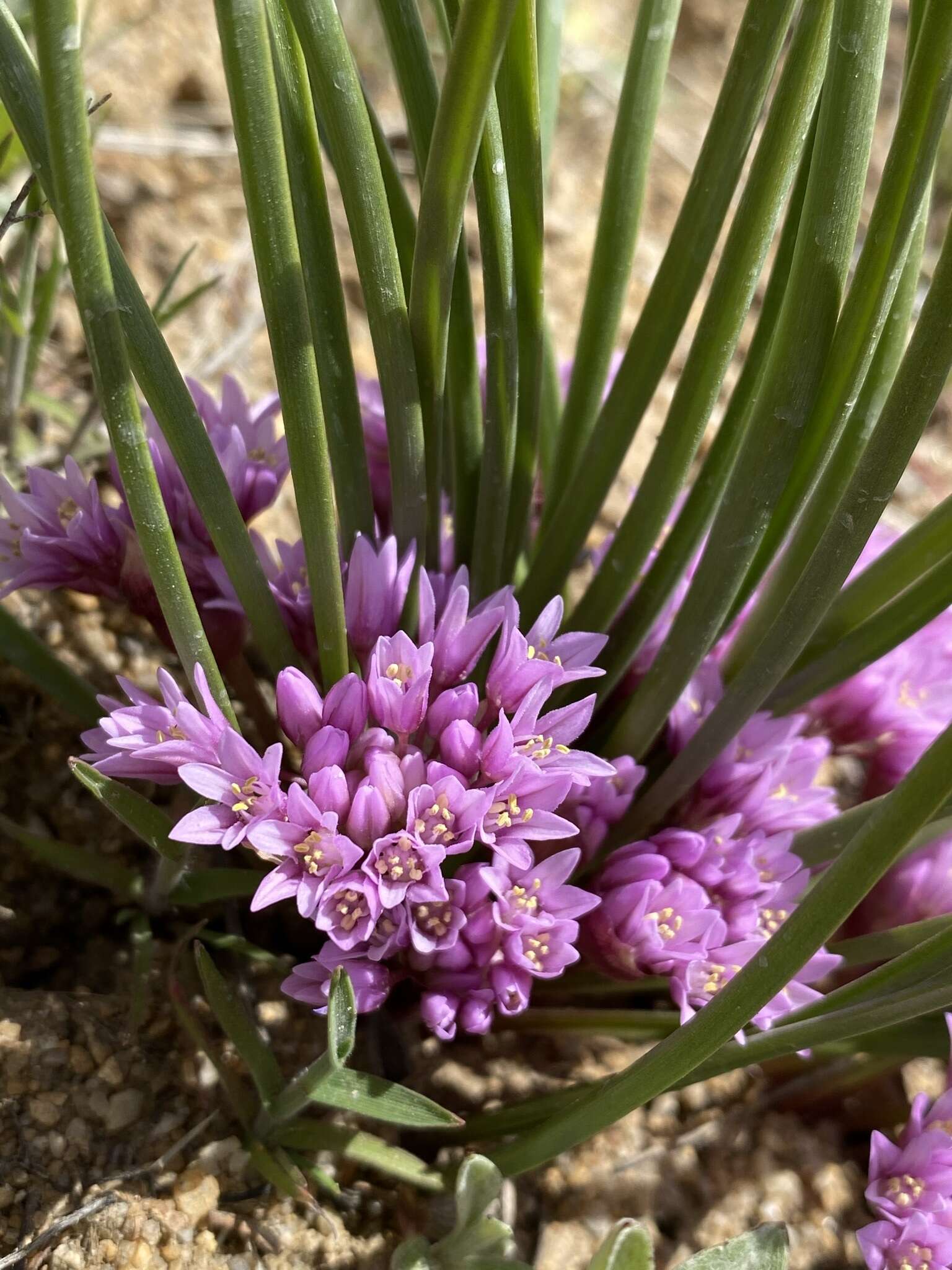
Allium aaseae. Perianth segments bright pink with rarely a white individual in an otherwise pink population; anthers yellow, pollen yellow, denticulations +/- irregular in number and distribution on perianth segments, often missing on plants from Rebecca Sand Hills RNA; usually restricted to lacustrine sands of the Glenns Ferry Formation, generally below 3700 ft., except in Cartwright Canyon where occurring up to 5100 ft. elevation.
Trusted
Ecology
Habitat
Comments: Aase's onion is restricted to a narrow range of habitat conditions. It occurs on open, relatively barren, xeric, gentle to very steep, sandy slopes, generally with a southerly aspect, but ranging from east to west. It is usually associated with relatively sparsely vegetated bitterbrush (Purshia tridentata) or bitterbrush/sagebrush (Artemisia tridentata) communities. One or several bunchgrasses such as red threeawn (Aristida longiseta), bluebunch wheatgrass (Agropyron spicatum), squirreltail (Sitanion hystrix), needle-and-thread (Stipa comata), Sandberg's bluegrass (Poa sandbergii), Indian ricegrass (Oryzopsis hymenoides) and sand dropseed (Sporobolus cryptandrus) are often closely associated. Aase's onion sites are often bordered by Artemisia tridentata ssp. wyomingensis or ssp. tridentata/bunchgrass- dominated communities. Commonly associated species Eriophyllum lanatum, Balsamorhiza sagittata, Achillea millefolium, Phacelia heterophylla, and Eriogonum ovalifolium. A number of exotic species may be abundant, especially Bromus tectorum, Erodium cicutarium and Taeniatherum caput-medusae. Allium aaseae populations in the Boise Foothills often occur in close proximity to Astragalus mulfordiae, and/or Lepidium papilliferum, two other rare, regional endemic plants. These three rare species largely share the same conservation concerns and problems. On a local scale, Allium aaseae can be very common. At some sites it is one of the dominant forbs in early spring. When considering its sagebrush-bitterbrush/steppe and foothill grassland habitats rangewide, however, it is a minor constituent. Most populations are restricted to the alluvial soils of the Glenns Ferry Formation. This sandy substrate is of granitic origin and typically coarse textured, well-drained and relatively deep (Packard 1979; Prentice 1988). In the Boise Foothills, all populations occur on one of three sand-dominated geologic units - Pierce Gulch Formation Sand, Terteling Springs Formation Sand and Sandstone, and Terteling Springs Formation Sandy Sediments (Beck 1988). A large majority of Boise Foothill populations occur on three soil mapping units of Beck (1988): Quincy-Lankbush complex, Payette-Quincy complex, and Haw-Lankbush complex. Rarely, populations or portions of populations occur on other soil types, namely, Lankbush-Brent sand loam, Ada gravelly sand, and Searless-Rock outcrop complex. All known populations except for the two in Cartwright Canyon occur between 2700-4300 feet elevation, with the great majority below 3700 feet. Cartwright Canyon populations occur at 4950 and 5100 feet, and possibly indicate that soil characteristics such as texture are more important than elevation in determining the distribution of Allium aaseae (McNeal 1993).
Trusted
Population Biology
Number of Occurrences
Note: For many non-migratory species, occurrences are roughly equivalent to populations.
Estimated Number of Occurrences: 21 - 80
Comments: 29 recently seen.
Trusted
General Ecology
There is little quantitative data regarding the effects of herbivores, disease, competition, hybridization or allelopathy on population viability. No native plant species appear to substantially compete with Allium aaseae for moisture, and only red three-awn seems to compete for space (Prentice 1988). Two exotic winter annuals, cheatgrass and storksbill, apparently are important interspecific competitors. Vigor of Allium aaseae populations can be reduced where these weeds are prolific (Prentice 1988). Livestock grazing on Allium aaseae is minimal, although indirect effects, such as habitat degradation and trampling are more serious. Deer have been observed feeding on Allium aaseae in early spring and chukars are known to eat bulbs later in the spring. The most serious insect pest seems to be an unknown seed predator that bores into and devours inner portions of the seed (Prentice 1988). A rust is common on populations in the Woods Gulch area, and maybe other places as well. The deep-seated bulb of Allium aaseae would survive wildfires. Hybridization and introgression are likely occurring between Allium aaseae and the more widespread A. simillimum (Smith 1995).
Trusted
Life History and Behavior
Cyclicity
Reproduction
Allium aaseae reproduces from both seed and bulb division. Seed viability from different sites is variable, as is often the case in wild pant populations. The mean viability from four sites studied by Prentice (1988) was 55%. The number of seeds per pound is estimated to be 622,000 (Prentice 1988). Seed production is also variable from year to year (Prentice 1989). The pollination biology of Allium aaseae is unknown, although it has been reported to have no specific pollinators, and flowers visited by many types of insects (Bolin and Rosentreter 1986). This species flowers early in the season and likely makes use of any insect taxa active at this time of year. Seed dispersal mechanisms are unknown, but probably at least partly relies on the dried, detached umbel being blown around (Packard 1979).
Trusted
Conservation
Conservation Status
National NatureServe Conservation Status
United States
Rounded National Status Rank: N3 - Vulnerable
Trusted
NatureServe Conservation Status
Rounded Global Status Rank: G3 - Vulnerable
Reasons: Although there are nearly 30 known sites, all but a few face direct threats.
Trusted
Threats
Comments: All but a few known sites directly threatened by dirt bikes, mining, ORVs, grazing, and/or housing developments.
Trusted
Management
Biological Research Needs: Clarification of taxonomic status.
Trusted
Relevance to Humans and Ecosystems
Benefits
Notes
Comments
Trusted
Disclaimer
EOL content is automatically assembled from many different content providers. As a result, from time to time you may find pages on EOL that are confusing.
To request an improvement, please leave a comment on the page. Thank you!