Articles on this page are available in 1 other language: Arabic (13) (learn more)
Overview
Brief Summary
- Wikipedia contributors, "American cockroach," Wikipedia, The Free Encyclopedia, http://en.wikipedia.org/w/index.php?title=American_cockroach&oldid=365693184 (accessed June 18, 2010).Frederic Gomes Cassidy; Joan Houston Hall (2002). Dictionary of American regional English (illustrated ed.). Harvard University Press. p. 20. ISBN 9780674008847. http://books.google.com/books?id=i33BWgxbvXgC.
Trusted
Distribution
Geographic Range
The American Cockroach, despite its name, is not native to North America but was most probably introduced via ships from Africa. It is currently worldwide in distribution.
(Smith & Whitman, 1992)
Biogeographic Regions: nearctic (Introduced ); palearctic (Introduced , Native ); oriental (Introduced ); ethiopian (Native ); neotropical (Introduced ); australian (Introduced )
Other Geographic Terms: cosmopolitan
Trusted
Physical Description
Morphology
Physical Description
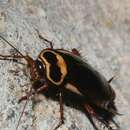
Periplaneta americana adults are about 1 3/8 to 2 1/8 inches (34-53 mm) long. Their color is a reddish brown except for a submarginal pale brown to yellowish band around the edge of their pronotal shield (Pronotal shield - an expanded version of the top surface plate of the front segment of the thorax). Both sexes are fully winged. The wings of males extend beyond the tip of the abdomen, while females' do not. They are poor to moderately good fliers.
Early instars of P. americana nymphs are uniformly grayish brown dorsally, paler ventrally, and shiny. The cerci (cercus [pl. cerci]- One of a pair of dorsal appendages at the posterior end of the abdomen) are slender, and distinctly tapered from the base with length about 5 times the width. Later instars are reddish brown with lateral and posterior margins of the thorax and lateral areas (sides) of abdominal segments somewhat darker. The cerci are about the same as in the early instars. The widest segments are 2.5 times as wide as long. The antennae are uniformly brown.
The cockroach's walking pattern can be described as follows:
"The cyclic movement of a walking leg consists of two parts, the power stroke (also stance phase or support phase) and the return stroke (also swing phase or recovery phase). During the power stroke, the leg is on the ground where it can support and propel the body. In a forward-walking animal, this corresponds to a retraction movement of the leg. During the return stroke, the leg is lifted off the ground and swung to the starting position for the next power stroke."
(Cruse 1990; Cochran 1980; Smith & Whitman 1992; Bio-Serv 1998)
Trusted
Ecology
Habitat
Habitat
P. americana is found in many different habitats. Although they generally live in moist areas, they can survive in dry areas if they have access to water. They prefer warm temperatures around 84 degrees Fahrenheit and do not tolerate cold. They die at temperatures below 15 degrees Fahrenheit. These criteria are often met in large commercial buildings such as restaurants, bakeries, grocery stores, food processing plants, hospitals, etc., where cockroaches may infest food-storage and food-preparation areas, basements, and steam tunnels. They are also found, although not as commonly, in residences. During the summer months, they can be found outdoors in yards and alleys. In the United States this is the most common species found in city sewer systems. They can enter structures by being brought in, coming up from the sewer system via drains, or occasional mass migration from other structures, dumps, etc., during warm weather.
(Cochran, 1980; Smith & Whitman, 1992)
Terrestrial Biomes: savanna or grassland ; forest ; rainforest ; scrub forest
Trusted
Trophic Strategy
Food Habits
Roaches themselves will eat anything, including one another. There is very little organic material that a cockroach won't eat. The list includes bark, leaves, paper, wool clothes, sugar, cheese, bread, oil, lemons, ink, soap, flesh, fish, leather, other roaches (dead or alive), or their own cast-off skins and egg-capsules. Some of these items, such as cellulose, can not be digested by normal means. However, like cows and other grazing animals, cockroaches have a symbiotic relationship with a bacteria that allows them to digest such substances. Although they feed on many kinds of food, they show a particular fondness for fermenting food.
(Helfer, 1972; Boraiko, 1981)
Trusted
Associations
Associations
cyst of Gregarina blattarum endoparasitises intestine of Periplaneta americana
Animal / parasite / endoparasite
Hammerschmidtiella diesingi endoparasitises intestine of Periplaneta americana
Animal / parasite / endoparasite
Leidynema appendiculata endoparasitises intestine of Periplaneta americana
Animal / parasite / endoparasite
Nyctotherus ovalis endoparasitises intestine of Periplaneta americana
Trusted
Life History and Behavior
Reproduction
Reproduction
Female P. americana produce many different sex pheromones to attract a suitable mate. Examples of these attractive chemicals include periplanone-B, periplanone-A, germacradien-9-one, cresol, phenol, undecen, hexenal, cyclohexanedial, hexanoic acid, dodecalactone, pentanone, and octanone. Sperm transfer occurs through the use of a spermatophore, which is sometimes eaten by the female because of its protein-rich nature. (Spermatophore- Capsule or packet enclosing sperm, produced by males of several invertebrate groups and a few vertebrates). Once fertilization has occurred, a female forms oothecae, or egg sacs. Parthenogenesis or egg production without fertilization does occur, but eggs either fail to hatch, or produce only a few nymphs. The ootheca is a dark reddish to blackish brown; about 3/8" (8 mm) long, with length about1.5 times the width. The female deposits her ootheca within a few hours or up to 4 days after it is formed. It is dropped or glued with an oral secretion to a suitable surface, usually in a crack or crevice of high relative humidity near a food source.
On average, females produce 9-10 (range 6-14; maximum 90) oothecae, each containing 14-16 eggs. Developmental time (egg to adult) is greatly influenced by temperature, varying from 168-786+ days but averaging about 600 days under ordinary room conditions. During this time, they molt 10-13 times. Adult females live about 440 days (range 102-588; maximum 913) at ordinary room conditions(e.g. 70°F/20°C), but at 84°F/29°C, adult females live about 225 days (range 90-706), whereas adult males live about 200 days (range 90-362) at 84°F/29°C.
The development of P. americana is hemimetabolous, meaning there is no major metamophosis. The nymphs look very much like small adults.
Nymphs are given no parental care; hatchling roaches are left to fend for themselves. The nymph grows by molting and it goes through about 13 molts before it reaches the adult form. The next to last nymphal stage has wing pads, but only adult cockroaches have wings.
(Bell, 1981; Smith & Whitman, 1992)
Trusted
Evolution and Systematics
Functional Adaptations
Functional adaptation
The cuticle of cockroaches allows temperature-controlled variability of moisture loss via a waxy coat.
"It was shown by Ramsay (1935) that the cockroach owes its impermeability to water to a thin and apparently mobile layer of lipoid on its surface. At a critical temperature of about 30° C. this lipoid seems to undergo a change of phase, and it then allows water to pass freely through it. This interesting observation has never been confirmed on other insects. It forms the starting-point of the present study." (Wigglesworth 1945:97)
Learn more about this functional adaptation.
- Wigglesworth, V. B. 1945. Transpiration Through the Cuticle of Insects. Journal of Experimental Biology. 21(3): 97-114.
Trusted
Molecular Biology and Genetics
Molecular Biology
Barcode data: Periplaneta americana
There are 3 barcode sequences available from BOLD and GenBank. Below is a sequence of the barcode region Cytochrome oxidase subunit 1 (COI or COX1) from a member of the species. See the BOLD taxonomy browser for more complete information about this specimen and other sequences.
-- end --
Download FASTA File
Trusted
Statistics of barcoding coverage: Periplaneta americana
Public Records: 2
Species: 22
Species With Barcodes: 1
Trusted
Conservation
Conservation Status
Conservation Status
This species is considered a pest, and there are no efforts being made to conserve it.
US Federal List: no special status
CITES: no special status
State of Michigan List: no special status
Trusted
Relevance to Humans and Ecosystems
Benefits
Economic Importance for Humans: Negative
This species is harmful to humans, and its impact on human health and economies is substantial. The greatest potential harm is an agent for disease transmission. American cockroaches can transmit a variety of bacterial diseases by feeding on contaminated material, and then contacting people's food. Cockroaches are also the fourth most common allergen. 50-60% of all atopic and asthmatic people show intense reactions to cockroach extract. Sensitivity to cockroach allergens may be as high as 79% in asthmatic children in severely infested homes. The species also has a psychological impact on humans, causing anxiety and stress due to embarrassment and physical invasion (Bio-Serv 1998; Cochran 1980).
Trusted
Wikipedia
American cockroach
The American cockroach (Periplaneta americana), also known as the waterbug,[1] or misidentified as the palmetto bug (see Florida woods cockroach for the differences), is the largest species of common cockroach, and often considered a pest. None of the Periplaneta species are endemic to the Americas; despite the name, P. americana was introduced to the United States from Africa as early as 1625.[2] They are now common in tropical climates because human activity has extended the insect's range of habitation, and global shipping has transported the insects to world ports including the Southern United States, Tenerife, southern Spain, Greece, Taiwan, and Cape Town and Durban, South Africa.
Contents |
Characteristics
American cockroach adults grow to an average length of around 4 centimetres (1.6 in) and about 7 millimetres (0.28 in) tall.[3] They are reddish brown and have a yellowish margin on the body region behind the head. Immature cockroaches resemble adults except that they are wingless.
The insect can travel quickly, often darting out of sight when someone enters a room, and can fit into small cracks and under doors despite its fairly large size. It is considered one of the fastest running insects.[4]
In an experiment carried out at the University of California, Berkeley in 1991, a Periplaneta americana registered a record speed of 5.4 kilometres per hour (3.4 mph), about 50 body lengths per second, which would be comparable to a human running at 330 kilometres per hour (210 mph).[5][6]
It has a pair of large compound eyes each having over 2000 individual lenses, and is a very active night insect that shuns light.
Many people find this cockroach disgusting and terrifying, but aside from being a general nuisance, they are in fact harmless to humans. They do not bite and are not poisonous.
Habitat
American cockroaches generally live in moist areas, but can survive in dry areas if they have access to water. They prefer warm temperatures around 29 °C (84 °F) and do not tolerate cold temperatures. In residential areas, these cockroaches live in basements and sewers, and may move outdoors into yards during warm weather. These cockroaches are common in basements, crawl spaces, cracks and crevices of porches, foundations, and walkways adjacent to buildings.
The American cockroach is a scavenger that feeds on decaying organic matter and a variety of other foods. It is particularly fond of fermenting foods.[7]
Life cycle
Females produce an egg case called an ootheca which protrudes from the tip of the abdomen. After about two days, the egg cases are placed on a surface in a safe location. Egg cases are about 0.9 centimetres (0.35 in) long, brown, and purse shaped. Immature cockroaches emerge from egg cases in 6 to 8 weeks and require 6 to 12 months to mature. Adult cockroaches can live up to one year, during which females produce an average of 150 young.
Control
Due to their large size and slow development, large infestations of these insects are not common within houses. However, during certain times of the year, these cockroaches may move inside a house from outside. In cold weather these cockroaches may move indoors, seeking warmer temperatures and food. Cockroaches may enter houses through sewer connections, under doors, around plumbing, air ducts, or other openings in the foundation.[8] Cockroach populations may be controlled through the use of insecticides.
Comparison of three common roaches
| Roach | German cockroach | Oriental cockroach | American cockroach |
| Size | 12 mm (0.47 in) to 15 mm (0.59 in) | 25 mm (0.98 in) to 30 mm (1.2 in) | 28 mm (1.1 in) to 43 mm (1.7 in) |
| Habitat | Heated buildings, optimum 32 °C (90 °F) | 20 °C (68 °F) to 29 °C (84 °F) | Same as German |
| Nymphal development time | 6 to 12 weeks | 6 to 12 months | 6 to 12 months |
| Life Span | 6 to 9 months | 1 to 1.5 years | 1 to 2 years |
| Able to fly? | No | No | Yes |
See also
- Periplanone B - American cockroach pheromone
- Mouse, another ubiquitous and commonly-loathed pest
References
- ^ Cassidy, Frederic Gomes; Hall, Joan Houston (2002). Dictionary of American Regional English (illustrated ed.). Harvard University Press. p. 20. ISBN 978-0-674-00884-7. http://books.google.com/?id=i33BWgxbvXgC.
- ^ Bell, W.J.; Adiyodi, K.G. (1981). The American Cockroach. London: Chapman and Hall. ISBN 978-0412161407.
- ^ Barbara, Kathryn A. (2008). "American cockroach - Periplaneta americana (Linnaeus)". http://entomology.ifas.ufl.edu/creatures/urban/roaches/american_cockroach.htm. Retrieved 2008-07-10.
- ^ Merritt, Thomas M. (July 31, 1999). "Chapter 39 — Fastest Runner". Book of Insect Records. University of Florida. http://entomology.ifas.ufl.edu/walker/ufbir/chapters/chapter_39.shtml.
- ^ Shukolyukov, S.A. (September 27, 2001). "Discovering the Achievements of the American Cockroach". University Science News. http://www.unisci.com/stories/20013/0927016.htm. Retrieved 2008-07-10.
- ^ "Fastest Land Insect". http://www.4to40.com/recordbook/index.asp?id=41&category=animal.
- ^ Jones, Susan C. (2008). "Agricultural and Natural Resources Fact Sheet: American Cockroach (HYG-2096-08)" (PDF). Ohio State University. http://ohioline.osu.edu/hyg-fact/2000/pdf/2096.pdf.
- ^ "American Cockroach". Amalgamated Pest Control. http://www.amalpest.com.au/LearningCentre/PestFacts/Cockroaches/AmericanCockroach/.
Unreviewed
Disclaimer
EOL content is automatically assembled from many different content providers. As a result, from time to time you may find pages on EOL that are confusing.
To request an improvement, please leave a comment on the page. Thank you!