Overview

Distribution

Range Description

This species is widely distributed throughout south central Asia and Southeast Asia, from India in the west, eastward to Indonesia and north into southern China below the 25° latitude. This species also occurs in the Philippines. It is found up to a maximum altitude of 2,000 m above sea level.
Creative Commons Attribution Non Commercial Share Alike 3.0 (CC BY-NC-SA 3.0)

© International Union for Conservation of Nature and Natural Resources

Source: IUCN

Trusted

Article rating from 0 people

Average rating: 2.5 of 5

Geographic Range

Northern India, east to southern People's Republic of China, including Hong Kong and Hainan; south throughout the Malay Peninsula, and east to western Indonesia and the Philippines.

Biogeographic Regions: oriental (Native )

Creative Commons Attribution Non Commercial Share Alike 3.0 (CC BY-NC-SA 3.0)

© The Regents of the University of Michigan and its licensors

Source: Animal Diversity Web

Trusted

Article rating from 0 people

Average rating: 2.5 of 5

Continent: Asia
Distribution: Bangladesh, Myanmar (= Burma), Cambodia, China (Fukien, Kwangtung, Hong Kong, Kwangsi, Hainan, Yunnan, SW Sichuan, SE Xizang = Tibet), India (Karnataka (Dandeli) [J.Kadapatti, pers. comm.]; Arunachal Pradesh (Miao - Changlang district, Itanagar – Papum Pare district) [A. Captain, pers. Comm.], Sikkim, WEst Bengal, Bihar, Orissa, Andaman Islands), Nepal, Indonesia (Sumatra, Java, Sulawesi, Borneo, Bangka, Bali, Mentawai Islands, Riau Islands), Singapore, Laos, Thailand, Vietnam, W Malaysia (Pulau Tioman), Philippines (Balabac, Jolo, Luzon, Mindanao, Mindoro, Negros, Palawan, Panay). Elevation up to 2000 m.  
Type locality: “Sunderbuns” (= Sunderbans, West Bengal, E India) and “jungle not far from Calcutta”.
Creative Commons Attribution Non Commercial Share Alike 3.0 (CC BY-NC-SA 3.0)

© Peter Uetz

Source: The Reptile Database

Trusted

Article rating from 0 people

Average rating: 2.5 of 5

Physical Description

Morphology

Physical Description

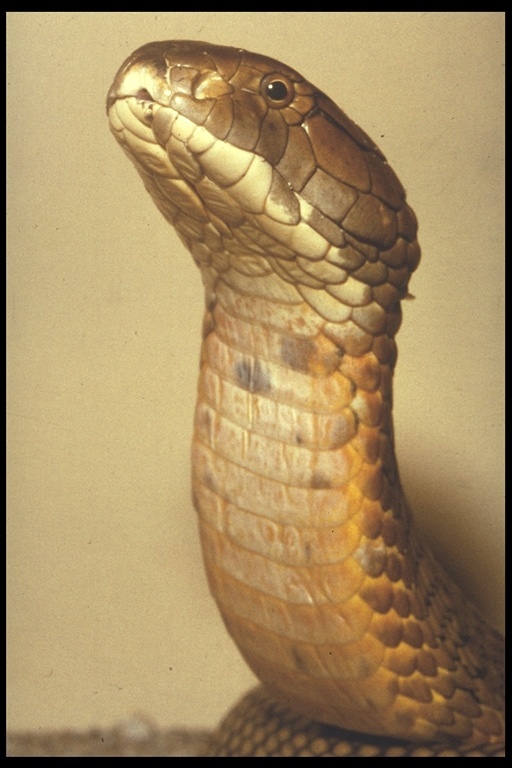
The King Cobra's average size is 10-12 feet, but can reach 18 feet. The full grown King Cobra is yellow, green, brown, or black. There are usually yellowish or white cross-bars or chevrons on its body. The belly may be uniform in color or ornamented with bars. The throat is light yellow or cream-colored. The juveniles are jet-black, with yellow or white cross-bars on the body and tail and four similar cross-bars on the head. The King Cobra is regarded as a fierce and aggressive snake, and its length and size give it an awesome appearance.

Creative Commons Attribution Non Commercial Share Alike 3.0 (CC BY-NC-SA 3.0)

© The Regents of the University of Michigan and its licensors

Source: Animal Diversity Web

Trusted

Article rating from 0 people

Average rating: 2.5 of 5

Ecology

Habitat

Habitat and Ecology

Habitat and Ecology
This species is found in a variety of habitats, primarily in forests, but it can also be found in degraded forest, mangrove swamps and even agricultural areas with remnants of woodland. It has also been found swimming in rivers in non-forested land and probably occurs in palm oil plantations (R. Inger pers. comm.).

Systems
  • Terrestrial
Creative Commons Attribution Non Commercial Share Alike 3.0 (CC BY-NC-SA 3.0)

© International Union for Conservation of Nature and Natural Resources

Source: IUCN

Trusted

Article rating from 0 people

Average rating: 2.5 of 5

Habitat

Near streams in dense or open forest, bamboo thickets, adjacent agricultural areas, and dense mangrove swamps.

Terrestrial Biomes: savanna or grassland ; forest ; rainforest ; scrub forest

Creative Commons Attribution Non Commercial Share Alike 3.0 (CC BY-NC-SA 3.0)

© The Regents of the University of Michigan and its licensors

Source: Animal Diversity Web

Trusted

Article rating from 0 people

Average rating: 2.5 of 5

Trophic Strategy

Food Habits

Ophiophagus hannah normally restricts its diet to cold-blooded animals, particularly other snakes. Some specimens develop a rigid diet of a single species of snake and will refuse any other type. The snakes eaten by the King Cobra are mostly the larger harmless species, such as Asian rat snakes, dhamans, and pythons up to about 10 feet in length.

Creative Commons Attribution Non Commercial Share Alike 3.0 (CC BY-NC-SA 3.0)

© The Regents of the University of Michigan and its licensors

Source: Animal Diversity Web

Trusted

Article rating from 0 people

Average rating: 2.5 of 5

Life History and Behavior

Life Expectancy

Lifespan/Longevity

Average lifespan

Sex: male

Status: captivity:
17.1 years.

Creative Commons Attribution Non Commercial Share Alike 3.0 (CC BY-NC-SA 3.0)

© The Regents of the University of Michigan and its licensors

Source: Animal Diversity Web

Trusted

Article rating from 0 people

Average rating: 2.5 of 5

Lifespan, longevity, and ageing

Maximum longevity: 22.5 years (captivity)
Creative Commons Attribution 3.0 (CC BY 3.0)

© Joao Pedro de Magalhaes

Source: AnAge

Trusted

Article rating from 0 people

Average rating: 2.5 of 5

Reproduction

Reproduction

King Cobras are oviparous and lay 21-40 eggs. The female pushes leaves and branches into a nest pile where the eggs are incubated by the elevated temperatures of decomposition. The female remains on top of the nest to guard the eggs, and the male also remains close by. During the brood care period, the king cobra tends to be very aggressive toward approaching humans. Breeding usually occurs from January through April. The eggs of the king cobra incubate during spring and summer, hatching in the fall.

Creative Commons Attribution Non Commercial Share Alike 3.0 (CC BY-NC-SA 3.0)

© The Regents of the University of Michigan and its licensors

Source: Animal Diversity Web

Trusted

Article rating from 0 people

Average rating: 2.5 of 5

Evolution and Systematics

Functional Adaptations

Functional adaptation

Pocket-like structures produce hissing sounds: king cobra
 

Pocket-like structures extending from the trachea of a king cobra help produce the snake's growl-like hisses by serving as low-frequency resonance chambers.

   
  "In 1991, studies conducted by Dr. Bruce Young of Hollins College, Virginia, with king cobras (Ophiophagus hannah) suggest that although they have only vestigial ears, they are able to hear their characteristic, unusually deep, growl-like hisses. These are believed to be produced via pocket-like structures called diverticula extending from the trachea that seem to function as low-frequency resonance chambers. Clearly, there is still a lot to learn about the mechanisms and limits of snake vocalization, especially in view of the controversial claims that have been made for the abilities of certain species." (Shuker 2001:155)
  Learn more about this functional adaptation.
  • Shuker, KPN. 2001. The Hidden Powers of Animals: Uncovering the Secrets of Nature. London: Marshall Editions Ltd. 240 p.
Creative Commons Attribution Non Commercial 3.0 (CC BY-NC 3.0)

© The Biomimicry Institute

Source: AskNature

Trusted

Article rating from 0 people

Average rating: 2.5 of 5

Molecular Biology and Genetics

Molecular Biology

Barcode data: Ophiophagus hannah

The following is a representative barcode sequence, the centroid of all available sequences for this species. 

 
There are 2 barcode sequences available from BOLD and GenBank.  Below is a sequence of the barcode region Cytochrome oxidase subunit 1 (COI or COX1) from a member of the species.  See the BOLD taxonomy browser for more complete information about this specimen and other sequences.
 
GBGC7075-09|NC_011394|Ophiophagus hannah| ACTCGTTGACTATTTTCAACTAATCACAAAGATATTGGAACACTATACCTTCTATTCGGTGCTTGGTCTGGCCTAGTCGGAGCATGCCTA---AGCATGCTCATGCGTATAGAACTAACCCAGCCCGGATCACTATTTGGCAGC---GACCAAATCTTTAACGTTCTAGTAACTGCCCACGCATTCATCATAATCTTCTTCATGGTTATACCTATTATGATTGGCGGCTTTGGTAACTGACTAATCCCCCTAATA---ATCGGAGCCCCAGACATAGCTTTCCCCCGAATAAACAATATAAGCTTCTGATTACTACCCCCAGCATTACTCCTCCTTTTATCATCCTCCTATGTAGAAGCTGGTGCAGGCACAGGCTGAACAGTTTACCCGCCCCTATCGGGTAATCTAGTTCACTCAGGCCCATCAGTAGACCTA---GCCATTTTCTCACTGCATCTGGCAGGAGCCTCCTCCATCCTGGGAGCAATCAACTTCATTACCACATGCATTAACATAAAACCTAAATCCATACCCATATTCAACATCCCCCTATTCGTATGATCAGTCATAATCACTGCCATCATACTCTTACTAGCCTTGCCAGTCCTAGCAGCT---GCAATTACCATACTCTTAACCGATCGTAATCTCAGCACATCCTTCTTCGACCCCTGCGGAGGAGGAGACCCTGTGCTATTCCAACACCTGTTCTGATTCTTCGGCCACCCAGAAGTATATATCCTCATCCTCCCCGGATTCGGCATCGTATCTAGTATTATCACCTTCTACACCGGAAAAAAA---AACACCTTTGGCTACACAAGCATAATTTGAGCAATAATATCTATTGCAATCCTTGGATTTGTCGTATGAGCCCACCACATATTCACTGTAGGCCTAG 
-- end --

Download FASTA File
Creative Commons Attribution 3.0 (CC BY 3.0)

© Barcode of Life Data Systems

Source: Barcode of Life Data Systems (BOLD)

Trusted

Article rating from 0 people

Average rating: 2.5 of 5

Statistics of barcoding coverage: Ophiophagus hannah

Barcode of Life Data Systems (BOLDS) Stats
Public Records: 2
Species: 2
Species With Barcodes: 1

Creative Commons Attribution 3.0 (CC BY 3.0)

© Barcode of Life Data Systems

Source: Barcode of Life Data Systems (BOLD)

Trusted

Article rating from 0 people

Average rating: 2.5 of 5

Conservation

Conservation Status

IUCN Red List Assessment


Red List Category
VU
Vulnerable

Red List Criteria
A2cd

Version
3.1

Year Assessed
2010

Assessor/s
Inger R.F., Stuart, B.L., Auliya, M., Shankar, G. & Mohapatra, P.

Reviewer/s
Bohm, M, Collen, B. & Ram, M.

Contributor/s
Zug, G., De Silva, R., Milligan, HT, Wearn, O.R., Wren, S., Zamin, T., Sears, J., Wilson, P., Lewis, S., Lintott, P., Powney, G., Collen, B. & Ram, M.

Justification
Ophiophagus hannah has been assessed as Vulnerable under criterion A2cd. This species has a wide distribution range, however, it is not common in any area in which it occurs. A population reduction of 30% over 75 years has been inferred because of the numerous threats against this species, including habitat destruction and harvesting of mature individuals from the wild. Conservation measures are required to reduce the rate of habitat loss within its range and to protect this species from persecution. Research into, and monitoring of the population status of this species is recommended to gain a better understanding of how the population responds to threats and conservation.
Creative Commons Attribution Non Commercial Share Alike 3.0 (CC BY-NC-SA 3.0)

© International Union for Conservation of Nature and Natural Resources

Source: IUCN

Trusted

Article rating from 0 people

Average rating: 2.5 of 5

Conservation Status

King Cobras, as well as all snakes, are threatened from the destruction of their habitats, and by persecution by humans afraid of them

IUCN Red List of Threatened Species: vulnerable

Creative Commons Attribution Non Commercial Share Alike 3.0 (CC BY-NC-SA 3.0)

© The Regents of the University of Michigan and its licensors

Source: Animal Diversity Web

Trusted

Article rating from 0 people

Average rating: 2.5 of 5

Population

Population
This species is not commonly found. A population reduction of 30% over 75 years has been inferred because of the numerous threats against this species, including habitat destruction and harvesting of mature individuals from the wild. A relatively recent study in northwestern India showed that even though the species was recorded in diverse ecosystems, analysis of observational records revealed that abundance of King Cobras and that of undisturbed forests are strongly linked to each other (Das et al. 2008), indicating that the destruction of natural forests is likely causing significant declines in this species' population.

Population Trend
Unknown
Creative Commons Attribution Non Commercial Share Alike 3.0 (CC BY-NC-SA 3.0)

© International Union for Conservation of Nature and Natural Resources

Source: IUCN

Trusted

Article rating from 0 people

Average rating: 2.5 of 5

Threats

Threats

Major Threats
This species is threatened by destruction of habitat due to mining, logging and agricultural expansion and the harvesting of individuals for skin, food and medicine (R. Inger pers. comm. 2010). Southeast Asia is experiencing one of the highest rates of deforestation in the tropics (Sodhi et al. 2009). It is also used in the domestic and international pet trade (M. Auliya, pers. comm. 2010), and suffers persecution by humans in parts of its range. Animals are also illegally collected for their venom in parts of its range. It is collected by snake charmers in India. The wild population in China was considered as “very low” in the 1990s (Zhou & Jiang 2004), which very likely reflects the trade impact in China for medicinal purposes.
Creative Commons Attribution Non Commercial Share Alike 3.0 (CC BY-NC-SA 3.0)

© International Union for Conservation of Nature and Natural Resources

Source: IUCN

Trusted

Article rating from 0 people

Average rating: 2.5 of 5

Management

Conservation Actions

Conservation Actions
The species is listed on Appendix II of CITES. In India, it is included in Schedule II Part II of the Wildlife (Protection) Act, 1972. There are protected areas within the range of this species which probably provide small safeguards from harvesting pressure. Conservation measures are required to reduce the rate of habitat destruction occurring within its range and manage the trade levels of this species. Further research into, and monitoring of the population status of this species is required, as well as research into sustainable harvesting levels. Educational programmes may also help to limit the persecution of the species.
Creative Commons Attribution Non Commercial Share Alike 3.0 (CC BY-NC-SA 3.0)

© International Union for Conservation of Nature and Natural Resources

Source: IUCN

Trusted

Article rating from 0 people

Average rating: 2.5 of 5

Relevance to Humans and Ecosystems

Benefits

Economic Importance for Humans: Negative

The venom of Ophiophagus hannah is very potent. It is a strong neurotoxin, which affects respiratory centres in the medulla of the brain. Death results from respiratory arrest and cardiac failure. Death may occur in a very short time, but, as with any bite, the location of the bite and the efficacy of first aid and medical treatment may delay or prevent death. The anti-venom, sometimes referred to as anti-venin, reverses the actions of the neurotoxins (proteins and enzymes). Anti-venin, even after five or six decades, is still the most trusted and commonly used method in controlling snake venom poisoning.

Creative Commons Attribution Non Commercial Share Alike 3.0 (CC BY-NC-SA 3.0)

© The Regents of the University of Michigan and its licensors

Source: Animal Diversity Web

Trusted

Article rating from 0 people

Average rating: 2.5 of 5

Economic Importance for Humans: Positive

King Cobras are among the most attractive highlights in large display terrariums at zoos.

Creative Commons Attribution Non Commercial Share Alike 3.0 (CC BY-NC-SA 3.0)

© The Regents of the University of Michigan and its licensors

Source: Animal Diversity Web

Trusted

Article rating from 0 people

Average rating: 2.5 of 5

Wikipedia

King Cobra

The king cobra (Ophiophagus hannah) is the world's longest venomous snake, with a length up to 5.6 m (18.5 ft).[1] This species is widespread throughout Southeast Asia and parts of India, and is found mostly in forested areas. The king cobra can be highly aggressive and agile, and can deliver a large quantity of highly potent venom in a single bite. It is regarded as one of the most dangerous and feared Asiatic snakes due to various factors.[2]

Contents

Profile

The King Cobra is a large and powerful snake, averaging 3.6–4 m (12–13 feet) in length and typically weighing about 6 kg (13.2 lb). A particularly large specimen was kept captive at the London Zoo, and grew to 5.7 m (18.8 ft) before being euthanized upon the outbreak of World War II.[3] Despite their large size, king cobras are fast and agile.

Characteristics

The skin of this snake is either olive-green, tan, or black, and it has faint, pale yellow cross bands down the length of the body. The belly is cream or pale yellow, and the scales are smooth. Juveniles are shiny black with narrow yellow bands (can be mistaken for a banded krait, but readily identified with its expanded hood). The head of a mature snake can be quite massive and bulky in appearance, though like all snakes, they can expand their jaws to swallow large prey items. It has proteroglyph dentition, meaning it has two short, fixed fangs in the front of the mouth which channel venom into the prey like hypodermic needles. The male is larger and thicker than the female. The average lifespan of a king cobra is about 20 years.

Identification

The king cobra is the sole member of genus Ophiophagus, while most other cobras are members of the genus Naja. They can be distinguished from other cobras by size and hood marks. King cobras are larger than other cobras, and the stripe on the neck is like the symbol "^" instead of a double or single eye(s) shape that may be seen in most of the other cobras. A foolproof method of identification is if on the head, clearly visible, is the presence of a pair of large scales known as occipitals, at the back of the top of the head. These are behind the usual "nine-plate" arrangement typical of colubrids and elapids, and are unique to the king cobra.

Scalation

Dorsal scales: midbody 15 rows; Ventral scales: Males 235-250, females 239-265; Tail: Subcaudal scales single or paired in each row, 83-96 in males and 77-98 in females.[2]

Habitat

The king cobra is distributed across South Asia, Southeast Asia, and the southern areas of East Asia (southern China) where it is not common. It lives in dense highland forests,[1][4] preferring areas dotted with lakes and streams. King cobra populations have dropped in some areas of its range because of the destruction of forests. It is listed as an Appendix II Animal within CITES.[5]

Scalation of the King Cobra

Behavior

King cobras, like other snakes, receive chemical information ("smell") via their forked tongues, which pick up scent particles and transfer them to a special sensory receptor (Jacobson's organ) located in the roof of its mouth.[1] When the scent of a meal is detected, the snake flicks its tongue to gauge the prey's location (the twin forks of the tongue acting in stereo); it also uses its keen eyesight (king cobras are able to detect moving prey almost 100 m [300 feet] away), intelligence[6] and sensitivity to earth-borne vibration to track its prey.[7] Following envenomation, the king cobra will begin to swallow its struggling prey while its toxins begin the digestion of its victim. King cobras, like all snakes, have flexible jaws. The jaw bones are connected by pliable ligaments, enabling the lower jaw bones to move independently, enabling the King cobra to swallow its prey whole. The expansion of the jaw enables the snake to swallow prey much larger than its head.[1]

King cobras are able to hunt at all times of day, although it is rarely seen at night, leading most herpetologists to classify it as a diurnal species.[1][8]

Defense

The king cobra can be highly aggressive if provoked.[9] When threatened, it raises up the anterior portion of its body, extending the neck, showing the fangs and hissing loudly. (Bioacoustic analysis of the "growl" of the king cobra has shown that it differs significantly from other snakes. Generally a typical snake hiss has a broad-frequency span (~3,000 to 13,000 Hz) with a dominant frequency near 7,500 Hz, whereas the "growl" of the king cobra consists of frequencies below 2,500 Hz, with a dominant frequency near 600 Hz.)[10] It can be easily irritated by closely approaching objects or sudden movements. The king cobra attacks rapidly, and the strike distance is about 2 m (7 feet); people can easily misjudge the safe distance. The king cobra may deliver multiple bites in a single attack, or bite and hold on.[11] Although it is a highly dangerous snake, it, just like other snakes, prefers to escape unless it is cornered or provoked.[9]

If a king cobra encounters a natural predator, such as the mongoose, which has some resistance to the neurotoxins,[12] the snake generally tries to flee. If unable to do so, it forms the distinctive cobra hood and emits a hiss, sometimes with feigned closed-mouth strikes. These efforts usually prove to be very effective, especially since it is more dangerous than other mongoose prey, as well as being much too large for the small mammal to kill with ease.

Diet

The king cobra's genus name, Ophiophagus, means "snake-eater", and its diet consists primarily of other snakes, including ratsnakes, sizeable pythons and even other venomous snakes (including kraits, cobras and smaller members of its own species).[8][13] When food is scarce, they may also feed on other small vertebrates, such as lizards, birds, and rodents. In some cases, the cobra may "constrict" its prey, such as birds and larger rodents, using its muscular body, though this is uncommon.[1][13] After a large meal, the snake may live for many months without another one because of its slow metabolic rate.[1] The king cobra's most common meal is the ratsnake; pursuit of this species often brings king cobras close to human settlements.

Venom

King cobra skull, lateral view, showing fangs

The venom of the king cobra consists primarily of neurotoxins, but it also contains cardiotoxic compounds.[8] Toxic constituents are mainly proteins and polypeptides.

During a bite, venom is forced through the snake's half-inch (1.25 cm) fangs into the wound, and quickly attacks the victim's central nervous system, inducing severe pain, blurred vision, vertigo, drowsiness, and paralysis.[14] Envenomation progresses to cardiovascular collapse, and the victim falls into a coma. Death soon follows due to respiratory failure.

In the past, the LD50 of the king cobra's venom was treated as 1.6 mg/kg – 1.8 mg/kg (which was one of the least venomous elapids). However, in recent toxicology study, the LD50 of Chinese king cobra venom was found to be 0.34 mg/kg[15]. In the same test, many Naja species found in the same habitats (such as the Chinese cobra) possess larger values, thus showing that the king cobra can actually be more venomous than many other cobras based on LD50.[15][16] The king cobra is also capable of delivering larger quantities of venom than most other snakes, injecting a 380-600 mg dose in a single bite on average. It was reported that a single bite from this species can kill an adult Asian elephant. A bite from the king cobra can cause the death of an adult human within 15 minutes,[15] though the average death time recorded is between 30–45 minutes after envenomation.[14][16][17] The mortality rate from a bite can be over 75%,[8][18]depending upon treatment details. It is regarded as one of the deadliest snakes in the world.[16][19]

There are two types of antivenom made specifically to treat king cobra envenomations. The Red Cross in Thailand manufactures one, and the Central Research Institute in India manufactures the other; however, both are made in small quantities and are not widely available.[20] Ohanin, a protein component of the venom, causes hypolocomotion and hyperalgesia in mammals.[21] Other components have cardiotoxic,[22] cytotoxic and neurotoxic effects.[23] In Thailand, a concoction of alcohol and the ground root of turmeric is ingested, which has been clinically shown to create a strong resilience against the venom of the king cobra, and other snakes with neurotoxic venom.[24]

Reproduction

The king cobra is unusual among snakes in that the female king cobra is a very dedicated parent. She makes a nest for her eggs, scraping up leaves and other debris into a mound in which to deposit them, and remains in the nest until the young hatch.

A female usually deposits 20 to 40 eggs into the mound, which acts as an incubator. She stays with the eggs and guards the mound tenaciously, rearing up into a threat display if any large animal gets too close.[25]

Inside the mound the eggs are incubated at a steady 28 °C (82 °F). When the eggs start to hatch, instinct causes the female to leave the nest and find prey to eat so she does not eat her young.[26] The baby king cobras have a length of 45 to 55 centimeters (18 to 22 in). They are highly aggressive, and their venom is as deadly as that of an adult.

Other culture

In Burma, king cobras are often used by female snake charmers.[13] The charmer is usually tattooed with three pictograms, using an ink mixed with snake venom; superstition holds that it protects the charmer from the snake.[13] The charmer kisses the snake on the top of its head at the end of the show.[13]

Related species

The king cobra belongs to the family Elapidae which includes other well known snakes, such as the cobra, the coral snake, the death adder and the black mamba.

Gallery

References

  1. ^ a b c d e f g Mehrtens, John (1987). Living Snakes of the World. New York: Sterling. ISBN 0806964618. 
  2. ^ a b Venomous Land Snakes, Dr.Willott. Cosmos Books Ltd. ISBN 9882113265. 
  3. ^ Wood, The Guinness Book of Animal Facts and Feats. Sterling Pub Co Inc (1983), ISBN 978-0851122359
  4. ^ Miller, Harry (September 1970). "The Cobra, India's 'Good Snake'". National Geographic 20: 393–409 
  5. ^ "CITES List of animal species used in traditional medicine". http://www.cites.org/eng/com/aC/17/E17i-05Rev.doc. Retrieved 2007-09-01. 
  6. ^ Philadelphia Zoo - King cobra
  7. ^ Taylor, David (1997). King Cobra.. National Geographic Magazine. Archived from the original on 2007-08-20. http://web.archive.org/web/20070820143553/http://www.nationalgeographic.com/kingcobra/index-n.html. Retrieved 2007-09-08 
  8. ^ a b c d Capula, Massimo; Behler (1989). Simon & Schuster's Guide to Reptiles and Amphibians of the World. New York: Simon & Schuster. ISBN 0671690981. 
  9. ^ a b "Ophiophagus hannah". http://animaldiversity.ummz.umich.edu/site/accounts/information/Ophiophagus_hannah.html. 
  10. ^ Young, Bruce A. (1991). "Morphological basis of "growling" in the king cobra, Ophiophagus Hannah". Journal of Experimental Zoology 260 (3): 275–287. doi:10.1002/jez.1402600302. PMID 1744612. http://onlinelibrary.wiley.com/doi/10.1002/jez.1402600302/abstract. 
  11. ^ "King Cobra". http://drdavidson.ucsd.edu/Portals/0/snake/Ophiopha.htm. 
  12. ^ Dr. Zoltan Takacs. "Why the cobra is resistant to its own venom". http://zoltantakacs.com/zt/sc/naja.shtml. Retrieved 2007-09-05. 
  13. ^ a b c d e Coborn, John (October 1991). The Atlas of Snakes of the World. TFH Publications. pp. 30, 452. ISBN 978-0866227490. 
  14. ^ a b Freiberg, Dr. Marcos; Walls (1984). The World of Venomous Animals. New Jersey: TFH. ISBN 0876665679. 
  15. ^ a b c Snake of medical importance. Singapore: Venom and toxins research group. 
  16. ^ a b c Tun-Pe, Tun-Pe, Warrell DA, Tin-Myint (March 1995). "King cobra (Ophiophagus hannah) bites in Myanmar: venom antigen levels and development of venom antibodies". Toxicon 33 (3): 379–82. doi:10.1016/0041-0101(94)00157-4. PMID 7638877. 
  17. ^ "MSN Encarta: King Cobra". MSN Encarta. Archived from the original on 2009-10-31. http://www.webcitation.org/5kwsGkvxq. Retrieved 2007-09-05. 
  18. ^ "Ophitoxaemia (venomous snake bite)". http://www.priory.com/med/ophitoxaemia.htm. Retrieved 2007-09-05. 
  19. ^ The new encyclopedia of Reptiles. Time Book Ltd. 2002. 
  20. ^ "Munich AntiVenom Index:Ophiophagus hannah". Munich Poison Center. MAVIN (Munich AntiVenom Index). 01/02/2007. http://www.toxinfo.org/antivenoms/indication/OPHIOPHAGUS_HANNAH.html. Retrieved 2007-09-02. 
  21. ^ Pung, Y.F., Kumar, S.V., Rajagopalan, N., Fry, B.G., Kumar, P.P., Kini, R.M. 2006 Ohanin, a novel protein from king cobra venom: Its cDNA and genomic organization. Gene 371 (2):246–256
  22. ^ Rajagopalan, N., Pung, Y.F., Zhu, Y.Z., Wong, P.T.H., Kumar, P.P., Kini, R.M. 2007 β-Cardiotoxin: A new three-finger toxin from Ophiophagus hannah (King Cobra) venom with beta-blocker activity. FASEB Journal 21 (13):3685–3695
  23. ^ Chang, L.-S., Liou, J.-C., Lin, S.-R., Huang, H.-B. 2002Purification and characterization of a neurotoxin from the venom of Ophiophagus hannah (king cobra). Biochemical and Biophysical Research Communications 294 (3):574–578
  24. ^ Ernst, Carl H. & Evelyn M. (2011). Venomous Reptiles of the United States, Canada, and Northern Mexico: Heloderma, Micruroides, Micrurus, Pelamis, Agkistrodon, Sistrurus. JHU Press. pp. 44-45. ISBN 9780801898754. http://books.google.com/books?id=o8DTAQffi4UC&pg=PA44. 
  25. ^ Extraordinary Animals: An Encyclopedia of Curious and Unusual Animals. Westport, Conn.Greenwood Press. ISBN 9780313339226.
  26. ^ National Geographic Program 17 May 2009

Creative Commons Attribution Share Alike 3.0 (CC BY-SA 3.0)


Source: Wikipedia

Unreviewed

Article rating from 0 people

Average rating: 2.5 of 5

Disclaimer

EOL content is automatically assembled from many different content providers. As a result, from time to time you may find pages on EOL that are confusing.

To request an improvement, please leave a comment on the page. Thank you!