Overview
Comprehensive Description
Description
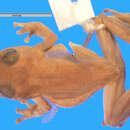
Eleutherodactylus jasperi can be distinguished from other Eleutherodactylus in Puerto Rico by its golden ground color without dorsal patterning, by its translucent venter without dark pigmentation, and by the lack of prevomerine teeth (Drewry and Jones, 1976).
The chromosome number of Eleutherodactylus jasperi is 2n = 26 (Drewry and Jones, 1976).
This species was first described by Drewry and Jones (1976). It was named for one of the collectors of the holotype, Dr. Jasper J. Loftus-Hills, of New Victoria, Australia. Dr. Loftus-Hills passed away in 1974 at the age of 28 from an automobile accident. (Drewry and Jones, 1976).
- Burrowes, P. A., Joglar, R. L., and Green, D. E. (2004). ''Potential causes for amphibian declines in Puerto Rico.'' Herpetologica, 60, 141-154.
- Drewry, G. E., and Jones, K. L. (1976). ''A new ovoviviparous frog, Eleutherodactylus jasperi (Amphibia, Anura, Leptodactylidae) from Puerto Rico.'' Journal of Herpetology, 10(3), 161-165.
- Duellman, W. E. (2003). ''Golden coqui, Eleutherodactylus jasperi.'' Grzimek's Animal Life Encyclopedia, Volume 6, Amphibians. 2nd edition. M. Hutchins, W. E. Duellman, and N. Schlager, eds., Gale Group, Farmington Hills, Michigan.
- Moreno, J. A. (1991). ''Status survey of the Golden Coqui, Eleutherodactylus jasperi.'' Status y Distribución de los Anfibios y Reptiles de Puerto Rico, Publicación Científica Miscelaneous No. 1. J.A. Moreno, eds., Departamento de Recursos Naturales, San Juan, Puerto Rico, 37-41.
- Wake, M. H. (1978). ''The reproductive biology of Eleutherodactylus jasperi (Amphibia, Anura, Leptodactylidae, with comments on the evolution of live-bearing systems.'' Journal of Herpetology, 12(2), 121-133.
Trusted
Distribution
Range Description
Trusted
Distribution and Habitat
- Burrowes, P. A., Joglar, R. L., and Green, D. E. (2004). ''Potential causes for amphibian declines in Puerto Rico.'' Herpetologica, 60, 141-154.
- Drewry, G. E., and Jones, K. L. (1976). ''A new ovoviviparous frog, Eleutherodactylus jasperi (Amphibia, Anura, Leptodactylidae) from Puerto Rico.'' Journal of Herpetology, 10(3), 161-165.
- Duellman, W. E. (2003). ''Golden coqui, Eleutherodactylus jasperi.'' Grzimek's Animal Life Encyclopedia, Volume 6, Amphibians. 2nd edition. M. Hutchins, W. E. Duellman, and N. Schlager, eds., Gale Group, Farmington Hills, Michigan.
- Moreno, J. A. (1991). ''Status survey of the Golden Coqui, Eleutherodactylus jasperi.'' Status y Distribución de los Anfibios y Reptiles de Puerto Rico, Publicación Científica Miscelaneous No. 1. J.A. Moreno, eds., Departamento de Recursos Naturales, San Juan, Puerto Rico, 37-41.
- Wake, M. H. (1978). ''The reproductive biology of Eleutherodactylus jasperi (Amphibia, Anura, Leptodactylidae, with comments on the evolution of live-bearing systems.'' Journal of Herpetology, 12(2), 121-133.
Trusted
Physical Description
Type Information
Collection: Smithsonian Institution, National Museum of Natural History, Department of Vertebrate Zoology, Division of Amphibians & Reptiles
Preparation: Ethanol
Year Collected: 1973
Locality: Cerro de la Tabla, near, km 15 on PR Route 15, Puerto Rico
- Paratype: Drewry, G. E. & Jones, K. L. 1976. Journal of Herpetology. 10 (3): 161, figure 2.
Trusted
Collection: Smithsonian Institution, National Museum of Natural History, Department of Vertebrate Zoology, Division of Amphibians & Reptiles
Preparation: Ethanol
Year Collected: 1973
Locality: Cerro de la Tabla, near, km 15 on PR Route 15, Puerto Rico
- Paratype: Drewry, G. E. & Jones, K. L. 1976. Journal of Herpetology. 10 (3): 161, figure 2.
Trusted
Collection: Smithsonian Institution, National Museum of Natural History, Department of Vertebrate Zoology, Division of Amphibians & Reptiles
Preparation: Ethanol
Year Collected: 1974
Locality: Monte El Gato Peak, Puerto Rico
- Paratype: Drewry, G. E. & Jones, K. L. 1976. Journal of Herpetology. 10 (3): 161, figure 2.
Trusted
Ecology
Habitat
Habitat and Ecology
Systems
- Terrestrial
Trusted
Conservation
Conservation Status
IUCN Red List Assessment
Red List Category
Red List Criteria
Version
Year Assessed
Assessor/s
Reviewer/s
Contributor/s
Justification
History
- 2008Critically Endangered(IUCN 2008)
- 2004Critically Endangered
- 1996Data Deficient
- 1994Rare(Groombridge 1994)
- 1990Rare(IUCN 1990)
- 1988Rare(IUCN Conservation Monitoring Centre 1988)
- 1986Rare(IUCN Conservation Monitoring Centre 1986)
Trusted
Status: Threatened
Date Listed: 11/11/1977
Lead Region: Southeast Region (Region 4)
Where Listed:
Population detail:
Population location: entire
Listing status: T
For most current information and documents related to the conservation status and management of Eleutherodactylus jasperi , see its USFWS Species Profile
Trusted
Trends
Population
Population Trend
Trusted
Life History, Abundance, Activity, and Special Behaviors
During the mating season, males give off a call that sounds like "tuit-tuit-tuit-tuit" (Duellman, 2003). A single call sequence lasts for between ten seconds and two minutes. The first call of the sequence has one to two notes, with successive calls increasing up to a maximum of four to six notes, and maintaining at that maximum number until the end of the call sequence. Notes have approximately the same duration. They consist of relatively pure tones of about 5 kHz. The advertisement calls seem to be the same as territorial calls, as there was no difference between calls made by solitary calling males and those given by multiple males placed together in a single collecting bag. Males placed together in a bag alternately called and engaged in biting each other (Drewry and Jones, 1976).
Call sequences are somewhat synchronized between neighboring males. Eleutherodactylus jasperi is more difficult to distinguish in a multi-species chorus, as it makes somewhat softer calls than other frog species in the same habitat. However, it calls throughout the night, unlike other species which subside between midnight and dawn (Drewry and Jones, 1976).
Eleutherodactylus jasperi is ovoviviparous. It is the only live-bearing species in the genus Eleutherodactylus and family Leptodactylidae, and thus presumably also the only species in that genus and family to have internal fertilization. The only other species of frogs known to retain developing embryos within the oviducts are in the genus Nectophrynoides, in the family Bufonidae (Wake, 1978).
Gravid females have been collected between April and August, containing three to six mature eggs (Drewry and Jones, 1976). Mature eggs are large, 3.3 to 5 mm in diameter (Drewry and Jones, 1976; Wake, 1978). Once fertilized, eggs are retained within a chamber, essentially a uterus, formed of fused portions of the oviducts (Wake, 1978). The embryos take about a month to develop (Drewry and Jones, 1976). As is characteristic of other species with direct development, Eleutherodactylus jasperi embryos have poorly developed mouthparts, lacking denticles and adhesive organs (Wake, 1978). The larval spiracle and external gills are present but transitory, and rates of development are also modified (Wake, 1978). Approximately thirty-three days after amplexus, three to five tiny, fully metamorphosed froglets are born (Drewry and Jones, 1976). The froglets of this species have a small egg tooth and a large, thin, highly vascularized fan-like tail (Wake, 1978). The tail may function in intra-oviducal gaseous exchange (Wake, 1978). The source of nutrition for developing embryos appears to be egg yolk and not maternal secretions, as there is no evidence of a placenta or maternal secretions, and unresorbed yolk is still present in froglets after birth (Wake, 1978). Thus E. jasperi is classified as ovoviviparous, and not viviparous.
Females may reproduce more than once a year, since dissected females had two visible size classes of eggs within the ovaries (Wake, 1978). Although gravid females were collected between April and August, Wake (1978) noted that year-round collections had not been done. Thus it is not known whether reproduction in this species is seasonal or if it occurs throughout the year.
Subadults have been found in the same plant with females, implying that dispersal does not occur until the juvenile is older (Drewry and Jones, 1976).
This species preys mostly on small arthropods (Duellman, 2003).
- Burrowes, P. A., Joglar, R. L., and Green, D. E. (2004). ''Potential causes for amphibian declines in Puerto Rico.'' Herpetologica, 60, 141-154.
- Drewry, G. E., and Jones, K. L. (1976). ''A new ovoviviparous frog, Eleutherodactylus jasperi (Amphibia, Anura, Leptodactylidae) from Puerto Rico.'' Journal of Herpetology, 10(3), 161-165.
- Duellman, W. E. (2003). ''Golden coqui, Eleutherodactylus jasperi.'' Grzimek's Animal Life Encyclopedia, Volume 6, Amphibians. 2nd edition. M. Hutchins, W. E. Duellman, and N. Schlager, eds., Gale Group, Farmington Hills, Michigan.
- Moreno, J. A. (1991). ''Status survey of the Golden Coqui, Eleutherodactylus jasperi.'' Status y Distribución de los Anfibios y Reptiles de Puerto Rico, Publicación Científica Miscelaneous No. 1. J.A. Moreno, eds., Departamento de Recursos Naturales, San Juan, Puerto Rico, 37-41.
- Wake, M. H. (1978). ''The reproductive biology of Eleutherodactylus jasperi (Amphibia, Anura, Leptodactylidae, with comments on the evolution of live-bearing systems.'' Journal of Herpetology, 12(2), 121-133.
Trusted
Threats
Threats
Trusted
Life History, Abundance, Activity, and Special Behaviors
- Burrowes, P. A., Joglar, R. L., and Green, D. E. (2004). ''Potential causes for amphibian declines in Puerto Rico.'' Herpetologica, 60, 141-154.
- Drewry, G. E., and Jones, K. L. (1976). ''A new ovoviviparous frog, Eleutherodactylus jasperi (Amphibia, Anura, Leptodactylidae) from Puerto Rico.'' Journal of Herpetology, 10(3), 161-165.
- Duellman, W. E. (2003). ''Golden coqui, Eleutherodactylus jasperi.'' Grzimek's Animal Life Encyclopedia, Volume 6, Amphibians. 2nd edition. M. Hutchins, W. E. Duellman, and N. Schlager, eds., Gale Group, Farmington Hills, Michigan.
- Moreno, J. A. (1991). ''Status survey of the Golden Coqui, Eleutherodactylus jasperi.'' Status y Distribución de los Anfibios y Reptiles de Puerto Rico, Publicación Científica Miscelaneous No. 1. J.A. Moreno, eds., Departamento de Recursos Naturales, San Juan, Puerto Rico, 37-41.
- Wake, M. H. (1978). ''The reproductive biology of Eleutherodactylus jasperi (Amphibia, Anura, Leptodactylidae, with comments on the evolution of live-bearing systems.'' Journal of Herpetology, 12(2), 121-133.
Trusted
Management
Conservation Actions
Trusted
Wikipedia
Golden coquí
The Golden coquí (Eleutherodactylus jasperi; Spanish: Coquí dorado) is a rare and possibly extinct frog species endemic to Puerto Rico.
Contents |
General description
Golden coquís are roughly 3/4 inch (~1.9 cm) long (snout-vent length) and are olive-gold to yellow-gold without pattern. The juveniles resemble adults.
The four co-discoverers (George E. Drewry, Kirkland L. Jones, Julia R. Clark and Jasper J. Loftus-Hill) planned to name the species for its color. However, when Dr. Loftus-Hill was killed in 1974 in an automobile accident, his colleagues chose instead to name it in his honor: Jasperi.
Biology
First reported to science in the 1970s [1], the golden coquí is ovoviviparous, the only live-bearing species known from the family Leptodactylidae and the first New World anuran reported to be ovoviviparous. The species is restricted to a few genera of water-containing bromeliads in certain moist tropical/subtropical forests and rocky areas.
Distribution and Status
Golden coquís have only been found in areas of dense bromeliad growth in the Sierra de Cayey of Puerto Rico between 647 and 785 metres above sea level. The species was last observed in 1981, and surveys of suitable habitat have not found individuals since this date. However, many of the surveys have covered only historical sites and areas next to roads. Due to the apparent disappearance of the population from sites where the species was formerly found, the golden coquí is listed by the IUCN Red List as Critically Endangered[2] and by NatureServe as GH (Possibly Extinct). Burrowes et al. (2004)[3] presumed the golden coquí extinct. The species is listed as Threatened by the United States under the Endangered Species Act[4].
Researchers have suggested the fungal disease chytridiomycosis in combination with climate change as likely causes of the species' decline. However, since no direct link has been found, and not all species are affected by the fungus, the cause for the decline are still not clear. Habitat loss to homes and agriculture is the major ongoing threat. The areas where the species was discovered have been deforested. These factors, in combination with the species' low reproductive rate, limited dispersal ability, narrow geographic range, and obligate bromeliad-dwelling existence, may be responsible for the species' precarious existence, if not its outright extinction. The species' range includes privately owned land and one protected area, the Carite Forest Reserve. Additional surveys are required to determine if golden coquís survive.
See also
- List of amphibians and reptiles of Puerto Rico
- Fauna of Puerto Rico
- List of endemic fauna of Puerto Rico
Notes
- ^ Drewry, G.E. and Jones, K. 1976. A new ovovivaparous frog, Eleutherodactylus jasperi (Amphibia, Anura, Leptodactylidae) from Puerto Rico. Journal of Herpetology. 10:161-165.
- ^ Hedges & Joglar (2004). Eleutherodactylus jasperi. 2006. IUCN Red List of Threatened Species. IUCN 2006. www.iucnredlist.org. Retrieved on 11 May 2006.
- ^ Burrowes, P. A., R. L. Joglar, and D. E. Green. 2004. Potential causes for amphibian declines in Puerto Rico. Herpetologica 60:141-154.
- ^ U.S. Fish and Wildlife Service. 1984. Recovery plan for the golden coqui (Eleutherodactylus jasperi). U.S. Fish and Wildlife Service, Atlanta, Ga. 12pp.
Unreviewed
Disclaimer
EOL content is automatically assembled from many different content providers. As a result, from time to time you may find pages on EOL that are confusing.
To request an improvement, please leave a comment on the page. Thank you!